 Français (France)
 English (UK)
 English (US)
 Deutsch (Deutschland)

Contents
What is the weakest point of a fishing line? Not the line, nor the hook, but the knot that joins them. The Illinois Department of Natural Resources’ guide puts it plainly: a good knot retains more than 90% of the line’s strength, while a poor one keeps less than half [2]. In other words, badly tied 8-pound line breaks at under 4 pounds. Five knots cover most needs; here they are, in the order anglers usually learn them. To choose the hook you tie on, see hook sizes.
Three rules for every knot
- Wet the line before tightening. New York State’s I FISH NY program repeats it for every knot [1], and Take Me Fishing advises lubricating the lines before pulling a double uni tight [4].
- Tighten slowly by pulling the standing line, while keeping tension on the tag end [2].
- Trim the tag end once the knot is tight, without cutting into the knot itself [1, 2].
For knots with turns, the number of wraps depends on the line’s weight. The Illinois guide advises six turns with light 2- to 6-pound-test line, five turns with medium 8- to 12-pound line, and four turns with heavy 14- to 20-pound line [2]. Thicker line holds better with fewer turns, which bed down more neatly.
The improved clinch, the classic
This is the knot most people learn first, to tie on a hook, lure, swivel or fly, in freshwater or saltwater [1]. Pass the tag end through the eye, leaving at least 6 inches of line, wrap it around the standing line, bring it back through the small loop formed next to the eye, then through the big loop that move has just created: that last pass is what makes it the improved clinch rather than the plain clinch [1, 2]. Wet it, tighten by pulling the standing line, and trim [2].
The Palomar, strong and quick to retie
The Palomar is tied with doubled line, which makes it both strong and simple: the Illinois guide credits it with “maximum strength and versatility” [2], and I FISH NY rates it as very handy if you change hooks or lures often [1]. Double about 6 inches of line, pass this loop through the eye, tie a loose overhand knot with the doubled line, hook hanging below the loop, then pass the loop over the hook and tighten by pulling on the doubled line [1, 2]. The one catch: the loop must be big enough for the lure or hook to pass through [2].
The uni knot, the all-rounder
The uni knot, also known as the grinner, is a dependable knot for tying nylon monofilament to a hook or swivel; some anglers find it easier to tie than the improved clinch, and just as dependable, notes I FISH NY [1]. Pass the tag end through the eye, double it back along the standing line, lay a loop over the doubled line, then make six turns around both strands, inside the loop. Wet it, pull the tag end to snug up the turns, and slide the knot down to the eye [1].
| Knot | For | Strength | Watch out |
|---|---|---|---|
| Improved clinch | Hook, lure, swivel, fly | The classic, freshwater and saltwater | Pass back through the big loop |
| Palomar | Hook, lure, swivel | Very strong, quick to retie | The loop must clear the lure |
| Uni | Hook, swivel, nylon line | Simple, the basis of the double uni | Slide the knot down to the eye |
| Double uni | Joining two lines, main line to leader | Works between braid and mono or fluorocarbon | Leave long tags to tighten |
| Simple loop | Hanging a weight, a loop at the end of the line | The quickest of all | It reduces the line’s strength |
Based on the I FISH NY program (New York State), the Illinois DNR guide and Take Me Fishing.
The double uni, to join two lines
To join your main line to a leader, or repair a broken line, the double uni is an excellent choice: it’s two uni knots tied back to back, which slide together as you tighten, explains Take Me Fishing, the US foundation for recreational fishing and boating [4]. It even works between different lines, braid with monofilament or fluorocarbon [4].
Overlap the two lines by a good length, at least a foot to start with [4]. With the left-hand line, form a loop, make five turns around the other line inside the loop, and snug it without pulling tight; do the same with the right-hand line, in the opposite direction, three turns being enough with a thick leader [4]. Wet the lines, pull them in opposite directions: the knots slide together and tighten. Trim the tags: the finished knot looks like a small barrel [4].
The simple loop, for a weight or a rig
Sometimes you need a loop at the end of the line, to hang a weight. The simplest takes a second: double 3 to 4 inches of line at the end, tie an overhand knot with the doubled part, and trim the tag close to the knot [1]. I FISH NY describes it for saltwater fishing, where it’s used to attach a sinker [1]. For a loop in the middle of the line, to add a hook on a dropper, there’s the dropper loop, which takes longer to learn [1].
Before you cast: check your knot
- Pull hard on the knot before casting: better it fails in your hands than on a fish.
- Look at the turns: they should be tight and neatly stacked, with no loop sticking out.
- Retie the knot after a fish, a snag, or if the line near the knot looks whitened or twisted.
Learn them at home with a hook with the point cut off, or a ring, and a length of cord, then with your real line: that’s how the I FISH NY program teaches them to children, on boards fitted with eyelets [1]; Colorado State University Extension even suggests practicing the improved clinch and the Palomar on a paper clip [3]. Before your next trip, check the local rules too, starting with your fishing license and, in saltwater, the minimum size limits.
Gear related to this article
No affiliation: no commission, no sponsored products.
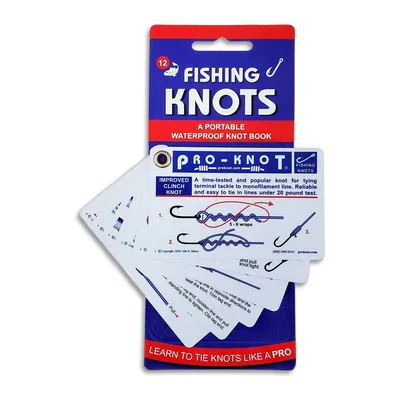
Pro-Knot Fishing Knots (waterproof knot cards)
Twelve fishing knots, the improved clinch among them, illustrated on six waterproof plastic cards held by a brass grommet: pocket-size at 3½ by 2¼ inches, made for a tackle box.
View on Amazon (opens in a new tab)
Worth watching
Take Me Fishing, the national recreational fishing foundation quoted in the article, ties the improved clinch step by step in under two minutes: the go-to knot for a hook, lure, or swivel.
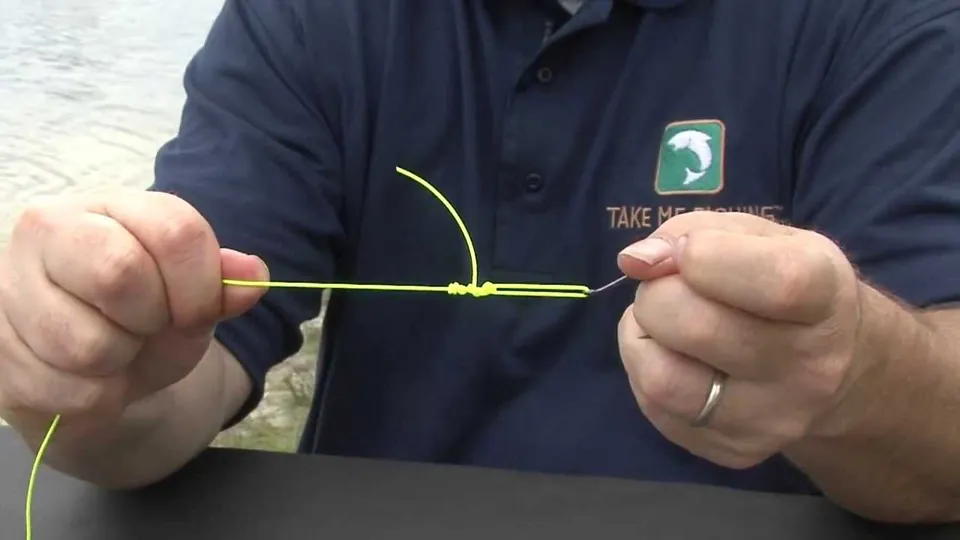
The video is hosted by YouTube (Google): nothing loads until you play it, and Google may then set cookies.
FAQ
What is the strongest fishing knot?
The Illinois guide presents the Palomar as offering maximum strength and versatility for tying on a hook or lure. But strength depends above all on how well it’s tied: a good knot keeps more than 90% of the line’s strength, a poor one less than half. Wet the line, tighten slowly and check the knot before you cast.
Which knot should I use to tie on a hook?
Three knots work well: the improved clinch, the classic; the Palomar, very strong and quick to retie; and the uni knot, which some anglers find easier than the clinch. For the clinch and the uni, make about six turns with light line and four with heavy line. Either way, wet the line before tightening and trim the tag end.
How do I join two fishing lines?
With a double uni: overlap the lines by about a foot, tie a five-turn uni knot with each line around the other, in opposite directions, wet them, then pull both lines so the knots slide together. It even works between braid and mono. The double surgeon’s knot is another very strong option.
Should I wet a knot before tightening it?
Yes. New York State’s I FISH NY program repeats it for every knot it teaches: wet the line, then tighten slowly by pulling the standing line. For the double uni, Take Me Fishing advises lubricating both lines with a little saliva before pulling them apart. A little water does the job too.
How many turns for an improved clinch knot?
It depends on the line. The Illinois guide advises six turns for light 2- to 6-pound-test line, five turns for medium 8- to 12-pound line, and four turns for heavy 14- to 20-pound line. The thicker the line, the fewer turns you need for the knot to bed down properly.
Sources
- New York State Department of Environmental Conservation, I FISH NY program, “Knot Tying,” lesson plan, 2013, accessed October 23, 2026. extapps.dec.ny.gov https://extapps.dec.ny.gov/docs/administration_pdf/ifnyknotlp.pdf ↩
- Illinois Department of Natural Resources, “Knot-Tying Guide,” accessed October 23, 2026. dnr.illinois.gov https://dnr.illinois.gov/content/dam/soi/en/web/dnr/publications/documents/00000150.pdf ↩
- Colorado State University Extension, “It’s a Clinch! Fishing Knots,” accessed October 23, 2026. garfield.extension.colostate.edu https://garfield.extension.colostate.edu/wp-content/uploads/sites/43/2025/12/Its-A-Clinch-Fishing-Knots.pdf ↩
- Take Me Fishing (Recreational Boating & Fishing Foundation), “Fishing Line Joining Knots,” version archived on July 13, 2026, accessed October 23, 2026. takemefishing.org https://www.takemefishing.org/how-to-fish/how-tie-fishing-knots/line-joining-knots/ ↩

Fact-checking, regulations, and safety
Arnaud Couderc reviews our contributors’ articles and writes for Outfarer about regulations, safety, fishing, the ocean, and outdoor activities. He traces every rule back to its official text and every number to its source, so you head out with solid benchmarks.


