 Français (France)
 English (UK)
 English (US)
 Deutsch (Deutschland)

Contents
At the trailhead, it’s a familiar sight: two brand-new poles, set by eye the day you bought them, one shorter than the other because a section slipped in the trunk. By the first switchback, your shoulders are creeping up toward your ears; on the first descent, you’re stooping to reach the ground. A badly sized pole doesn’t hurt right away: it wears you down quietly.
Getting the length right comes down to one move, a right angle at the elbow, and two adjustments, one for going up and one for coming down. Height-based formulas give you a starting point: this guide puts those of a manufacturer, a retailer, and a federation doctor side by side, explains why they differ, then covers pole types, wrist straps, the research, and pole tips. It fills in the “Gear up and pack your backpack” step of our guide to planning a hike, after hiking boots; and our day hike packing list is a reminder that a good pack has a place to strap them.
The basic rule: a right angle at the elbow
Standing on flat ground, hold the pole by the grip, tip on the ground next to your foot. Your upper arm hangs naturally and your forearm stays level: your elbow makes a right angle. Hand too high? Shorten the pole. Too low? Lengthen it. That’s the method of pole maker Leki [1], and of the German Alpine Club (DAV), which talks about an angle of roughly 90° [2]. Stiftung Warentest, Germany’s consumer product testing organization, gives a similar benchmark: an angle of about 90° between arm and shaft [3]. Black Diamond puts it in terms of height: on flat ground, the top of the grip comes to your waist or hip [4].
One exception: “cane-style” poles, whose grip you hold from the top. Decathlon, the French sporting goods retailer, sets them shorter, arm nearly straight, elbow opened to about 140° [5]. This guide covers classic poles, the kind you hold with your fist wrapped around an upright grip.
What length for your height: the chart
To buy a fixed-length pole, or to get a telescoping pole roughly set, you can start with a multiplication. Leki multiplies your height in centimeters by 0.68: about 120 cm (47 in) for a 175 cm (5′9″) hiker [1]. The coefficient works just as well with your height in inches. Decathlon, which sells its own poles, uses the same coefficient and gets 119 cm for the same height [5]. In 2012, the medical officer of the French mountaineering and climbing federation (FFME), Pierre Belleudy, recommended adjustable poles ideally measuring two-thirds of your height [6], or about 0.67. At 5′7″, the first formula gives 46 inches (116 cm), the second 45 inches (113 cm).
| Height | 0.68 × height (Leki, Decathlon) | 2/3 of height (FFME) | Uphill (2 to 4 in shorter) | Downhill (2 to 4 in longer) |
|---|---|---|---|---|
| 4′11″ (150 cm) | 40 in (102 cm) | 39 in (100 cm) | 36 to 38 in (92 to 97 cm) | 42 to 44 in (107 to 112 cm) |
| 5′1″ (155 cm) | 41 in (105 cm) | 41 in (103 cm) | 38 to 40 in (95 to 100 cm) | 43 to 45 in (110 to 115 cm) |
| 5′3″ (160 cm) | 43 in (109 cm) | 42 in (107 cm) | 39 to 41 in (99 to 104 cm) | 45 to 47 in (114 to 119 cm) |
| 5′5″ (165 cm) | 44 in (112 cm) | 43 in (110 cm) | 40 to 42 in (102 to 107 cm) | 46 to 48 in (117 to 122 cm) |
| 5′7″ (170 cm) | 46 in (116 cm) | 45 in (113 cm) | 42 to 44 in (106 to 111 cm) | 48 to 49 in (121 to 126 cm) |
| 5′9″ (175 cm) | 47 in (119 cm) | 46 in (117 cm) | 43 to 45 in (109 to 114 cm) | 49 to 51 in (124 to 129 cm) |
| 5′11″ (180 cm) | 48 in (123 cm) | 47 in (120 cm) | 44 to 46 in (113 to 118 cm) | 50 to 52 in (128 to 133 cm) |
| 6′1″ (185 cm) | 50 in (126 cm) | 49 in (124 cm) | 46 to 48 in (116 to 121 cm) | 52 to 54 in (131 to 136 cm) |
| 6′3″ (191 cm) | 51 in (130 cm) | 50 in (127 cm) | 47 to 49 in (120 to 125 cm) | 53 to 55 in (135 to 140 cm) |
| 6′5″ (196 cm) | 52 in (133 cm) | 51 in (130 cm) | 48 to 50 in (123 to 128 cm) | 54 to 56 in (138 to 143 cm) |
Calculated by us from the published formulas: inches from height in inches, centimeters from height in centimeters, each rounded to the nearest whole number. The uphill and downhill adjustments are Leki’s 5 to 10 cm, applied here to the 0.68 column. None of the three sources says whether height is measured barefoot or in shoes. [1, 5, 6]
Manufacturers’ charts round things into brackets. Leki puts heights of 170 to 180 cm (5′7″ to 5′11″) on poles of 115 to 125 cm (45 to 49 in) [1]; Black Diamond, for its Distance Carbon Z folding pole, suggests 120 to 125 cm (47 to 49 in) from 5′8″ to 5′11″ [4]. If you fall between two lengths, Black Diamond decides by activity: size up for hiking, where stability and support matter most, and size down for running, where uphill propulsion matters most [4].
Why the formulas don’t give the same number
Between 0.68 and two-thirds, the gap is 2 to 3 cm, about an inch, across the whole chart: less than the adjustment for a climb. These coefficients are starting points, as Leki itself says, to be fine-tuned with the elbow test [1]. And the setting is partly a matter of taste: after the right angle, some people like their poles a little longer, others a little shorter, the DAV notes [2].
The coefficient also changes with the activity. For Nordic walking, Metsähallitus, Finland’s forests and parks agency, uses 0.68 as a general rule, but adjusts it to intensity: 0.62 for a beginner walking on flat ground, 0.65 for brisk walking on gentle slopes, 0.68 for good fitness, and 0.72 for an athlete attacking hills [7]. So the 0.68 for trekking poles is also the Nordic walking number; cross-country skiing has its own, much larger coefficients, covered in our guide to cross-country ski and pole length.
| Activity, according to Metsähallitus | Coefficient | At 5′9″ (175 cm) |
|---|---|---|
| Beginner, flat ground, able to talk | 0.62 | 43 in (109 cm) |
| Brisk walking, gentle slopes | 0.65 | 45 in (114 cm) |
| Good fitness | 0.68 | 47 in (119 cm) |
| Athlete, demanding hills | 0.72 | 50 in (126 cm) |
Metsähallitus coefficients for Nordic walking; lengths calculated by us from a height of 69 inches, rounded to the nearest inch and centimeter. [7]
On the research side, the two studies we found on pole length both deal with Nordic walking. In 2023, an Italian team had 12 young men walk with poles at 55, 65, and 75% of their height, at 2.5, 3.1, and 3.7 mph (4, 5, and 6 km/h): at 65%, neither movement nor perceived effort differed from the other two lengths; at 75%, oxygen consumption went up at 3.7 mph [8]. In 2009, 12 Nordic walkers climbed a 12° slope with poles at their own chosen length, then with poles 3 inches (7.5 cm) shorter: 3% more energy expenditure with the short ones, for similar comfort, and no difference on flat ground or downhill [9]. Neither study points to an ideal coefficient for hiking.
Uphill, downhill, sidehill: adjusting as you go
On a sustained climb, Leki shortens each pole by 2 to 4 inches (5 to 10 cm), so you can push down into the slope [1]; Decathlon talks about lowering the height slightly [5]. The ground rises in front of you and the pole hits it sooner: without adjusting, your hand comes up, and your shoulder with it. For a short climb, there’s no need to touch the lock: on a pole with an extended grip, your hand just slides farther down the shaft, Stiftung Warentest notes [3].
Going downhill, it’s the reverse. Leki lengthens by 2 to 4 inches (5 to 10 cm), so you can plant ahead and below without hunching over [1], and Stiftung Warentest gives the same range for steep descents, leaning on both poles [3]. The DAV simply considers a slightly longer pole better on steep descents [2], and France’s hiking federation (FFRandonnée) asks, more generally, that you adjust the pole’s length to keep roughly a 90° angle between upper arm and forearm [10].
That leaves sidehill sections, trails cut across a slope where the ground is higher on one side than the other. There, the DAV changes grip: on the uphill side, your hand moves some way down below the grip; on the downhill side, it rests on the top of the handle. That way, both hands get back to a good working height [2]. That’s what grips extended down the shaft are for, according to Stiftung Warentest [3].
Fixed, folding, or telescoping: set once or as you go
A few centuries separate the old alpenstock and the hazel walking stick decorated with hiking badges from today’s folding carbon poles, the DAV points out [2], and Leki says it launched the first adjustable trekking pole in 1974 [1]. Today, France’s hiking federation distinguishes three main types: fixed, telescoping, and folding [10]. For length, only one question matters: do you pick it once and for all, or as you go?
| Type | Length adjustment | Collapsed | What the manufacturer says |
|---|---|---|---|
| Fixed | None: you buy the length | Doesn’t collapse | The lightest and stiffest, for runners and minimalists who know their number (Leki) |
| Fixed-length Z folding | None: one model per length, 105 to 130 cm (41 to 51 in) | 14 to 17 in (35 to 44 cm) | Black Diamond Distance Carbon Z, 9.0 to 10.4 oz (256 to 296 g) per pair |
| Adjustable folding | About 8 in (20 cm) of range | Packs small | Versatile, for travel or scrambling (Leki, Vario line) |
| Telescoping | Push button, lever lock, or internal expander | About 30 in (75 cm) with 2 sections, 22 in (55 cm) with 3, 16 in (40 cm) with 5 (Decathlon) | Any length across a wide range, for varied terrain or shared poles (Leki) |
From Leki, Black Diamond, and Decathlon, each about its own models. [1, 4, 5]
For telescoping poles, Decathlon describes three locking systems. The push button snaps into a hole in the tube: simple and reliable for beginners, but limited by the spacing of the holes. The lever, or external lock, clamps the tube at any height. A combination of the two is what the brand recommends for long days in the mountains. A pole with no visible adjustment hides an expander inside the tube [5].
For length, the takeaway is simple: a fixed pole has to be right when you buy it, and can only follow the slope through how you grip it, as the DAV describes [2]. Decathlon recommends an adjustable model in any case [5]. Ounce counters will still eye those fixed poles: check your elbow before you get to the register, because after that, there’s no cheating.
Wrist straps: from below, and not on every descent
On flat ground and moderate slopes, Stiftung Warentest advises bringing your hand up through the strap from below: that’s how you lean on the pole properly as you walk [3]. On steep descents, it’s the opposite. In the mountains, France’s hiking federation says to take the straps off on steep or dangerous descents [10], and Stiftung Warentest explains why: with your hands free, you’re better able to catch yourself in a fall [3]. The DAV goes further: without straps, you can quickly switch both poles to one hand, change the height of your grip, and the risk of injury in a fall is lower [2].
France’s hiking federation adds two rules: use two poles rather than one, because a single pole makes your gait lopsided and can trigger pain, and hold the poles on either side of your body. It also points out that you can take a serious fall by tripping over your own poles, or injure a hiking partner [10].
Knees and effort: what the studies measured
Poles “save your knees,” or so people say. Here’s what the studies we read actually measured, with their conditions, from the lab to the mountains.
| Study | Who | Conditions | Result |
|---|---|---|---|
| Schwameder et al., 1999 | 8 men | Descent on a ramp inclined at 25°, in a lab | Ground reaction force, knee moment, and compressive and shear forces in the knee, the latter calculated with a model: 12 to 25% lower |
| Willson et al., 2001 | 13 healthy adults | Walking on flat ground | Lower vertical force at the knee; impulse of the knee extensor muscles, their cumulative effort over the stride, 7.3 to 10.4% lower depending on how the poles were planted |
| Jensen et al., 2011 | 10 healthy adults | Walking on flat ground, pushing up to 2.4 times harder on the poles | No reduction in knee compression force |
| Bohne and Abendroth-Smith, 2007 | 15 experienced male hikers | Descent with no pack, then with 15% and 30% of body weight on the back | Lower moments at the ankles, knees, and hips with poles, whatever the pack |
| Howatson et al., 2011 | 37 active people: 26 men, 11 women | Up and down Mount Snowdon, in Wales, with a 12.3 lb (5.6 kg) pack on average | Lower perceived effort on the way up, same heart rate; strength better maintained up to 48 hours afterward, less muscle soreness at 24 and 48 hours |
| Saunders et al., 2008 | 14 recreational hikers | Varied course, same speed with and without poles | Oxygen consumption 10% higher, heart rate 6 beats per minute faster, perceived effort unchanged |
From the published abstracts, read on November 8, 2026. The Saunders percentage is calculated by us from the published means. [11, 12, 13, 14, 15, 16]
Going downhill, the measurements point the same way, but on few people and often in the lab: Schwameder’s 25% is the top of a range obtained from eight men, a 25° ramp, and a model of the knee [11]. On flat ground, two studies contradict each other. One finds a lower vertical force at the knee [12]; the other finds no drop in compression, even when pushing hard, and its authors think the result could be different off flat ground or in people with osteoarthritis [13]. As for effort, the arms are working: heart rate and oxygen consumption go up, without the hike feeling any harder [16].
A review published in 2020 sums it up: without a load, it’s a trade-off, less stress on the legs against more work for the heart; with a heavy pack, poles can help by reducing leg muscle activity and improving balance and stability [17]. The DAV adds some nuance: poles cushion force peaks on the knee on descents and big steps, but heavy use can overload the wrists, and walking without poles keeps your balance sharp; it advises alternating, and leaving them aside in boulder fields, where they’re more danger than help [2]. France’s hiking federation also warns against using them all the time, which creates a dependence that’s bad for your balance [10].
Pole tips: where rubber is required
A metal tip can scratch rock. France’s hiking federation lists damage to fragile ground from tips without rubber covers among the risks of using poles [10]. Stiftung Warentest reserves those rubber pads for pavement and cobblestones, where they protect the tip and muffle the clicking; they’re not suited to forest floor, grass, or scree [3].
Some places make it a rule. As of November 8, 2026, we had read three, all in Europe:
- Côtes-d’Armor, in Brittany, France, on the GR34 coastal trail: rubber tips required at Ploumanac’h (Perros-Guirec), the Gouffre de Plougrescant, and Île Renote (Trégastel), and strongly recommended on the area’s other trails, according to the local tourism board, Côtes d’Armor Destination [18].
- Corsica Regional Nature Park, France, on the GR20: poles banned at Lake Ninu and on the Cuscionu plateau, both sensitive wetlands [19].
- Teide National Park, Tenerife, Spain: metal tips banned, even with a rubber cap, except on snow or ice, under the park management plan approved in late 2025 [20].
Elsewhere, a rule may exist that we haven’t found: check with the park or the local visitor center before you go. In the US, Leave No Trace’s guidelines for the Appalachian Trail suggest rubber tips to avoid scratching rocks, the clicking, and holes along the trail [21]: a recommendation, not a rule. Our guides to the GR34, the GR20, and Mount Teide cover these rules along with the rest of the logistics.
The smart move at the trailhead: plant the pole by your foot, forearm level, and take a quick look at where the lock falls on the shaft. At the bottom of the first climb, a couple of inches shorter; before the descent, a couple of inches longer, and hands out of the straps if the trail gets steep. The chart gives you a starting point; your elbow gets the final say.
Gear related to this article
No affiliation: no commission, no sponsored products.
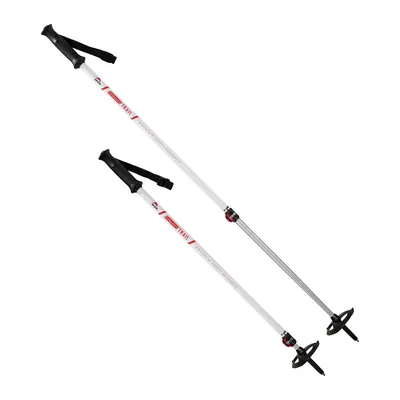
MSR DynaLock Trail Poles
Aluminum poles adjustable from 39.5 to 55 in, with a DynaLock lever lock that tightens without tools, plus snow and summer baskets: shorter uphill, longer downhill.
View on Amazon (opens in a new tab)
Worth watching
Black Diamond shows how to set up and adjust its two- and three-section trekking poles.
The video is hosted by YouTube (Google): nothing loads until you play it, and Google may then set cookies.
FAQ
What length trekking poles do I need at 5′7″?
About 46 inches (116 cm) with Leki’s and Decathlon’s formula, 0.68 times your height, and 45 inches (113 cm) with the two-thirds recommended by a doctor from the French mountaineering federation (FFME). Leki’s chart puts 170 to 180 cm (5′7″ to 5′11″) at 115 to 125 cm (45 to 49 in). That’s only a starting point: on flat ground, your elbow should bend at a right angle, forearm level, tip on the ground by your foot.
Should you set your poles differently going uphill and downhill?
Yes, according to Leki: shorten them by 2 to 4 inches (5 to 10 cm) on a sustained climb and lengthen them by the same amount on a long descent. Stiftung Warentest, Germany’s consumer testing organization, gives the same range for steep descents. For a short climb, an extended grip saves you from touching the setting: your hand simply slides down below the grip.
Fixed, folding, or telescoping poles: which should you choose?
A fixed pole is the lightest and stiffest, according to Leki, but you buy it at the right length and it doesn’t adjust. A Z folding pole can also be fixed-length, like the Black Diamond Distance Carbon Z, sold in lengths from 105 to 130 cm (41 to 51 in). A telescoping pole adjusts as you go, to follow the slope or to pass from one person to another.
How do you use the wrist strap on a trekking pole?
On flat ground and moderate slopes, bring your hand up through the strap from below: according to Stiftung Warentest, you lean on the pole better that way. On steep or dangerous descents, France’s hiking federation (FFRandonnée) advises the opposite, taking your hands out of the straps so you can catch yourself if you fall. The German Alpine Club (DAV) notes that without a strap, the risk of injury in a fall is lower.
Do trekking poles protect your knees?
Going downhill, several studies measure an effect: 12 to 25% lower forces and moment measured at the knee among eight men on a lab ramp, and less muscle soreness after hiking up and down Mount Snowdon in a study of 37 walkers. On flat ground, the results contradict each other. The German Alpine Club (DAV) advises using poles in moderation, alternating with walking without them, and leaving them aside in boulder fields.
Sources
- Leki UK, “Walking Pole Length Guide: What Size Do I Need?,” blog, June 17, 2026, accessed November 8, 2026. leki.co.uk https://www.leki.co.uk/blog/walking-pole-length-guide ↩
- German Alpine Club (DAV), Max Bolland, “So geht das: Trekkingstöcke richtig einsetzen” (how to use trekking poles properly), Panorama 4/2021, July 15, 2021, updated March 27, 2024 (in German), accessed November 8, 2026. alpenverein.de https://www.alpenverein.de/artikel/so-geht-das-trekkingstocke-richtig-einsetzen_d294025d-018e-4cb3-b1ab-d12c1311476b ↩
- Stiftung Warentest, “Wanderstöcke im Test: Tipps zum Wandern mit Stöcken” (tips for hiking with poles), January 17, 2024 (in German), accessed November 8, 2026. test.de https://www.test.de/Wanderstoecke-im-Test-5623087-6084170/ ↩
- Black Diamond, Distance Carbon Z poles product page and suggested length chart, accessed November 8, 2026. blackdiamondequipment.com https://blackdiamondequipment.com/products/distance-carbon-z-poles ↩
- Decathlon, “Comment bien choisir vos bâtons de randonnée ou de trekking?” (how to choose hiking or trekking poles), advice page (in French), accessed November 8, 2026. decathlon.fr https://www.decathlon.fr/c/htc/comment-bien-choisir-des-batons-de-randonnee-ou-de-trekking_09c68c0f-86de-443c-a58c-0eb11c66623b ↩
- Pierre Belleudy, medical officer, medical committee of the French mountaineering and climbing federation (FFME), “Faut-il randonner avec des bâtons?” (should you hike with poles?), January 12, 2012 (PDF, in French), accessed November 8, 2026. ffme.fr https://www.ffme.fr/wp-content/uploads/2019/06/randonnee-batons.pdf ↩
- Metsähallitus (Finland), Luontoon.fi, “Nordic walking,” accessed November 8, 2026. luontoon.fi https://www.luontoon.fi/en/activities/nordic-walking ↩
- L. Russo et al., “The Impact of Nordic Walking Pole Length on Gait Kinematic Parameters,” Journal of Functional Morphology and Kinesiology, 8(2), 50, 2023, abstract accessed November 8, 2026. pubmed.ncbi.nlm.nih.gov https://pubmed.ncbi.nlm.nih.gov/37218846/ ↩
- E. A. Hansen and G. Smith, “Energy expenditure and comfort during Nordic walking with different pole lengths,” Journal of Strength and Conditioning Research, 23(4), 1187-1194, 2009, abstract accessed November 8, 2026. pubmed.ncbi.nlm.nih.gov https://pubmed.ncbi.nlm.nih.gov/19528847/ ↩
- French hiking federation (FFRandonnée), “Les bâtons de randonnée sont-ils utiles? Faisons le point” (are hiking poles useful?), with Dr. Lise Grangeon, October 13, 2021 (in French), accessed November 8, 2026. ffrandonnee.fr https://www.ffrandonnee.fr/s-informer/actualites/les-batons-de-randonnee-sont-ils-utiles-faisons-le-point ↩
- H. Schwameder et al., “Knee joint forces during downhill walking with hiking poles,” Journal of Sports Sciences, 17(12), 969-978, 1999, abstract accessed November 8, 2026. pubmed.ncbi.nlm.nih.gov https://pubmed.ncbi.nlm.nih.gov/10622357/ ↩
- J. Willson et al., “Effects of walking poles on lower extremity gait mechanics,” Medicine and Science in Sports and Exercise, 33(1), 142-147, 2001, abstract accessed November 8, 2026. pubmed.ncbi.nlm.nih.gov https://pubmed.ncbi.nlm.nih.gov/11194099/ ↩
- S. B. Jensen et al., “Is it possible to reduce the knee joint compression force during level walking with hiking poles?,” Scandinavian Journal of Medicine and Science in Sports, 21(6), e195-e200, 2011, abstract accessed November 8, 2026. pubmed.ncbi.nlm.nih.gov https://pubmed.ncbi.nlm.nih.gov/21083766/ ↩
- M. Bohne and J. Abendroth-Smith, “Effects of hiking downhill using trekking poles while carrying external loads,” Medicine and Science in Sports and Exercise, 39(1), 177-183, 2007, abstract accessed November 8, 2026. pubmed.ncbi.nlm.nih.gov https://pubmed.ncbi.nlm.nih.gov/17218900/ ↩
- G. Howatson et al., “Trekking poles reduce exercise-induced muscle injury during mountain walking,” Medicine and Science in Sports and Exercise, 43(1), 140-145, 2011, abstract accessed November 8, 2026. pubmed.ncbi.nlm.nih.gov https://pubmed.ncbi.nlm.nih.gov/20473229/ ↩
- M. J. Saunders et al., “Trekking poles increase physiological responses to hiking without increased perceived exertion,” Journal of Strength and Conditioning Research, 22(5), 1468-1474, 2008, abstract accessed November 8, 2026. pubmed.ncbi.nlm.nih.gov https://pubmed.ncbi.nlm.nih.gov/18714242/ ↩
- A. L. Hawke and R. L. Jensen, “Are Trekking Poles Helping or Hindering Your Hiking Experience? A Review,” Wilderness and Environmental Medicine, 31(4), 482-488, 2020, abstract accessed November 8, 2026. pubmed.ncbi.nlm.nih.gov https://pubmed.ncbi.nlm.nih.gov/32980249/ ↩
- Côtes d’Armor Destination, “GR34, sentier des douaniers: infos pratiques” (practical information, in French), accessed November 8, 2026. cotesdarmor.com https://www.cotesdarmor.com/balades-et-randonnees/a-pied/gr34-sentier-des-douaniers/infos-pratiques/ ↩
- Corsica Regional Nature Park, “GR20 Fra li monti,” recommendations (in French), accessed November 8, 2026. pnr.corsica https://www.pnr.corsica/fr/randonnees-decouverte/gr-20-fra-li-monti ↩
- Government of the Canary Islands, Decree 182/2025 of December 1 approving the master plan for the use and management of Teide National Park, section 6.2.4, Boletín Oficial de Canarias no. 240, December 3, 2025 (in Spanish), accessed November 8, 2026. sede.gobiernodecanarias.org https://sede.gobiernodecanarias.org/boc/boc-a-2025-240-4148.pdf ↩
- Leave No Trace, “Leave No Trace Practices for the Appalachian Trail” (PDF), accessed November 8, 2026. lnt.org https://lnt.org/sites/default/files/LeaveNoTraceAppalachianTrail.pdf ↩

Camping, backpacking, bushcraft and hiking
Guillaume Hoarau writes for Outfarer about camping, backpacking, bushcraft, and hiking. A survival-skills buff and a collector of vintage field manuals, he loves clear explanations, lists that actually help and other people’s stories, which he tells well.


