 Français (France)
 English (UK)
 English (US)
 Deutsch (Deutschland)

Why weight comes before height
For its Redster C5 classic range, Atomic puts the 195 cm ski in four boxes: 99 to 121 lb (45 to 55 kg) in the soft flex, 121 to 143 lb (55 to 65 kg) in medium, 143 to 165 lb (65 to 75 kg) in hard, 165 to 198 lb (75 to 90 kg) in extra hard [1]. Same length, a factor of two in pounds. That is the detail that changes everything: length is only a label, and the camber does the work.
Salomon puts it bluntly: in cross-country skiing you choose ski size mainly by weight, not height, unlike alpine skiing, and makers publish a weight-to-length chart you should follow [2]. The mechanism is the double camber of a classic ski: with your weight shared between both skis, as in the glide, the grip zone stays clear of the snow; when all your weight goes onto one ski, it flattens and the grip zone bites. REI sums up the two ways to get it wrong: skis that are too short do not glide as they should, skis that are too long are hard to grip with [3].
The training manual of the Coaching Association of Canada and Cross Country Canada goes further: the most common mistake is picking a ski that is too stiff. A slightly soft ski is better, because with a waxable ski you can then shorten or thin the kick wax [4].
| Flex | 186 cm | 195 cm | 204 cm |
|---|---|---|---|
| Soft | - | 99-121 lb (45-55 kg) | 143-165 lb (65-75 kg) |
| Medium | 121-143 lb (55-65 kg) | 121-143 lb (55-65 kg) | 165-187 lb (75-85 kg) |
| Hard | 143-165 lb (65-75 kg) | 143-165 lb (65-75 kg) | 187-209 lb (85-95 kg) |
| Extra hard | - | 165-198 lb (75-90 kg) | 209-242 lb (95-110 kg) |
Source: Atomic, size guide for the Redster C5 classic ski (accessed October 31, 2026). A dash means no combination is offered. This chart applies to that model only.
Decathlon gives figures of the same kind for its classic skis (page in French): with a medium camber, 188 cm for 132 to 154 lb (60 to 70 kg), 195 cm for 143 to 165 lb (65 to 75 kg), 202 cm for 165 to 198 lb (75 to 90 kg) [5]. The ranges overlap, so at 154 lb (70 kg) two lengths fit. That is where your level decides, further down.
Classic or skate: how much shorter to go
Salomon gives the gap in one sentence: skate skis are generally 10 to 15 cm shorter than classic skis for the same skier [2]. REI says about 10 cm [3], the Canadian manual about 15 cm shorter than the traditional classic length [4]. The sources agree on the principle and argue only about centimeters.
Tied to height, the rules are alike too, with their nuances. Atomic advises adding 20 to 30 cm to your height for a classic ski, and adds that the more skilled you are, the longer the ski can be [1]. Madshus, according to the retailer SkatePro’s guide, suggests 20 to 25 cm above your height for classic and 10 to 15 cm for skate [6]. The French guide from Mon séjour en montagne gives 15 to 25 cm for classic and 10 to 15 cm for skate, and reminds readers that the maker’s chart always comes first [7].
| Source | Classic rule | Skate rule | For 5 ft 9 in: classic | For 5 ft 9 in: skate |
|---|---|---|---|---|
| Atomic | height + 20 to 30 cm | not given | 195-205 cm | - |
| Madshus (SkatePro) | height + 20 to 25 cm | height + 10 to 15 cm | 195-200 cm | 185-190 cm |
| Mon séjour en montagne | height + 15 to 25 cm | height + 10 to 15 cm | 190-200 cm | 185-190 cm |
The lengths for 175 cm are our own calculation from each source’s rule. They give a range to pick the chart to open, not the length to buy.
Elite skiers have made their choice. Among 87 men and 36 women at the 2020 Norwegian championships, classic skis averaged 112.6% of body height for men and 117.2% for women; skate skis, 104.4% and 108.0% [8]. For a man of 6 ft (1.83 m), the group’s average height, that is about 206 cm for classic and 191 cm for skate. The authors note that the retail rules of thumb, 10 to 15 cm above height for skate and about 25 cm for classic, have barely moved since the late 1980s [8]. These are championship figures, not advice for a first outing.
Poles: one coefficient, several answers
The most quoted rule is Salomon’s: height times 0.83 for classic, up to the armpits; height times 0.89 for skate, up to the nose or ears [9]. Rossignol, in a size guide reproduced by the retailer Hardloop (in French), simply subtracts: height minus 30 cm for classic, minus 20 cm for skate [10]. For a 5 ft 11 in (1.80 m) adult the two are almost identical, 150 and 160 cm. Swix subtracts 35 cm for classic and 22.5 cm for skate, but from your height measured with ski boots on [11].
| Source | Rule | Classic | Skate |
|---|---|---|---|
| Salomon | height × 0.83; height × 0.89 | 145 cm (57 in) | 156 cm (61 in) |
| Rossignol | height - 30 cm; height - 20 cm | 145 cm (57 in) | 155 cm (61 in) |
| REI | chart by height (5 ft 8 in to 5 ft 9 in) | 145 cm (57 in) | 155 cm (61 in) |
| Swix | height with boots - 35 cm; - 22.5 cm | 140 cm (55 in) | 152.5 cm (60 in) |
| FIS (racing) | 83% of height with boots, at most | 145.3 cm (57 in) at most | - |
Sources: Salomon, Rossignol (via Hardloop), REI, Swix, FIS table published by Swix. For Swix and the FIS, 175 cm is height measured in ski boots. The other values are our own calculation.
The catch is in the measurement. Swix specifies that height is taken with ski boots on, as the FIS does for its checks [11]; most of the others say “your height” without saying so. The thickness of a pair of boots is enough to shift the result by a few centimeters. The simplest approach is to pick one guide, one brand, and stick to it.
Between two pole lengths the brands contradict each other. Salomon advises the longer one, and says a specialist retailer can shorten a pole by a few centimeters under the grip [9]; Swix advises the shorter [11]. REI suggests trying poles in the store, tips on the floor, held up against you [3]. Its body landmarks, the armpit for touring, between the chin and lips for skate, do not land in the same place as Salomon’s: use them as a check, not a rule.
In racing, the rule is a cap, not advice: in classic technique a pole may not exceed 83% of height measured in ski boots, and Swix publishes the matching table [11]. The Norwegian skiers surveyed report classic poles averaging 83.9% of their height, right at the limit [8]. Unless you race, you have no reason to copy them.
Between two sizes: your level decides
For skis, the sources agree. Salomon: the shorter ski for easy, safe skiing, because it is more manageable; the longer for performance, because it glides better [2]. REI: if you have never skied, the short ski gives more control and keeps your speed down, and experienced skiers prefer the long, faster one [3]. Decathlon: the lower size to start, the upper size for more flotation and a longer stride [5].
The US retailer evo lists reasons to go shorter, closer to the chin: you are a beginner or intermediate, or lighter than average for your height; and reasons to go longer: you ski fast and aggressively, or heavier than average for your height [12]. That is the same weight-first logic, said in other words.
The paper test, in the store
The chart gives a length and a flex. A sheet of paper checks that the camber suits your weight. The Canadian manual describes the test for a waxable classic ski [4]:
- put the two skis side by side on a flat, smooth floor and stand on them, toes at the balance point, weight evenly spread;
- slide an ordinary sheet of paper under the wax pocket: it should pass along about 50 cm;
- shift all your weight onto one ski: the paper should be pinched between the base and the floor;
- repeat with the other ski.
For a skate ski it is the reverse reading: standing on one ski, you should still be able to move a sheet of paper freely under your foot [4]. A static test does not tell the whole story, and the manual advises trying borrowed skis from friends, if you can, to compare [4]. Finally, tell the sales associate your weight, your level and what you plan to do: it is exactly what the maker’s chart expects.
Worth watching
L.L.Bean’s short how-to covers skill level, extra weight and snow conditions, then shows what the right ski length looks like next to the skier, and ends on a size chart.
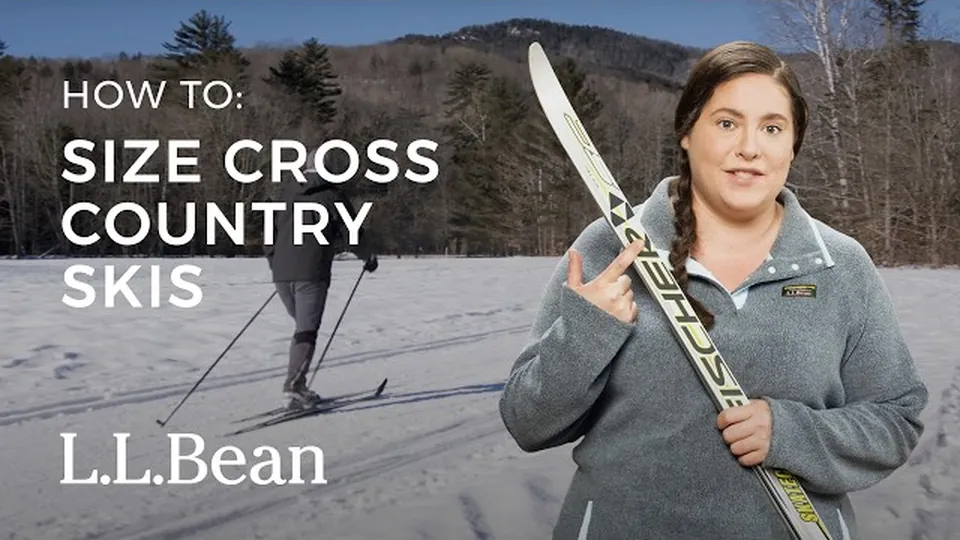
The video is hosted by YouTube (Google): nothing loads until you play it, and Google may then set cookies.
FAQ
What length of cross-country skis for 5 ft 9 in and 154 lb?
From height alone, the range is 190 to 205 cm for classic and 185 to 190 cm for skate. The maker’s chart settles it: for 154 lb (70 kg), Decathlon lists 195 cm in a medium camber (143 to 165 lb), and Atomic 195 cm in hard (143 to 165 lb). Check the chart of the exact model.
What pole length for a cross-country skier of 5 ft 7 in?
About 140 cm (55 in) for classic and 150 cm (59 in) for skate for a skier of 170 cm: that is what Salomon (141 and 151 cm), Rossignol (140 and 150 cm) and REI give. Swix, which starts from height measured in ski boots, gives 135 and 147.5 cm for 170 cm. If you are between two lengths, try both in the store.
Can I use the same skis for classic and skate?
No. The two techniques need their own kit: skate skis are shorter and have no grip zone, and the boots are stiffer. Only a few versatile boots work for both styles, according to Salomon. If you are starting out, begin with classic and its waxless skis with a textured or skin base.
Is a longer ski faster?
Generally yes, as long as the stiffness matches your weight. REI notes that longer skis tend to be faster and that experienced skiers prefer them; Decathlon speaks of flotation and a longer stride. A ski that is too long for a beginner is harder to control.
Should I follow height or weight on the maker’s chart?
Weight. Salomon is clear: in cross-country skiing, ski size is chosen mainly by weight. Height serves to check that the length stays within the usual range, 15 to 30 cm above your height for classic according to the guides.
Sources
- Atomic, size guide for the classic ski "Redster C5 med + Shift CL", product page, accessed October 31, 2026. atomic.com https://www.atomic.com/en-int/products/redster-c5-med-shift-cl-ab2348-202600 ↩
- Salomon, "What size cross-country skis do I need?", updated March 17, 2025. salomon.com https://www.salomon.com/en-us/sg/a/what-size-cross-country-skis-do-i-need ↩
- REI Co-op, "Cross-Country Skiing Equipment Guide", accessed October 31, 2026. rei.com https://www.rei.com/learn/expert-advice/crosscountry-ski-touring-gear.html ↩
- Coaching Association of Canada and Cross Country Canada, "Equipment Selection and Ski Preparation", reference manual, 2011. crosscountrybc.ca https://crosscountrybc.ca/sites/default/files/documents/CC%20RM%20Section%207%20-%20Equipment%20Selection%20%26%20Ski%20Prep_0.pdf ↩
- Decathlon, "Comment choisir ses skis de fond classique" (in French), accessed October 31, 2026. decathlon.fr https://www.decathlon.fr/c/htc/comment-choisir-ses-skis-de-fond-classique_8ebd1672-8326-4d6a-9a8f-54cb40ff33b8 ↩
- SkatePro, "Recommended Length of Madshus Classic and Skate Adult Skis", accessed October 31, 2026. skatepro.com https://www.skatepro.com/en-us/a853.htm ↩
- Mon séjour en montagne, "Notre guide ultime pour bien choisir ses skis de fond et de skating" (in French), updated September 9, 2026. mon-sejour-en-montagne.com https://www.mon-sejour-en-montagne.com/tutos/notre-guide-ultime-pour-bien-choisir-ses-skis-de-fond/ ↩
- Frontiers in Sports and Active Living, "Choice of Pole and Ski Lengths Among Elite Cross-Country Skiers: The Influence of Sex and Performance Level", April 22, 2021. frontiersin.org https://www.frontiersin.org/articles/10.3389/fspor.2021.654864/full ↩
- Salomon, "How to choose cross-country ski poles", updated March 17, 2025. salomon.com https://www.salomon.com/en-us/sg/a/how-to-choose-cross-country-ski-poles ↩
- Hardloop, "Guide des tailles Rossignol", cross-country poles (in French), accessed October 31, 2026. hardloop.fr https://www.hardloop.fr/boutique/content/103-guide-des-tailles-rossignol ↩
- Swix, "Cross country ski poles", size guide and FIS table, accessed October 31, 2026. swixsport.com https://swixsport.com/en/tips/find-your-size/poles/ ↩
- evo, "Cross Country Ski Size Chart", accessed October 31, 2026. evo.com https://www.evo.com/pages/cross-country-ski-size-chart ↩

Trail running, snow, water, nature and destinations
Nolwenn covers trail running, snow, water, nature and destinations for Outfarer. Curious about everything, from meteor showers to night-train schedules, she has a knack for digging up the one detail that changes everything, and nailing it in a single sentence.


