 Français (France)
 English (UK)
 English (US)
 Deutsch (Deutschland)

Do You Really Need to Wax Your Skis?
Salomon lists picking the right kick wax for the snow temperature among the sciences you’ll have to master, and says the skis that demand it are for advanced skiers [1]. Good news: for a casual outing, you can happily skip it.
Classic cross-country skiing has three kinds of grip. Fishscale skis grip best, at the expense of glide: perfect for learning and for easy outings in the tracks. Skin skis, borrowed from ski touring, are a compromise between grip and glide, more forgiving than waxable skis, so much so that they show up in long-distance racing. Waxable skis glide best, but their grip depends on waxes you have to pick to suit the snow [1]. Skate skiing has no kick zone, which means quicker waxing [3].
| Type of ski | Glide zones (front and back) | Kick zone (underfoot) |
|---|---|---|
| Classic waxable | Glide wax, with an iron | Kick wax, applied cold |
| Classic fishscale | Glide wax, with an iron | No kick wax |
| Classic skin | Glide wax, with an iron | No kick wax; a dedicated wax exists for skins |
| Skate | Glide wax along the whole length | No kick zone |
Sources: Salomon, “How to wax Nordic skis”; Decathlon, “Which waxing for cross-country skis?” (in French). Skins have their own wax, which keeps both glide and grip.
For beginners the rule is simple: a fishscale or skin ski needs glide wax and nothing else, and Salomon points out that, since kick waxing is hard to master, skin skis are a far easier answer for classic [2]. To choose your skis, our guide to classic or skate skiing and the one on ski and pole length cover the basics.
Glide Wax: Five Steps With an Iron
The basic kit fits on a workbench: a waxing iron with adjustable temperature, a groove scraper, a plexi scraper (never a metal one), a brass or boar-bristle brush, a nylon brush, and a block of universal wax. A full kit costs about €100 [2]. To start, universal wax works on every kind of snow; you fine-tune later by temperature and moisture [2].
- Clean the base with a brass or boar-bristle brush, tip to tail; if the snow was dirty, wipe on liquid wax remover with a cloth [2].
- Melt: set the iron to the temperature on the block, usually 212 °F (100 °C) for universal wax (the harder the wax, the hotter), lay down two lines on each side of the groove, and spread it without leaving the iron in one spot [2].
- Let it cool at room temperature for at least 10 minutes [2]; Bergzeit allows 20 to 30 [11].
- Scrape the groove with the groove scraper, then the excess with the plexi scraper, in the direction of glide, without pressing too hard [2].
- Brush with the brass or boar-bristle brush, then with the nylon brush to polish the base [2].

How often should you start over? Decathlon suggests waxing as soon as your skis take a lot of effort to push along on the flat [3]. Bergzeit goes further: an active skier refreshes the glide with liquid wax every 5 to 6 days on snow, with a hot wax at the start, middle, and end of the season; an occasional skier gets by with the start and the end, and a gray film on the base means the treatment can’t wait [11].
That leaves the quick option: liquid wax. Swix, which describes it as an everyday product without fluorine, sprays on, dries for 15 minutes, then gets brushed with nylon, only in front of and behind the binding on a classic ski; it gives good glide for about 20 to 30 miles (30 to 50 km) before the next coat [5]. It lacks the staying power of hot waxing, which soaks deeper into the base [11].
| Color | Temperature range | Snow |
|---|---|---|
| Blue | -22 to 14 °F (-30 to -10 °C) | Very cold |
| Violet | 10 to 23 °F (-12 to -5 °C) | Cold |
| Red | 25 to 39 °F (-4 to +4 °C) | Standard |
| Yellow | 25 to 68 °F (-4 to +20 °C) | Spring snow, often wet |
| White or clear | Universal | All snow |
Source: Decathlon, “Which waxing for cross-country skis?” (in French). Colors and ranges vary from brand to brand: the label on the block has the last word.
Kick Wax: Read the Snow Before You Choose
Two families, depending on the snow. Hard wax looks like a crayon and is rubbed into the kick zone; it suits cold, fresh snow. Klister, a paste sold in a tube, is for wet and transformed snow [2] [4]. Glisshop explains that hard wax suits fresh snow and the days after it if the weather stays stable, before a thaw, and klister suits the time after a thaw, when the snow has turned to round, wet grains [6].

| Kick wax (Swix) | Snow temperature |
|---|---|
| V30 Blue | 14 to 28 °F (-10 to -2 °C) |
| V40 Blue Extra | 19 to 30 °F (-7 to -1 °C) |
| V45 Violet | 27 to 32 °F (-3 to 0 °C) |
| V60 Red and silver | 32 to 37 °F (0 to +3 °C) |
Source: Swix, “Four simple steps to prep your skis”. One color comes in several varieties with different ranges: read the label. For wet, transformed, or old snow, Swix switches to klister.
Next, put the wax in the right place. Decathlon has a method: stand on both skis laid flat, slide a sheet of paper under one ski, and mark where it meets resistance. As a rule, the zone starts about 6 to 8 in (15 to 20 cm) in front of the binding and ends at the heel; if the ski grips poorly after a few outings, you can extend it to about 10 in (25 cm) in front of the binding [4].
- Hard wax: strip the zone if needed, mark it off with painter’s tape, rub the wax on, smooth it with a cork, then repeat 3 or 4 times [4]; Swix counts 4 to 8 thin layers for V40 [5].
- Klister: apply in V-shaped chevrons, spread with a scraper or by hand, in one or two layers [4].
- Swix puts a base-wax underlay, ironed in or sprayed on, beneath the thin layers of kick wax [5].
Fishscale or Skin Skis: What Still Needs Looking After
Fishscale and skin skis take no kick wax at all [2]. Their glide zones are waxed like those of any classic ski, and skins have a dedicated wax that brings both glide and grip [2]. Bergzeit adds two precautions: on a fishscale ski, a liquid spray against snow build-up and never any glide wax on the scales; on a skin ski, a skin treatment renewed about every second or third outing, a skin lasting 100 to 150 days on snow [11].
Fluorinated Wax: Why Nobody Wants It Anymore
The FIS voted a total ban on fluorinated waxes in November 2019, then put it into force for the 2023-2024 season [7] [8]. Rule 222.8 prohibits waxes and preparation products containing fluorine in all disciplines and at every FIS level; using one in a race means disqualification [8].
Testing uses Fourier transform infrared spectroscopy, in a dedicated area near the finish: at 1.0 absorbance units or less, the test is negative; three positive points on one ski mean disqualification. The FIS team took 60,000 measurements over the 2023-2024 season [7]. At the Milan-Cortina 2026 Games, three athletes were disqualified for waxes containing PFAS, according to Chemistry World [10].
The issue goes beyond racing. In March 2025, Empa, the Swiss federal laboratory, sampled snow at the Engadin Ski Marathon: the highest PFAS levels were at the start line, where skis had just been waxed, and the soil at the same sites was contaminated. On the skis of the ten best professional racers, no PFAS was found. Empa blames mostly a lack of awareness, and recommends that recreational skiers use waxes labeled fluoro-free [9].
Beyond the workbench lies the trail. An iron, a block of wax, and ten minutes’ wait: that’s all the first silent glide of the season asks for, the one that makes you want to go out again the very next day.
Gear related to this article
No affiliation: no commission, no sponsored products.
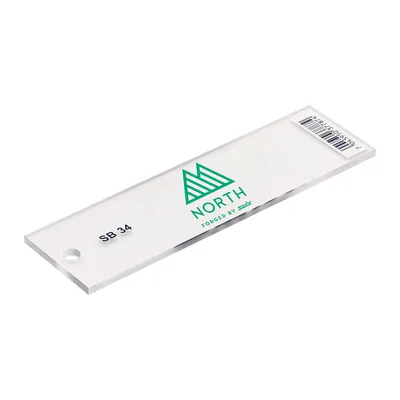
Swix plexi wax scraper, 4 mm
A 4 mm plexiglass blade for scraping excess glide wax off the base once it has cooled. Plexiglass rather than metal is what Salomon recommends, so the base is not damaged.
View on Amazon (opens in a new tab)
Worth watching
Madshus shows step by step how to apply kick wax to classic skis, the stage of waxing that is hardest to picture from a text alone.
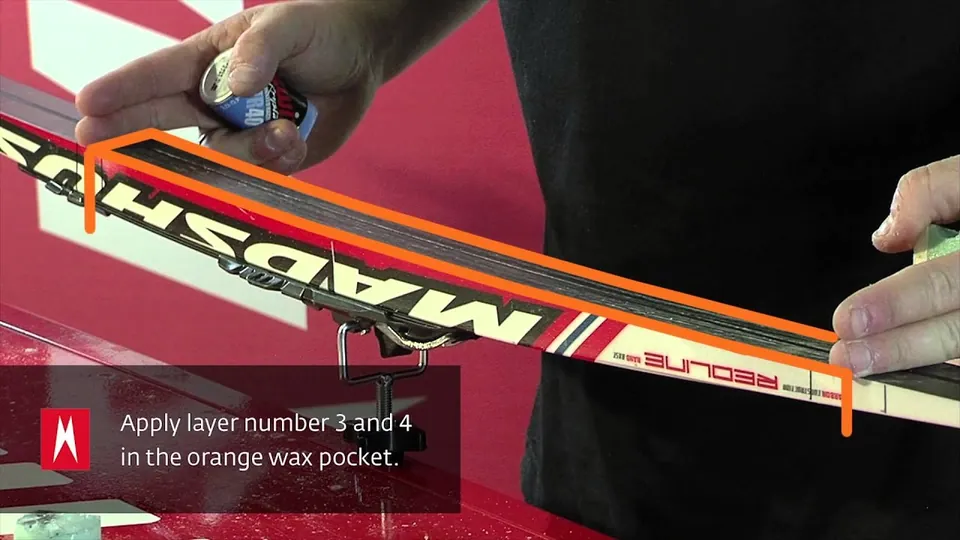
The video is hosted by YouTube (Google): nothing loads until you play it, and Google may then set cookies.
FAQ
Do fishscale or skin skis need waxing?
Not with kick wax: neither fishscales nor skins take any. The glide zones, in front of and behind the foot, are still waxed with an iron, just as on a classic waxable ski, and skins have a dedicated wax that keeps both glide and grip, according to Salomon.
What temperature should the waxing iron be?
The one printed on the block of wax. According to Salomon, it’s usually 212 °F (100 °C) for a universal wax, and the harder the wax, meant for cold snow, the hotter the iron must be. Never leave the iron in one spot, or you risk overheating the base.
How long should glide wax cool?
At least 10 minutes at room temperature, according to Salomon, before scraping the groove and then the base. Bergzeit allows 20 to 30 minutes. The two figures exist side by side, so check which one your wax’s maker gives: the label on the wax has the last word.
When should I use klister rather than hard wax?
When the snow is wet, transformed, or soaked, for instance after a thaw: Salomon and Decathlon keep klister for these snows. Hard wax, a crayon-like wax rubbed into the kick zone, suits cold, fresh snow. The temperature range on the wax label makes the final call.
Are fluorinated waxes banned?
In competition, yes: the FIS has banned them in all its disciplines since the 2023-2024 season, on pain of disqualification. For recreation, Empa recommends switching to waxes labeled fluoro-free and replacing old blocks, since almost all of them contain PFAS.
Sources
- Salomon, “How to choose classic cross-country skis” (in French), accessed November 3, 2026. salomon.com https://www.salomon.com/fr-fr/sg/a/how-to-choose-classic-cross-country-skis ↩
- Salomon, “How to wax Nordic skis,” accessed November 3, 2026. salomon.com https://www.salomon.com/en-gb/sg/a/how-to-wax-nordic-skis ↩
- Decathlon, “Which waxing for cross-country skis?” (in French), accessed November 3, 2026. conseilsport.decathlon.fr https://conseilsport.decathlon.fr/quel-fartage-pour-des-skis-de-fond ↩
- Decathlon, “How to maintain classic waxable cross-country skis” (in French), accessed November 3, 2026. conseilsport.decathlon.fr https://conseilsport.decathlon.fr/comment-entretenir-ses-skis-de-fond-classiques-a-farter ↩
- Swix, “Four simple steps to prep your skis,” accessed November 3, 2026. swixsport.com https://swixsport.com/eu/article/wax/four-simple-steps-to-prep-your-skis ↩
- Glisshop, “Which type of kick wax to choose for cross-country skiing?” (in French), accessed November 3, 2026. glisshop.com https://www.glisshop.com/conseils/type-fart-retenue-ski-de-fond.html ↩
- FIS, “FIS widens scope of fluor testing after successful first season,” 2024-25 season, accessed November 3, 2026. fis-ski.com https://fis-ski.com/inside-fis/news/2024-25/fis-widens-scope-of-fluor-testing-after-successful-first-season ↩
- SkiRacing.com, “Enforcing the fluor wax ban: FIS implements reliable testing,” accessed November 3, 2026. skiracing.com https://skiracing.com/enforcing-the-fluor-wax-ban-fis-implements-reliable-testing/ ↩
- Empa, press release on PFAS in the snow at the Engadin Ski Marathon, November 18, 2025, accessed November 3, 2026. admin.ch https://www.admin.ch/en/newnsb/-T2IotDsXdgEKUAAJgdv0 ↩
- Chemistry World, “PFAS waxes found on skis and snowboards lead to three Olympic disqualifications,” February 18, 2026, accessed November 3, 2026. chemistryworld.com https://www.chemistryworld.com/news/pfas-waxes-found-on-skis-and-snowboards-lead-to-three-olympic-disqualifications/4022977.article ↩
- Bergzeit, “Waxing cross-country skis: instructions” (in German), accessed November 3, 2026. bergzeit.de https://www.bergzeit.de/magazin/langlaufski-wachsen-anleitung-kaltwachs-heisswachs-fluessigwachs/ ↩

Trail running, snow, water, nature and destinations
Nolwenn covers trail running, snow, water, nature and destinations for Outfarer. Curious about everything, from meteor showers to night-train schedules, she has a knack for digging up the one detail that changes everything, and nailing it in a single sentence.


