 Français (France)
 English (UK)
 English (US)
 Deutsch (Deutschland)

Contents
Two in the afternoon, on the shortest days of the year: in Grimentz, in the Swiss canton of Valais, the sun has already slipped behind the mountains, according to the Swiss hiking trails association, Schweizer Wanderwege [1]. Astronomically, it doesn’t set there until 4:46 p.m. on December 21, 2026 [2]. Nearly three hours’ difference, and that’s winter hiking in a nutshell: the trail is groomed, the snow squeaks underfoot, and the light waits for no one. Good news: a winter trail calls for neither skis nor snowshoes, just sturdy boots, a pair of slip-on traction devices in your pack, and an eye on the clock.
What a winter trail is, and who grooms it
If you’ve only hiked in the US, the idea may sound odd: in the Alps, towns and resorts groom trails just for people on foot. A winter trail isn’t a summer trail under snow. In Switzerland, where the system is described in the most detail, signposted winter hiking trails are open to everyone and generally meant for people on foot. They’re checked and Packed and smoothed by machine: fresh snow becomes a firm surface that holds your weight, so you can walk it in ordinary winter boots., and run as far as possible from roads with traffic [3]. Technically, they’re on par with the country’s easiest trails, marked in yellow, and mostly call for extra attention to the weather and the risk of slipping [3].
The difference is the upkeep. Trails marked in yellow, white-red-white, or white-blue-white are neither checked nor maintained in winter, and they can become impassable or even dangerous, Schweizer Wanderwege warns [4]. A winter trail, on the other hand, is plowed by a town vehicle or packed by a grooming machine about 16 feet (5 m) wide into a firm surface that holds your weight. When temperatures swing, in strong sun, or when ice forms, the surface is tilled again, regularly and daily if needed. That’s according to a guide published in 2020 by Switzerland’s Federal Roads Office (FEDRO), Schweizer Wanderwege, and SwitzerlandMobility [5].
Who does the work? In Switzerland, a sponsoring organization: a town, a lift company, a tourism office, a trails association, or several of them together [5]. The country counts about 3,700 miles (6,000 km) of signposted winter routes, winter hiking trails and snowshoe trails combined [1]. In Germany, many regions and mountain huts have trails cleared and leveled [6]: more than 87 miles (140 km) are groomed around Oberstdorf in the Allgäu region, and about 170 miles (280 km) in the Chiemgau, according to the German Alpine Club (DAV) [7]. In Austria, since the 2025-26 winter, the first 18 winter trails carry Austria’s hiking quality seal (Österreichisches Wandergütesiegel), with continuous trail markings and regular, sometimes daily, maintenance [8].
How to recognize a winter trail
In Switzerland, it’s easy: winter hiking trails are signposted in pink, with a hiker symbol on the signs [1], and the signs go up specially every winter [4]. Snowshoe trails are pink too, but they carry a white snowshoe symbol and aren’t packed [1]. Their difficulty is shown in blue, red, or black on the boards at the trailhead, and sometimes on the signposts [3]. In boots, you follow the hiker, not the snowshoe.
Elsewhere, signage depends on the place. In Germany and Austria, the winter trail map from the town or tourism office shows which trails are groomed; Austria’s certified trails have their own winter signage [8]. In France, ski resorts and Nordic areas lay out routes for people on foot: Nordic France, which brings together more than 160 cross-country ski areas, describes trails designed so that people on snowshoes or on foot can explore without getting in skiers’ way [9]. The resort or Nordic center map shows where they run.
Why you stay on the groomed trail
Because it was planned for winter. In Switzerland, the organization in charge works with a local avalanche commission or with specialists from the WSL Institute for Snow and Avalanche Research SLF to identify where avalanches or falling ice could hit, and routes the trails so that, as far as possible, no avalanche danger threatens them [5]. The German Alpine Club puts it its own way: on secured routes such as hut access roads and sledding runs, avalanche danger is practically ruled out when they’re officially open [10]. The detail that changes everything is in those last two words: officially open.
In Switzerland, a closed trail has to be marked on site, with a clearly visible sign at every access point [5]. And next to the packed track lies open terrain that nobody has assessed for you. Even so, the DAV recommends checking the avalanche forecast before every winter hike, even on secured trails, and notes that the risk is often underestimated in Germany’s lower mountain ranges [6]. European forecasts use a five-level danger scale, from 1, low, to 5, very high [11]. You’ll find them from the SLF for Switzerland, the Bavarian avalanche warning service, lawinen.at for the Austrian states, and Météo-France for the French mountains.
Staying on the trail also protects wildlife, which has to conserve energy in winter. Schweizer Wanderwege asks hikers to keep dogs leashed, especially in the woods, and to respect wildlife quiet zones and protected areas [4].
Ski runs and cross-country trails aren’t winter hiking trails
A freshly groomed ski run looks like an invitation, but it isn’t a footpath. What’s allowed there is decided country by country, and often resort by resort. Take France, where towns set the rules for their ski runs by mayoral decree. In Montgenèvre (Hautes-Alpes), for the 2025-26 season, the runs are off-limits to anyone not wearing skis, a snowboard, or similar gear; hikers are tolerated on just three easy runs, at their own risk [12].
In Switzerland, winter hiking trails are supposed to avoid crossing ski runs wherever possible and share a route with them only in exceptional cases [5]. They may share a cross-country ski trail for short stretches; you then walk along the edge [5].
Boots, gaiters, traction, and poles
Gear-wise, winter hiking stays refreshingly simple. On Swiss winter trails, sturdy footwear with a sole that grips on snow, or spikes, is expected, plus weather-appropriate clothing, and a topographic map is recommended [3]. The DAV suggests sturdy hiking boots with a lugged sole and clothing in layers [6], as covered in our guide to layering for the cold. Gaiters often get overlooked: once snow gets into your boot, it won’t dry out anytime soon [10].
That leaves Small metal spikes, often on short chains, stretched over your boot sole with a rubber harness. Germans call them Grödel, and many hikers call them microspikes. The German Alpine Club describes them as the simplest form of crampon.. Their spikes grip on hard old snow, crust, and icy snow [6]. On Austria’s certified trails, they’re the spare in your pack for the occasional icy patch [8]. When snow thaws and refreezes often, things get slick, and traction and poles help [6]. Walking in them takes some getting used to: lift your feet clearly and don’t shuffle, or the spikes will catch [10].
Snowshoes only earn their keep in fresh, deep snow away from groomed trails; on a firm, well-packed track, walking in boots is usually more comfortable [10]. That’s another chapter, covered in our beginner’s guide to snowshoeing.
Daylight: when it gets dark in winter
In winter, the light sets the limits of every outing. Cold and snow slow your usual pace, and the days are shorter, Schweizer Wanderwege reminds hikers [1]. How much shorter? We ran the numbers for six places with data from the U.S. Naval Observatory [2]: on December 21, 2026, Oberstdorf gets 8 hours 27 minutes between sunrise and sunset, and Aviemore, in the Scottish Highlands, just 6 hours 40.
| Place | Dec. 21: sunrise | Dec. 21: sunset | Feb. 1: sunrise | Feb. 1: sunset |
|---|---|---|---|---|
| Oberstdorf (Allgäu, Germany) | 8:03 a.m. | 4:30 p.m. | 7:45 a.m. | 5:20 p.m. |
| Innsbruck (Tyrol, Austria) | 7:58 a.m. | 4:27 p.m. | 7:41 a.m. | 5:16 p.m. |
| Davos (Graubünden, Switzerland) | 8:03 a.m. | 4:35 p.m. | 7:46 a.m. | 5:23 p.m. |
| Chamonix (Haute-Savoie, France) | 8:11 a.m. | 4:50 p.m. | 7:55 a.m. | 5:38 p.m. |
| Aviemore (Scotland) | 8:53 a.m. | 3:33 p.m. | 8:16 a.m. | 4:43 p.m. |
| Lake Placid (New York) | 7:28 a.m. | 4:20 p.m. | 7:14 a.m. | 5:05 p.m. |
Standard time: Central European Time in the Alps, Greenwich Mean Time in Scotland, Eastern Standard Time in Lake Placid. Times assume a flat horizon; on a valley floor, the sun drops behind the mountains earlier. Data: U.S. Naval Observatory.
Three things stand out. The earliest sunset isn’t on December 21 but on December 11 in Oberstdorf, Innsbruck, and Davos, and on December 9 in Lake Placid: after that, evenings are already getting longer, while mornings keep getting darker until early January [2]. So the day grows in the afternoon first: by February 1, Oberstdorf gains 50 minutes in the evening but only 18 in the morning. And after sunset you get a good half hour of The period when the center of the sun is up to 6° below the horizon. After it ends, you normally need artificial light for ordinary outdoor activities.: in Oberstdorf, it ends at 5:06 p.m. on December 21 [2, 13].
On a valley floor, night comes even sooner. The times in the table assume a flat horizon [13]; in Grimentz, the sun disappears behind the mountains by 2 p.m. on the shortest days [1]. So plan backward: be back well before sunset, with a buffer for your slower pace in snow. For winter outings with climbing, the DAV allows at most about 650 to 1,000 feet (200 to 300 m) of elevation gain per hour [10], less than the summer figures in our guide to estimating hiking time.

Britain and the US: where winter trails exist, and where they don’t
In Britain, as far as we know, there’s no network of groomed winter trails like the ones in the Alps. Heading into the hills in winter, especially in Scotland, takes gear and skills beyond those of summer hiking and resort skiing, Mountaineering Scotland points out [14]. Snow erases every trace of a trail up there [14]. The Scottish Avalanche Information Service publishes avalanche reports for six Scottish mountain areas [15].
Here in the US, some state parks come closest to a winter hiking trail. Governor Thompson State Park in Wisconsin rolls about 5 miles (8 km) of multi-purpose trails for winter hiking, snowshoeing, and skiing; hikers, snowshoers, and dogs, however, aren’t allowed on the tracked cross-country ski trails when they’re snow-covered, with one exception [16]. There, too, the ski trail belongs to skiers. For avalanche forecasts, Avalanche.org brings together data from professional forecast centers.
| Country | Groomed trails for hikers | How to spot them | Ski runs on foot |
|---|---|---|---|
| Switzerland | Yes, about 3,700 miles (6,000 km) of signposted winter routes, snowshoe trails included | Pink signposts with a hiker symbol | Crossings avoided where possible; otherwise, cross one at a time |
| Germany | Yes, cleared or groomed by regions and mountain huts | Local winter trail map | Ski area and town rules |
| Austria | Yes; since 2025-26, the first 18 trails with a quality seal | Dedicated signage on certified trails; otherwise, the local map | Ski area and town rules |
| France | Yes, at ski resorts and Nordic areas | Resort or Nordic center map | Set by town decree, often banned |
| United Kingdom | No comparable network known | Not applicable | Not applicable |
| United States | Rolled multi-purpose trails in some state parks | Park map | Cross-country ski trails closed to hikers (Wisconsin example) |
Summary of the sources cited above. On site, posted rules apply.
A pink signpost or a freshly groomed track, the hush only snow can make, and a glance at your watch around 3 p.m.: a winter day doesn’t need much more. Toss the traction in your pack and go while the light is still golden.
Gear related to this article
No affiliation: no commission, no sponsored products.
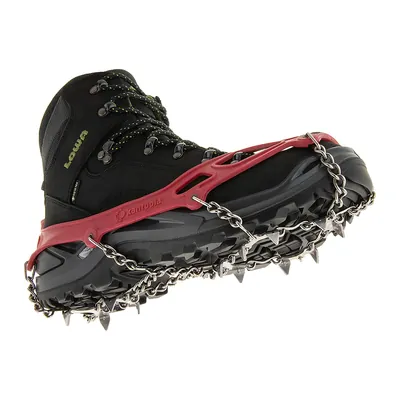
Kahtoola MICROspikes
Traction devices that stretch over your boots: 12 stainless steel spikes of 0.41 in per foot on chains, with a harness that stays supple down to -22 °F. For icy stretches of winter trails.
View on Amazon (opens in a new tab)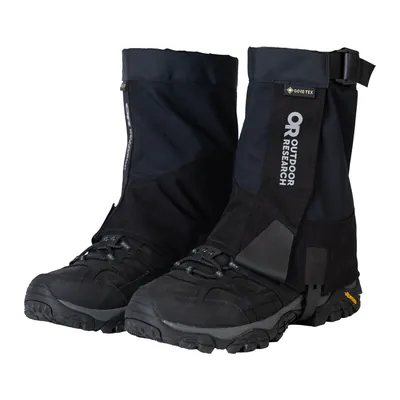
Outdoor Research Crocodile Mid-Height
Waterproof, breathable Gore-Tex gaiters with a Cordura-reinforced base and a replaceable instep strap: they keep rain, mud and snow from getting in over the top of your boots. Unisex.
View on Amazon (opens in a new tab)
FAQ
What boots do I need for winter hiking?
On groomed trails, sturdy boots with good grip will do: in Switzerland, sturdy footwear with a sole that grips on snow, or spikes, is expected on winter hiking trails. Add gaiters to keep snow out, poles, and slip-on traction in your pack for icy stretches. You only need snowshoes in deep snow away from the trails.
What are slip-on traction devices, and when do I need them?
They’re small metal spikes, often on short chains, that you stretch over your boot sole with a rubber harness; many hikers call them microspikes, and the German Alpine Club calls them the simplest form of crampon. They grip on hard, crusty, or icy snow, for example when a trail thaws and refreezes. Lift your feet clearly as you walk so the spikes don’t catch.
How do I recognize a winter hiking trail?
In Switzerland, by pink signposts with a hiker symbol; pink signs with a snowshoe symbol mark snowshoe trails, which aren’t packed. Summer trails marked in yellow or white-red-white aren’t maintained in winter. In Germany, Austria, and France, the map from the resort, tourism office, or Nordic center shows which trails are groomed.
Can I hike on a ski run?
It depends on the resort, and often the answer is no. In Montgenèvre, France, the runs are closed for the 2025-26 season to anyone without skis or a snowboard, except three easy runs where hikers are tolerated, and all activity is banned from 5:15 p.m. to 9 a.m. while grooming is underway. In Switzerland, you cross a run only at marked crossings, one person at a time.
Do I need to worry about avalanches on a groomed trail?
On a secured trail that’s officially open, avalanche danger is practically ruled out, according to the German Alpine Club, and in Switzerland winter trails are routed to avoid avalanche danger as far as possible. Still, respect closures, stay on the trail, and check the avalanche forecast before you go, as the DAV recommends.
When should I be back from a winter hike?
Well before sunset. On December 21, 2026, the sun sets at 4:30 p.m. in Oberstdorf, Germany, followed by a good half hour of twilight. On a valley floor, it often disappears much earlier behind the mountains: by 2 p.m. in Grimentz, Switzerland. Build in a buffer, because you hike more slowly in snow.
Sources
- Schweizer Wanderwege (Swiss hiking trails association), “Wandern im Winter” (in German), accessed October 23, 2026. schweizer-wanderwege.ch https://www.schweizer-wanderwege.ch/de/wissen/wandern-im-winter ↩
- U.S. Naval Observatory, Astronomical Applications Department, “Complete Sun and Moon Data for One Day,” data for Grimentz, Oberstdorf, Innsbruck, Davos, Chamonix, Aviemore, and Lake Placid, December 21, 2026, and February 1, 2027, accessed October 23, 2026. aa.usno.navy.mil https://aa.usno.navy.mil/data/RS_OneDay ↩
- Schweizer Wanderwege, “Wegkategorien” (in German), accessed October 23, 2026. schweizer-wanderwege.ch https://www.schweizer-wanderwege.ch/de/wissen/signalisation/wegkategorien ↩
- Schweizer Wanderwege, “Wo Wandervögel auf Schneehasen treffen: So geht Winterwandern” (in German), press release, December 8, 2021. swisshiking.ch https://www.swisshiking.ch/de/media/download/c03497e7e7744a7114474e14074b130df3a7cf96 ↩
- Swiss Federal Roads Office (FEDRO), Schweizer Wanderwege, and SwitzerlandMobility Foundation, Winterwanderwege und Schneeschuhrouten. Leitfaden für Planung, Signalisation, Betrieb und Information (in German), Materialien Langsamverkehr no. 143, 2020, as published by the canton of Schwyz. sz.ch https://www.sz.ch/public/upload/assets/51359/Winterwanderwege_und_Schneeschuhrouten_Leitfaden_fuer_Planung_Signalisation_Betrieb_und_Information.pdf?fp=3 ↩
- German Alpine Club (Deutscher Alpenverein), “Winterwandern” (in German), October 28, 2024, last updated March 3, 2025. alpenverein.de https://www.alpenverein.de/artikel/winterwandern_72ac514c-e21a-4d51-a708-89baffe5581e ↩
- German Alpine Club (Deutscher Alpenverein), “Winterwandern in den Alpen” (in German), January 15, 2026, last updated February 2, 2026. alpenverein.de https://www.alpenverein.de/artikel/winterwandern-in-den-alpen_2d9660f7-e2c8-4f5b-b094-d1f618c0ef20 ↩
- Österreichs Wanderdörfer (Austrian hiking villages association), “Österreichs erste ausgezeichnete Winterwanderwege” (in German), accessed October 23, 2026. wanderdoerfer.at https://www.wanderdoerfer.at/wintersonne/osterreichs-zertifizierte-winterwanderwege/ ↩
- Nordic France (French federation of cross-country ski areas), “Raquettes” (in French), accessed October 23, 2026. nordicfrance.fr https://www.nordicfrance.fr/activites-nordiques/mode-detente/raquettes/ ↩
- German Alpine Club (Deutscher Alpenverein), “Sicher wandern im Schnee” (in German), DAV Panorama, last updated March 20, 2023. alpenverein.de https://www.alpenverein.de/artikel/sicher-wandern-im-schnee_19158f10-be75-4fbc-a65e-3254fad90796 ↩
- European Avalanche Warning Services (EAWS), “Avalanche Danger Scale,” accessed October 23, 2026. avalanches.org https://www.avalanches.org/standards/avalanche-danger-scale/ ↩
- Town of Montgenèvre, France, Arrêté relatif à la pratique du ski alpin sur la Commune de Montgenèvre, saison 2025/2026 (in French), decree no. 05085202586, received by the prefecture on November 28, 2025. skipass.montgenevre.com https://skipass.montgenevre.com/media/download/montgenevreb2c/cms/media/refont-2022/pdf/2.%20ARRETE%20GENERAL%20PRATIQUE%20DU%20SKI%20ALPIN%20MTG.pdf ↩
- U.S. Naval Observatory, “Rise, Set, and Twilight Definitions,” accessed October 23, 2026. aa.usno.navy.mil https://aa.usno.navy.mil/faq/RST_defs ↩
- Mountaineering Scotland, “ThinkWINTER,” accessed October 23, 2026. mountaineering.scot https://www.mountaineering.scot/safety-and-skills/thinkwinter ↩
- Scottish Avalanche Information Service, home page with avalanche reports for six mountain areas, accessed October 23, 2026. sais.gov.uk https://www.sais.gov.uk/ ↩
- Wisconsin Department of Natural Resources, “Winter Recreation, Governor Thompson State Park,” accessed October 23, 2026. dnr.wisconsin.gov https://dnr.wisconsin.gov/topic/parks/govthompson/recreation/winter ↩

Trail running, snow, water, nature and destinations
Nolwenn covers trail running, snow, water, nature and destinations for Outfarer. Curious about everything, from meteor showers to night-train schedules, she has a knack for digging up the one detail that changes everything, and nailing it in a single sentence.


