 Français (France)
 English (UK)
 English (US)
 Deutsch (Deutschland)

Two techniques, one trail
169 days. That’s how long the 2025-2026 cross-country ski season ran in France, from November 2, 2025, at Bessans, in Savoie in the French Alps, to April 19, 2026, at Avoriaz; more than a million passes (season, weekly, and daily) were sold [1]. On those trails, two ways of gliding share the snow.
Nordic France, the federation of France’s Nordic ski areas, describes them this way: in classic, skiers keep their skis parallel and let them glide in the tracks; in skate skiing, they push along with their skis apart on the smooth lane laid down by the grooming machine. Classic, close to walking, is the more accessible of the two for beginners. Skate skiing takes good balance and more power, especially on climbs, but the speed and the fun come fast [2].
Classic is the age-old discipline of Nordic skiing, with a diagonal stride that looks a lot like walking; skate skiing, also called freestyle, took off in the 1980s, with a stride that recalls ice skating [3, 5].
Different gear for each style
Good news for your wallet: nobody starts out with two sets of gear. The catch: you can’t switch styles on the same setup. Salomon is clear that classic and skate skiing don’t use the same equipment, except for a few versatile boots that work for both [3, 5].
| Item | Classic | Skate |
|---|---|---|
| Skis | Longer, with a more pronounced tip, a kick zone underfoot, and glide zones in front and behind | Shorter, chosen by weight, with a glide zone along the entire base |
| Grip | Fish scales or skins for touring, no kick wax | No kick zone |
| Boots | Flexible sole, low cut, ankle left free | Stiffer sole, higher cuff, ankle support |
| Bindings | Style-specific; several systems, not all compatible | Style-specific; several systems, not all compatible |
| Poles | About 0.83 times your height, up to your shoulder | About 0.89 times your height, up to your nose or ears |
Source: Salomon, “Classic vs Skating Cross-Country Skiing,” and its French version. Ski length also depends on your weight and ability.
For your first time out, classic is easy to pick up whatever the snow conditions, and waxless skis with fish scales or skins, made for touring, are the simplest choice: they need no kick wax and let you glide at your own pace in the tracks [3, 5]. Figuring out pole length takes seconds: for someone 5 ft 5 in (1.65 m) tall, about 137 cm for classic and 147 cm for skate skiing. Our waxing guide covers what you wax, or don’t, depending on the ski.
| Your height | Classic poles (0.83) | Skate poles (0.89) |
|---|---|---|
| 5 ft 1 in (1.55 m) | 129 cm | 138 cm |
| 5 ft 5 in (1.65 m) | 137 cm | 147 cm |
| 5 ft 9 in (1.75 m) | 145 cm | 156 cm |
| 6 ft 1 in (1.85 m) | 154 cm | 165 cm |
Calculation: height in centimeters multiplied by 0.83 or 0.89, rounded to the nearest centimeter; heights in feet and inches are rounded to the nearest inch. Poles are sold in centimeters, in steps of a few centimeters: pick the closest length available.
Trail fees and France’s national Nordic pass
Groomed trails in France aren’t free: Nordic areas charge a trail fee, the “redevance activités nordiques,” provided for in the French Tourism Code, and Nordic France brings together the areas that collect it [2]. Each area sets its own daily and weekly rates; if you ski often, or in more than one mountain range, there’s a national season pass.
| Pass | Presale, October 1 to November 15 | Full price, from November 16 |
|---|---|---|
| Adult | €214 | €255 |
| Youth, ages 5 through 15 | €79 | €94 |
Source: Nordic France. Good at all member Nordic areas, except for night skiing and for trails opened before December 15 thanks to snowfarming (snow stored over the summer), snowmaking, or glacier skiing.
Here’s the detail that changes everything: the presale. Buy by November 15, and the adult pass costs €41 less. It works with a contactless card at some 160 Nordic areas in France and, thanks to agreements between France and Switzerland, also gets you into Nordic areas in French-speaking Switzerland [4].
Making your first time out a success
Nordic France’s advice: to have fun and stay safe from your very first strides, nothing beats learning a few basic moves from an instructor. Some resorts have beginner areas and learning zones where kids learn through games: jumping bumps, skiing through gates, slaloming [2]. Start with classic, on an easy green trail, and save skate skiing for your second or third time out, once your balance has caught up with you.
Cross-country skiing heats you up fast: dress in thin layers you can peel off as you go, with a warm layer in your backpack for breaks. And where routes are shared, hikers and snowshoers have their own trails: our snowshoeing guide explains where to walk without getting in skiers’ way.

Picture a first morning of fresh snow, the trail still untouched under the firs: a few hours of classic, and you’ll see why so many cross-country skiers never look twice at a chairlift again.
Worth watching
Nordic Ski Lab, a cross-country ski coaching channel, compares classic and skate skiing to help you figure out which technique is the right fit before your first time out.
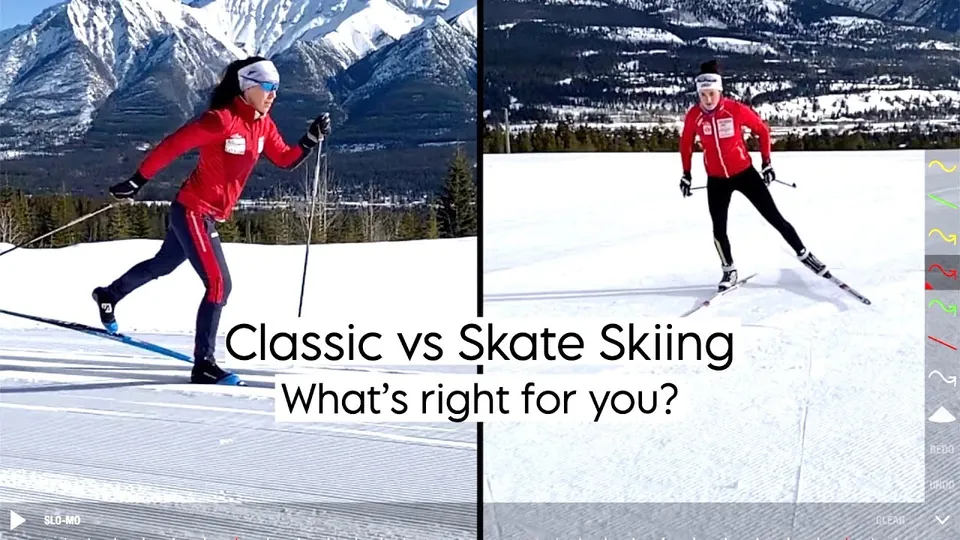
The video is hosted by YouTube (Google): nothing loads until you play it, and Google may then set cookies.
FAQ
Should beginners start with classic or skate skiing?
Classic. With your skis parallel in the tracks, it’s close to walking, and it’s the technique Nordic France considers more accessible for beginners. On waxless skis with fish scales or skins, you get grip without kick wax. Skate skiing takes more balance and more power: save it for later, once you’re comfortable on skis.
Can you skate ski on classic skis?
No. Salomon points out that classic and skate skiing don’t use the same equipment: classic skis have a kick zone and are longer, while skate skis are shorter and glide along their entire base. Boots and bindings are different too, and only a few versatile boots work for both styles.
How long should my cross-country ski poles be?
According to Salomon, about 0.83 times your height for classic, which puts them at shoulder height, and 0.89 times for skate skiing, up to your nose or ears. For someone 5 ft 5 in (1.65 m) tall, that works out to about 137 cm for classic and 147 cm for skate skiing. Poles are sold in centimeters: pick the closest length available.
How much does France’s national Nordic pass cost for 2026-2027?
For adults, €214 during the presale from October 1 to November 15, then €255. For ages 5 to 15, €79, then €94. It covers the trails at some 160 member Nordic areas, except night skiing and trails opened before December 15 thanks to snowfarming, snowmaking, or glacier skiing, plus partner areas in Switzerland.
Sources
- Nordic France (federation of French Nordic ski areas), Bilan de la saison 2025-2026, season review (in French), accessed October 22, 2026. nordicfrance.fr https://www.nordicfrance.fr/bilan-de-la-saison-2025-2026.htm ↩
- Nordic France, Ski de fond, Nordic activities page (in French), accessed October 22, 2026. nordicfrance.fr https://www.nordicfrance.fr/activites-nordiques/mode-sport/ski-de-fond/ ↩
- Salomon, Ski de fond classique & skate : quelles différences ? (in French), accessed October 22, 2026. salomon.com https://www.salomon.com/fr-fr/sg/a/cross-country-skiing-classic-vs-skating ↩
- Nordic France, Pass National, 2026-2027 season prices (in French), accessed October 22, 2026. nordicfrance.fr https://www.nordicfrance.fr/qui-sommes-nous/pass-national ↩
- Salomon, Classic vs Skating Cross-Country Skiing, US version of the same guide, accessed October 22, 2026. salomon.com https://www.salomon.com/en-us/sg/a/cross-country-skiing-classic-vs-skating ↩

Trail running, snow, water, nature and destinations
Nolwenn covers trail running, snow, water, nature and destinations for Outfarer. Curious about everything, from meteor showers to night-train schedules, she has a knack for digging up the one detail that changes everything, and nailing it in a single sentence.


