 Français (France)
 English (UK)
 English (US)
 Deutsch (Deutschland)

Contents
Two techniques on the same trail
169 days. That was the length of France’s 2025-2026 cross-country ski season, from 2 November 2025 at Bessans, in Savoie, to 19 April 2026 at Avoriaz; more than a million passes, for the season, the week or the day, were sold [1]. On those trails, two ways of gliding share the snow.
Nordic France, the federation of France’s Nordic ski areas, describes them like this: in classic, skiers keep their skis parallel and let them glide in the tracks; in skating, they move forward with their skis apart on the smooth lane laid by the piste groomer. Classic, close to walking, is the more accessible of the two for beginners. Skating takes good balance and more power, especially on the climbs, but speed and enjoyment arrive quickly [2].
Classic is the age-old discipline of Nordic skiing, with its diagonal stride that resembles walking; skating, or freestyle, took off in the 1980s, with a skater’s stride reminiscent of ice skating [3, 5].
Different kit for each style
Good news for your budget: nobody starts out with two sets of kit. The catch is that you cannot switch from one style to the other on the same set: Salomon is clear that classic and skating do not use the same equipment, apart from a few versatile boots that work for both [3, 5].
| Item | Classic | Skating |
|---|---|---|
| Skis | Longer, with a more pronounced tip, a grip zone underfoot and glide zones in front and behind | Shorter, chosen according to your weight, with a glide zone along the whole base |
| Grip | Fishscales or skins for touring, no grip wax | No grip zone |
| Boots | Soft sole, low cut, ankle left free | Stiffer sole, higher cuff, ankle support |
| Bindings | Specific to the style; several systems, not all compatible | Specific to the style; several systems, not all compatible |
| Poles | About 0.83 times your height, up to your shoulder | About 0.89 times your height, up to your nose or ears |
Source: Salomon, ‘Classic vs Skating Cross-Country Skiing’, and its French version. Ski length also depends on your weight and level.
For a first outing, classic is easy to pick up whatever the snow, and fishscale or skin skis, designed for touring, are the simplest choice: they need no grip wax and let you glide at your own pace in the tracks [3, 5]. Pole length is quick to work out: for someone 1.65 m tall, about 137 cm for classic and 147 cm for skating. Our waxing guide sets out what you wax, or don’t, depending on the ski.
| Your height | Classic poles (0.83) | Skating poles (0.89) |
|---|---|---|
| 1.55 m | 129 cm | 138 cm |
| 1.65 m | 137 cm | 147 cm |
| 1.75 m | 145 cm | 156 cm |
| 1.85 m | 154 cm | 165 cm |
Calculation: height multiplied by 0.83 or 0.89, rounded to the nearest centimetre. Poles are sold in steps of a few centimetres: take the nearest length available.
The trail fee and the Nordic pass: what trail access costs in France
Groomed trails are not free: Nordic areas in France charge the ‘redevance activités nordiques’, a fee provided for by the French Tourism Code, and Nordic France brings together the areas that collect it [2]. Each area sets its own prices by the day or the week; if you ski often, or in several mountain ranges, there is a national pass.
| Pass | Early-bird price, 1 October to 15 November | Full price, from 16 November |
|---|---|---|
| Adult | €214 | €255 |
| Young person, aged 5 to 15 inclusive | €79 | €94 |
Source: Nordic France. Valid at all member Nordic areas, except for night skiing and for trails opened before 15 December thanks to snowfarming (snow stored over the summer), artificial snow or glacier skiing.
Here’s the detail that changes everything: the early-bird price. Bought by 15 November, the adult pass costs €41 less. It works with a contactless card at some 160 Nordic areas in France and, thanks to Franco-Swiss agreements, also opens Nordic areas in French-speaking Switzerland [4].
Getting your first outing right
Nordic France’s advice: to progress safely, and enjoy it, from your very first steps, nothing beats learning a few basic moves with an instructor. Some resorts have beginner areas and learning zones where children learn through play: jumping over bumps, going through gates, slaloming [2]. Start with classic, on an easy green trail, and save skating for your second or third outing, once your balance has caught up with you.
Cross-country skiing warms you up: dress in thin layers that you take off as the effort builds, with a warm layer in your rucksack for the stops. And where routes are shared, walkers and snowshoers have their own tracks: our snowshoeing guide explains where to walk without getting in the skiers’ way.

A first morning of fresh snow, the trail still untouched beneath the firs: a few hours of classic, and you will understand why so many cross-country skiers never look at a chairlift again.
Worth watching
Nordic Ski Lab, a cross-country ski coaching channel, weighs up classic against skate skiing to help you decide which technique is right for you before you set off.
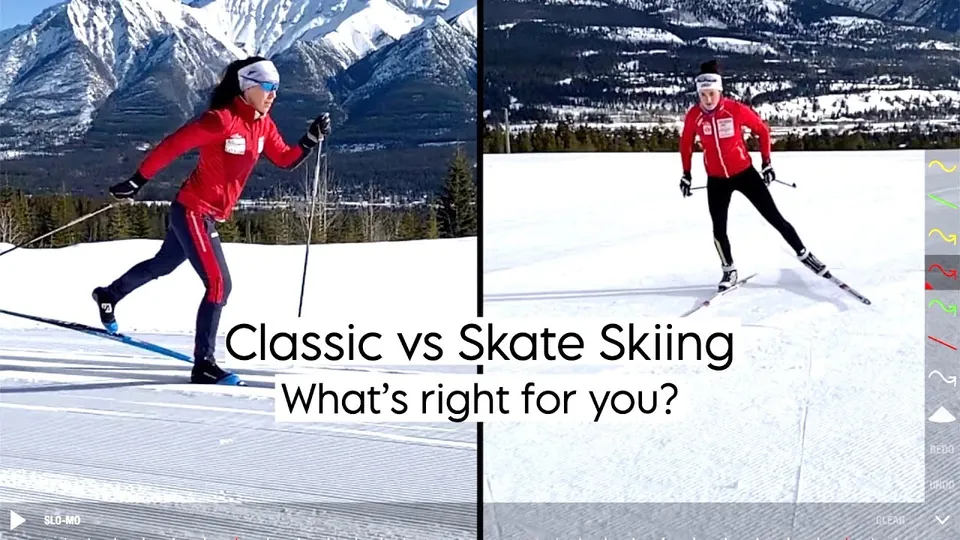
The video is hosted by YouTube (Google): nothing loads until you play it, and Google may then set cookies.
FAQs
Which technique should I choose to start cross-country skiing?
Classic. With your skis parallel in the tracks, it is close to walking, and it is the technique Nordic France considers the more accessible for beginners. On fishscale or skin skis, you get grip without grip wax. Skating takes more balance and more power: keep it for later, once you feel at ease on your skis.
Can I skate on classic skis?
No. Salomon points out that classic and skating do not use the same equipment: classic skis have a grip zone and are longer, while skating skis are shorter and glide along their whole base. Boots and bindings differ too; only a few versatile boots work for both styles.
How long should cross-country ski poles be?
According to Salomon, about 0.83 times your height for classic, which brings them up to your shoulder, and 0.89 times for skating, up to your nose or ears. For someone 1.65 m tall, that gives about 137 cm for classic and 147 cm for skating. Take the nearest length available.
How much is France’s national Nordic pass for 2026-2027?
For an adult, €214 at the early-bird price from 1 October to 15 November, then €255. For ages 5 to 15, €79, then €94. It covers the trails of some 160 member Nordic areas, except night skiing and trails opened before 15 December thanks to snowfarming, artificial snow or glacier skiing, as well as partner areas in Switzerland.
Sources
- Nordic France (federation of French Nordic ski areas), Bilan de la saison 2025-2026, season review (in French), accessed 22 October 2026. nordicfrance.fr https://www.nordicfrance.fr/bilan-de-la-saison-2025-2026.htm ↩
- Nordic France, Ski de fond, Nordic activities page (in French), accessed 22 October 2026. nordicfrance.fr https://www.nordicfrance.fr/activites-nordiques/mode-sport/ski-de-fond/ ↩
- Salomon, Ski de fond classique & skate : quelles différences ? (in French), accessed 22 October 2026. salomon.com https://www.salomon.com/fr-fr/sg/a/cross-country-skiing-classic-vs-skating ↩
- Nordic France, Pass National, 2026-2027 season prices (in French), accessed 22 October 2026. nordicfrance.fr https://www.nordicfrance.fr/qui-sommes-nous/pass-national ↩
- Salomon, Classic vs Skating Cross-Country Skiing, UK version of the same guide, accessed 22 October 2026. salomon.com https://www.salomon.com/en-gb/sg/a/cross-country-skiing-classic-vs-skating ↩

Trail running, snow, water, nature and destinations
Nolwenn covers trail running, snow, water, nature and destinations for Outfarer. Curious about everything, from meteor showers to night-train timetables, she has a knack for unearthing the one detail that changes everything, and putting it in a single sentence.


