 Français (France)
 English (UK)
 English (US)
 Deutsch (Deutschland)

Contents
It’s 9 p.m. the night before you leave. Tent, sleeping bag, sleeping pad, stove, and one fleece too many are spread across the bed, and the 30-liter pack you bought for day hikes won’t close. You push, you cram, you end up sitting on it. No luck: you pick a pack for what it has to swallow, and the number on the tag tells you less than you’d think.
This guide is about backpacking packs, not school bags or carry-ons. It lines up the recommended volumes, explains why one brand’s liters aren’t another’s, then moves on to torso length and weight. It picks up the “night before” step in our guide to your first backcountry camping trip. For what goes inside, see the backcountry camping gear list or, for a day out, the day hike packing list.
How many liters for a day, a weekend, or a week
No official rule sets these volumes, so treat them as ballpark figures. Here are the numbers from Gregory [1], the German brand Deuter [2], and French sporting goods retailer Decathlon [3], three companies that sell these packs, plus the Swiss Council for Accident Prevention (BFU, or BPA in French) [4] and the FFRandonnée, France’s national hiking federation [5]. Read them as advice, each shaped by what its source has in mind.
| Trip | Gregory | Deuter | Decathlon | BFU, FFRandonnée |
|---|---|---|---|---|
| Easy day hike | 15 to 25 L | 16 to 25 L | 20 to 30 L | 18 to 32 L (BFU) |
| Long day | 20 to 35 L | 26 to 35 L | 20 to 40 L | 18 to 32 L (BFU) |
| 1 to 3 nights in a tent | 35 to 50 L | 36 to 50 L, toward the top | up to 60 L for one night | no figure |
| Several days in huts, meals included | no figure | 45 to 60 L | no figure | a little more (BFU) |
| 3 to 5 nights self-supported | 50 to 70 L | 36 to 50 L, toward the top | from 50 L | 55 L beyond 4 days (FFRandonnée) |
| Remote terrain, several weeks | 60 to 100 L | 65 L or more | no figure | no figure |
From each source’s pages, accessed November 7, 2026. “No figure”: the page gives no volume for this case. Trip labels vary by source: Gregory writes “Weekend Trip (1 - 3 Nights),” Deuter “multi-day tours,” with no number of nights, Decathlon “un bivouac d’une nuit” (a one-night camp). Pack volumes stay in liters here, the way manufacturers list them.
For a day hike, everyone lands around 20 to 30 liters. The gaps show up once you sleep out. For backcountry camping, Gregory stops at 50 L and Decathlon goes up to 60 L, while Alpkit, a British brand, puts spring-through-fall overnights in its 30 to 45 L packs [6]. Hut trips, common in Europe, are just as unsettled: Deuter talks about 45 to 60 L with meals included, the BFU about a volume barely bigger than a daypack’s, and our guide to the Tour du Mont-Blanc aims for 35 to 45 L. The FFRandonnée, which doesn’t sell packs, settles on 55 L for trips longer than 4 days, possibly with some fold-up stuff sacks [5].
Winter and summer: what the season changes
For winter, Gregory puts a number on the extra: 10 to 15 L more [1]. Alpkit explains what that space is for, namely extra clothing, crampons, and an emergency shelter, and puts winter daypacks in its 30 to 45 L range [6]. In hot weather, the brand adds, you sometimes need more water: that’s more pounds than liters, and you can work it out with our guide to water and food on a hike.
Why two 35-liter packs don’t hold the same amount
Alpkit says it flat out: nothing guarantees that two 35 L packs have the same capacity, because every brand measures a little differently [6]. There is a standard, though, ASTM F2153, from the American standards organization ASTM International, dated 2007 and reapproved in 2018. It’s sold behind a paywall, and we’re citing only its official summary: it distinguishes an unextended and an extended capacity, and excludes anything not completely enclosed by fabric, such as mesh pockets, water bottle holders, and compression pockets [7]. We didn’t find any ISO or European equivalent.
The idea is easier to see with instructions in hand. CabinZero, a travel bag maker that cites this standard, loosens the straps, then fills the main compartment and all the closed pockets with plastic balls 0.4 to 0.8 in (10 to 20 mm) across, or dried beans, using a 1-liter measuring cup, and counts the cups [8]. Alpkit pours polystyrene beads into a big graduated cylinder, but counts only the main compartment [6]. So on a pack with pockets, the second method gives a smaller number than the first.
Not everyone follows the standard. Minaal, a travel bag brand that says it applies it, claims many manufacturers skip it, to the point that one company’s 35 L could equal another’s 50 L [9]. That’s a competitor talking, with no measurements to back it up; the takeaway is that the number doesn’t compare from brand to brand.
Then there’s the plus sign. On Deuter’s Aircontact Lite 40+10, the spec sheet lists 40 L [10], and the adjustable The flap that closes the top of the pack, often with a pocket. Adjustable in height, it frees up room above the main compartment. adds up to 10 L [2]. Compare base volumes with base volumes, and save the extension for resupply days.
Calculating liters: the tape measure lies, adding up helps
The DIY instinct is to multiply height, width, and depth. That works on a moving box. On a pack, here’s what the math gives you using the dimensions manufacturers publish.
| Pack | Listed | Dimensions (in) | Box calculation | Gap |
|---|---|---|---|---|
| Vaude Agile 20 | 20 L | 18.9 × 11.0 × 7.1 | 24 L | +21% |
| Deuter Futura 30 SL | 30 L | 24.8 × 11.8 × 7.9 | 38 L | +26% |
| Deuter Aircontact Lite 35+10 SL | 35 L | 27.6 × 11.4 × 9.1 | 47 L | +33% |
| Deuter Aircontact Lite 40+10 | 40 L | 28.7 × 11.8 × 9.8 | 55 L | +37% |
| Gregory Baltoro 65, size S | 65 L | 31.1 × 13.4 × 13.4 | 91 L | +40% |
| Gregory Baltoro 65, size L | 65 L | 33.1 × 13.4 × 13.4 | 97 L | +49% |
Spec sheets accessed November 7, 2026; dimensions converted from the centimeters listed; calculations and gaps by us, on the base volume, from those centimeters. With their 10 L extension, the two Aircontact Lite packs drop to +4% and +9%. The spec sheets don’t say what these dimensions cover. [11, 12, 13, 10, 14, 15]
The calculation overshoots the listed number by 21 to 49%, and the gap changes from pack to pack: a pack isn’t a box, and nothing lets you work back from its dimensions to its liters. Your own needs add up better. The big items of a backcountry trip have a published packed size, and each is roughly a cylinder.
Spec sheet in inches? Multiply each number by 2.54 to get centimeters, or keep the inches and divide by 61 instead of 1,000. The example below works from the centimeters on three spec sheets. Deuter’s synthetic Orbit +5 sleeping bag is 7.9 in (20 cm) in diameter by 15.4 in (39 cm), or 12 L, a number the spec sheet also gives [16]. Hilleberg’s one-person Akto tent, 17 by 5.1 in (43 by 13 cm), takes up 5.7 L [17], and Sea to Summit’s Ether Light XT pad, 9.4 by 4.3 in (24 by 11 cm), 2.3 L [18]. Total: 20 L. Add that to a 20- to 30-liter daypack and you get 40 to 50 L, right in Gregory’s range, before water and dinner.
This is an example, not a recommendation: a two-person tent or a different sleeping bag changes the total. But the method takes one evening, a few spec sheets, and a calculator.
Torso length: measure it before you look at liters
Volume tells you what fits; torso length, which Deuter calls back length, tells you whether the pack will carry well. Deuter defines it as the distance between the seventh cervical vertebra and the upper edge of the The top rim of the hip bone, which you can feel under your fingers when you put your hands on your hips. [19]. Gregory walks through the steps on its spec sheets [14]: head tilted forward to find the bump at the base of your neck, hands on your hips sliding up to the top of the bone, then thumbs toward the small of your back, where you read the tape. Decathlon more simply talks about measuring from the waist to the neck vertebrae [3], a lower and less precise reference point.
Deuter puts its SL packs at around 16.5 in (42 cm), Regular at 18.1 in (46 cm), and EL at 19.7 in (50 cm), give or take 0.8 in (2 cm), and notes that two people of the same height can have different torsos [19]. The measurement is only a starting point: for the brand, trying the pack on is the only sure test [19], and Decathlon recommends trying it loaded [3]. Deuter also sets a threshold on its trekking packs: an adjustable back from 35 L up, which matters most with loads over 22 lb (10 kg) and on long hikes, and none below that, to keep the empty pack light [20].
Size sometimes affects the liters. Deuter adjusts the volume of its EL models [19], and the SL version of the Aircontact Lite lists 35 L instead of 40 L [13, 10]. Gregory, on the other hand, lists 65 L for its Baltoro in both size S and size L, even though the pack goes from 31 to 33 in (79 to 84 cm) tall [14, 15]. One more reason to look at the pack filled rather than at the tag.
How much weight to put in those liters
More liters often means more pounds: the bigger the pack, the FFRandonnée notes, the more we tend to load it [5]. The published limits look alike, but they aren’t equal, and the only U.S. agency figure in the table, from a single national park, runs higher than the rest.
| Source | For whom | What it says |
|---|---|---|
| FFRandonnée | Long-distance hiking | At most 20% of the hiker’s weight: 24 lb (11 kg) for 121 lb (55 kg), 35 lb (16 kg) for 176 lb (80 kg) |
| BFU (Switzerland) | Well-trained person, over long periods | At most 20 to 25% of their weight |
| Decathlon | Adult | About 20 to 25% of their maximum weight, as the brand puts it |
| Isle Royale National Park (Michigan) | Backpackers at this park | Rule of thumb: no more than 30% of body weight, and under 50 lb no matter what you weigh |
| Moya-Cuenca et al., 2026 | 39 hikers on Spain’s Camino de Santiago | An exploratory benchmark around 10%, not a safe limit |
| O’Shea, 2014 | Simple physical model | No fixed percentage |
A federation’s recommendation, a prevention agency’s advice, a brand’s advice, one park’s rule of thumb, a plantar pressure study, and a model: their conclusions can’t be compared directly. [5, 4, 3, 24, 21, 22]
The Spanish study published in January 2026 measured the pressure under the feet of 39 Camino de Santiago hikers, standing and barefoot: compared with no pack, it climbs about 5% with 10% of body weight on board, and nearly 10% with 20% [21]. The authors call this an exploratory benchmark, not a universal safety limit, and their protocol says nothing about injury risk. Michael O’Shea, a physicist at Kansas State University, challenges the fixed percentage from another angle: in his model, strength follows muscle cross-section rather than body weight, so a smaller hiker doesn’t necessarily have to carry less [22]. He himself says the model is too simple to set any one person’s load [22], and finds the idea of a single percentage somewhat misleading [23].
The pack gets a vote too. Deuter recommends 13 to 22 lb (6 to 10 kg) on the Futura 30 SL and 26 to 33 lb (12 to 15 kg) on the Aircontact Lite 40+10 [12, 10], and Gregory 60 lb (27.2 kg) at most on the Baltoro [14]. For Deuter, those numbers are comfort guidelines, not the pack’s strength [20]. Do the math: at 176 lb (80 kg), the FFRandonnée’s 35-lb (16 kg) ceiling already exceeds the 26 to 33 lb Deuter recommends on this 40-liter pack. The empty pack counts too: 1 lb 7 oz (640 g) for the Vaude Agile 20, 3 lb 8 oz (1.59 kg) for the Aircontact Lite 40+10, 4 lb 11 oz (2.13 kg) for the Baltoro in size S [11, 10, 14]. Gregory aims for 70% of the weight on your hips and 30% on your shoulders [1], which is why a hip belt at the right height matters. For kids, see our guide to hiking with kids.
From daypack to overnight pack: which one to get
- You day hike: 20 to 30 L falls within almost every benchmark; go bigger for the mountains or winter.
- You sleep in huts: the numbers run from 35 to 60 L depending on the source; start low, and do a practice pack before you buy bigger.
- One or two nights in a tent: 35 to 50 L, more if your sleeping bag takes up a lot of room.
- A week self-supported: 50 to 70 L, with the FFRandonnée’s 55 L as a reference point.
If you’re only buying one pack, I’d look around 40 L: that’s near the middle of Gregory’s range for tent camping, the top of Alpkit’s, and just above the 35 L where Deuter starts adjusting torso length. Ounce counters, Gregory admits, can get by with fewer liters [1]; I suspect their toothbrushes lost their handles years ago.
The smart move the night before you leave: lay everything out on the bed, do one practice pack, then step on the bathroom scale wearing the pack and subtract your own weight. If it closes without anyone sitting on it and the weight stays under your limit, the volume is right. If not, you don’t necessarily need a new pack: start by evicting that extra fleece.
Gear related to this article
No affiliation: no commission, no sponsored products.
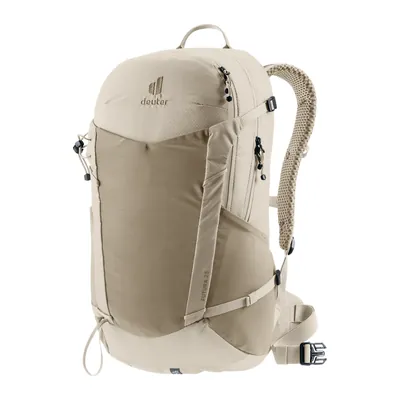
Deuter Futura 23
A 23-liter daypack with a ventilated Aircomfort mesh back, an included rain cover, and room for a hydration reservoir up to 3 liters; 2.6 lb, designed for loads of 6.6 to 13 lb.
View on Amazon (opens in a new tab)
Worth watching
REI’s Katie and Miranda measure a torso to find the right pack size, then show how to fit the pack: the steps from this guide, in motion.
The video is hosted by YouTube (Google): nothing loads until you play it, and Google may then set cookies.
FAQ
What size pack do you need for a day hike?
Decathlon recommends 20 to 30 L for a day out, and Switzerland’s BFU 18 to 32 L. Gregory distinguishes 15 to 25 L for a half day or an easy day hike, and 20 to 35 L for a long day or a winter day. Deuter puts day hikes in its 16 to 25 L packs, and long days in its 26 to 35 L packs.
Is a 30-liter pack big enough for a weekend?
Without a tent or with very light gear, you can make it work: Deuter puts weekend trips in its 26 to 35 L packs, and Gregory admits ultralight hikers manage with less. With a tent, Gregory suggests more like 35 to 50 L for one to three nights, and Alpkit 30 to 45 L for a spring-through-fall overnight. Do a practice pack before you go.
How do you calculate a backpack’s volume?
Not by multiplying height, width, and depth: on our six spec sheets, that calculation overshoots the listed volume by 21 to 49%. Alpkit and CabinZero fill the pack with beads or balls, then count the liters poured in. To estimate what you need, add up the packed volumes of your big items, treated as cylinders, then add what you’d need for a day.
Do pockets count toward a pack’s volume?
It depends on the brand. Alpkit counts only the main compartment. The ASTM F2153 standard excludes anything not enclosed by fabric, such as mesh and bottle holders, and CabinZero, which cites it, counts closed outside pockets. Gregory, Deuter, and Decathlon don’t spell out their method in the advice pages cited here. So the number doesn’t compare from brand to brand.
How do you measure your torso length?
Measure from the seventh cervical vertebra, the bump at the base of your neck when you tilt your head forward, to the top of your iliac crest, the rim of your hip bone. Deuter puts its SL, Regular, and EL sizes at around 16.5, 18.1, and 19.7 in, give or take 0.8 in; on Gregory’s Baltoro, size M runs from 17 to 20 in. For Deuter, trying it on is the only sure test.
What’s the maximum weight for a backpacking pack?
On long trips, France’s FFRandonnée recommends at most 20% of your body weight, or 24 lb at 121 lb and 35 lb at 176 lb, and considers that too much for a day hike. Switzerland’s BFU says 20 to 25% at most for a well-trained person. Isle Royale National Park’s rule of thumb is 30%, under 50 lb. An exploratory 2026 study of hikers standing still measured about 5% more foot pressure at 10% of body weight, without calling that a safe limit.
Sources
- Gregory, “How to choose the perfect hiking backpack for your adventure,” online guide, undated, page carrying a 2026 copyright, accessed November 7, 2026. eu.gregorypacks.com https://eu.gregorypacks.com/uk-en/blog/choose-your-gear/how-to-choose-perfect-hiking-backpack.html ↩
- Deuter, “How big is a backpack? Sizes compared,” advice page, accessed November 7, 2026. deuter.com https://www.deuter.com/us-en/advice/backpack-sizes/ ↩
- Decathlon, “Comment choisir le meilleur sac à dos de randonnée ?” buying advice (in French), accessed November 7, 2026. decathlon.fr https://www.decathlon.fr/c/htc/comment-choisir-le-meilleur-sac-a-dos-de-randonnee_141cbaa5-4e96-488c-90cf-a7a2e6104d5f ↩
- Swiss Council for Accident Prevention (BFU, known as BPA in French), “Rando en montagne” campaign, “Bien s’équiper” (in French), accessed November 7, 2026. rando-en-montagne.ch https://www.rando-en-montagne.ch/fr/bien-s-equiper ↩
- Fédération française de la randonnée pédestre (FFRandonnée, the French hiking federation), “Préparer son sac à dos,” June 6, 2024 (in French), accessed November 7, 2026. ffrandonnee.fr https://www.ffrandonnee.fr/randonner/conseils/preparer-son-sac-a-dos ↩
- Alpkit, “What size backpack do I need? Complete sizing guide,” accessed November 7, 2026. eu.alpkit.com https://eu.alpkit.com/blogs/spotlight/what-size-backpack-do-i-need ↩
- ASTM International, “F2153-07(2018) Standard Test Method for Measurement of Backpack Capacity,” summary of the standard, accessed November 7, 2026. store.astm.org https://store.astm.org/f2153-07r18.html ↩
- CabinZero, “How do you measure the volume of a CabinZero backpacks?” accessed November 7, 2026. cabinzero.com https://www.cabinzero.com/pages/how-do-you-measure-the-volume-of-a-cabinzero-backpack ↩
- Minaal, “How to Measure Luggage Capacity,” accessed November 7, 2026. minaal.com https://www.minaal.com/pages/how-to-measure-backpack-bag-luggage-capacity ↩
- Deuter, Aircontact Lite 40 + 10 backpack, spec sheet, accessed November 7, 2026. deuter.com https://www.deuter.com/us-en/aircontact-lite-40-10/4046051187549 ↩
- Vaude, Agile 20 backpack, spec sheet, accessed November 7, 2026. vaude.com https://www.vaude.com/int/en/45439-agile-20-hiking-backpack.html ↩
- Deuter, Futura 30 SL backpack, spec sheet, accessed November 7, 2026. deuter.com https://www.deuter.com/us-en/futura-30-sl/3400726 ↩
- Deuter, Aircontact Lite 35 + 10 SL backpack, spec sheet, accessed November 7, 2026. deuter.com https://www.deuter.com/uk-en/aircontact-lite-35-10-sl/4046051171975 ↩
- Gregory, Baltoro 65 backpack, size S, spec sheet and measuring guide, accessed November 7, 2026. eu.gregorypacks.com https://eu.gregorypacks.com/sk-en/-baltoro-65-rc-s--shadow-pine-black/157942-A798.html ↩
- Gregory, Baltoro 65 backpack, size L, spec sheet, accessed November 7, 2026. eu.gregorypacks.com https://eu.gregorypacks.com/uk-en/-baltoro-65-rc-l--stellar-blue/157938-E319.html ↩
- Deuter, Orbit +5° sleeping bag, spec sheet (UK site; not found on the US site), accessed November 7, 2026. deuter.com https://www.deuter.com/uk-en/orbit-5c-41f/4046051174914 ↩
- Hilleberg, “Akto,” spec sheet, accessed November 7, 2026. hilleberg.com https://hilleberg.com/eng/products/tent/Akto ↩
- Sea to Summit, “Ether Light XT Insulated Sleeping Pad,” spec sheet, accessed November 7, 2026. seatosummit.com https://seatosummit.com/pages/ether-light-xt-insulated-sleeping-pad ↩
- Deuter, “Backpack fits,” advice page, accessed November 7, 2026. deuter.com https://www.deuter.com/us-en/advice/backpacks-fits/ ↩
- Deuter, “All about trekking backpacks,” advice page, accessed November 7, 2026. deuter.com https://www.deuter.com/us-en/advice/all-about-trekking-backpacks/ ↩
- C. Moya-Cuenca et al., “Plantar Pressure Responses to Backpack Load in Long-Distance Hikers: A Cross-Sectional Observational Study,” Journal of Functional Morphology and Kinesiology, 11(1), 36, January 15, 2026, accessed November 7, 2026. pmc.ncbi.nlm.nih.gov https://pmc.ncbi.nlm.nih.gov/articles/PMC12821408/ ↩
- Michael J. O’Shea, Kansas State University, “Backpacking,” introduction to his paper “Backpack Weight and the Scaling of the Human Frame,” The Physics Teacher, 52, 479, 2014, accessed November 7, 2026. phys.ksu.edu https://www.phys.ksu.edu/personal/mjoshea/OutdoorSportModelling/Backpacking/BackpackWeight-Intro.html ↩
- American Institute of Physics, “Backpack physics: Smaller hikers carry heavier loads,” republished by ScienceDaily, October 26, 2014, accessed November 7, 2026. sciencedaily.com https://www.sciencedaily.com/releases/2014/10/141021111233.htm ↩
- National Park Service, Isle Royale National Park, “Packing Guide,” updated September 25, 2026, accessed November 7, 2026. nps.gov https://www.nps.gov/isro/planyourvisit/packing-guide.htm ↩

Camping, backpacking, bushcraft and hiking
Guillaume Hoarau writes for Outfarer about camping, backpacking, bushcraft, and hiking. A survival-skills buff and a collector of vintage field manuals, he loves clear explanations, lists that actually help and other people’s stories, which he tells well.


