 Français (France)
 English (UK)
 English (US)
 Deutsch (Deutschland)

Contents
Friday night, the evening before you leave. Piled on the bed: a tent a coworker lent you, a sleeping bag that smells a bit like the attic, three flashlights, a cast-iron skillet, and a family-size box of pasta. For a first night out, the hard part isn’t thinking of everything: it’s deciding what to leave behind. Here’s the list, item by item, with what each piece weighs according to its manufacturer, what you can borrow, what stays home, and a checklist at the bottom of the page.
It picks up where our day hike packing list leaves off: water, food, a rain jacket, a warm layer, and the first aid kit stay in your pack, and the night adds a shelter, a bed, a kitchen, and light. The National Park Service’s Ten Essentials already include emergency shelter, such as a tent, tarp, bivy sack, or space blanket [1]. For an overnight, Rocky Mountain National Park’s summer backpacking checklist adds a sleeping bag and pad suited to the season, a stove with fuel and a repair kit, a lighter or waterproof matches, cooking pots, utensils, water bottles, and a filter or tablets [2]. For several days on your own, France’s hiking federation (FFRandonnée) gives much the same list, plus several trash bags, a roll of strong string, and a large plastic tarp [3]. This page fleshes out the checklist in our step-by-step guide to a first backcountry camp, which covers where to sleep and how to go about it.
What it all weighs: about 12.6 lb before water and food
Let’s start with the scale, since it decides how much you’ll enjoy the hike in. The table gives, item by item, the weight a manufacturer lists for one of its models. These models are examples of spec sheets, not recommendations: check the sheet for the gear you’ll borrow or buy, since weights vary a lot from one model to another.
| Item | Example spec sheet | Listed weight |
|---|---|---|
| 40-liter backpack (+10) | Deuter Aircontact Lite 40+10 | 3 lb 8 oz (1.59 kg) [4] |
| Two-person backpacking tent | MSR Hubba Hubba NX 2, packaged | 3 lb 13 oz (1.72 kg) [5] |
| Two-person camping tent | Vaude Campo Compact 2P | 5 lb 15 oz (2.7 kg) [6] |
| Tarp, 3 × 3 m (about 10 × 10 ft) | DD Hammocks DD Tarp 3x3, without stakes or guylines | 1 lb 12 oz (790 g) [7] |
| Summer sleeping bag, synthetic | Deuter Orbit +5°, stuff sack included | 2 lb 7 oz (1.1 kg) [8] |
| Down sleeping bag | Sea to Summit Trek, 30 °F (-1 °C) limit | 2 lb 10 oz (1.2 kg) [9] |
| Foam sleeping pad | Therm-a-Rest Z Lite Sol | 14.5 oz (410 g) [10] |
| Inflatable sleeping pad | Therm-a-Rest NeoAir XLite NXT | 13.1 oz (370 g) [11] |
| Canister stove | MSR PocketRocket 2 | 2.6 oz (73 g) [12] |
| Canister holding 3.9 oz (110 g) of fuel | MSR IsoPro | 7.4 oz (210 g) [13] |
| Hard-sided water bottle, 32 fl oz | Nalgene 32oz Wide Mouth | 6.2 oz (177 g) [14] |
| Headlamp | Petzl Actik Core | 3.1 oz (88 g) [15] |
| First aid kit, stocked | Deuter First Aid Kit | 10.6 oz (300 g) [16] |
| Small folding trowel | Sea to Summit Pocket Trowel | 2.4 oz (68 g) [17] |
Weights listed by each manufacturer for the standard size; they change from one model and size to the next. Pounds and ounces are our conversions of the metric weights.
Add up one item per category, using the backpacking tent, the summer sleeping bag, and the foam pad, and you get 12.6 lb (5.7 kg), before water, food, clothes, and cookware. Mostly, the math shows one thing: four items, the tent, the backpack, the sleeping bag, and the pad, weigh 10.6 lb (4.8 kg) on their own, or 84% of the total. That’s where the pounds are won or lost, far more than in your toiletry kit. Ultralight devotees will do better, and more power to them; on a first trip, what matters most is not forgetting anything.
Then there’s water, which weighs 2.2 lb (1 kg) per liter. Compare the total with what you can carry. For a multiday hike, France’s hiking federation recommends no more than 20% of your body weight, or about 24 lb (11 kg) if you weigh 121 lb (55 kg) and 35 lb (16 kg) at 176 lb (80 kg) [3]. The pack in our example is designed for loads of 26 to 33 lb (12 to 15 kg), according to Deuter [4].
Shelter and sleep: the three items that matter most
For shelter, a two-person tent is still the easiest way to start. Look at its The weight of everything in the box: tent body, rainfly, poles, stakes, guylines, and stuff sacks.: at MSR, it counts everything in the package, while the minimum weight covers only the tent body, rainfly, and poles, which gives 3 lb 13 oz (1.72 kg) versus 3 lb 6 oz (1.54 kg) for the Hubba Hubba NX 2 [5]. A camping tent of the same capacity gets heavy fast: 5 lb 15 oz (2.7 kg) for the Campo Compact 2P, which Vaude lists for camping [6]. A tarp, just a sheet of fabric pitched taut, gets down to 1 lb 12 oz (790 g) for a 3 × 3 m model, about 10 by 10 feet, without stakes or guylines [7], but you need to know how to pitch it: our guide to tarp setups explains which ones to use.
At night, two pieces of gear work as a team. Choose a sleeping bag by its comfort rating, not the number in its name, which often gives the limit: Deuter’s synthetic Orbit +5° has a comfort rating of 48 °F (9 °C) and a limit of 41 °F (5 °C), and weighs 2 lb 5 oz (1,050 g), plus a 1.7 oz (48 g) stuff sack [8]. A down bag like Sea to Summit’s Trek lists 2 lb 10 oz (1,197 g) for a 30 °F (-1 °C) limit [9]. Our guide to sleeping bag temperature ratings explains how to read these numbers.
The pad, meanwhile, insulates you from the ground, which pulls heat from your body when you lie down. Its A pad’s thermal resistance: the higher it is, the better it insulates you from the ground. tells you how well: 2 for the Z Lite Sol folding foam pad, which weighs 14.5 oz (410 g) [10], and 4.5 for the NeoAir XLite NXT inflatable, 13.1 oz (370 g), which comes with a field repair kit [11]. Foam doesn’t care about thorns; the inflatable insulates better for less weight, as long as you remember the patch kit. Our guide to R-value explains how to compare them. Add a warm layer and dry socks saved for the night, plus the extra layer the Ten Essentials call for, such as a jacket, a hat, or gloves [1].
Food and water: a stove, a pot, and water
The kitchen fits in one hand: a canister stove like MSR’s PocketRocket 2 weighs 2.6 oz (73 g) [12], and a canister holding 3.9 oz (110 g) of fuel is listed at 7.4 oz (210 g) [13]. Add a cup, a bowl, and a spoon, as Rocky Mountain National Park’s checklist suggests, with a pot and a lighter or waterproof matches [2]. The stove stands in for a campfire: the Leave No Trace principles recommend a lightweight stove for cooking [18], and the Ten Essentials ask you to check your park’s fire rules [1]. And it never goes inside the tent.
For food, plan dinner, breakfast, a snack for when you reach camp, and an extra one. Take it out of excess packaging before you leave: the Leave No Trace principles recommend repackaging food to minimize waste [18]. In bear country, storage matters too: Rocky Mountain National Park’s checklist includes a hard-sided, lockable bear canister for all food, trash, and scented items [2], and the Leave No Trace principles ask you to store food and trash securely [18]. Then there’s water, which adds up fast, especially since a hard-sided bottle already weighs 6.2 oz (177 g) empty [14]. Plan for evening and morning, for drinking and cooking, and bring a way to treat water from streams, a filter or tablets: our guide to backcountry water compares the methods.
Light, navigation, and first aid
Night always falls sooner than you planned, and Rocky Mountain National Park’s checklist asks you to be ready for sudden weather changes and even a night out in extreme conditions [2]. A headlamp keeps your hands free to pitch the tent or cook, which is why the Park Service recommends it [1]: Petzl’s Actik Core, for example, weighs 3.1 oz (88 g) and charges over USB-C, but doesn’t come with a cable [15]. Charge it the day before, and pack extra batteries [1].
For navigation, the Ten Essentials start with a map and compass, with a paper map as a backup if you use your phone, and an extra battery for the phone [1]. A charged phone is also how you call for help: dial 911 [20]. Rocky Mountain National Park’s checklist rounds out the safety kit with a first aid kit, a whistle, and a multi-tool or pocketknife [2].
Hygiene, trash, and a few extras
For washing up, a toothbrush, a little soap, and a small towel are plenty, as long as you wash away from the water: the Leave No Trace principles ask you to carry water 200 feet (61 m) away from streams or lakes and use small amounts of biodegradable soap [18]. For bathroom needs, a small folding trowel weighs 2.4 oz (68 g), and its depth markings help you dig deep enough [17]: catholes go 6 to 8 inches (15 to 20 cm) deep, at least 200 feet from water, camp, and trails, and toilet paper gets packed out [18]. Our guide to Leave No Trace on the trail covers the details.
Bring several trash bags too [3]: pack it in, pack it out, which means all trash, leftover food, and litter [18].
Borrow or rent instead of buying
For a first trip, there’s no need to buy a tent, sleeping bag, pad, and big backpack before you know whether you like sleeping outside: borrow them from friends or family, or rent them. In Montana, for example, the outfitter Glacier Guides rents a backpacking bundle with a tent, backpack, sleeping bag, sleeping pad, and trekking poles, picked up at its office in West Glacier, near Glacier National Park [21]. Save your money for the small personal items you’ll also use on every day hike: the headlamp, the water bottle, the first aid kit, the space blanket. When it’s time to buy the pack, our guide covers how many liters you need.
Borrowed gear is sometimes heavier than what’s on the spec sheets: with a 5 lb 15 oz (2.7 kg) camping tent instead of a 3 lb 13 oz (1.72 kg) backpacking tent, our example goes from 12.6 to 14.8 lb (5.7 to 6.7 kg) [6, 5]. On a short hike in, those extra 2 lb or so are no big deal; on a long climb, you’ll feel them.
What stays home
Everything that makes car camping comfy stays in the garage. For extra comfort, Decathlon’s French camping checklist adds a cot, a cooler, a folding table and chairs, and a solar shower [23]: none of it belongs on your back. Neither does the big family tent: besides its weight, it’s the opposite of a bivouac as France’s national parks define it, a night in a small, compact tent you can’t stand up in [22].
The ax and saw stay in the shed: campfires can leave lasting marks, and where fires are allowed, the Leave No Trace principles ask you to use existing fire rings and keep fires small [18]; check your park’s rules before you go [1]. The speaker stays home too: “Let nature’s sounds prevail,” the same principles say, and avoid loud voices and noises [18]. As for the third sweater “just in case,” the cast-iron skillet, and the three flashlights, you’d already spotted them.
The printable checklist
Check it off the night before, laying each item on the floor, then go over it again as you close your pack. Adjust it for the season, the elevation, and the forecast.
Shelter
- Tent, set up at least once before, or tarp and guylines
- Poles, stakes, and guylines, counted
- Footprint or ground tarp, depending on the shelter
Sleep
- Sleeping bag chosen by its comfort rating
- Insulated pad, plus its repair kit if inflatable
- Warm layer, warm hat, and dry socks saved for the night
- Gloves for evening and morning, depending on the season
Food and water
- Stove and compatible canister, tested together
- Lighter and waterproof matches
- Pot, cup, spoon, sponge, and dish towel
- Dinner, breakfast, snacks, and an extra ration
- Bear canister, where your park calls for one
- Water for the hike, the evening, and the morning
- Filter or tablets to treat stream water
Light and navigation
- Headlamp, charged, or extra batteries
- Map and compass
- Charged phone and backup battery
First aid and protection
- First aid kit and personal medications
- Space blanket and whistle
- Knife and tick remover
- Rain jacket
- Sunscreen, sunglasses, cap
- Hiking boots, already broken in
Hygiene and trash
- Toothbrush, a little biodegradable soap, small towel
- Toilet paper and a zip-top bag to pack it out
- Small folding trowel
- Several trash bags
Extras
- Camp shoes or light sandals
- Sleeping bag liner
- Length of cord
- Inflatable pillow or rolled-up fleece
- Earplugs and a paperback
The smart move, once your pack is zipped: set it on the bathroom scale, water and food included, and compare it with 20% of your body weight. If it’s over, pull out the “just in case” items first, never the first aid kit, the headlamp, or the warm layer.
Gear related to this article
No affiliation: no commission, no sponsored products.
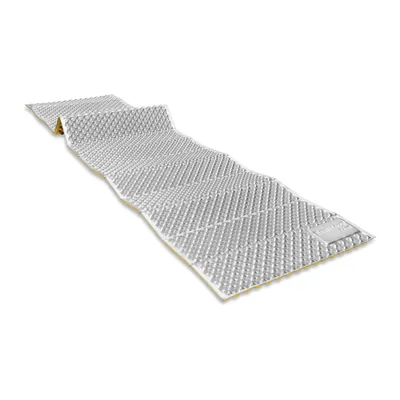
Therm-a-Rest Z Lite Sol
An accordion-fold foam pad rated R 2.0, 14 oz in Regular: the bottom layer of the winter combo, which also protects an air pad from rocks.
View on Amazon (opens in a new tab)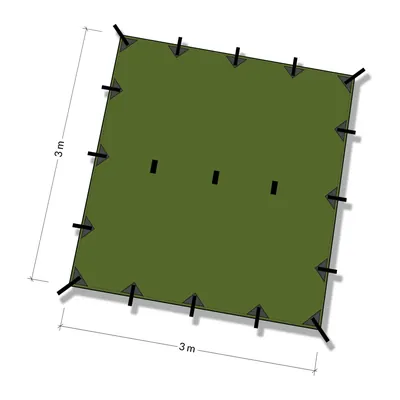
DD Hammocks Tarp 3x3
A 10 × 10 ft (3 × 3 m) square tarp in coated polyester (3,000 mm), 1.74 lb, with 19 reinforced attachment points: the size for all four basic setups, diamond and closed included.
View on Amazon (opens in a new tab)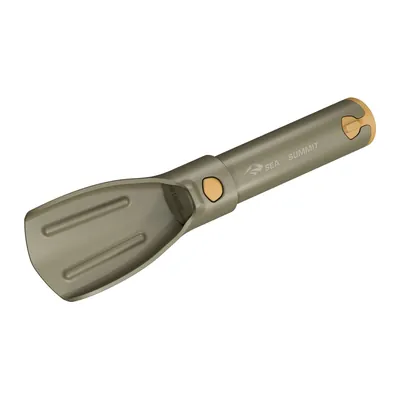
Sea to Summit Pocket Trowel
A 2.4 oz trowel in glass-reinforced nylon, with a hollow retractable handle for TP and depth markings for digging a cathole the 6 to 8 inches Leave No Trace recommends.
View on Amazon (opens in a new tab)
Worth watching
In this REI video, Miranda unpacks what she brings on a backpacking trip, a quick walk-through of the gear behind a printable checklist like ours.
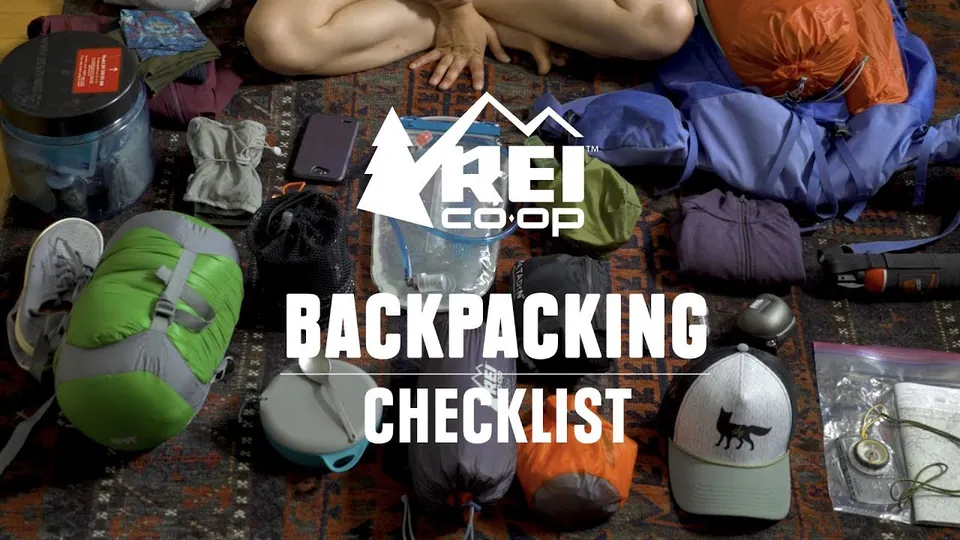
The video is hosted by YouTube (Google): nothing loads until you play it, and Google may then set cookies.
FAQ
What gear do I need for my first backpacking trip?
Your day hike gear, plus a shelter, tent or tarp, a sleeping bag chosen by its comfort rating, an insulated pad, a stove and canister, a pot, water for the evening and morning with a way to treat it, a headlamp, a first aid kit, a small trowel, and trash bags. In bear country, add a bear canister if your park calls for one. The full checklist is at the bottom of this page.
How much does a backpack weigh for one night out?
Adding up the weights manufacturers list for a 40-liter pack, a two-person backpacking tent, a summer sleeping bag, a foam pad, a stove, a canister, a water bottle, a headlamp, a first aid kit, and a trowel gives about 12.6 lb (5.7 kg), before water, food, and clothes. France’s hiking federation recommends staying under 20% of your body weight.
Can I rent backpacking gear?
Yes. Some outfitters rent it: in West Glacier, Montana, near Glacier National Park, Glacier Guides rents a backpacking bundle with a tent, backpack, sleeping bag, pad, and trekking poles. Friends can often lend the big items too. Test the gear at home before you go: pitch the tent, count the stakes, inflate the pad, read the sleeping bag’s label, and make sure the canister fits the stove.
What size backpack do I need for one night?
For one night, a pack of about 40 liters with an extension is a good starting point if your tent and sleeping bag pack small: Deuter’s Aircontact Lite 40+10, for example, is designed for loads of 26 to 33 lb (12 to 15 kg). Don’t go too big: the bigger the pack, the more you tend to fill it, France’s hiking federation warns, and it suggests 55 liters for trips longer than four days.
Do I need a sleeping pad if my sleeping bag is warm?
Yes. When you lie down, your body loses heat to the ground, and the sleeping bag’s insulation, crushed under your weight, barely insulates at all. That’s the pad’s job, and its R-value measures its thermal resistance: 2 for a folding foam pad like Therm-a-Rest’s Z Lite Sol, 4.5 for an inflatable like the NeoAir XLite NXT. The higher it is, the better it insulates you from the ground.
Sources
- National Park Service, “Ten Essentials,” updated May 28, 2026, accessed October 29, 2026. nps.gov https://www.nps.gov/articles/10essentials.htm ↩
- National Park Service, Rocky Mountain National Park, “Summer Backpacking Gear Checklist,” updated October 2, 2024, accessed October 29, 2026. nps.gov https://www.nps.gov/romo/planyourvisit/summer-backpacking-gear-checklist.htm ↩
- French Hiking Federation (FFRandonnée), “Préparer son sac à dos” (in French), June 6, 2024, accessed October 29, 2026. ffrandonnee.fr https://www.ffrandonnee.fr/randonner/conseils/preparer-son-sac-a-dos ↩
- Deuter, Aircontact Lite 40+10 backpack spec sheet (US site), accessed October 29, 2026. deuter.com https://www.deuter.com/us-en/aircontact-lite-40-10/3340123 ↩
- MSR (Cascade Designs), Hubba Hubba NX 2-Person tent spec sheet (European site; the US site no longer lists this model), accessed October 29, 2026. cascadedesigns.com https://cascadedesigns.com/en-eu/products/hubba-hubba-nx-2-person-backpacking-tent ↩
- Vaude, Campo Compact 2P tent spec sheet, manufacturer’s outlet store (in German), accessed October 29, 2026. outlet.vaude.com https://outlet.vaude.com/produkt/campo-compact-2p/ ↩
- DD Hammocks, DD Tarp 3x3 spec sheet (UK site), accessed October 29, 2026. ddhammocks.com https://www.ddhammocks.com/products/ddtarp_3x3 ↩
- Deuter, Orbit +5° sleeping bag spec sheet (UK site; not listed on the US site), accessed October 29, 2026. deuter.com https://www.deuter.com/uk-en/orbit-5c-41f/4046051174914 ↩
- Sea to Summit, Trek Down sleeping bag spec sheet, accessed October 29, 2026. seatosummit.com https://seatosummit.com/products/trek-down-sleeping-bag ↩
- Therm-a-Rest (Cascade Designs), Z Lite Sol sleeping pad spec sheet, accessed October 29, 2026. cascadedesigns.com https://cascadedesigns.com/products/z-lite-sol-sleeping-pad ↩
- Therm-a-Rest (Cascade Designs), NeoAir XLite NXT sleeping pad spec sheet, accessed October 29, 2026. cascadedesigns.com https://cascadedesigns.com/products/neoair-xlite-nxt-sleeping-pad ↩
- MSR (Cascade Designs), PocketRocket 2 stove spec sheet, accessed October 29, 2026. cascadedesigns.com https://cascadedesigns.com/products/pocketrocket-2-stove ↩
- MSR (Cascade Designs), IsoPro fuel canister spec sheet, accessed October 29, 2026. cascadedesigns.com https://cascadedesigns.com/products/msr-isopro-fuel ↩
- Nalgene, 32oz Wide Mouth bottle spec sheet, accessed October 29, 2026. nalgene.com https://nalgene.com/product/32oz-wide-mouth-bottle/ ↩
- Petzl, Actik Core headlamp spec sheet (US site), accessed October 29, 2026. petzl.com https://www.petzl.com/us/en/sport/products/multisport-headlamps/actik-core/ACTIK-CORE_SPO_a2mTx000000o12YIAQ.html ↩
- Deuter, First Aid Kit spec sheet (UK site), accessed October 29, 2026. deuter.com https://www.deuter.com/uk-en/first-aid-kit/4046051180403 ↩
- Sea to Summit, Pocket Trowel spec sheet, accessed October 29, 2026. seatosummit.com https://seatosummit.com/products/pocket-trowel-nylon-66 ↩
- National Park Service, “Leave No Trace Seven Principles,” updated June 16, 2022, accessed October 29, 2026. nps.gov https://www.nps.gov/articles/leave-no-trace-seven-principles.htm ↩
- Campingaz, instructions for the Bivouac stove (safety instructions), manufacturer’s multilingual manual, accessed October 29, 2026. campingaz.com https://www.campingaz.com/trade/images/SpareParts/01ad513b-3784-4fc5-9430-1d51b5db5b6b/4010057703.pdf ↩
- National Park Service, “Outdoor Emergency Plan,” updated June 21, 2023, accessed October 29, 2026. nps.gov https://www.nps.gov/articles/gtgemergencyplan.htm ↩
- Glacier Guides, “Glacier National Park Gear Rental,” accessed October 29, 2026. glacierguides.com https://glacierguides.com/plan/gnp-equipment-rentals/glacier-national-park-gear-rental/ ↩
- Parcs nationaux de France, “Le bivouac” (in French), updated February 17, 2025, accessed October 29, 2026. parcsnationaux.fr https://www.parcsnationaux.fr/fr/des-decouvertes/visiter-et-semerveiller/la-reglementation-et-les-conseils/le-bivouac ↩
- Decathlon France, “Matériel de camping : la liste des essentiels pour dormir en plein air” (in French), accessed October 29, 2026. decathlon.fr https://www.decathlon.fr/c/htc/materiel-de-camping-la-liste-des-essentiels-pour-dormir-en-plein-air_bc8970a8-2058-4afc-ad3b-f4029e02857d ↩

Camping, backpacking, bushcraft and hiking
Guillaume Hoarau writes for Outfarer about camping, backpacking, bushcraft, and hiking. A survival-skills buff and a collector of vintage field manuals, he loves clear explanations, lists that actually help and other people’s stories, which he tells well.


