 Français (France)
 English (UK)
 English (US)
 Deutsch (Deutschland)

Contents
Three temperatures on one label
2 a.m., in your tent. Your watch thermometer reads 37 °F (3 °C), the bag promised 32 °F (0 °C), and your feet are still cold. The bag didn’t lie: you just read the wrong number. A bag tested to the standard carries three of them on its label, and they don’t mean the same thing.
Those three numbers come from ISO 23537-1, whose current version dates from 2022. It sets the requirements, test methods, and labeling for adult sleeping bags made for sports and recreation, down to a limit temperature of -4 °F (-20 °C); it doesn’t cover military bags, expedition bags for extreme climates, or bags for children [1].
- The comfort temperature: the lowest at which you sleep well in a relaxed position [2]. Decathlon, the French sporting goods retailer, specifies that it’s set for a standard woman aged 25, weighing 132 lb (60 kg) and standing 5 ft 3 in (1.60 m) [3].
- The limit temperature: the lowest at which you can sleep through the night curled up to protect yourself from the cold [2], set for a standard man aged 25 and 5 ft 8 in (1.73 m) tall [3].
- The extreme temperature: a survival temperature, for emergencies only, at which you can stay curled up in the bag for six hours, with an increased risk of frostbite [2] and hypothermia [3].
How it’s measured: a heated mannequin in the bag
These ratings don’t come from a trial night in a tent. In a lab, a thermal mannequin fitted with heaters and sensors is placed inside the bag, on a foam pad, and a series of measurements shows how well the bag insulates at different temperatures [2]. Decathlon has this testing done by an independent lab, AITEX [3].
The method has two strengths: it’s repeatable, and it lets you compare bags from different brands. It also has its limits. The mannequin doesn’t sleep, doesn’t eat dinner before bed, and probably looks nothing like you. Expedition bags fall outside its scope, too: Rab points out that the standard doesn’t measure performance below -4 °F (-20 °C) [2].
Why two 32 °F (0 °C) bags aren’t equally warm
Here’s the catch: nothing requires a brand to put the same rating in a bag’s name. Decathlon shows the comfort temperature on all its bags [3]; Rab names its models after the limit temperature [2]. Decathlon’s MT500 “5 °C” trekking bag, for example, has a comfort temperature of 41 °F (5 °C) and a limit of 32 °F (0 °C) [3].
So a bag named 32 °F (0 °C) after its limit will sleep colder than a bag named 32 °F after its comfort rating: on the MT500, the gap between the two ratings is 9 °F (5 °C). Before you compare two prices, compare the same two numbers: comfort against comfort, limit against limit. And be wary of a bag that shows just one temperature without saying which one, or under which standard.
| Name on the bag | Rating used | Comfort temperature | Limit temperature |
|---|---|---|---|
| Decathlon MT500 “5 °C” | Comfort | 41 °F (5 °C) | 32 °F (0 °C) |
| “32 °F” from a brand that names by comfort | Comfort | 32 °F (0 °C) | below 32 °F (0 °C) |
| “32 °F” from a brand that names by limit | Limit | above 32 °F (0 °C) | 32 °F (0 °C) |
The first row is a real example (Decathlon product page); the other two illustrate the principle. Only each bag’s spec sheet gives its real numbers.
Choosing your bag’s temperature rating by season
Start with the coldest night you expect, right where you’ll sleep: at elevation or at the bottom of a valley, the night can get much colder than the forecast for the nearest town. Then pick a bag with a comfort temperature at or below that number. The limit temperature is your floor: get close to it and it’ll be a long night.

If you sleep cold, go by the comfort rating; if you sleep warm, the range between comfort and limit is still bearable, curled up. Either way, never choose a bag by its extreme temperature: that’s a survival temperature, not a sleeping temperature [2].
Your pad, your clothes, and the rest
The standard’s temperatures assume the mannequin is lying on an insulating pad [2], and a serious one: Decathlon gives an R-value of 4.8 for the test pad [3], while Exped speaks of R 7 and recommends at least 6.5 for a bag to deliver the warmth it’s rated for [4]. On bare ground, the ground pulls heat through the crushed insulation, and no bag lives up to its rating: your pad matters as much as your bag, and its insulation value is on a label too, as our guide to sleeping pad R-values explains.
A tent sheltered from the wind, a dry layer of clothes for the night, a beanie: anything that holds in heat adds to the bag. In winter, in a camper van, a good bag also lets you turn down the heat, as our guide to camper vans in winter explains.

The smart move: read both numbers, comfort and limit, and pick your bag by the first one.
Gear related to this article
No affiliation: no commission, no sponsored products.
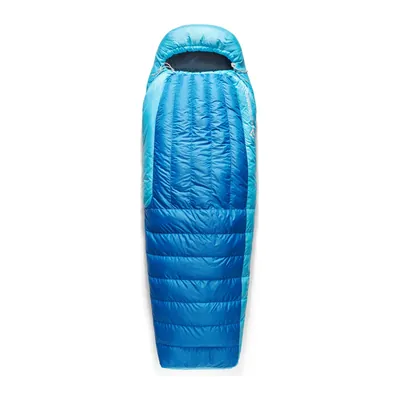
Sea to Summit Trek 30°F
A down bag named after its limit temperature, 30 °F; its comfort temperature, the one to shop by, is 37 °F under ISO 23537. 2.47 lb in Regular.
View on Amazon (opens in a new tab)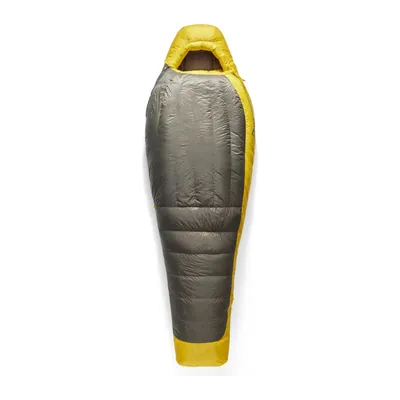
Sea to Summit Spark 0°F
A down winter bag named after its limit temperature, 0 °F; its comfort temperature, the one to shop by, is 14 °F under ISO 23537. 2.45 lb in Regular.
View on Amazon (opens in a new tab)
FAQ
What’s the difference between comfort and limit temperature?
The comfort temperature is the lowest at which you sleep well, relaxed; the standard calculates it for a standard woman. The limit temperature is the lowest at which you can sleep through the night curled up; it’s calculated for a standard man. That makes it lower than the comfort temperature: 32 °F (0 °C) versus 41 °F (5 °C) on Decathlon’s MT500 bag, for example.
What does a sleeping bag’s extreme temperature mean?
It’s a survival temperature, not a sleeping one: the temperature at which you can stay curled up in the bag for six hours, with an increased risk of frostbite and hypothermia. It should never be used to choose a bag. For sleeping, look at the comfort temperature, and treat the limit temperature as your floor.
Why aren’t two 32 °F (0 °C) sleeping bags equally warm?
Because brands don’t put the same rating in a bag’s name. Decathlon shows the comfort temperature, Rab the limit temperature. A 32 °F (0 °C) bag named after its limit is noticeably colder than a 32 °F bag named after its comfort rating. Always compare comfort against comfort, or limit against limit.
What temperature rating do I need for summer in the mountains?
Start with the coldest night you expect where you’ll sleep, elevation included, and choose a bag with a comfort temperature at or below that level. If you sleep cold, leave yourself a margin. And don’t forget your pad: the standard’s temperatures assume an insulating pad under the sleeper.
Sources
- ISO 23537-1:2022, Requirements for sleeping bags, Part 1: Thermal, mass and dimensional requirements, scope as reproduced by Genorma, accessed October 22, 2026. genorma.com https://genorma.com/en/standards/iso-23537-1-2022 ↩
- Rab, Sleeping Bag Temperature Ratings Explained, Rab Lab, accessed October 22, 2026. rab.equipment https://rab.equipment/us/rab-lab/sleeping-bag-temperature-ratings-explained ↩
- Decathlon, Sac de couchage de trekking 5 °C, MT500, product page and explanation of the temperature ratings (in French), accessed October 22, 2026. decathlon.fr https://www.decathlon.fr/p/sac-de-couchage-de-trekking-5degc-mt500/346446/c382m8799899 ↩
- Exped, FAQs, “What is R-Value” section, accessed October 22, 2026. exped.com https://www.exped.com/en/faqs ↩

Camping, backpacking, bushcraft and hiking
Guillaume Hoarau writes for Outfarer about camping, backpacking, bushcraft, and hiking. A survival-skills buff and a collector of vintage field manuals, he loves clear explanations, lists that actually help and other people’s stories, which he tells well.


