 Français (France)
 English (UK)
 English (US)
 Deutsch (Deutschland)

What R-value measures
Midnight at the lake. Your bag is a good one, the tent is pitched tight, and still the cold creeps up through your back and hips, right where your weight presses down. It’s not the bag’s fault: crushed under you, its down can’t insulate anymore. The whole night comes down to the few inches between you and the ground.
That’s what R-value measures: a material’s thermal resistance, meaning how well it slows the flow of heat. The higher the number, the better the pad insulates [1]. There’s nothing exotic about it: engineers use the same measure for windows and fiberglass [1]. Lying right on the ground, you lose heat through conduction, and compressed down no longer creates an insulating layer. That’s why the pad matters so much [1].
The ASTM F3340 standard: numbers you can finally compare
For years, not every brand measured R-value with the same test, and some rated their pads with temperature ranges or other subjective measures, which led to some pretty wild claims. In 2016, Therm-a-Rest and a group of other pad makers started developing a common method, which became the ASTM F3340-18 standard. It lets you compare the R-values of two pads directly [1].
The test itself is simple. The pad goes between two metal plates, and one of them is held at a constant temperature by a measured electric current. The better the pad insulates, the less energy it takes to keep that plate warm, and that energy gets converted into an R-value. At Therm-a-Rest, the test runs in a cold chamber kept at 39 °F (4 °C) [1].
Foam or air pads: ballpark numbers
Foam insulates at roughly R 3 per inch of thickness, according to Therm-a-Rest [1] (about R 1.2 per centimeter), so a 0.8-inch (2 cm) foam pad comes out around R 2.4. Older air pads, designed before 2000 for comfort rather than insulation, mostly stay below R 2 [1]. Newer air pads, with built-in insulation or reflective films, go much higher: Therm-a-Rest lists R 4.5 for its NeoAir XLite and R 7.3 for its NeoAir XTherm [1].

| Pad | R-value | Source |
|---|---|---|
| 0.8 in (2 cm) foam pad (3-per-inch rule) | about 2.4 | Calculation based on Therm-a-Rest |
| Older air pad, pre-2000 | usually below 2 | Therm-a-Rest |
| Therm-a-Rest NeoAir XLite | 4.5 | Therm-a-Rest |
| Pad Exped recommends under a sleeping bag | at least 6.5 | Exped |
| Therm-a-Rest NeoAir XTherm | 7.3 | Therm-a-Rest |
Values published by the manufacturers, measured to the ASTM F3340 standard for recent models. The foam figure is a calculated order of magnitude.
Why your pad matters as much as your bag
Sleeping bag temperature ratings are measured in a lab, on a manikin lying on a pad. Exped spells it out: ISO-rated bags are tested on pads with an R-value of 7, and the brand recommends at least 6.5 so your bag delivers the warmth it’s rated for [2]. So a good bag on a mediocre pad won’t live up to its rating, as our guide to sleeping bag temperature ratings explains.
It works the other way, too: Therm-a-Rest notes that with a warmer pad, you can sometimes take a three-season bag into colder nights instead of hauling a heavy winter bag [1]. And the weight penalty is small: at Therm-a-Rest, stepping up from the NeoAir XLite (13 oz) to the NeoAir XTherm (15.5 oz) adds just 2.5 ounces, far less than a heavy winter bag [1].
Stacking two pads for winter
Stack two insulating layers and their thermal resistances add up: that’s physics, and it’s the best news in this guide. An R 2 foam pad under an R 4.5 air pad gets you about R 6.5, the level Exped recommends. For the math to work, the two pads need to lie flat against each other, with no air pocket shifting around during the night.
The combo has another upside. The foam protects the air pad from rocks and thorns, and if the air pad goes flat in the middle of the night, you still have an insulating layer between you and the snow. In winter, that’s lightweight insurance.

The smart move: pick your pad along with your sleeping bag, never after, and check its R-value before its weight.
Gear related to this article
No affiliation: no commission, no sponsored products.
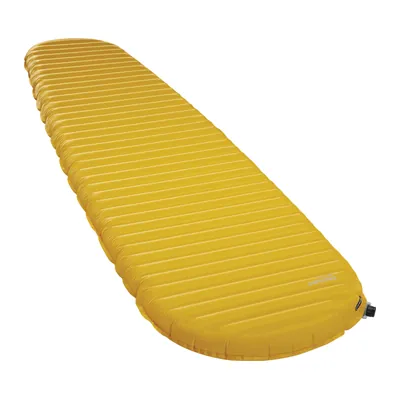
Therm-a-Rest NeoAir XLite NXT
A 3-inch inflatable sleeping pad with an R-value of 4.5 under ASTM F3340, 13 oz in Regular: on top of an R 2 foam pad, the pair comes to about R 6.5.
View on Amazon (opens in a new tab)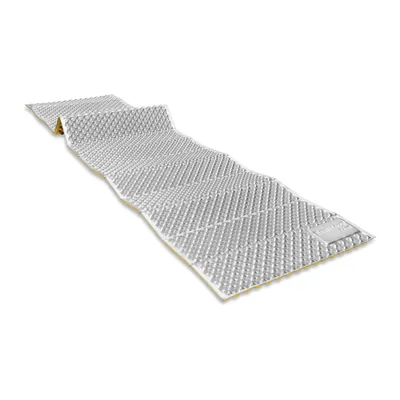
Therm-a-Rest Z Lite Sol
An accordion-fold foam pad rated R 2.0, 14 oz in Regular: the bottom layer of the winter combo, which also protects an air pad from rocks.
View on Amazon (opens in a new tab)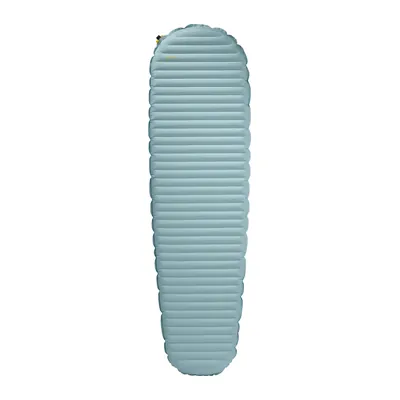
Therm-a-Rest NeoAir XTherm NXT
A 3-inch winter air pad: an R-value of 7.3 under ASTM F3340, above the 6.5 Exped recommends, at 15.5 oz in Regular, 2.5 oz more than the XLite NXT.
View on Amazon (opens in a new tab)
Worth watching
Therm-a-Rest, one of the brands that helped write the ASTM F3340 standard, explains what R-value measures, how it’s tested, and how to use the number to pick a pad.
The video is hosted by YouTube (Google): nothing loads until you play it, and Google may then set cookies.
FAQ
What is a sleeping pad’s R-value?
It’s the pad’s thermal resistance, meaning its ability to slow the flow of heat from your body into the ground. The higher the R-value, the better the pad insulates. Since the ASTM F3340-18 standard, developed with manufacturers, R-values measured with this method can be compared from one brand to another.
Can you stack two pads and add up their R-values?
Yes. Two stacked insulating layers add their thermal resistances together. An R 2 foam pad under an R 4.5 air pad gives you about R 6.5. The two pads need to lie flat against each other. The combo also protects the air pad from rocks, and keeps an insulating layer under you if it deflates during the night.
What R-value do I need for my sleeping pad?
It depends on the season and the ground. Exped points out that ISO-rated sleeping bags are tested on pads with an R-value of 7, and recommends at least 6.5 so the bag delivers its rated warmth. For sleeping on snow or frozen ground, aim high, even if that means stacking two pads.
Why do I sleep cold even in a good sleeping bag?
Often, it’s the pad. Crushed under your weight, the bag’s insulation stops working, so the pad is all that separates you from the ground, which pulls heat away through conduction. A pad that insulates too little, or one that deflates, is enough to make for a cold night, whatever temperature the bag is rated for.
Sources
- Cascade Designs (Therm-a-Rest), “How warm is my sleeping pad and what is R-Value?” online help center, accessed October 22, 2026. support.cascadedesigns.com https://support.cascadedesigns.com/hc/en-us/articles/35376948338195-How-warm-is-my-sleeping-pad-and-what-is-R-Value ↩
- Exped, “FAQs,” “What is R-Value” section, accessed October 22, 2026. exped.com https://www.exped.com/en/faqs ↩

Camping, backpacking, bushcraft and hiking
Guillaume Hoarau writes for Outfarer about camping, backpacking, bushcraft, and hiking. A survival-skills buff and a collector of vintage field manuals, he loves clear explanations, lists that actually help and other people’s stories, which he tells well.


