 Français (France)
 English (UK)
 English (US)
 Deutsch (Deutschland)

Contents
Take a piece of your rainfly, stretch it across the bottom of a tube, and fill the tube with water to 9.8 ft (3 m), well above your living room ceiling. If the fabric holds, the spec sheet can say 3,000 mm. That’s the entire promise of a The water pressure, measured in millimeters of water column, that a fabric withstands before water gets through.: a pressure, on a small piece of fabric. It says nothing about a stormy night, a poorly finished seam, or a zipper left partly open.
So this guide reads just that one line of the spec sheet, the one our article on choosing a backpacking tent only skims. It backs up the shelter step in our guide to your first backcountry camping trip, and it answers the question you ask yourself standing in front of two tents: how many millimeters before you can sleep easy?
What a waterproof rating measures
French sporting goods retailer Decathlon defines it as a fabric’s resistance to water pressure, expressed in millimeters, from a test based on the ISO 811 standard [1]. The technical term is “hydrostatic head,” and the Germans say “Wassersäule.” Either way, the number stays in millimeters on the spec sheets cited here, American brands included, so it stays in millimeters in this guide. A 2,000 mm fabric withstands the pressure exerted by 2,000 mm of water [1].
German brand Vaude describes the test: the fabric is stretched under a water-filled cylinder 3.9 in (10 cm) across, and the number recorded is the point where water starts coming through drop by drop [2]. At MSR, the pressure rises until 3 drops get through [3]. ISO 811, whose title refers to resistance to water penetration and a hydrostatic pressure test, is also a reference for the camping tent standard, ISO 5912 [4]. You have to pay to read ISO 811: these details come from the brands that use it, not from its text.
These aren’t the millimeters from the weather report. A 2,000 mm tent won’t hold out against 2,000 mm of rain, points out the British consumer group Which? [5], and the retailer Scandinavian Outdoor sets the record straight the same way [6]. For a sense of scale, MSR ran umbrella fabric through its tester: 420 mm [3]. Your umbrella keeps you dry with way less than a rainfly, but then it never has to rub against a rock.
1,500, 3,000, 5,000 mm: what the brands say
None of our sources gives a common scale. Vaude and the German magazine OUTDOOR cite 1,300 mm as the DIN threshold for calling a fabric waterproof [2, 7], without saying which DIN standard (DIN is Germany’s standards body), and Swedish brand Hilleberg notes the lack of a test method shared across the industry, which makes comparisons harder [8]. So everyone sets their own benchmarks, and sellers don’t all have the same tents to defend.
| Number | On a rainfly | On a floor |
|---|---|---|
| 1,500 mm | Enough for Scandinavian Outdoor [6], a baseline for German retailer Fritz Berger [9], the rating of MSR’s Elixir [10] | None of our sources recommends it; 1,200 mm shows up on ultralight floors [6] |
| 3,000 mm | Vaude’s minimum [2], PU and SI fabrics at Danish brand Nordisk [11], minimum advised by German retailer Bergzeit [12] and Fritz Berger [9] | Vaude’s minimum [13], floor of MSR’s Access [3], an ultralight compromise for Bergzeit [12] |
| 5,000 mm | Hilleberg’s Kerlon fabrics, from 5,000 to 5,500 mm [8] | Floor of Decathlon’s backpacking tents [1], Bergzeit’s minimum [12], Fritz Berger’s ideal [9] |
Numbers stated by each brand for its own products, and retailers’ advice on what they sell, recorded on November 7, 2026.
The gap goes further than you might think. MSR stands by 1,200 mm rainflies [3, 10] and won’t commit to a single value, since each tent has its own balance of waterproofness, durability, and weight [3]. Decathlon sticks to 2,000 mm on its trekking tents and tarps [1], and Nordisk to 2,000 mm on its LW models [11]. And OUTDOOR’s view is that the number only really counts on polyurethane-coated floors, not on the rainfly [7].
Why the floor needs more than the rainfly
The rainfly takes the rain. The The waterproof part of the tent that forms the bottom of the tent body., on the other hand, gets squashed against wet ground, and Vaude describes it as exposed to high pressure [13]. Bergzeit runs the numbers: a 183 lb (83 kg) person in European size 43 shoes exerts about 0.22 bar (3.2 psi) standing up, or 2,200 mm, and more than 4,000 mm crouching on the balls of the feet [12]. A 3,000 mm floor would no longer hold, it concludes [12]. That’s a seller’s example, not a standardized test: the pressure depends on the contact area, and nobody digs through a backpack in that position all night.
MSR gives another reason: abrasion. On the Access, the 3,000 mm floor makes up for wear, and floors generally get a thicker coating than rainflies [3, 10]. The two explanations go hand in hand: a floor has to deal with both pressure and wear.
Independent tests look at this too. For the Swiss consumer show Kassensturz, in 2022, a German lab examined ten two-person tents: for four of them, the head of testing expected moisture to come through the floor after about three days on wet ground [14]. OUTDOOR, for its part, wants more than 4,000 mm on a polyurethane-coated floor [7], but finds the number says little about a polyethylene or silicone-coated one, which it prefers to test on a flooded surface, kneeling and jumping [7].
What wear, coatings, and hydrolysis do to the number
A tent fabric’s waterproofness comes from its The layer of polyurethane or silicone applied to a fabric to make it waterproof., MSR reminds us [10]. And the number on the spec sheet describes new fabric. Hilleberg offers an example: until 2017, the brand required at least 3,000 mm after mechanical rubbing; since then, it has published numbers for the fabric as delivered, like most manufacturers [16]. Its published numbers then jumped, because they were no longer measuring the same thing.
| Coating | Claimed advantages | Stated limitations |
|---|---|---|
| Polyurethane (PU) | Waterproof and tough according to Vaude; seams can be heat-sealed at Nordisk [11, 13] | Makes the fabric heavier; degrades through hydrolysis and turns sticky, according to MSR [10, 13] |
| Silicone | Better resistance to tearing and UV, according to Vaude [13] | Seams can’t be heat-sealed, and are folded and sewn at Nordisk, which doesn’t call these tents fully waterproof; ventilation needs attention, according to Vaude [11, 13] |
Manufacturers’ claims for their own products, not compared in a shared test.
The chemical breakdown of a coating caused by water, heat, and time. is polyurethane’s enemy. Time, moisture, and heat chemically break down the coating, MSR explains [10], in use as well as in storage [17]. The brand adds that coatings last longer on thicker fabrics [10], and promotes its own Xtreme Shield coating as three times more durable, a manufacturer’s claim [17].
The sun is another story. According to Hilleberg, UV attacks tear strength first, then The property that makes water bead up and roll off a fabric’s surface.: water stops beading, without the fabric being any less waterproof [18]. Decathlon describes the same repellency, which fades with UV and rubbing and can be revived with a spray [19]. Don’t mix the two up: a treatment makes water roll off, and Hilleberg points out that it doesn’t bring back tear strength [18]. None of these brands promises that a spray will give a damaged coating its millimeters back.
Why a very high number doesn’t guarantee a dry night
Which? sees it in its tests: two tents with similarly high ratings can end up one dry and the other with a puddle, because most leaks come through the seams and zippers, not the fabric [5]. MSR adds that a higher number comes at the cost of more coating: the fabric gets heavier and stiffer and, past a certain point, tears more easily [3], which does a rainfly in the wind no favors.
- Seams. The needle punches through the fabric: Decathlon closes these holes with heat-sealed tape [19], MSR with a thread that swells when wet on its tapeless models [10]. Hilleberg admits that a little moisture can get through a seam during a long rain, and then suggests a seam sealer [20].
- Zippers and openings. Nordisk calls its PU tents waterproof, except for the zippers and openings [11]. Which? warns against doors that open inward: the water they hold falls into the tent [5].
- Tension. Nordisk wants the fabric pulled taut for strength and water repellency [11], and MSR counts on a well-tensioned tent to shed water to the ground [21].
- Contact. Pressing against a wet wall can let water through at that spot, Which? warns [5].
The link with condensation
A more waterproof fabric doesn’t mean a fabric that gets less wet from the inside. Hilleberg points out that its rainflies are neither breathable nor air-permeable, so vapor condenses on them [22]. Decathlon takes the reasoning further: a fabric made perfectly waterproof keeps the sleeper’s vapor inside [19]. So the number on the spec sheet promises nothing against condensation, which comes down to ventilation and where you pitch.
The two do meet in a downpour, though: raindrops hitting the rainfly knock off the condensation clinging to its underside, and the rain seems to come through, Hilleberg explains [22]. Before you blame your 3,000 mm, look at where the water is landing. Erik Gauden lived this distinction during his three days of rain in Brittany’s Monts d’Arrée: nothing through the floor, condensation under the rainfly.
Which waterproof rating to choose for your tent
None of our sources makes this call for you, and I’m not about to hand you a magic number. Here’s how I’d read a spec sheet, using what this guide’s sources say:
| Line on the sheet | This guide’s benchmarks | What the number doesn’t say |
|---|---|---|
| Rainfly | 1,200 to 2,000 mm at MSR and Decathlon, on hiking tents; at least 3,000 mm for Vaude, Bergzeit, and Fritz Berger | How well the seams, doors, and tension hold up |
| Floor | 5,000 mm for Bergzeit and Fritz Berger, more than 4,000 mm on a PU floor for OUTDOOR; 3,000 mm remains a compromise for a light tent | Wear from rocks and thorns, hence the separate footprint Vaude recommends [13] |
| Coating | Polyurethane, silicone, or both, depending on the brand | Age: sticky fabric no longer has the number on its spec sheet |
A recap of the sources cited above; the rest of the spec sheet is covered in our guide to choosing a tent.
The smart move: read two numbers instead of one, the rainfly’s and the floor’s, then ask yourself where the most exposed seam is. And when you get home, pull the tent out of its stuff sack to dry it, because the closet is where the millimeters go missing.
Gear related to this article
No affiliation: no commission, no sponsored products.
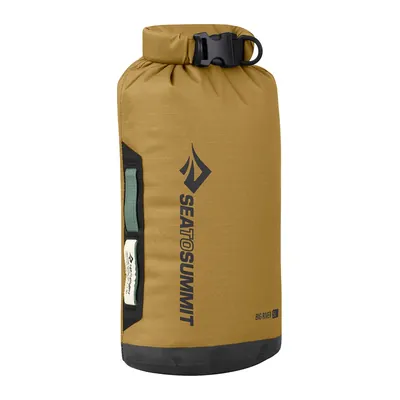
Sea to Summit Big River Dry Bag
A roll-top dry bag in 420D nylon with a TPU laminate, taped seams and lash points: to keep the tent, sleeping bag and evening clothes dry. Sizes from 5 to 65 liters.
View on Amazon (opens in a new tab)
Worth watching
British retailer Mountain Warehouse demonstrates the test on squares of its own fabric: three minutes to watch what this guide describes, the water column rising until the fabric gives way.
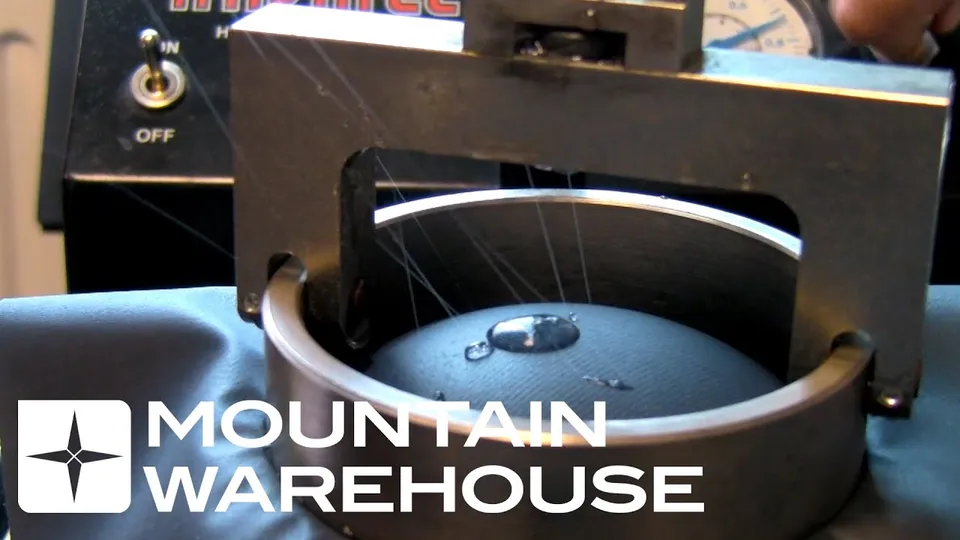
The video is hosted by YouTube (Google): nothing loads until you play it, and Google may then set cookies.
FAQ
What waterproof rating does a tent need?
Our sources give no common official number. For a rainfly, Scandinavian Outdoor considers 1,500 mm enough, Decathlon lists 2,000 mm on its trekking tents, and Vaude and Bergzeit start at 3,000 mm. For the floor, Bergzeit advises at least 5,000 mm and sees 3,000 mm as an ultralight compromise. Then look at the seams and doors, where most leaks get in.
What does 3,000 mm mean on a tent?
It means that, in a lab, the fabric withstands the pressure of a water column 9.8 ft (3 m) tall, about 4.3 psi (29 kPa), before the first drops come through. It isn’t the thickness of the fabric or an amount of rain. It describes the fabric alone, usually new: seams and zippers aren’t part of this measurement.
What rating makes a tent waterproof?
The sources don’t agree. Vaude and OUTDOOR magazine cite 1,300 mm, based on a DIN standard they don’t specify, and Fritz Berger sees 1,500 mm as a baseline for a rainfly. MSR uses 1,200 mm on several tents, and in its tester umbrella fabric comes in at 420 mm. A tent only stays waterproof if its seams and doors do too.
Why does a tent floor have a higher waterproof rating?
Because your weight presses the fabric into wet ground. The retailer Bergzeit calculates about 2,200 mm under a 183 lb (83 kg) person standing, and more than 4,000 mm crouching on the balls of the feet. MSR adds abrasion: a thicker coating resists it better, which explains the 3,000 mm floor on its Access versus 1,200 mm on the rainfly.
Does a tent’s waterproof rating drop over time?
Coatings age. MSR explains that time, moisture, and heat degrade polyurethane through hydrolysis, until it turns sticky and is no longer waterproof at all, especially on a tent stored damp. Hilleberg notes that UV mainly reduces tear strength and water repellency, with no loss of waterproofness. Always dry your tent before putting it away.
Sources
- Decathlon, “Comment choisir une tente de bivouac ?” buying advice (in French), accessed November 7, 2026. decathlon.fr https://www.decathlon.fr/c/htc/comment-choisir-une-tente-de-bivouac_8913b556-225e-43be-8efc-3ebdf74ac313 ↩
- Vaude, “Welches Zelt ist das beste für mich?” blog, June 10, 2023, updated April 30, 2026 (in German), accessed November 7, 2026. vaude.com https://www.vaude.com/de/de/blog/post/welches-zelt-ist-das-beste-fuer-mich.html ↩
- MSR (Cascade Designs), “Tent Fabrics Part 2: Waterproof Ratings,” March 3, 2022, accessed November 7, 2026. cascadedesigns.com https://cascadedesigns.com/blogs/msr-gear-guides/tent-fabrics-part-2-waterproof-ratings ↩
- ISO 5912:2020 and EN ISO 5912:2020, “Camping tents, Requirements and test methods,” official preview (contents and normative references) published by the Slovak standards office ÚNMS SR, accessed November 7, 2026. normy.normoff.gov.sk https://normy.normoff.gov.sk/norma/131213/nahlad ↩
- Which?, “Why you shouldn’t rely on the waterproof rating of your tent,” May 18, 2024, accessed November 7, 2026. which.co.uk https://www.which.co.uk/news/article/why-you-shouldnt-rely-on-the-waterproof-rating-of-your-tent-a0NT34h6Xhbe ↩
- Scandinavian Outdoor, “What on earth is a hydrostatic head rating?” retailer’s blog, accessed November 7, 2026. scandinavianoutdoor.com https://scandinavianoutdoor.com/life-outdoors/what-on-earth-is-hydrostatic-head-2/ ↩
- OUTDOOR, “Unter der Lupe: So funktionieren unsere Tests,” August 15, 2024 (in German), accessed November 7, 2026. outdoor-magazin.com https://www.outdoor-magazin.com/wandertipps/so-testen-wir/ ↩
- Hilleberg, “The Tent Handbook 2026/2027,” catalog, pages 12 and 13, accessed November 7, 2026. cdn.hilleberg.com https://cdn.hilleberg.com/cms/support/order-catalog/Hilleberg2026Handbook-EN.pdf ↩
- Fritz Berger, “Was bedeutet die Wassersäule bei einem Zelt?” retailer’s advice, September 27, 2022, updated September 4, 2026 (in German), accessed November 7, 2026. fritz-berger.de https://www.fritz-berger.de/blog/hilfe-beratung/zeltratgeber/was-bedeutet-die-wassersaeule-bei-einem-zelt/ ↩
- MSR (Cascade Designs), “How to Choose the Best Backpacking Tent,” guide published August 24, 2021, and since updated, accessed November 7, 2026. cascadedesigns.com https://cascadedesigns.com/blogs/msr-gear-guides/how-to-choose-best-backpacking-tent ↩
- Nordisk, “Trekking Tents FAQ,” FAQs, accessed November 7, 2026. nordisk.eu https://nordisk.eu/pages/faq-trekking-tents ↩
- Bergzeit, “Wassersäule: Welche Regenjacken & Zelte sind wasserdicht?” retailer’s magazine, February 4, 2025, updated September 30, 2026 (in German), accessed November 7, 2026. bergzeit.de https://www.bergzeit.de/magazin/wassersaeule-zelte-jacken/ ↩
- Vaude, “Aus welchen Teilen besteht ein Zelt?” blog, June 5, 2024, updated April 30, 2026 (in German), accessed November 7, 2026. vaude.com https://www.vaude.com/de/de/blog/post/aus-welchen-teilen-besteht-ein-zelt.html ↩
- SRF, Kassensturz, “Zweierzelte im Test: Undicht und kein Platz fürs Gepäck,” May 31, 2022 (in German), accessed November 7, 2026. srf.ch https://www.srf.ch/sendungen/kassensturz-espresso/tests/camping-zelte-zweierzelte-im-test-undicht-und-kein-platz-fuers-gepaeck ↩
- Hilleberg, “Do I need footprints? Do the footprints cover the vestibules?” FAQs, accessed November 7, 2026. hilleberg.com https://hilleberg.com/eng/resources/faqs/do-i-need-footprints-do-the-footprints-cover-the-vestibules ↩
- Hilleberg, “Why did your hydrostatic head figures change so much in 2017?” FAQs, accessed November 7, 2026. hilleberg.com https://hilleberg.com/eng/resources/faqs/why-did-your-hydrostatic-head-figures-change-so-much-in-2017 ↩
- MSR (Cascade Designs), presentation of the Xtreme Shield coating, December 6, 2018, and later update, accessed November 7, 2026. cascadedesigns.com https://cascadedesigns.com/blogs/msr-gear-guides/xtreme-shield-system-extends-the-life-of-your-tent ↩
- Hilleberg, “My tent is paler after a lot of time in the sun, what happened?” FAQs, accessed November 7, 2026. hilleberg.com https://hilleberg.com/eng/resources/faqs/my-tent-is-paler-after-a-lot-of-time-in-the-sun-what-happened ↩
- Decathlon, “Comment imperméabiliser une tente ?” advice page (in French), accessed November 7, 2026. conseilsport.decathlon.fr https://conseilsport.decathlon.fr/comment-impermeabiliser-une-tente ↩
- Hilleberg, “Do I need to seal the seams on my new tent?” FAQs, accessed November 7, 2026. hilleberg.com https://hilleberg.com/eng/resources/faqs/do-i-need-to-seal-the-seams-on-my-new-tent ↩
- MSR (Cascade Designs), “How to Avoid Tent Condensation,” July 10, 2023, first published January 18, 2020, accessed November 7, 2026. cascadedesigns.com https://cascadedesigns.com/blogs/msr-gear-guides/msr-youtube-tips-condensation-tents ↩
- Hilleberg, “I want a tent with no condensation,” FAQs, accessed November 7, 2026. hilleberg.com https://hilleberg.com/eng/resources/faqs/i-want-a-tent-with-no-condensation ↩

Camping, backpacking, bushcraft and hiking
Guillaume Hoarau writes for Outfarer about camping, backpacking, bushcraft, and hiking. A survival-skills buff and a collector of vintage field manuals, he loves clear explanations, lists that actually help and other people’s stories, which he tells well.


