 Français (France)
 English (UK)
 English (US)
 Deutsch (Deutschland)

Contents
Two beech trees 13 feet apart, on sloping ground covered in roots and rocks. For a tent, it’s a spot to skip. For a hammock, it’s perfect: the ground doesn’t matter anymore, only the trees do. In exchange, sleeping off the ground comes with its own questions. How long should the hammock be? How do you hang it without hurting the bark? How do you lie flat in it? And most of all, how do you keep from freezing from underneath?
We read the spec sheets and guides of five hammock makers, DD Hammocks, Warbonnet, ENO, Hennessy, and Amok, crediting each with what it actually claims, then the Leave No Trace guidelines and the rules of a few parks. This guide builds on the shelter step in our guide to your first backcountry camping trip, which compares the tent and the tarp.
Length and width: what the makers say
Pick a backpacking hammock by your height first. DD Hammocks, a British brand, lists its Frontline, with a built-in bug net, at 2.7 × 1.4 m (8 ft 10 in × 4 ft 7 in) laid flat, comfortable for people up to 6 ft 5 in and 125 kg (276 lb) [1, 2], and an XL version of 3 × 1.8 m (9 ft 10 in × 5 ft 11 in) for sleepers up to 7 ft [1]. Warbonnet offers an even more useful rule: its Blackbird fits people up to 6 ft, the Blackbird XLC, 12 inches longer, up to 6 ft 6 in, and the brand says folks 5 ft 10 in and up will normally find noticeably more comfort in the long model [3]. So the maximum height listed isn’t the ideal height.
Width matters just as much, because it’s what lets you lie across the hammock; more on that below. The models in the table run from about 4 ft 7 in to 5 ft 11 in wide. Amok’s Draumr is the exception: it lists no fabric dimensions, only a user height, because it’s tensioned around an inflatable sleeping pad.
| Model | Dimensions laid flat | Sleeper height | Listed weight | Bug net |
|---|---|---|---|---|
| DD Frontline [1, 2] | 8 ft 10 in × 4 ft 7 in (2.7 × 1.4 m) | up to 6 ft 5 in | 30 oz (850 g), hammock only | built in |
| DD XL Frontline [1] | 9 ft 10 in × 5 ft 11 in (3 × 1.8 m) | up to 7 ft | 2 lb 12 oz (1,250 g) without webbing | built in |
| Warbonnet Blackbird XLC, single layer [3, 4] | 11 ft × 62 in | up to 6 ft 6 in | 19 oz with bug net and stuff sack, without suspension | removable |
| ENO SingleNest [5] | 9 ft 6 in × 4 ft 10 in | not listed | 16 oz | none |
| Amok Draumr 5.0, LW size [6] | not listed | up to 5 ft 11 in | 46.9 oz with bug net, straps, and rods | built in |
Manufacturers’ figures as of November 8, 2026; DD Hammocks’ metric figures converted by us. Each weight counts something different, so check what it includes before you compare ounces. For the Frontline, DD’s comparison table lists 820 g (29 oz) without webbing, and its product page 850 g (30 oz) for the hammock only.
Hanging the hammock: wide straps, 30°, and chair height
It all starts with two trees. Leave No Trace, the organization behind the Leave No Trace principles, wants them alive, at least 6 inches in diameter, preferably with hard bark and no lichen. It asks you to hang on the thickest part of the trunk and to avoid trees that bend or that grow in wet areas, which could get uprooted [7]. DD Hammocks uses the same minimum diameter [8]. Leave No Trace adds a distance people tend to forget: at least 200 feet from any water source, to protect the riparian areas along the banks [7].
How far apart the trunks should be depends on the hammock’s length, and each brand has its own range: 3 to 5 m (about 10 to 16 ft) at DD Hammocks [8], about 10 to 14 ft at ENO [9], 14 to 20 ft at Hennessy [10]. Pace it off before you pull out the straps.
Around the trunk goes a flat strap 1 inch or wider, and never anything thinner: that’s the Leave No Trace rule. One wrap, no knots, and a strap left a little slack until someone gets in the hammock, because too tight a hang twists and squishes the bark and the The living tissue just under the bark, which carries the sap made in the leaves. [7]. Nothing nailed or screwed in, of course. Our guide to tarp setups comes back to these straps, and our guide to backcountry knots covers the knots, which go on the strap and never on the bark.
Next comes the angle. ENO says to loop the straps at least 5 feet up the trunk, at a 30° hanging angle, with the hammock no higher than 18 inches off the ground once you’re in it [9]. Warbonnet aims for the same slope, about 30° for any gathered-end hammock, and warns that you don’t raise a hammock by cranking the suspension tighter, which stretches and overstresses it, but by moving the straps higher on the tree [3]. DD Hammocks explains why: the flatter the hang, the greater the force on the suspension [8].
The math, which we did ourselves for a still hammock held by two symmetrical straps, speaks for itself. At 30°, each strap carries exactly your weight. At 15°, nearly twice that; at 10°, almost three times. For a 175-pound sleeper, that’s 175, then 338, then 504 pounds of pull on each strap and each trunk. A hammock strung tight as a clothesline looks great in photos; mostly, it just beats up your gear.
For height, the makers talk about chairs: about 0.5 m (20 inches) off the ground at DD Hammocks [8], chair height at Warbonnet [4]. Leave No Trace sets a ceiling of less than 5 feet, to prevent accidents and avoid damaging higher branches [7]. DD also suggests hanging the foot end slightly higher than the head [8].
Lying on the diagonal, under a ridgeline
Lie straight down the middle and you end up bent like a banana. The fix is one simple move: lie across it. DD Hammocks recommends the diagonal for the flattest lay, because it spreads the fabric out around you and creates more width [8]. Hennessy puts a number on the offset, about 15 or 20°, and designed its asymmetrical hammocks around it: head and shoulders on the left, feet on the right [10]. Warbonnet gives you a reference point: head close to one end, eyes roughly even with the far side tie-out, foot end raised so you’re level from hips to shoulders [3].
Above the sleeper there’s often a A cord attached to both ends of the hammock and running above the sleeper, which always keeps the same distance between the two ends.. At Hennessy, its length sets the curve: shorter, and the hammock gets too deep; longer, and it’s too flat. The brand has dialed it in model by model and recommends against changing it: even 2 inches makes a noticeable difference [10]. The Blackbird XLC’s is 112 inches long on an 11-foot hammock [4].
It also works as a gauge. Warbonnet wants it neither guitar-string tight nor drooping while you’re lying in the hammock [3], which is what you get with straps at about 30° [4]. Don’t mix it up with a tarp’s ridgeline: that one holds up the fabric, this one sets up the hammock.
Bug net and tarp: the walls and the roof
A bare hammock lets in mosquitoes and rain. Three of the models in the table have their own net: built into the Frontline, which DD Hammocks says protects against all insects, “even the Scottish midge” [2], removable on the Blackbird XLC [4], built into the Draumr [6]. ENO’s SingleNest comes without one [5]: if you add one, add its weight.
Overhead goes a tarp. DD Hammocks suggests setting it up first if it’s raining, so you have shelter while you rig the rest [8]. As for size, Warbonnet pairs its gathered-end hammocks, like the Blackbird XLC, with 11-foot tarps, measured along the ridge seam, which overlap them by about 10 inches at each end [11], and DD recommends its 3 × 3 m (about 10 × 10 ft) tarp for its standard-size hammocks, pitched as an A-frame or a diamond [12].
One detail saves rainy nights: water running down the suspension ends up in the hammock. DD suggests a ring or carabiner on the suspension, so the water drips off before it reaches the fabric [8]. The setups themselves, A-frame, diamond, or closed against the wind, are in our guide to tarp setups.
Cold from below: underquilt or sleeping pad
It’s the big surprise of the first few nights. Your sleeping bag, so warm on a pad, no longer protects you from below. Warbonnet explains why: compressible insulation, down or highly compressible synthetic, gets crushed under your weight to almost zero thickness and stops insulating wherever you’re lying on it [13]. DD Hammocks makes the same point: in a hammock, most of your heat escapes from underneath, because your body compresses your clothes and the loft of your sleeping bag [14].
And that cold isn’t just a winter thing. Without bottom insulation, Warbonnet warns, you’ll start to get a cold backside after a few hours even in the high 60s °F, so you’ll need something underneath year-round [13]. There are two solutions, and each brand backs its own.
- The A quilt hung outside and underneath the hammock, which the sleeper’s weight doesn’t compress., hung under the hammock, out of reach of your weight, so it never gets crushed [13]. DD Hammocks’ version, with synthetic fill, weighs about 2 lb 2 oz (950 g) [14]. Warbonnet recommends one, if you can afford it, for every gathered-end hammock, its own and other brands’ alike [13].
- The sleeping pad, slipped into the hammock or between its two layers. Warbonnet sees two drawbacks: 20 or 25 inches wide, compared with 40 inches or more for an underquilt, and a tendency to buckle and poke near your hips; as for air pads, most folks, it says, prefer them only about half inflated in a hammock [13]. Hennessy, on the other hand, makes no underquilt and insulates its double-bottom hammocks with a pad slipped between the two layers [10]. Amok built its Draumr around an inflatable pad, which makes it lie flat and insulates it, and says you don’t need an underquilt in its hammock [15].
In a hammock, Warbonnet points out, you need insulation, not padding: R-value and warmth matter more than thickness [4]. Our guide to sleeping pad R-values explains how to read that number.
Hammock or tent: weight, terrain, and cold
Hammocks have a reputation for being light. The makers’ spec sheets tell a more nuanced story: the hammock alone weighs little, but a real hanging sleep system adds up hammock, tarp, and insulation. Here are a few setups pieced together from listed weights, next to two one-person tents.
| Shelter | Listed weight | What you still need | Where to set it up |
|---|---|---|---|
| DD Frontline and DD 3 × 3 m tarp [2, 12] | 3 lb 10 oz | bottom insulation: DD’s Underblanket, its underquilt, weighs 2 lb 2 oz, for 5 lb 11 oz in all [14] | between two trees |
| Warbonnet Blackbird XLC single layer, light suspension, and Superfly tarp [4, 11] | 2 lb 7 oz | bottom insulation, not counted | between two trees, or on the ground as a bug bivy |
| Amok Draumr 5.0 LW and Skjold 10 tarp [6] | 4 lb 1 oz | the inflatable sleeping pad, which is required | between two trees |
| MSR Hubba Hubba LT 1 tent, packaged weight [16] | 2 lb 11 oz | a sleeping pad | on flat ground |
| Hilleberg Akto tent, packaged weight [17] | 3 lb 12 oz | a sleeping pad | on flat ground |
Totals calculated by us from the spec sheets as of November 8, 2026: from ounces for Warbonnet and Amok, converted from grams for DD Hammocks, so a total can be an ounce off the sum of its rounded parts. Each brand counts something different (straps, stakes, stuff sacks): it’s a ballpark, not a ranking.
Read this table both ways. A light hammock with its tarp weighs about as much as a light tent; the bottom insulation, which Warbonnet says you need even in summer, then widens the gap. But the tent needs its pad too. Terrain, on the other hand, settles it: a tent goes on flat ground, a hammock needs two well-placed trees. Above treeline, on a beach, or in open country, some hammocks can be set up on the ground as a bug bivy: Warbonnet allows for this with its XLC, on a groundcloth and a pad [4]. To compare tents with each other, our guide to choosing a backpacking tent explains packaged weight.
Hanging a hammock from trees: what a few rules say
A tree trunk isn’t a public post. Leave No Trace notes that some state and local parks prohibit hanging hammocks, and asks you to check with local land managers before you set up [7]. Even the national parks don’t speak with one voice.
If you’re headed to France, the rules look different. The French national parks’ portal says backcountry camping in a park’s core zone is only possible in certain places and under certain conditions, and that it’s banned on the islands of Port-Cros and Porquerolles and in the Calanques, near Marseille [21]. The portal describes it as a night under the stars or in a small, compact tent you can’t stand up in, and rules out, for example, cutting branches to set up your tent [21]. Hammocks aren’t mentioned: as of November 8, 2026, in the pages we read, no French national park rule expressly allows or bans them. Ask the park before you go, and read our guide to backcountry camping in France, which covers the rules park by park.
The ONF, France’s national forest service, shows another approach in French Guiana, an overseas region of France in South America. In the Savane-roche Virginie managed biological reserve, where camping outside the designated area and cutting wood are prohibited, permanent frames let you string a tarp and hang a hammock [22]. That rule applies to this reserve, not to every public forest.
Safety: look up, stay low
Before you unpack anything, look up. Leave No Trace rules out any dead tree and asks you to check above you for dead branches, even if the tree looks alive [7]. DD Hammocks adds loose branches and insect nests [8]. The ONF warns that in high winds you’re never safe from falling branches, or even a dead tree coming down [23], and that after a storm, branches left hanging can give way without warning [24].
The smart move, before you even buy: measure yourself, and pick the hammock that gives you room rather than the one that barely fits. At camp: two living trees, two wide straps at about 30°, chair height, and you lying across it. Then slide something under your back, even in July. Ounce counters will groan at the underquilt; their backs won’t.
Worth watching
Warbonnet shows how to set up its updated Blackbird XLC, the hammock this guide uses for its length and structural ridgeline figures.
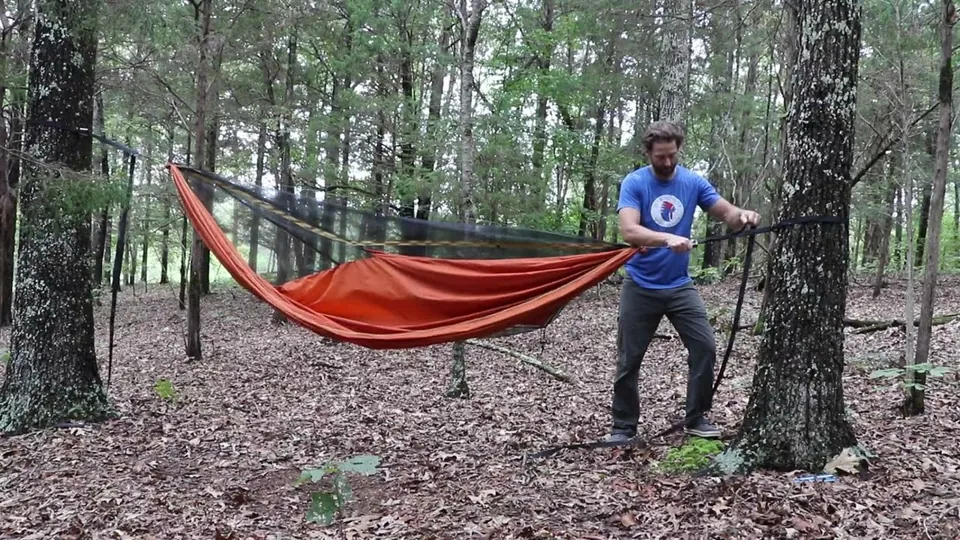
The video is hosted by YouTube (Google): nothing loads until you play it, and Google may then set cookies.
FAQ
What length hammock should I get for my height?
Check the sleeper height the maker lists, then give yourself some room. DD Hammocks rates its Frontline, about 8 ft 10 in long, as comfortable up to 6 ft 5 in, and its 9 ft 10 in version up to 7 ft. Warbonnet rates its Blackbird up to 6 ft, but recommends the long model, 12 inches longer, from 5 ft 10 in. Width matters too: it’s what lets you lie on the diagonal.
Do you need an underquilt in summer?
You need at least some insulation under your back. Warbonnet warns that without it, you’ll get a cold backside after a few hours even in the high 60s °F, because the sleeping bag crushed under your body barely insulates. An underquilt is one answer, a pad another: Amok designs its Draumr around an inflatable pad, and Hennessy insulates some of its hammocks with a pad slipped into a double bottom.
Why angle the straps at 30°?
ENO and Warbonnet recommend it, and the math shows why: at 30°, each strap carries exactly the sleeper’s weight; the flatter the hang, the higher the pull, nearly twice that weight at 15° and almost three times at 10°. DD Hammocks warns that this force strains the suspension. Warbonnet adds that at 30°, its ridgeline is neither too tight nor drooping.
Is a hammock lighter than a tent?
Not necessarily. According to the makers’ spec sheets, a Warbonnet Blackbird XLC with its suspension and a tarp comes to about 2 lb 7 oz, a little less than a one-person tent like MSR’s Hubba Hubba LT 1, at 2 lb 11 oz packaged. But you’ll need bottom insulation: DD Hammocks’ underquilt weighs about 2 lb 2 oz on its own. And the tent needs its pad too.
Can you hang a hammock in a national park?
It depends on the park. Zion prohibits hammocks, Rocky Mountain limits them to the campsite footprint, and Yosemite allows them in its campgrounds, with the trees padded. In France, the national parks’ portal describes backcountry camping in a park’s core zone as a night under the stars or in a small tent, without mentioning hammocks, and bans it on Port-Cros, Porquerolles, and in the Calanques. Check with the park before you go.
Sources
- DD Hammocks, “Choosing your DD Hammock,” hammock comparison table, accessed November 8, 2026. ddhammocks.com https://www.ddhammocks.com/pages/choosing-your-dd-hammock ↩
- DD Hammocks, “DD Frontline Hammock,” product page, accessed November 8, 2026. ddhammocks.com https://www.ddhammocks.com/products/dd-frontline-hammock ↩
- Warbonnet Outdoors, “Hammocking 101,” hammock guide, accessed November 8, 2026. warbonnetoutdoors.com https://www.warbonnetoutdoors.com/hammocks-101/ ↩
- Warbonnet Outdoors, “Blackbird XLC,” product page, third-generation design of October 1, 2025, accessed November 8, 2026. warbonnetoutdoors.com https://www.warbonnetoutdoors.com/product/blackbird-xlc/ ↩
- ENO (Eagles Nest Outfitters), “SingleNest Hammock,” product page, accessed November 8, 2026. eaglesnestoutfittersinc.com https://eaglesnestoutfittersinc.com/products/singlenest-hammock ↩
- Amok Equipment, “Amok Draumr 5.0 - Hammock,” product page, accessed November 8, 2026. amokequipment.com https://amokequipment.com/en-us/products/draumr-5-0-hammock ↩
- Leave No Trace, “How to Hammock Camp Responsibly,” guidelines, 2025, accessed November 8, 2026. lnt.org https://lnt.org/wp-content/uploads/2026/01/2025-LNT-Hammock-Camping-Guidelines.pdf ↩
- DD Hammocks, “Setting up your DD hammock,” setup guide, accessed November 8, 2026. ddhammocks.com https://www.ddhammocks.com/pages/setting-up-your-dd-hammock ↩
- ENO (Eagles Nest Outfitters), “How To: Set Up Your Atlas Hammock Straps,” March 10, 2022, accessed November 8, 2026. eaglesnestoutfittersinc.com https://eaglesnestoutfittersinc.com/blogs/product-education/how-to-set-up-your-atlas-suspension-system ↩
- Hennessy Hammock, “Frequently Asked Questions,” accessed November 8, 2026. hennessyhammock.com https://hennessyhammock.com/pages/frequently-asked-questions-faq ↩
- Warbonnet Outdoors, “Superfly,” tarp product page, accessed November 8, 2026. warbonnetoutdoors.com https://www.warbonnetoutdoors.com/product/superfly/ ↩
- DD Hammocks, “DD Tarp 3x3,” spec sheet, accessed November 8, 2026. media.ddhammocks.com https://media.ddhammocks.com/images/2024_Spec_Sheets/Spec_sheet_Tarp_3x3.pdf ↩
- Warbonnet Outdoors, “Underquilts 101,” guide to bottom insulation, accessed November 8, 2026. warbonnetoutdoors.com https://www.warbonnetoutdoors.com/underquilts-101/ ↩
- DD Hammocks, “DD Underblanket,” product page, accessed November 8, 2026. ddhammocks.com https://www.ddhammocks.com/products/dd-underblanket-coyote-brown ↩
- Amok Equipment, “How Draumr hammocks work,” guide, accessed November 8, 2026. amokequipment.com https://amokequipment.com/en-us/pages/how-draumr-hammocks-work ↩
- MSR (Cascade Designs), “Hubba Hubba LT 1 Tent,” product page, accessed November 8, 2026. cascadedesigns.com https://cascadedesigns.com/products/hubba-hubba-lt-1-person-backpacking-tent ↩
- Hilleberg, “Akto,” product page, accessed November 8, 2026. hilleberg.com https://hilleberg.com/eng/products/tent/Akto ↩
- National Park Service, Zion National Park, “Camping Regulations,” last updated June 2, 2026, accessed November 8, 2026. nps.gov https://www.nps.gov/zion/planyourvisit/camping-regulations.htm ↩
- National Park Service, Rocky Mountain National Park, “Superintendent’s Compendium,” last updated July 24, 2026, accessed November 8, 2026. nps.gov https://www.nps.gov/romo/learn/management/rmnp_compendium.htm ↩
- National Park Service, Yosemite National Park, “Campground Regulations,” last updated August 1, 2025, accessed November 8, 2026. nps.gov https://www.nps.gov/yose/planyourvisit/campregs.htm ↩
- Parcs nationaux de France, the French national parks’ portal, “Le bivouac” (in French), accessed November 8, 2026. parcsnationaux.fr https://parcsnationaux.fr/votre-visite/bonnes-pratiques-et-activites/le-bivouac ↩
- Office national des forêts (ONF), France’s national forest service, “Réserve biologique dirigée de la Savane-roche Virginie” (in French), accessed November 8, 2026. onf.fr https://www.onf.fr/vivre-la-foret/+/278d::reserve-biologique-dirigee-de-la-savane-roche-virginie.html ↩
- Office national des forêts (ONF), “Nos conseils en cas d’urgence,” emergency advice (in French), accessed November 8, 2026. onf.fr https://www.onf.fr/vivre-la-foret/+/11d7::nos-conseils-en-cas-durgence.html ↩
- Office national des forêts (ONF), “Après une tempête : les bons réflexes en forêt,” advice after a storm (in French), accessed November 8, 2026. onf.fr https://www.onf.fr/vivre-la-foret/que-faire-en-foret/conseils-pratiques-foret/+/2bf3::apres-une-tempete-les-bons-reflexes-en-foret.html ↩

Camping, backpacking, bushcraft and hiking
Guillaume Hoarau writes for Outfarer about camping, backpacking, bushcraft, and hiking. A survival-skills buff and a collector of vintage field manuals, he loves clear explanations, lists that actually help and other people’s stories, which he tells well.


