 Français (France)
 English (UK)
 English (US)
 Deutsch (Deutschland)

Contents
Two beech trees 4 m apart, on sloping ground strewn with roots and stones. For a tent, it’s a pitch to avoid. For a hammock, it’s perfect: the ground no longer matters, only the trees do. In return, sleeping off the ground raises questions of its own. How long a hammock? How do you hang it without harming the bark? How do you lie flat in it? And above all, how do you stop freezing from underneath?
We read the spec sheets and guides of five hammock makers, DD Hammocks, Warbonnet, ENO, Hennessy and Amok, attributing to each what it claims, then the guidelines of Leave No Trace and the rules of a few parks. This guide builds on the shelter step of our guide to your first wild camp, which weighs the tent against the tarp.
Length and width: what the makers say
Choose a camping hammock for your height first. DD Hammocks, the British brand, lists its Frontline, with a built-in mosquito net, at 2.7 × 1.4 m laid flat, comfortable for people up to 6 ft 5 in (1.96 m) and 125 kg [1, 2], and an XL version of 3 × 1.8 m for sleepers up to 7 ft (2.13 m) [1]. Warbonnet gives an even more telling rule: its Blackbird suits people up to 1.83 m, the Blackbird XLC, 30 cm longer, up to 1.98 m, and the brand finds noticeably more comfort in the long model from 1.78 m [3]. The maximum height listed, then, is not the ideal height.
Width matters just as much, because it is what lets you lie across the hammock; more on that below. The models in the table measure between 1.4 and 1.8 m wide. Amok’s Draumr is the exception: it lists no fabric dimensions, only a user height, because it is tensioned around an inflatable sleeping mat.
| Model | Dimensions laid flat | Sleeper height | Listed weight | Mosquito net |
|---|---|---|---|---|
| DD Frontline [1, 2] | 2.7 × 1.4 m | up to 1.96 m | 850 g, hammock only | built in |
| DD XL Frontline [1] | 3 × 1.8 m | up to 2.13 m | 1,250 g without webbing | built in |
| Warbonnet Blackbird XLC, single layer [3, 4] | 3.35 × 1.57 m | up to 1.98 m | 539 g with net and stuff sack, without suspension | removable |
| ENO SingleNest [5] | 2.9 × 1.47 m | not stated | 454 g | none |
| Amok Draumr 5.0, LW size [6] | not stated | up to 1.80 m | 1,329 g with net, straps and rods | built in |
Makers’ figures, as of 8 November 2026. Each weight counts something different: check what it includes before comparing grams. For the Frontline, DD’s comparison table gives 820 g without webbing, its product page 850 g for the hammock only.
Hanging the hammock: wide straps, 30° and chair height
It all starts with two trees. Leave No Trace, the US organisation that promotes the leave-no-trace principles, wants them alive, at least 15 cm in diameter, preferably with hard bark and no lichen. It asks you to hang from the thickest part of the trunk and to avoid trees that bend or that grow in wet areas, which could be uprooted [7]. DD Hammocks uses the same minimum diameter [8]. Leave No Trace adds a distance people forget: at least 61 m from any water source, to protect the banks [7].
The gap between the trunks depends on the hammock’s length, and each brand has its own range: 3 to 5 m at DD Hammocks [8], roughly 3 to 4.3 m at ENO [9], 4.3 to 6.1 m at Hennessy [10]. Pace it out before you get the straps out.
Around the trunk goes a flat strap at least 2.5 cm wide, and never anything thinner: that is Leave No Trace’s rule. One wrap, no knots, and a strap left a little slack until someone gets into the hammock, because too tight a hang twists and crushes the bark and the The living tissue just beneath the bark, which carries the sap made in the leaves. [7]. Nothing nailed or screwed in, naturally. Our guide to tarp pitches comes back to these straps, and our guide to wild camping knots to the knots, which go on the strap and never on the bark.
Then comes the angle. ENO asks for straps fixed at least 1.5 m up the trunk, angled at 30°, and a hammock no more than 46 cm off the ground once you are in it [9]. Warbonnet aims for the same slope, about 30° for any gathered-end hammock, and warns that you don’t raise a hammock by pulling the suspension tighter, which stretches and overloads it, but by moving the straps higher up the tree [3]. DD Hammocks explains why: the flatter the hang, the greater the force on the suspension [8].
The calculation, our own, for a still hammock held by two symmetrical straps, speaks for itself. At 30°, each strap carries exactly your weight. At 15°, nearly twice that; at 10°, almost three times. For an 80 kg sleeper, that makes 80, then 155, then 230 kg of pull on each strap and each trunk. A hammock strung as tight as a washing line looks lovely in photos; mostly, it punishes the kit.
For height, the makers talk about chairs: about 0.5 m off the ground at DD Hammocks [8], chair height at Warbonnet [4]. Leave No Trace sets a ceiling of less than 1.5 m, to prevent accidents and spare the higher branches [7]. Finally, DD advises hanging the foot end slightly higher than the head [8].
Lying on the diagonal, under a ridgeline
Lie along the middle and you end up bent like a banana. The fix takes one move: lie across it. DD Hammocks recommends the diagonal for the flattest lie, because it spreads the fabric out around you and creates more width [8]. Hennessy puts a figure on the offset, about 15 or 20°, and designed its asymmetric hammocks for it: head and shoulders to the left, feet to the right [10]. Warbonnet gives a marker: head close to one end, eyes roughly level with the far side tie-out, foot end raised so that you stay level from hips to shoulders [3].
Above the sleeper there is often a A cord fixed to both ends of the hammock and running above the sleeper, which always keeps the same distance between the two ends.. At Hennessy, its length decides the curve: shorter, and the hammock becomes too deep; longer, and it is too flat. The brand has set it model by model and advises against changing it: even 5 cm makes a noticeable difference [10]. The Blackbird XLC’s measures 2.84 m on a 3.35 m hammock [4].
It doubles as a gauge. Warbonnet wants it neither guitar-string tight nor drooping once you are lying in the hammock [3], which you get with straps at about 30° [4]. Don’t confuse it with a tarp’s ridgeline: that one holds up the fabric, this one sets the hammock.
Mosquito net and tarp: the walls and the roof
A bare hammock lets in mosquitoes and rain. Three of the models in the table have their own net: built into the Frontline, which DD Hammocks says keeps out all insects, ‘even the Scottish midge’ [2], removable on the Blackbird XLC [4], built into the Draumr [6]. ENO’s SingleNest comes without one [5]: if you add one, add its weight.
Overhead, a tarp. DD Hammocks advises putting it up first if it is raining, so that you stay dry while you rig the rest [8]. As for size, Warbonnet pairs its gathered-end hammocks, such as the Blackbird XLC, with tarps that have a 3.35 m ridge, overhanging them by about 25 cm at each end [11], and DD recommends its 3 × 3 m tarp for its standard-size hammocks, pitched as an A-frame or a diamond [12].
One detail saves rainy nights: water running down the suspension ends up in the hammock. DD suggests a ring or a karabiner on the suspension, so that the water drips off before it reaches the fabric [8]. The pitches themselves, A-frame, diamond or closed against the wind, are in our guide to tarp pitches.
Cold from below: underquilt or sleeping mat
It is the surprise of the first nights. Your sleeping bag, so warm on a mat, no longer protects you from below. Warbonnet explains why: compressible insulation, down or highly compressible synthetic, is squashed under your weight to almost zero thickness and stops insulating wherever you lie on it [13]. DD Hammocks makes the same point: in a hammock, most of your heat escapes from underneath, because your body compresses your clothes and the loft of your sleeping bag [14].
Nor is this cold only a winter problem. Without insulation underneath, Warbonnet warns, you end up with a cold back after a few hours even at around 19 or 20 °C, hence insulation all year round [13]. There are two solutions, and each brand champions its own.
- The A quilt hung outside and beneath the hammock, which the sleeper’s weight does not compress., hung beneath the hammock, out of reach of your weight, so never crushed [13]. DD Hammocks’ own, with synthetic fill, weighs 950 g [14]. Warbonnet recommends one, budget permitting, for every gathered-end hammock, its own and other brands’ alike [13].
- The sleeping mat, slipped into the hammock or between its two layers. Warbonnet finds two drawbacks: 51 or 64 cm wide, against 1 m or more for an underquilt, and a tendency to buckle and poke near the hips; as for inflatable mats, most people, it says, prefer them only about half inflated in a hammock [13]. Hennessy, by contrast, makes no underquilt and insulates its double-bottom hammocks with a pad slipped between the two layers [10]. Amok built its Draumr around an inflatable mat, which makes it flat and insulates it, and considers an underquilt unnecessary in its hammock [15].
In a hammock, Warbonnet points out, you need insulation, not padding: R-value and warmth count for more than thickness [4]. Our guide to the R-value of a sleeping mat explains how to read that figure.
Hammock or tent: weight, terrain and cold
Hammocks have a reputation for being light. The makers’ spec sheets add some nuance: the fabric alone weighs little, but a proper hanging bed adds up hammock, tarp and insulation. Here are a few set-ups put together from the listed weights, alongside two one-person tents.
| Shelter | Listed weight | You still need | Where to pitch it |
|---|---|---|---|
| DD Frontline and DD 3 × 3 m tarp [2, 12] | 1.64 kg | insulation underneath: DD’s Underblanket, its underquilt, weighs 950 g, making 2.59 kg in all [14] | between two trees |
| Warbonnet Blackbird XLC single layer, light suspension and Superfly tarp [4, 11] | 1.12 kg | insulation underneath, not counted | between two trees, or on the ground as a bug shelter |
| Amok Draumr 5.0 LW and Skjold 10 tarp [6] | 1.84 kg | the inflatable mat, which is required | between two trees |
| MSR Hubba Hubba LT 1 tent, packaged weight [16] | 1.23 kg | a sleeping mat | on flat ground |
| Hilleberg Akto tent, packaged weight [17] | 1.7 kg | a sleeping mat | on flat ground |
Totals calculated by us from the spec sheets, as of 8 November 2026. Each brand counts something different (straps, pegs, stuff sacks): this is a rough guide, not a ranking.
Read this table both ways. A light hammock with its tarp weighs roughly what a light tent does; the insulation underneath, needed even in summer according to Warbonnet, then widens the gap. But the tent needs its mat too. The terrain, for its part, settles things cleanly: a tent goes on flat ground, a hammock needs two well-placed trees. Above the treeline, on a beach or a moor, some hammocks can be pitched on the ground as a bug shelter: Warbonnet allows for this with its XLC, on a groundsheet and a mat [4]. To compare tents with one another, our guide to choosing a wild camping tent explains packaged weight.
Hanging a hammock from trees: what a few rules say
A tree trunk is not a public post. Leave No Trace points out that some American state and local parks ban hammocks, and asks you to check with the land manager before you set up [7]. In the British guidance we were able to read, we found no rule specific to hammocks, so the examples here are American and French. The US national parks, for their part, do not speak with one voice.
In France, the national parks’ portal says that wild camping in the core zone of a park is only possible in certain places and under certain conditions, and that it is banned on Port-Cros, on Porquerolles and in the Calanques [21]. The portal describes it as a night under the stars or in a small, compact tent that you cannot stand up in, and rules out, for example, cutting branches to pitch your tent [21]. Hammocks are not mentioned: as of 8 November 2026, in the pages we read, no French national park rule expressly allows or bans them. Ask the park before you go, and read our guide to wild camping in France, which goes through the rules park by park.
The ONF, France’s national forest agency, shows another answer in French Guiana. In the Savane-roche Virginie managed biological reserve, where camping outside the designated area and cutting wood are banned, permanent frames let you stretch a tarp and hang a hammock [22]. The rule applies to that reserve, not to every public forest.
Safety: look up, stay low
Before you unfold anything, look up. Leave No Trace rules out any dead tree and asks you to check for dead branches above you, even on a tree that looks alive [7]. DD Hammocks adds loose branches and insect nests [8]. The ONF points out that in strong wind you are never safe from falling branches, or even from a dead tree collapsing [23], and that after a storm, branches left hanging can give way without warning [24].
A good habit to get into, before you even buy: measure yourself, and pick the hammock that leaves you room rather than the one that only just fits. On site: two living trees, two wide straps at about 30°, chair height, and you lying across it. Then slip something under your back, even in July. Gram-counters will wince at the underquilt; their backs won’t.
Worth watching
Dan Spencer of DD Hammocks shows how to set up a hammock in woodland, from the tree straps to a comfortable night’s lie.
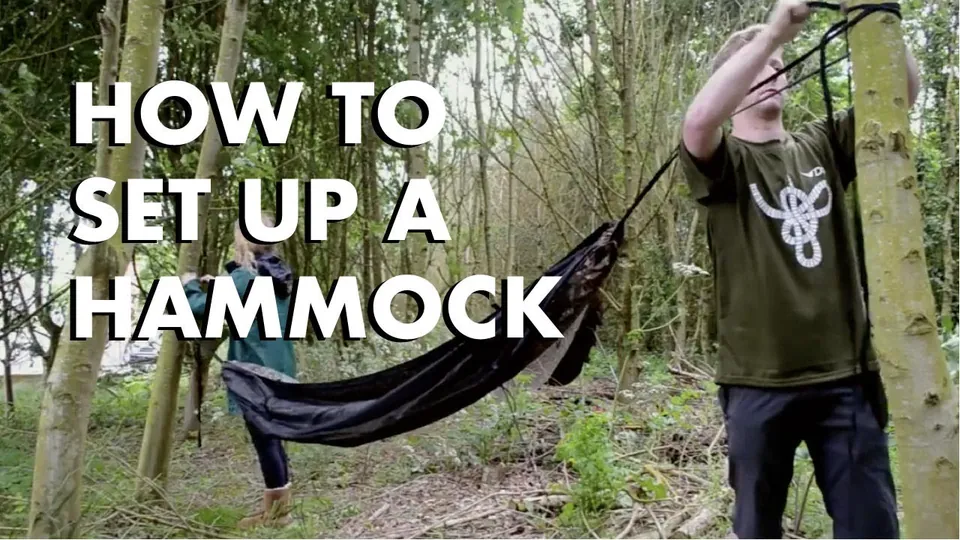
The video is hosted by YouTube (Google): nothing loads until you play it, and Google may then set cookies.
FAQs
What length of hammock should I choose for my height?
Look at the sleeper height the maker lists, then leave yourself some room. DD Hammocks rates its 2.7 m Frontline comfortable up to 1.96 m, and its 3 m version up to 2.13 m. Warbonnet rates its Blackbird up to 1.83 m, but recommends the long model, 30 cm longer, from 1.78 m. Width matters too: it is what lets you lie on the diagonal.
Do you need an underquilt in summer?
You need at least some insulation under your back. Warbonnet warns that without it, your back gets cold after a few hours even at around 19 or 20 °C, because the sleeping bag crushed under your body barely insulates. An underquilt is one answer, a mat another: Amok designs its Draumr around an inflatable mat, and Hennessy insulates some of its hammocks with a pad slipped into a double bottom.
Why angle the straps at 30°?
ENO and Warbonnet recommend it, and the calculation shows why: at 30°, each strap carries exactly the sleeper’s weight; the flatter the hang, the higher the pull, nearly twice that weight at 15° and almost three times at 10°. DD Hammocks warns that this force strains the suspension. Warbonnet adds that at 30°, its ridgeline is neither too tight nor drooping.
Is a hammock lighter than a tent?
Not necessarily. According to the makers’ spec sheets, a Warbonnet Blackbird XLC with its suspension and a tarp weighs about 1.12 kg, a little less than a one-person tent such as MSR’s Hubba Hubba LT 1, at 1.23 kg packaged. But you have to add insulation underneath: DD Hammocks’ underquilt weighs 950 g on its own. And the tent needs its mat too.
Are you allowed to hang a hammock in a national park?
It depends on the park. In the United States, Zion bans them, Rocky Mountain restricts them and Yosemite allows them on its campsites, with the trees padded. In France, the national parks’ portal describes wild camping in a park’s core zone as a night under the stars or in a small tent, without mentioning hammocks, and bans it on Port-Cros, Porquerolles and in the Calanques. Ask the park before you go.
Sources
- DD Hammocks, ‘Choosing your DD Hammock’, comparison table of the hammocks, accessed 8 November 2026. ddhammocks.com https://www.ddhammocks.com/pages/choosing-your-dd-hammock ↩
- DD Hammocks, ‘DD Frontline Hammock’, product page, accessed 8 November 2026. ddhammocks.com https://www.ddhammocks.com/products/dd-frontline-hammock ↩
- Warbonnet Outdoors, ‘Hammocking 101’, hammock guide, accessed 8 November 2026. warbonnetoutdoors.com https://www.warbonnetoutdoors.com/hammocks-101/ ↩
- Warbonnet Outdoors, ‘Blackbird XLC’, product page, third generation of 1 October 2025, accessed 8 November 2026. warbonnetoutdoors.com https://www.warbonnetoutdoors.com/product/blackbird-xlc/ ↩
- ENO (Eagles Nest Outfitters), ‘SingleNest Hammock’, product page, accessed 8 November 2026. eaglesnestoutfittersinc.com https://eaglesnestoutfittersinc.com/products/singlenest-hammock ↩
- Amok Equipment, ‘Amok Draumr 5.0 - Hammock’, product page, accessed 8 November 2026. amokequipment.com https://amokequipment.com/en-us/products/draumr-5-0-hammock ↩
- Leave No Trace, ‘How to Hammock Camp Responsibly’, guidelines, 2025, accessed 8 November 2026. lnt.org https://lnt.org/wp-content/uploads/2026/01/2025-LNT-Hammock-Camping-Guidelines.pdf ↩
- DD Hammocks, ‘Setting up your DD hammock’, set-up guide, accessed 8 November 2026. ddhammocks.com https://www.ddhammocks.com/pages/setting-up-your-dd-hammock ↩
- ENO (Eagles Nest Outfitters), ‘How To: Set Up Your Atlas Hammock Straps’, 10 March 2022, accessed 8 November 2026. eaglesnestoutfittersinc.com https://eaglesnestoutfittersinc.com/blogs/product-education/how-to-set-up-your-atlas-suspension-system ↩
- Hennessy Hammock, ‘Frequently Asked Questions’, accessed 8 November 2026. hennessyhammock.com https://hennessyhammock.com/pages/frequently-asked-questions-faq ↩
- Warbonnet Outdoors, ‘Superfly’, tarp product page, accessed 8 November 2026. warbonnetoutdoors.com https://www.warbonnetoutdoors.com/product/superfly/ ↩
- DD Hammocks, ‘DD Tarp 3x3’, spec sheet, accessed 8 November 2026. media.ddhammocks.com https://media.ddhammocks.com/images/2024_Spec_Sheets/Spec_sheet_Tarp_3x3.pdf ↩
- Warbonnet Outdoors, ‘Underquilts 101’, guide to insulation under the hammock, accessed 8 November 2026. warbonnetoutdoors.com https://www.warbonnetoutdoors.com/underquilts-101/ ↩
- DD Hammocks, ‘DD Underblanket’, product page, accessed 8 November 2026. ddhammocks.com https://www.ddhammocks.com/products/dd-underblanket-coyote-brown ↩
- Amok Equipment, ‘How Draumr hammocks work’, guide, accessed 8 November 2026. amokequipment.com https://amokequipment.com/en-us/pages/how-draumr-hammocks-work ↩
- MSR (Cascade Designs), ‘Hubba Hubba LT 1 Tent’, product page, accessed 8 November 2026. cascadedesigns.com https://cascadedesigns.com/products/hubba-hubba-lt-1-person-backpacking-tent ↩
- Hilleberg, ‘Akto’, product page, accessed 8 November 2026. hilleberg.com https://hilleberg.com/eng/products/tent/Akto ↩
- National Park Service, Zion National Park, ‘Camping Regulations’, page updated 2 June 2026, accessed 8 November 2026. nps.gov https://www.nps.gov/zion/planyourvisit/camping-regulations.htm ↩
- National Park Service, Rocky Mountain National Park, ‘Superintendent’s Compendium’, updated 24 July 2026, accessed 8 November 2026. nps.gov https://www.nps.gov/romo/learn/management/rmnp_compendium.htm ↩
- National Park Service, Yosemite National Park, ‘Campground Regulations’, page updated 1 August 2025, accessed 8 November 2026. nps.gov https://www.nps.gov/yose/planyourvisit/campregs.htm ↩
- Parcs nationaux de France, the French national parks’ portal, ‘Le bivouac’ (in French), accessed 8 November 2026. parcsnationaux.fr https://parcsnationaux.fr/votre-visite/bonnes-pratiques-et-activites/le-bivouac ↩
- Office national des forêts (ONF), France’s national forest agency, ‘Réserve biologique dirigée de la Savane-roche Virginie’ (in French), accessed 8 November 2026. onf.fr https://www.onf.fr/vivre-la-foret/+/278d::reserve-biologique-dirigee-de-la-savane-roche-virginie.html ↩
- Office national des forêts (ONF), ‘Nos conseils en cas d’urgence’, emergency advice (in French), accessed 8 November 2026. onf.fr https://www.onf.fr/vivre-la-foret/+/11d7::nos-conseils-en-cas-durgence.html ↩
- Office national des forêts (ONF), ‘Après une tempête : les bons réflexes en forêt’, advice after a storm (in French), accessed 8 November 2026. onf.fr https://www.onf.fr/vivre-la-foret/que-faire-en-foret/conseils-pratiques-foret/+/2bf3::apres-une-tempete-les-bons-reflexes-en-foret.html ↩

Camping, wild camping, bushcraft and hiking
Guillaume Hoarau writes for Outfarer about camping, wild camping, bushcraft and hiking. A survival-skills enthusiast and a collector of old field manuals, he likes clear explanations, lists that earn their place and other people’s stories, which he tells well.


