 Français (France)
 English (UK)
 English (US)
 Deutsch (Deutschland)

Contents
Night is falling, the tarp is unfolded, and the last guy line is dangling between your fingers. A shoelace knot, another on top, a third for morale. By morning, either the whole lot has given way or you need a knife to get your cord back. Ropework enthusiasts collect knots by the dozen, and I am in no position to judge: I collect old manuals. To set up a camp, six will do.
This guide follows on from our tarp pitches and comes in at the ‘The pitch’ stage of our guide to your first wild camp. For each knot: what it does at camp, how to tie it, the usual mistake and how to undo it.
Six knots, and where they go on a pitched tarp
On a tarp, three knots do almost all the work, the ones Scout Life, the magazine of Scouting America, gives for guy lines: the bowline at the eyelet, the taut-line hitch at the tent peg, and two half hitches to tie a line to a ring or a post [1]. The clove hitch joins them for fixing a rope to a stake [2]. The last two never touch the tarp: the timber hitch hauls a log, the square lashing joins two poles.
Three terms keep coming up in the steps. The The section of rope that stays put and runs towards the load or the other attachment. is the rest of the rope, the The end of the rope, the one you tie the knot with. is the end you work with [3], and a An overhand knot tied round the standing part, with the end coming back alongside it. is an overhand knot whose end comes back along the standing part [2].
The bowline: a fixed loop at the eyelet
This is the loop that does not slip [2]. At camp, it ties a guy line to the corner eyelet of a tarp or tent [5, 1]. Under load it neither slips nor jams; once unloaded, it unties without a struggle [11].
- Pass the running end through the eyelet, leaving plenty of length.
- On the standing part, make a small loop: the strand coming from the eyelet crosses over the standing part.
- Bring the end up through the small loop, from underneath.
- Take it behind the standing part, then back down into the small loop. It’s the old Scout image: the rabbit comes out of its hole, goes round the tree and back down the hole [3].
- Tighten by pulling the standing part, holding the large loop in your other hand. The end must come out on the inside of the large loop [1].
The usual mistake. Assuming it is sound in all circumstances. Animated Knots, an online knot reference, says so plainly: unloaded, it can very readily work itself undone [11]. A loop hanging with nothing pulling on it, a slackened guy line: those are the moments to look at it closely. Leave a generous running end, and on synthetic cord, secure it with a half hitch, as the Éclaireuses et Éclaireurs de France, a French Scouting association, advise [2].
To undo it. Never under load: it can be neither tied nor untied while the standing part is pulling [11]. Slacken the guy line, push back the A curve in the rope that does not cross itself. round the standing part, and the whole knot opens up.
The taut-line hitch: a guy line you adjust by hand
It forms an adjustable loop that stays put: this is Scout Life’s knot for guying out a tent or tarp [1]. Belgium’s French-speaking Scouts, Les Scouts, use it to replace a missing guy-line tensioner [5]. It goes at the bottom of the guy line, round the tent peg.
- Pass the running end round the tent peg and bring it back towards the standing part.
- Take a turn round the standing part and go back through the loop you have formed.
- Make a second turn inside the loop, closer to the tent peg.
- In the same direction, make a last turn round the standing part, this time outside the loop: that is a half hitch.
- Take out the slack, then slide the knot to tighten or loosen the guy line [1].
The usual mistake. Asking more of it than it can give. This knot is not safe, it slips easily, warn the Belgian Scouts, who rule it out for the guy lines of a mast that someone has to climb [5]. It will do for a tarp at a pinch, nothing more. Scouting America also points out that a knot can slip when wet [12]. So recheck a guy line before you sleep, all the more as nylon stretches in the damp, as our tarp pitches guide explains.
To undo it. One move loosens it: slide it towards the tent peg to give some slack, lift the loop off the peg, then unwind the turns in the reverse order.
The clove hitch: a rope on a stake, a stick or a post
The clove hitch is generally used to fix a rope round a stake [2]. At camp, it ties a line to a stick or a post, and it begins and ends many lashings [1]. On a living tree, it never goes directly on the bark: the section on trees, further down, explains what to do.
- Pass the running end over and then under the stick.
- Make a second turn, crossing the first: an X takes shape.
- Go round once more and tuck the end under the X.
- Check: both strands come out between the legs of the X. If they come out on either side of the X, it is not a clove hitch [1].
- Pull on both strands to tighten.
On a post with a free top, it’s simpler still: make a loop, drop it over the post, then drop an identical second loop on top [13].
The usual mistake. Leaving it on its own. The Scout Association rates it less secure than a round turn and two half hitches [14]. Animated Knots faults it for slipping and, conversely, for being able to jam, and advises distrusting it when used alone [13]. Without constant tension, it tends to work loose unless it is secured with two half hitches [2]. Add two, not ten: stack up half hitches and you risk a knot that a heavy strain makes impossible to undo [13].
To undo it. If it hasn’t been under heavy strain, it comes undone as easily as it goes on [5]: first remove the half hitches securing it, then push back the turns and slide them off the stick.
Two half hitches: tying off a line
They tie a rope to a ring, a post or an eyelet [1, 15]. At camp, they finish tying off a line and secure another knot, such as the clove hitch. With a The rope taken fully round an object, without tying a knot. round the support first, they are more secure, and that turn takes the strain while you finish [15, 16]. As soon as a line is pulling hard, use this version.
- Pass the end round the post or through the eyelet.
- Bring it over the standing part, round it and through the loop you have formed: that is one half hitch.
- Take another turn round the standing part, outside the loop, in the same direction.
- Tighten, then slide the knot up against the post or eyelet [1].
The usual mistake. Changing direction between the two. They must turn the same way round the standing part [1, 15]: that is how they form a clove hitch round it [15].
To undo them. Slacken the rope, loosen the last half hitch, then the first, and pull the end out of the ring or eyelet: with no tension, they put up no resistance.
The timber hitch: hauling a log, tying to a piece of wood
This is the knot for dragging a log along the ground: it holds as long as you pull, and comes off easily afterwards [1]. It also ties a rope to a piece of wood, as long as that rope stays more or less taut, and it starts a lashing [5]. The Scout Association classes it as a temporary knot [14].
- Pass the end round the log.
- Take it round the standing part.
- Wrap the end round itself: two or three times for the Belgian Scouts [5], at least three for Scout Life [1, 17].
- Pull: the turns lock against the wood.
For a long piece, place the knot near the middle and add a half hitch near the end, which acts as a guide as you pull [14, 17].
The usual mistake. Giving it slack. Give it slack, shake the rope, and it comes undone, write the Belgian Scouts [5]. So it only suits a rope that stays taut, never a guy line flapping in the wind.
To undo it. There is next to nothing to do. Ashley, author of the great American book of knots, quoted by Animated Knots, notes that it practically falls apart as soon as the pull stops [17]. Ease off, tug the end, done.
The square lashing: joining two poles
This is not a knot but a join: a rope holding two crossed pieces together, usually at right angles [5]. It is a Scout camp skill, for a frame or a table [18]. It stays temporary: ropes slacken, especially with damp, and you have to re-tension them regularly [5].
- Start with a timber hitch on the load-bearing pole, below the pole it carries [5, 19]. A clove hitch works too [2].
- Make three or four wrapping turns round both poles, even and side by side, tensioning the rope on every turn [5].
- Make three Turns taken between the two poles, round the wrapping turns, to tighten them. between the poles, pulling as hard as you can on each turn [19].
- Finish with a clove hitch round one of the poles [5, 19].
The usual mistake. Overlapping turns: some then take all the load, while others do no work [5]. Another trap is finishing with a reef knot: the Belgian Scouts advise against it, because it tightens poorly and works loose [5], even though other Scout booklets use it [2].
To undo it. Undo the final clove hitch and unwind the rope in the reverse order. Then put the wood back where you found it.
On a wild camp, lashing remains the exception. Leave No Trace Canada puts it this way: avoid building structures, making furniture or digging trenches [20]. Save it for a camping ground that allows it, with dead wood fallen on the ground, never with green wood cut for the occasion: that is the spirit of the ‘Leave What You Find’ principle, in our guide to leaving no trace. And a camp lashing takes nobody’s weight.
Which cord for these knots: 3 or 4 mm
Edelrid, the German rope maker, presents its 3 mm cord as a possible guy line for camping and tents [21]. Here are three spec sheets, as examples. And don’t forget to count it: the tarp in our kit list is weighed without its cords.
| Model | Diameter | Weight | Stated breaking strength |
|---|---|---|---|
| Edelrid Multicord SP [21] | 3 mm | 6 g/m | 2 kN |
| Simond (Decathlon) [6] | 3 mm | 6.5 g/m | 2.5 kN |
| Simond (Decathlon) [7] | 4 mm | 10.7 g/m | 4.4 kN |
Figures stated by the manufacturers. Examples of spec sheets, not recommendations. Simond is Decathlon’s climbing and mountaineering brand. Decathlon intends these cords as auxiliary lines for climbing, mountaineering, caving and work at height.
2 kN is of the order of 200 kg of pull, but that is a breaking load, not a working load. Decathlon’s instructions for its 4 to 8 mm cords warn that a knot halves the initial strength, and that cord loses strength when wet or frozen [22]. They also ask you to check the sheath regularly and to avoid any contact with sharp edges.
Trees: a wide strap, not bare cord
Leave No Trace, the US organisation behind the leave-no-trace principles, wrote its guidelines for hammocks [4]. They don’t mention tarps, but we apply them to any line tied to a tree. On a living tree, use a flat strap at least 2.5 cm wide, wrapped just once round the trunk, and nothing thinner, which damages the bark and the living tissue beneath. No knot on the trunk, no nail or screw [4].
So the knot ties to the strap, not to the bark: the clove hitch and timber hitch keep their place on a stake, a post or a log. Choose a living tree at least 15 cm in diameter, preferably with hard bark, never a dead tree, and look up to spot dead branches [4]. Our tarp pitches guide goes through all of this, including checking with whoever manages the land.
The summary sheet to print
It all fits in this table. The ‘Print this guide’ button, at the top of the article, puts the page on paper with the table and the diagram; the photos stay on screen.
| Knot | Use at camp | Remember |
|---|---|---|
| Bowline | Fixed loop in a tarp eyelet | Can come undone when unloaded: long running end, half hitch on synthetic cord |
| Taut-line hitch | Adjustable guy line, at the tent peg | Slips easily: recheck in the evening |
| Clove hitch | Rope on a stake, a stick, a post | Never alone: two half hitches after it |
| Two half hitches | Tying off a line, securing another knot | Same direction, and a round turn first if it pulls hard |
| Timber hitch | Dragging a log, starting a lashing | Holds while you pull: no slack |
| Square lashing | Joining two poles, on ground that allows it | Turns side by side, re-tension, dead wood only |
None of these knots is for belaying, tying in or taking a person’s weight.
Kit related to this article
No affiliation: no commission, no sponsored products.
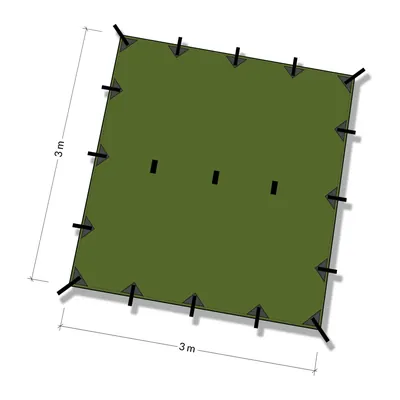
DD Hammocks Tarp 3x3
A 3 × 3 m square tarp in coated polyester (3,000 mm), 790 g, with 19 reinforced attachment points: the size that allows all four basic pitches, diamond and closed included.
View on Amazon (opens in a new tab)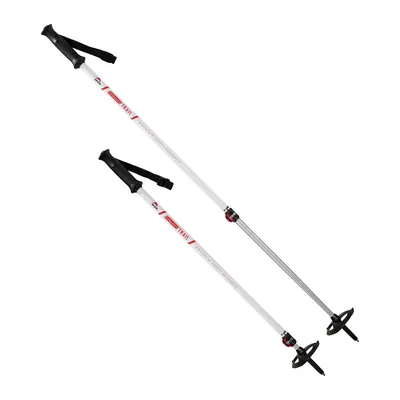
MSR DynaLock Trail Poles
Aluminium poles adjustable from 100 to 140 cm, with a DynaLock lever lock that tightens without tools, plus snow and summer baskets: shorter uphill, longer downhill.
View on Amazon (opens in a new tab)
Worth watching
In under a minute, TheTautLine ties the taut-line hitch for guying out a tent or tarp: a useful companion to the written steps, because this knot makes more sense in motion.
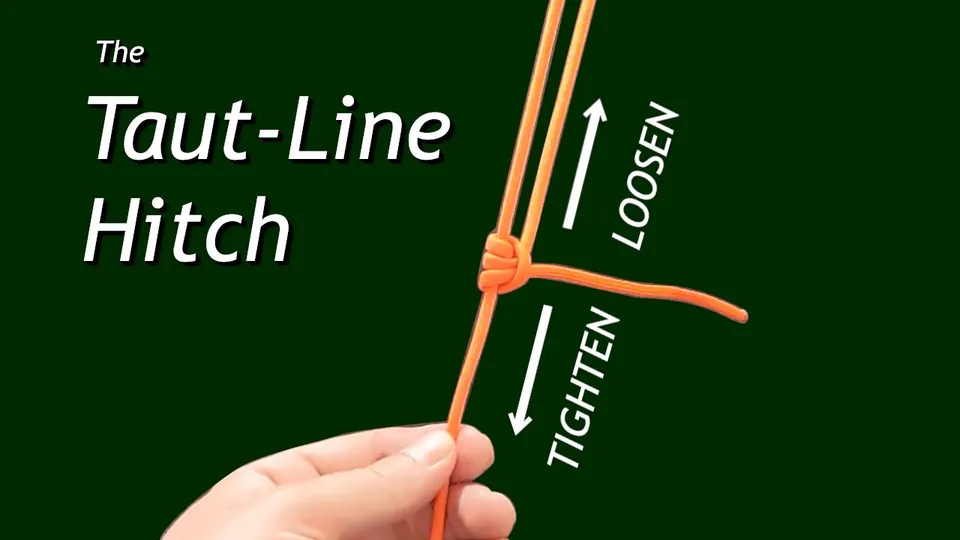
The video is hosted by YouTube (Google): nothing loads until you play it, and Google may then set cookies.
FAQs
Which knot should I use to tension a tarp guy line?
The taut-line hitch, tied round the tent peg, lets you set the tension by sliding it by hand. At the other end of the guy line, a bowline makes a fixed loop through the tarp’s eyelet. The taut-line hitch can slip, especially when wet: recheck the tension before you sleep, and re-tension if needed.
Can a bowline come undone on its own?
Yes. It holds well under load, but it can very readily come undone once it is no longer loaded, for example on a hanging loop or a slackened guy line. Leave a generous running end and, on synthetic cord, secure it with a half hitch. It is a camp knot for a tarp: here it is not for belaying or taking a person’s weight.
How do I tie a rope to a tree without damaging it?
First wrap a flat strap at least 2.5 cm wide once round the trunk, then tie your rope to the strap, with a bowline or two half hitches. Never put bare cord on the bark, and never use a nail or a screw. Choose a living tree at least 15 cm in diameter, and check with whoever manages the land.
What cord should I take for guy lines?
Edelrid presents its 3 mm cord as a possible guy line for camping. The spec sheets we read state a breaking strength of 2 to 2.5 kN at 3 mm, and 4.4 kN for one 4 mm model. That is a breaking load, not a working load, and Decathlon’s instructions for its 4 to 8 mm cords state that a knot halves the initial strength. Check the sheet for your own model.
Can I tie in with these knots?
No, this guide does not cover climbing. These knots and cords are for tensioning a tarp, tying down kit and hauling wood. To tie in, the French climbing federation FFME recommends the figure-of-eight, on a proper rope, checked by both the climber and their partner. All of this is learnt in a club, with an instructor, never from a page.
Sources
- Scout Life, magazine of Scouting America, ‘How to Tie the 7 Basic Scout Knots’, accessed 7 November 2026. scoutlife.org https://scoutlife.org/outdoors/176401/how-to-tie-the-7-basic-scout-knots/ ↩
- Éclaireuses et Éclaireurs de France (a French Scouting association), ‘Techniques de matelotage’, technical booklet, 2018 (in French), accessed 7 November 2026. eedf.fr https://www.eedf.fr/wp-content/uploads/2019/02/25.12-Livret-technique-matelotages.pdf ↩
- The Scout Association (UK), ‘Simple Knots Essentials’, accessed 7 November 2026. prod-cms.scouts.org.uk https://prod-cms.scouts.org.uk/media/3549/gruffalo-knot-tying.pdf ↩
- Leave No Trace, ‘How to Hammock Camp Responsibly’, 2025 guidelines, accessed 7 November 2026. lnt.org https://lnt.org/wp-content/uploads/2026/01/2025-LNT-Hammock-Camping-Guidelines.pdf ↩
- Les Scouts ASBL (French-speaking Scouts of Belgium), ‘S’installer au camp : Nœuds et brêlages’, information sheet, 2010 (in French), accessed 7 November 2026. lesscouts.be https://lesscouts.be/download-file/5099 ↩
- Decathlon Pro, ‘Cordelette d’escalade et d’alpinisme 3 mm x 10 m’ (Simond), product sheet (in French), accessed 7 November 2026. decathlonpro.fr https://www.decathlonpro.fr/cordelette-escalade-3mm-x-10m-coloris-assortis-id-1347579.html ↩
- Decathlon Pro, ‘Cordelette d’escalade et d’alpinisme 4 mm x 7 m’ (Simond), product sheet (in French), accessed 7 November 2026. decathlonpro.fr https://www.decathlonpro.fr/cordelette-d-escalade-et-d-alpinisme-4-mm-x-7-m-rouge-id-8525064.html ↩
- Fédération française de la montagne et de l’escalade (FFME, the French climbing and mountaineering federation), ‘Nœud d’encordement en huit’, technical safety sheet (in French), accessed 7 November 2026. ffme.fr https://www.ffme.fr/wp-content/uploads/2020/01/noeud-huit.pdf ↩
- OUTDOOR (Germany), ‘Duell der Knoten: Achter versus Bulin’, 10 April 2024 (in German), accessed 7 November 2026. outdoor-magazin.com https://www.outdoor-magazin.com/klettern/duell-der-knoten-achter-versus-bulin/ ↩
- Fédération française des clubs alpins et de montagne (FFCAM, the French federation of alpine and mountain clubs), ‘Se former en escalade’ (in French), accessed 7 November 2026. ffcam.fr https://ffcam.fr/se-former-en-escalade.html ↩
- Animated Knots by Grog, ‘Bowline Knot’, accessed 7 November 2026. animatedknots.com https://www.animatedknots.com/bowline-knot ↩
- Scouting America, Troop Leader Resources, ‘Information: Pioneering’, accessed 7 November 2026. troopleader.scouting.org https://troopleader.scouting.org/program-features/pioneering/information/ ↩
- Animated Knots by Grog, ‘Clove Hitch’, accessed 7 November 2026. animatedknots.com https://www.animatedknots.com/clove-hitch-knot-half-hitches ↩
- The Scout Association (UK), ‘What knot? Quick guide to popular knots’, July 2019, accessed 7 November 2026. prod-cms.scouts.org.uk https://prod-cms.scouts.org.uk/media/2732/a-knotty-challenge-what-knot.pdf ↩
- Animated Knots by Grog, ‘Two Half Hitches’, accessed 7 November 2026. animatedknots.com https://www.animatedknots.com/two-half-hitches-knot ↩
- Animated Knots by Grog, ‘Round Turn & Two Half Hitches’, accessed 7 November 2026. animatedknots.com https://www.animatedknots.com/round-turn-two-half-hitches-knot ↩
- Animated Knots by Grog, ‘Timber Hitch’, citing The Ashley Book of Knots, no. 1665, accessed 7 November 2026. animatedknots.com https://www.animatedknots.com/timber-hitch-knot ↩
- Animated Knots by Grog, ‘Square Lashing’, accessed 7 November 2026. animatedknots.com https://www.animatedknots.com/square-lashing-knot ↩
- Les Guides (French-speaking Guides of Belgium), ‘Woodcraft : révise tes brelages’, information sheet (in French), accessed 7 November 2026. guides.be https://www.guides.be/sites/default/files/2020-03/Noeuds%20-%20R%C3%A9vise%20tes%20brelages.pdf ↩
- Sans Trace Canada (Leave No Trace Canada), ‘Les sept principes Sans trace’ (in French), accessed 7 November 2026. sanstrace.ca https://sanstrace.ca/les-sept-principes-sans-trace/ ↩
- Edelrid, ‘Multicord SP 3 mm’, product sheet (in French), accessed 7 November 2026. edelrid.com https://edelrid.com/fr-fr/sport/cordes/multicord-sp-3-0mm ↩
- Decathlon, ‘Notice d’utilisation cordelettes’, instructions for use, 2023 (in French), accessed 7 November 2026. support.decathlon.fr https://support.decathlon.fr/notice-dutilisation-cordelettes ↩
- Animated Knots by Grog, ‘Prusik Knot’, accessed 8 November 2026. animatedknots.com https://www.animatedknots.com/prusik-knot ↩
- Frontier Bushcraft, Paul Kirtley, ‘How to keep your tarp in place on a ridgeline (using a Prusik knot for tarps)’, accessed 8 November 2026. frontierbushcraft.com https://frontierbushcraft.com/prusik-knot-tarps/ ↩
- Scandinavian Outdoor, ‘Choosing and pitching a tarp’, retailer advice, accessed 8 November 2026. scandinavianoutdoor.com https://scandinavianoutdoor.com/life-outdoors/choosing-and-pitching-a-tarp/ ↩
- Petzl, ‘Friction hitches’, tech tips, accessed 8 November 2026. petzl.com https://www.petzl.com/gb/en/sport/tech-tips/basic-techniques/friction-hitches/Noeuds-autobloquants_SPO_a77w0000000GnbrAAC.html ↩

Camping, wild camping, bushcraft and hiking
Guillaume Hoarau writes for Outfarer about camping, wild camping, bushcraft and hiking. A survival-skills enthusiast and a collector of old field manuals, he likes clear explanations, lists that earn their place and other people’s stories, which he tells well.


