 Français (France)
 English (UK)
 English (US)
 Deutsch (Deutschland)

Contents
Friday evening, the night before. Piled on the bed: a tent lent by a colleague, a sleeping bag that smells faintly of the loft, three torches, a cast-iron frying pan and a family-size bag of pasta. For a first night out, the hard part isn’t remembering everything: it’s deciding what to leave behind. Here is the list, section by section, with what each item weighs according to its manufacturer, what you can borrow, what stays at home, and a version to tick off at the bottom of the page.
It picks up where our day walk kit list leaves off: water, food, a waterproof jacket, a warm layer and the first aid kit stay in the rucksack, and the night adds a shelter, a bed, a kitchen and some light. Beyond the tent and sleeping bag, Mountaineering Scotland lists the necessities as a sleeping mat, cooking gear (stove, pans, mug, cutlery), a water container, a torch, ideally a head torch, and a lighter or waterproof matches [1]. For several days of self-sufficient walking, the French Hiking Federation (FFRandonnée) also lists the stove’s fuel, a sponge and tea towel for the pans, several bin bags, a roll of strong string, a large plastic tarpaulin and tablets to treat water [2]. This page expands the checklist in our step-by-step guide to a first wild camp, which covers where to sleep and how to go about it.
What it all weighs: about 5.7 kg before water and food
Let’s start with the scales, since they decide how much you’ll enjoy the walk in. The table gives, section by section, the weight a manufacturer lists for one of its models. These models are examples of product pages, not recommendations: read the page for the kit you’ll borrow or buy, because the differences from one model to the next are large.
| Item | Example product page | Listed weight |
|---|---|---|
| 40-litre rucksack (+10) | Deuter Aircontact Lite 40+10 | 1.59 kg [3] |
| Two-person backpacking tent | MSR Hubba Hubba NX 2, packaged | 1.72 kg [4] |
| Two-person camping tent | Vaude Campo Compact 2P | 2.7 kg [5] |
| 3 × 3 m tarp | DD Hammocks DD Tarp 3x3, without pegs or guy lines | 790 g [6] |
| Summer sleeping bag, synthetic | Deuter Orbit +5°, stuff sack included | 1.1 kg [7] |
| Down sleeping bag | Sea to Summit Trek, limit -1 °C | 1.2 kg [8] |
| Foam sleeping mat | Therm-a-Rest Z Lite Sol | 410 g [9] |
| Inflatable sleeping mat | Therm-a-Rest NeoAir XLite NXT | 370 g [10] |
| Canister stove | MSR PocketRocket 2 | 73 g [11] |
| Canister holding 110 g of gas | MSR IsoPro | 210 g [12] |
| Hard water bottle, just under 1 litre | Nalgene 32oz Wide Mouth | 177 g [13] |
| Head torch | Petzl Actik Core | 88 g [14] |
| First aid kit, stocked | Deuter First Aid Kit | 300 g [15] |
| Small folding trowel | Sea to Summit Pocket Trowel | 68 g [16] |
Weights listed by each manufacturer for the standard size; they vary from one model and size to the next.
Add up one item per section, taking the backpacking tent, the summer sleeping bag and the foam mat, and you reach 5.7 kg, before water, food, clothes and pans. Above all, the sum shows one thing: four items, the tent, the rucksack, the sleeping bag and the mat, account for 4.8 kg on their own, or 84% of the total. That’s where the kilos are won or lost, far more than in the wash bag. Dedicated gram-counters will do better, and quite right too; for a first night, what matters is not leaving anything behind.
Then there’s the water, which weighs exactly what it is: 1 kg per litre. Compare the total with what you can carry. For a walk of several days, the French Hiking Federation recommends no more than 20% of your body weight, which is 11 kg for someone weighing 55 kg and 16 kg at 80 kg [2]. For a three-day trip, the British Mountaineering Council (BMC) suggests a 45-litre rucksack weighing about 10 kg when full [17]. The rucksack in our example is designed for loads of 12 to 15 kg, according to Deuter [3].
Shelter and sleep: the three items that matter
For shelter, a two-person tent is still the simplest way to start. Look at its The weight of everything in the package: inner, flysheet, poles, pegs, guy lines and stuff sacks.: at MSR, it counts the whole contents of the package, whereas the minimum weight includes only the inner, the flysheet and the poles, which gives 1.72 kg against 1.54 kg for the Hubba Hubba NX 2 [4]. A camping tent of the same capacity is soon heavier: 2.7 kg for the Campo Compact 2P, which Vaude lists for camping [5]. A tarp, just a sheet of fabric pitched taut, comes down to 790 g for a 3 × 3 m model, without pegs or guy lines [6], but you need to know how to pitch it: our guide to tarp pitches explains which to choose.
At night, two items work together. Choose a sleeping bag by its comfort temperature, not by the figure in its name, which often gives the limit: Deuter’s synthetic Orbit +5° has a comfort rating of 9 °C and a limit of 5 °C, and weighs 1,050 g, plus a 48 g stuff sack [7]. A down bag such as Sea to Summit’s Trek lists 1,197 g for a limit of -1 °C [8]. Our guide to sleeping bag ratings explains how to read these figures.
The mat, for its part, insulates you from the ground, which draws heat from a body lying on it. Its A mat’s thermal resistance: the higher it is, the better it insulates you from the ground. tells you how well: 2 for the Z Lite Sol folding foam mat, which weighs 410 g [9], and 4.5 for the NeoAir XLite NXT inflatable, 370 g, supplied with its repair kit [10]. Foam doesn’t mind thorns; the inflatable insulates better for less weight, as long as you remember the patch kit. Our guide to R-value explains how to compare them. Add a warm layer and dry socks kept for the night: Mountaineering Scotland reckons a spare warm layer and a dry pair of walking socks are well worth their weight, and reminds campers not to forget a hat and gloves, ‘even though it’s summer’ [1].
Food and water: a stove, a pan and some water
The kitchen fits in one hand: a canister stove such as MSR’s PocketRocket 2 weighs 73 g [11], and a canister holding 110 g of gas is listed at 210 g [12]. Add, as Mountaineering Scotland lists, a pan, a mug and cutlery, with a lighter or waterproof matches [1]. The stove replaces the campfire, which Mountaineering Scotland strongly discourages for cooking, especially in woodland, on peaty soil and among dry vegetation [1]. And it never goes inside the tent.
For food, plan the evening meal, breakfast, something to nibble on arrival and a spare snack. Take it all out of unnecessary packaging before you leave: that’s less rubbish to carry back down. Then there’s the water, which quickly weighs the rucksack down, all the more so since a hard bottle already weighs 177 g empty [13]. Allow for the evening and the morning, for drinking and for cooking, and for a way to treat water from streams, filter or tablets: our guide to water for wild camping compares the methods.
Light, navigation and first aid
Night always falls sooner than planned. A head torch leaves your hands free to pitch the tent or cook: Petzl’s Actik Core, for example, weighs 88 g and charges via USB-C, but comes without a cable [14]. Charge it the day before; the French Hiking Federation also suggests a spare battery for the head torch [2].
To find your way, take a map and a compass: the French federation lists both, the map at 1:25,000, the scale of OS Explorer maps [2]. A charged phone, with a power bank, is how you raise the alarm: in England and Wales, Mountain Rescue says to dial 999 or 112 and ask for the police, then Mountain Rescue [19]. France’s national parks also ask for a minimum of kit to deal with the unexpected: a first aid kit, a whistle, a Swiss Army knife [20].
Hygiene, rubbish and a few small extras
For washing, a toothbrush, a little soap and a small towel are enough, as long as you wash well away from the water: in upland streams, soap could kill local insect and plant life, warns the BMC, which asks you to dispose of soapy water well away from watercourses [17]. For the call of nature, a small folding trowel weighs 68 g, and its depth markings help you dig deep enough [16]. Mountaineering Scotland asks you to urinate at least 30 m from open water, to bury solid waste as far as possible from water and buildings, and to carry out used toilet paper in resealable bags [1]. Our guide to leaving no trace covers the details.
Take several bin bags too [2]: all your rubbish goes home with you, biodegradable scraps included, which are slow to break down in the mountains and may be scattered by animals, the BMC points out [17].
Borrow or hire rather than buy
For a first night, there’s no need to buy the tent, sleeping bag, mat and big rucksack before you know whether you like sleeping outdoors: borrow them from friends or family, or hire them. Outdoorhire, for example, hires out tents, sleeping bags, sleeping mats and cooking kit, sent by courier within the UK [21]. Keep your money for the small personal items, which also come on every day walk: the head torch, the water bottle, the first aid kit, the survival blanket. When the time comes to buy the rucksack, our guide says how many litres you need.
Borrowed kit is sometimes heavier than the backpacking gear on the product pages: with a 2.7 kg camping tent instead of a 1.72 kg backpacking tent, our example goes from 5.7 to 6.7 kg [5, 4]. On a short walk in, the extra kilo is no great hardship; on a long climb, you’ll feel it.
What stays at home
Everything that makes a stay on a campsite comfortable stays in the garage. For extra comfort, Decathlon’s French camping checklist adds a camp bed, a cool box, a folding table and chairs and a solar shower [22]: none of that belongs on your back. Nor does the big family tent: in Scotland, access rights cover lightweight camping in small numbers, and the Outdoor Access Code asks campers to use small tents [23].
The axe and saw stay in the shed: Mountaineering Scotland strongly discourages fires [1], the Scottish Outdoor Access Code asks you to use a camping stove if you need to cook [23], and in England and Wales, the BMC points out, wild camping isn’t permitted by right on open access land without the landowner’s express permission [17]: our guide to where you can wild camp in the UK goes through the exceptions. The speaker disturbs wildlife: among its rules for an emergency bivouac in the mountains, the German Alpine Club asks you to avoid noise, especially at dusk, when most wild animals are active and easily disturbed [24]. As for the third jumper ‘just in case’, the cast-iron frying pan and the three torches, you’d spotted them already.
The printable list to tick off
Tick it off the night before, laying each item on the floor, then run through it again as you close the rucksack. Adapt it to the season, the altitude and the forecast.
Shelter
- Tent, pitched at least once before, or tarp and its guy lines
- Poles, pegs and guy lines, counted
- Groundsheet or footprint, depending on the shelter
Sleep
- Sleeping bag chosen by its comfort temperature
- Insulating mat, and its repair kit if inflatable
- Warm layer, hat and dry socks kept for the night
- Gloves for evening and morning, depending on the season
Food and water
- Stove and compatible canister, tried together
- Lighter and matches, kept dry
- Pan, mug, spoon, sponge and tea towel
- Evening meal, breakfast, snacks and a spare ration
- Water for the walk, the evening and the morning
- Filter or tablets to treat stream water
Light and navigation
- Head torch, charged, or spare batteries
- Map and compass
- Charged phone and power bank
First aid and protection
- First aid kit and personal medication
- Survival blanket and whistle
- Knife and tick remover
- Waterproof jacket
- Sun cream, sunglasses, cap
- Walking boots, already broken in
Hygiene and rubbish
- Toothbrush, a little soap, small towel
- Toilet paper and a resealable bag to carry it out
- Small folding trowel
- Several bin bags
Small extras
- Light sandals for the evening
- Sleeping bag liner
- Roll of string
- Inflatable pillow or rolled-up fleece
- Earplugs and a paperback
A good habit to get into, once the rucksack is packed: put it on the bathroom scales, water and food included, and compare it with 20% of your body weight. If it’s over, take out the ‘just in case’ items first, never the first aid kit, the head torch or the warm layer.
Kit related to this article
No affiliation: no commission, no sponsored products.
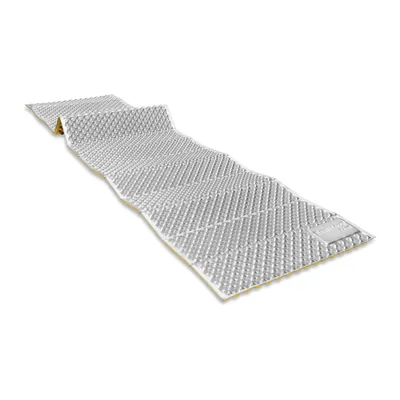
Therm-a-Rest Z Lite Sol
A concertina-fold foam mat rated R 2.0, 410 g in Regular: the bottom layer of the winter pairing, which also shields an inflatable mat from stones.
View on Amazon (opens in a new tab)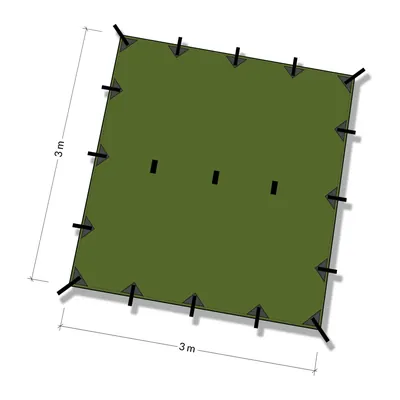
DD Hammocks Tarp 3x3
A 3 × 3 m square tarp in coated polyester (3,000 mm), 790 g, with 19 reinforced attachment points: the size that allows all four basic pitches, diamond and closed included.
View on Amazon (opens in a new tab)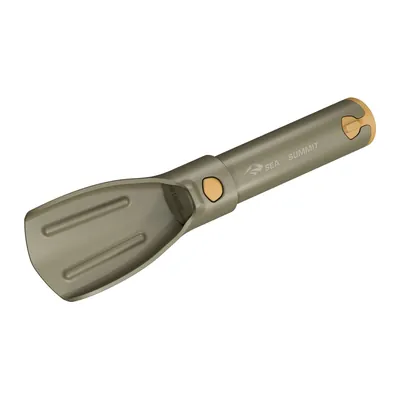
Sea to Summit Pocket Trowel
A 68 g trowel in glass-reinforced nylon, with a hollow retractable handle for loo roll and depth markings for digging the 15 to 20 cm hole the guidance asks for.
View on Amazon (opens in a new tab)
Worth watching
Dave Does Hiking lays out a beginner’s wild camping kit for Dartmoor and the UK, item by item: tent, sleeping bag and mat, cook kit, clothing, rucksack, electricals and a few optional extras.
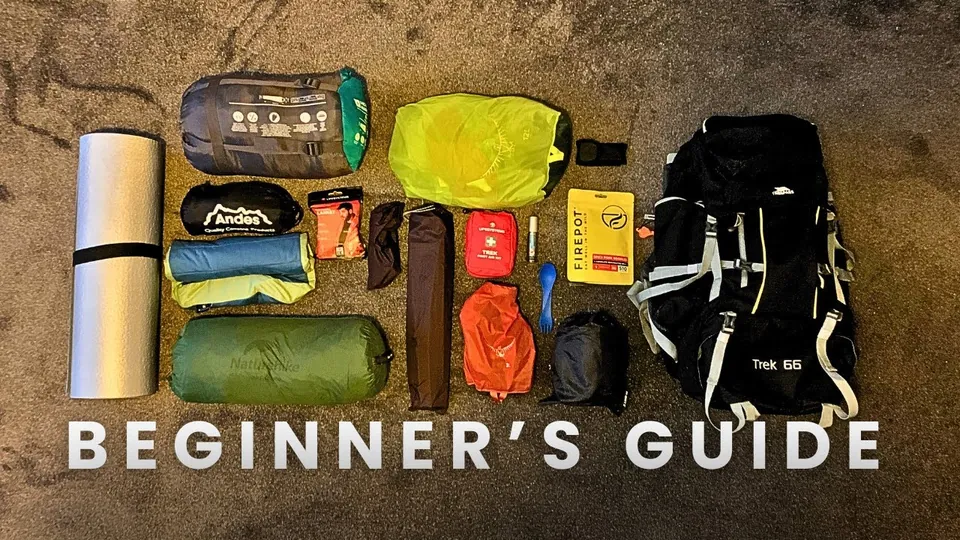
The video is hosted by YouTube (Google): nothing loads until you play it, and Google may then set cookies.
FAQs
What kit do I need for a first wild camp?
The kit for a day walk, plus a shelter, tent or tarp, a sleeping bag chosen by its comfort temperature, an insulating mat, a stove with its canister, a pan, water for the evening and morning with a way to treat it, a head torch, a first aid kit, a small trowel and bags for your rubbish. The full list is at the bottom of this page, ready to print and tick off.
How much does a wild camping rucksack weigh for one night?
Adding up the weights manufacturers list for a 40-litre rucksack, a two-person backpacking tent, a summer sleeping bag, a foam mat, a stove, a canister, a water bottle, a head torch, a first aid kit and a trowel gives about 5.7 kg, before water, food and clothes. The French Hiking Federation recommends staying under 20% of your body weight.
Can I hire wild camping kit?
Yes. Outdoorhire, for example, hires out tents, sleeping bags, sleeping mats and cooking kit, sent by courier within the UK, and friends can often lend the big items: tent, sleeping bag, mat and large rucksack. Try the kit at home before you go: pitch the tent, count the pegs, inflate the mat, read the sleeping bag’s label and check that the canister fits the stove.
What size rucksack for one night of wild camping?
For one night, a rucksack of about 40 litres with an extension is a good starting point, if the tent and sleeping bag pack small: Deuter’s Aircontact Lite 40+10, for example, is designed for loads of 12 to 15 kg. Don’t go too big: ‘whatever size your rucksack, you’ll fill it’, warns the BMC, which suggests about 45 litres for a three-day trip.
Do I need a sleeping mat if my sleeping bag is warm?
Yes. Lying down, your body loses heat to the ground, and the sleeping bag’s filling, crushed under your weight, hardly insulates at all. That’s the mat’s job, and its R-value measures its thermal resistance: 2 for a folding foam mat like Therm-a-Rest’s Z Lite Sol, 4.5 for an inflatable like the NeoAir XLite NXT. The higher it is, the better it insulates you from the ground.
Sources
- Mountaineering Scotland, ‘Wild camping in Scotland: the essentials’, accessed 29 October 2026. mountaineering.scot https://www.mountaineering.scot/activities/camping/wild-camping ↩
- French Hiking Federation (FFRandonnée), ‘Préparer son sac à dos’ (in French), 6 June 2024, accessed 29 October 2026. ffrandonnee.fr https://www.ffrandonnee.fr/randonner/conseils/preparer-son-sac-a-dos ↩
- Deuter, Aircontact Lite 40+10 rucksack product page (UK site), accessed 29 October 2026. deuter.com https://www.deuter.com/uk-en/aircontact-lite-40-10/3340123 ↩
- MSR (Cascade Designs), Hubba Hubba NX 2-Person tent product page (European site), accessed 29 October 2026. cascadedesigns.com https://cascadedesigns.com/en-eu/products/hubba-hubba-nx-2-person-backpacking-tent ↩
- Vaude, Campo Compact 2P tent product page, manufacturer’s outlet shop (in German), accessed 29 October 2026. outlet.vaude.com https://outlet.vaude.com/produkt/campo-compact-2p/ ↩
- DD Hammocks, DD Tarp 3x3 product page, accessed 29 October 2026. ddhammocks.com https://www.ddhammocks.com/products/ddtarp_3x3 ↩
- Deuter, Orbit +5° sleeping bag product page (UK site), accessed 29 October 2026. deuter.com https://www.deuter.com/uk-en/orbit-5c-41f/4046051174914 ↩
- Sea to Summit, Trek Down sleeping bag product page (European site), accessed 29 October 2026. seatosummit.eu https://seatosummit.eu/products/trek-down-sleeping-bag ↩
- Therm-a-Rest (Cascade Designs), Z Lite Sol sleeping mat product page (European site), accessed 29 October 2026. cascadedesigns.com https://cascadedesigns.com/en-eu/products/z-lite-sol-sleeping-pad ↩
- Therm-a-Rest (Cascade Designs), NeoAir XLite NXT sleeping mat product page (European site), accessed 29 October 2026. cascadedesigns.com https://cascadedesigns.com/en-eu/products/neoair-xlite-nxt-sleeping-pad ↩
- MSR (Cascade Designs), PocketRocket 2 stove product page (European site), accessed 29 October 2026. cascadedesigns.com https://cascadedesigns.com/en-eu/products/pocketrocket-2-stove ↩
- MSR (Cascade Designs), IsoPro fuel canister product page (European site), accessed 29 October 2026. cascadedesigns.com https://cascadedesigns.com/en-eu/products/msr-isopro-fuel ↩
- Nalgene, 32oz Wide Mouth bottle product page, accessed 29 October 2026. nalgene.com https://nalgene.com/product/32oz-wide-mouth-bottle/ ↩
- Petzl, Actik Core head torch product page (UK site), accessed 29 October 2026. petzl.com https://www.petzl.com/gb/en/sport/products/multisport-headlamps/actik-core/ACTIK-CORE_SPO_a2mTx000000o12YIAQ.html ↩
- Deuter, First Aid Kit product page (UK site), accessed 29 October 2026. deuter.com https://www.deuter.com/uk-en/first-aid-kit/4046051180403 ↩
- Sea to Summit, Pocket Trowel product page (European site), accessed 29 October 2026. seatosummit.eu https://seatosummit.eu/products/pocket-trowel-nylon-66 ↩
- British Mountaineering Council (BMC), ‘How to wild camp’, accessed 29 October 2026. thebmc.co.uk https://thebmc.co.uk/en/how-to-wild-camp ↩
- Campingaz, instructions for the ‘Bivouac’ stove (safety instructions), manufacturer’s multilingual manual, accessed 29 October 2026. campingaz.com https://www.campingaz.com/trade/images/SpareParts/01ad513b-3784-4fc5-9430-1d51b5db5b6b/4010057703.pdf ↩
- Mountain Rescue England and Wales, ‘In case of emergency’, accessed 29 October 2026. mountain.rescue.org.uk https://www.mountain.rescue.org.uk/how-to-call-out-mr/ ↩
- Parcs nationaux de France, ‘Le bivouac’ (in French), updated 17 February 2025, accessed 29 October 2026. parcsnationaux.fr https://www.parcsnationaux.fr/fr/des-decouvertes/visiter-et-semerveiller/la-reglementation-et-les-conseils/le-bivouac ↩
- Outdoorhire, outdoor equipment hire, home page, accessed 29 October 2026. outdoorhire.co.uk https://www.outdoorhire.co.uk/ ↩
- Decathlon France, ‘Matériel de camping : la liste des essentiels pour dormir en plein air’ (in French), accessed 29 October 2026. decathlon.fr https://www.decathlon.fr/c/htc/materiel-de-camping-la-liste-des-essentiels-pour-dormir-en-plein-air_bc8970a8-2058-4afc-ad3b-f4029e02857d ↩
- NatureScot, Scottish Outdoor Access Code, ‘Camping: being a cool camper’, accessed 29 October 2026. outdooraccess-scotland.scot https://www.outdooraccess-scotland.scot/practical-guide-all/camping ↩
- German Alpine Club (DAV), ‘Übernachten im Freien in den Alpen’ (in German), 17 June 2025, last updated 11 May 2026, accessed 29 October 2026. alpenverein.de https://www.alpenverein.de/artikel/ubernachten-im-freien-in-den-alpen_f4293fe8-1dd7-4117-964c-4866813a888c ↩

Camping, wild camping, bushcraft and hiking
Guillaume Hoarau writes for Outfarer about camping, wild camping, bushcraft and hiking. A survival-skills enthusiast and a collector of old field manuals, he likes clear explanations, lists that earn their place and other people’s stories, which he tells well.


