 Français (France)
 English (UK)
 English (US)
 Deutsch (Deutschland)

Contents
Cloud is building in the west, the rain is an hour away, and in your rucksack there is a square of fabric, six pegs and a few metres of cord. With that, you can rig a dry, quiet shelter, or a sail that flaps all night over a damp sleeping bag. The difference is not down to the price of the fabric or the number of knots you know: it comes down to the pitch you choose for the weather, and a few adjustments.
A A waterproof sheet with attachment points, pitched with cord and pegs between trees or on poles to make a shelter. has no shape of its own: you give it one. The British maker DD Hammocks reckons there are too many pitches to list them all [1]. Four will see you through almost any night on the hill.
Which tarp pitch for which weather
Three questions decide it: where is the wind coming from, is the rain falling straight or sideways, and what can you tie the tarp to? The diagram shows where each pitch is anchored; the table weighs up its strengths and limits.
| Pitch | High points | In the wind | In the rain | Best for |
|---|---|---|---|---|
| A-frame | 2 trees or 2 poles, a ridgeline | Holds better when low | Both sides; the ends stay open | A night on the ground, or over a hammock |
| Lean-to | 2 poles or 2 trees | Low edge into the wind | One side only | Breaks, day shelter, a calm night |
| Diamond | 1 pole or 1 tree; 2 trees over a hammock | Low corner into the wind | Covers the ends too | A hammock in windy weather, a night on the ground |
| Closed | 1 pole of about 90 cm, inside | Low and enclosed | Enclosed, door included | A wet night on the ground |
| Flat roof | 4 poles, or trees | High, so exposed | Needs a slope to shed water | Shade, group shelter |
Based on DD Hammocks, Tatonka, Terra Nova and The Scout Association. General trends: how well a pitch holds depends mostly on tension and height.
The flat roof, fifth on the list, is mostly a fair-weather pitch: four poles at the corners, two of them slightly shorter so that water runs off if a shower passes [2]. It is a shelter for shade or for a group; a large 4 × 4 m tarp can even cover several hammocks at once [3].
A-frame: the classic, between two trees or two poles
It is the most common pitch, especially over a hammock, according to DD Hammocks [1]. A rope, the The rope stretched between two trees or two poles, from which the middle of the tarp hangs., is strung between two trees; the tarp hangs from its central attachment points, then the four corners are pegged out, plus the side points if needed [1]. Away from trees, two poles hold the ridgeline in place [4]. For the rope, Terra Nova suggests at least twice the length of the tarp [5], Tatonka 6 to 8 m [2].
An A-frame shelters both sides well, but both ends stay open. Its height is a trade-off: the lower it is, the better it copes with wind, but the less room there is underneath, as Tatonka puts it [4]. The geometry shows what kind of room: on a 3 × 3 m tarp with its edges on the ground, a ridgeline at 0.9 m covers 2.4 m of ground, and one at 1.4 m just 1.1 m. Lower the A-frame and you lose headroom, not ground.
Lean-to: quick to pitch, sheltered on one side
A lean-to is a sloping roof: one edge pegged to the ground, the other raised on a ridgeline or on poles [1]. It goes up in minutes, which makes it the shelter for lunch and rest stops [1]; with a 3 × 3 m tarp, DD Hammocks reckons it can sleep up to three people on the ground [6]. Its weakness: only one side is properly protected [4].
Without trees, Tatonka pitches it on two poles: the two corners on the windward side are pegged to the ground, and each pole on the other side is held by two guy lines pulled outwards [2]. A walking pole goes in tip up through the eyelet, or handle first into the loop, where it holds better [2].
Diamond: for rain that blows in at the ends
The diamond is pitched on a point, and only with a square tarp, DD Hammocks specifies [1]. Over a hammock, two opposite corners are tied to two trees or posts and the other two are pegged to the ground: it is the pitch the maker recommends when wind drives rain in at the ends, and in very strong winds more attachment points can be guyed out [1]. On a 3 × 3 m square, the diagonal, 4.2 m, becomes the length of the shelter.
On the ground, one high point is enough: one corner tied to a tree or a pole, the opposite corner pegged down [5]. Turn that low corner into the wind, like the low edge of a lean-to [4]. You end up with a pointed shelter, high at the entrance and closed at the back, where you sleep with your head at the high end.
Closed pitch: the tarp that thinks it is a tent
When rain settles in for the night, a tarp can close in on itself. The Scout Association describes this pitch for a 3 × 3 m square with tie loops: it needs at least seven pegs, three guy lines and a single pole set to about 90 cm [7]. The two back corners are folded in and pegged, the two front corners form the door, and the pole goes under the first central loop in from the entrance [7].
The closer together the two front corners, the narrower the door: brought together in the middle, they leave only a slit, and the shelter is closed [7]. A final guy line, tied to the central loop at the front, tensions the whole thing [7]. On soft ground, a small block of wood under the foot of the pole stops it sinking; and if the tarp is not reinforced at that point, a strip of gaffer tape stops the pole going through it [7]. DD Hammocks describes a version held up from inside by a walking pole, or by a stick with padding on top [6].
Four more pitches: flat roof, envelope, arrowhead, raised A-frame
The four basic pitches cover most nights, but the same tarp takes plenty of other shapes. The Australian maker Mountain Designs describes nine with a single tarp [9]; here are three of them, plus Tatonka’s flat roof, which the table above keeps for fair weather.
- Flat roof. Four poles at the corners, two of them slightly shorter on one side so the water runs off, and eight guy lines to tension it all. Tatonka suggests pitching it with two people [2].
- Envelope. Two corners on the same edge are tied to two trees and form the top of a wall; the centre points and the other two corners are pegged down to make a floor. It is a windbreak for warm but windy days [9], with no roof overhead.
- Arrowhead. The middle of one edge is tied to a tree and that edge’s two corners are pegged; at the far end, the centre point is pegged and the sides are tucked underneath. The shelter is low, streamlined and holds up well in the rain, but it leaves no groundsheet to lie on [9]. Turn the low end into the wind, like the low corner of a diamond [4].
- Raised A-frame. The classic A-frame, but with its four corners held up by guy lines rather than pegged to the ground, so air flows underneath. The steeper the slope, the better the sides are protected; the flatter, the more room you have [9]. It is the shape to pitch over a hammock [1].
What keeps a pitch up: tension, slope, height, orientation
A good pitch does not flap, does not pool water and does not sag at 3am. Four adjustments see to that.
- Tension. First a taut ridgeline, then even tension all round: a slack tarp flaps in the wind and holds water. Nylon has a well-known flaw: it stretches when wet, even with dew, so a tarp pitched taut at bedtime can sag by morning [10]. Re-tension before you sleep, or add a short length of shock cord to each guy line to take up the slack [10].
- Slope. Water needs a way off: no spot where it can collect [4], and a slope, however slight, towards an edge [2]. Your groundsheet should not stick out beyond the tarp, or it will catch the rain running off it [4].
- Height. High for the view, low for stability in storms, as Terra Nova sums it up [5]. The A-frame diagram shows it: the centimetres you gain in height cost you width.
- Orientation. The windward side close to the ground [4], and a spot chosen before you unpack anything: no dead branches overhead, and no hollow between two rises, where cold air sinks and rainwater collects [7].
As for knots, Scout Life, the magazine of Scouting America, names three for guy lines and tarps: the taut-line hitch, to adjust the tension of a guy line; the bowline, which forms a fixed loop for tying a line to an eyelet; and two half hitches, for tying a rope to a ring or a post [11]. They are best learnt by practising with someone who knows them, rather than from a page. Our guide to wild camping knots still sets out the steps, the usual mistake and how to undo each one.
With or without trees: where to tie the tarp
A living tree makes an excellent anchor, as long as you do not damage it. Leave No Trace, the US organisation that promotes the leave-no-trace principles, wrote its guidelines for hammocks, which pull far harder on a trunk than a tarp’s ridgeline; they apply all the more to a tarp [12]:
- a flat strap at least 2.5 cm wide, wrapped once round the trunk, and never anything thinner, which damages the bark and the living layer just beneath it;
- never a nail or a screw driven into the wood;
- living trees at least 15 cm in diameter, with hard bark and no lichen, never a dead tree;
- a glance upwards: a perfectly healthy tree can still carry a dead branch ready to fall.
Add two common-sense rules: no notches cut into the wood, and no branches snapped off to make room. The best spot is one that already exists: good campsites are found, not made [12]. Some parks even ban hanging hammocks from trees; if in doubt, check with whoever manages the land [12].
Without trees, a tarp goes up on whatever you have to hand: walking poles, tarp poles, a fence or a post, and even, according to Tatonka, a bike or a canoe [2]. With no walking poles, DD Hammocks suggests a sturdy stick with padding on top, so it does not puncture the tarp [6]: look for one among the dead wood on the ground rather than cutting a living branch.
3 × 3 m, 3 × 2 m or 4 × 4 m: what each size allows
Size decides which pitches are possible. The 3 × 3 m square is the all-rounder of the category: it allows all four pitches in this guide, and DD Hammocks considers it big enough for one person and their kit [6]. Rectangles, from 3 × 2 m to 3 × 2.4 m, weigh less but lend themselves mainly to A-frames and lean-tos: the diamond is for squares only [1], and the Scouts’ closed pitch calls for a 3 × 3 m tarp [7]. Pitched lengthways as an A-frame, a 3 × 2 m tarp has only 1 m per side: at 0.8 m high, it covers 1.2 m of ground, enough for one sleeper. Terra Nova, for its part, suggests a 2.4 × 3 m tarp as a starting point [5].
| Size | Area | Pitches | Published examples |
|---|---|---|---|
| 3 × 3 m | 9 m² | All four in this guide, diamond and closed included | DD Tarp 3x3: 790 g, polyester; DD SuperLight, 3 × 2.9 m: 490 g, nylon |
| 3 × 2 m to 3 × 2.4 m | 6 to 7.2 m² | Mainly A-frame and lean-to | Terra Nova suggests 2.4 × 3 m to start with |
| 4 × 4 m | 16 m² | All of them, larger: group shelter, several hammocks | DD Tarp 4x4: 1,290 g, polyester |
Weight of the tarp alone, without pegs or guy lines, as stated by the maker. The three DD Hammocks models listed have a 3,000 mm hydrostatic head.
Two details matter as much as size. Waterproofing: Terra Nova recommends at least 3,000 mm of The height of a column of water, in millimetres, that a fabric can withstand before letting water through, measured in a laboratory. for rain [5]. And fabric: for almost the same area, the nylon SuperLight weighs 300 g less than the same brand’s polyester 3 × 3 m [6] [13], but it stretches when wet [10]. Gram-counters will already have chosen; they should just remember to re-tension before bed.
Where are you allowed to pitch a tarp?
A tarp changes nothing in law: where wild camping is not allowed, it is not allowed under a tarp either. The rules vary from country to country, and we cover them in dedicated articles:
- wild camping in the UK, from Scotland to Dartmoor;
- wild camping in France, from beaches to national parks, with a note on Belgium;
- wild camping in Switzerland, canton by canton;
- wild camping in Germany, state by state.
One question comes up often: does a tarp count as a tent? The rules we have gathered talk about tents, camping or bivouacking, almost never about tarps. The safest course is to treat it as a tent, and to ask the landowner or whoever manages the land (council, park, public forest) before you unpack it. As for fire, it has no place under a tarp or next to one: the rules, which are strict, are in our UK article above and in our guide to campfires in France.
Gallery: real pitches in Brittany
These photos are Erik Gauden’s, who started Outfarer: his own trial pitches, by day and at dusk, and friends’ shelters on a woodland bivouac in November, all in Brittany. They are amateur pitches, not expert demonstrations. Tap or click a photo to enlarge it.
Kit related to this article
No affiliation: no commission, no sponsored products.
DD Hammocks Tarp 3x3
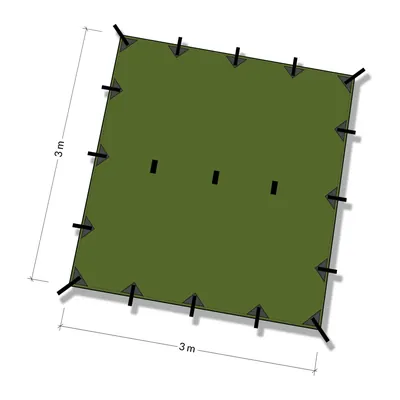
A 3 × 3 m square tarp in coated polyester (3,000 mm), 790 g, with 19 reinforced attachment points: the size that allows all four basic pitches, diamond and closed included.
View on Amazon (opens in a new tab)
FAQs
What size tarp should I get for solo wild camping?
A 3 × 3 m square is the most versatile: it allows the A-frame, lean-to, diamond and closed pitches, and covers one person and their kit. A rectangle from 3 × 2 m to 3 × 2.4 m weighs less, but is mainly for A-frames and lean-tos, and covers just one person. Beyond that, a 4 × 4 m tarp is mostly a group shelter.
How do you pitch a tarp without trees?
With two walking poles or two tarp poles: a pole goes tip up through the eyelet, or handle first into the loop, and is held by two guy lines pulled outwards. The lean-to, diamond and closed pitches only need one or two high points. With no walking poles, a stick of dead wood picked up from the ground, padded on top, will do the job.
What is the best tarp pitch for rain?
The closed pitch gives the most protection: a 3 × 3 m square on a pole of about 90 cm, corners folded in, with a door you can close down to a slit. If the wind drives rain in at the ends, the diamond covers them. Whatever the pitch, keep the tarp taut and sloping, with no pockets where water can pool, and re-tension at night if it is nylon.
Can you tie a tarp to a tree without damaging it?
Yes, with a flat strap at least 2.5 cm wide, wrapped once round the trunk of a living tree at least 15 cm in diameter, with hard bark. Never a nail, a screw or a notch, and never a dead tree. Look up for dead branches, and check with whoever manages the land that it is allowed.
Is it legal to sleep under a tarp in the woods?
The wild camping rules apply, and they change from one country, region or even forest to the next. They talk about tents, camping or bivouacking, almost never about tarps, so the safest course is to treat it as a tent and ask the landowner or land manager. Our articles on wild camping in the UK, France, Switzerland and Germany explain what is allowed.
Tarp or tent: which is better for wild camping?
A tarp is lighter, more open and can be pitched in many ways, with or without trees; a tent is enclosed and asks less of your skills. The maker Terra Nova reckons that, with practice, a tarp will protect you in most spring and summer conditions in the UK. For winter and storms, a tent remains the simpler shelter.
Sources
- DD Hammocks, Setting up your DD Tarp, accessed 23 October 2026. ddhammocks.com https://www.ddhammocks.com/pages/setting-up-your-dd-tarp ↩
- Tatonka, Tips for setting up a tarp, 21 April 2026, accessed 23 October 2026. tatonka.com https://www.tatonka.com/en/guide/tarp-guide/tips-for-setting-up-a-tarp/ ↩
- DD Hammocks, DD Tarp 4x4, Spec Sheet, 2024, accessed 23 October 2026. media.ddhammocks.com https://media.ddhammocks.com/images/2024_Spec_Sheets/Spec_Sheet_Tarp_4x4.pdf ↩
- Tatonka, Basic Knowledge: Erecting a tarp, blog, 2 August 2012, updated 15 May 2023, accessed 23 October 2026. blog.tatonka.com https://blog.tatonka.com/en/basic-knowledge-erecting-a-tarp/ ↩
- Terra Nova Equipment, How To Use A Tarp, 14 July 2023, updated 24 March 2026, accessed 23 October 2026. terra-nova.co.uk https://www.terra-nova.co.uk/blog/top-tips/how-to-use-a-tarp/ ↩
- DD Hammocks, DD Tarp 3x3, Spec Sheet, 2024, accessed 23 October 2026. media.ddhammocks.com https://media.ddhammocks.com/images/2024_Spec_Sheets/Spec_sheet_Tarp_3x3.pdf ↩
- The Scout Association, Building Shelter, Survival Skills Badge pack, March 2015, accessed 23 October 2026. cms.scouts.org.uk https://cms.scouts.org.uk/media/3588/shelter-building-activities.pdf ↩
- nidirect (Northern Ireland government), Carbon monoxide dangers if camping, caravanning or boating, updated 2 April 2026, accessed 23 October 2026. nidirect.gov.uk https://www.nidirect.gov.uk/news/carbon-monoxide-dangers-if-camping-caravanning-or-boating ↩
- Mountain Designs, Use The Tarp 9.0 Nine Ways, how-to guide, 21 January 2022, accessed 24 October 2026. mountaindesigns.com https://www.mountaindesigns.com/en-au/field-notes/how-to-guides/how-to-use-the-tarp-90-nine-ways ↩
- Gossamer Gear, DIY Self-Tensioning Guy Lines, 31 January 2020, accessed 23 October 2026. gossamergear.com https://www.gossamergear.com/blogs/our-blog/diy-self-tensioning-guy-lines-2 ↩
- Scout Life (Scouting America), How to Tie the 7 Basic Scout Knots, 15 September 2022, updated 18 September 2026, accessed 23 October 2026. scoutlife.org https://scoutlife.org/outdoors/176401/how-to-tie-the-7-basic-scout-knots/ ↩
- Leave No Trace, How to Hammock Camp Responsibly, 2025 guidelines, accessed 23 October 2026. lnt.org https://lnt.org/wp-content/uploads/2026/01/2025-LNT-Hammock-Camping-Guidelines.pdf ↩
- DD Hammocks, DD SuperLight Tarp, spec sheet, 2024, accessed 23 October 2026. media.ddhammocks.com https://media.ddhammocks.com/images/2024_Spec_Sheets/Spec_Sheet_SuperLight_Tarp.pdf ↩

Camping, wild camping, bushcraft and hiking
Guillaume Hoarau writes for Outfarer about camping, wild camping, bushcraft and hiking. A survival-skills enthusiast and a collector of old field manuals, he likes clear explanations, lists that earn their place and other people’s stories, which he tells well.


