 Français (France)
 English (UK)
 English (US)
 Deutsch (Deutschland)

Contents
Can you wild camp in Germany? The short answer: it depends on the state. The federal nature conservation act lets everyone enter the open countryside for recreation, but says nothing about tents [1]. Each state fills that gap in its own way. We read the laws of ten states: here is what they allow, what they ban and what breaking them can cost.
The framework: a right to walk, not to camp
Everyone may enter the open countryside on roads and paths, and on unused land, for recreation, under section 59 of the federal nature conservation act [1]. For woodland, the same act refers to the federal forest act and to the states’ forest laws [1]. The federal forest act allows people to enter woodland for recreation and leaves the details to the states, which may treat other uses as part of that right or restrict it [2]. Pitching a tent is not provided for in any of these federal laws: the state decides.
Three states allow one night in a tent
Three states have written the night in a tent into law. In Brandenburg, walkers, cyclists, riders and canoeists may pitch a tent for one night in open countryside; gardens, yards and other private living areas are excluded, and conflicting rules in other laws still apply [3]. In Mecklenburg-Western Pomerania, walkers without a motor vehicle may camp for one night in open countryside away from campsites, except in national parks, national natural monuments and nature reserves [4]. Schleswig-Holstein allows the same, except in national parks and nature reserves [5].
The two coastal states add a condition that is often missed: walkers must be ‘entitled under private law’ to camp there, and no other rule may stand in the way [4, 5]. On private land, that means not without the owner’s permission. And if you are travelling by car or campervan, the rule does not cover you: it only applies to walkers without a motor vehicle [4, 5].

Where tents are off limits in the woods
Elsewhere, tents appear in the forest law, as an exception to the right of access. In Baden-Württemberg, camping in woodland is not allowed ‘without special authorisation’ [6]. In Hesse, it needs the woodland owner’s consent [7], as it does in Thuringia [8] and Saarland [9]. Berlin only allows a tent in the woods on land opened for that purpose [10]. Saxony-Anhalt goes further: camping there needs the prior consent of the land user across the whole countryside, not just in woodland [11].
Bavaria is a special case. Its nature conservation act lets everyone enter every part of the countryside free of charge, expressly including woodland, mountain pasture and rock [12]. It counts skiing, sledging, riding, ball games and similar sports as part of that right [12]; tents are not mentioned. No right to pitch a tent can be drawn from it.
| State | Law | What it says about tents | Maximum fine in the law |
|---|---|---|---|
| Brandenburg | BbgNatSchAG, section 22 | One night for walkers, cyclists, riders and canoeists in open countryside | Not reviewed |
| Mecklenburg-Western Pomerania | NatSchAG M-V, section 28 | One night for walkers without a motor vehicle, with the owner’s permission; not in national parks, national natural monuments or nature reserves | Not reviewed |
| Schleswig-Holstein | LNatSchG, section 37 | One night for walkers without a motor vehicle, with the owner’s permission; not in national parks or nature reserves | Not reviewed |
| Baden-Württemberg | LWaldG, sections 37 and 83 | No tents in woodland without special authorisation | €2,500, €10,000 in particularly serious cases |
| Berlin | LWaldG, section 23 | Tents in woodland only on land opened for that purpose | €10,000 |
| Hesse | HWaldG, sections 15 and 29 | Tents in woodland only with the owner’s consent | €1,000 |
| Saarland | LWaldG, sections 25 and 50 | Tents in woodland only with the owner’s consent | €5,000 |
| Saxony-Anhalt | LWaldG, sections 22, 37 and 38 | Tents anywhere in the countryside only with prior consent | €25,000 |
| Thuringia | ThürWaldG, sections 6 and 66 | Tents in woodland only with the owner’s consent | Not reviewed |
| Bavaria | BayNatSchG, articles 27 and 29 | Right of access to all countryside, no mention of tents | No specific offence |
Maximum amounts set by law; the authority sets the actual fine case by case. For negligence, half the maximum at most when the law does not distinguish (section 17 OWiG).
What a breach really costs
How much does a night in the wrong wood cost? There is no set rate, because the laws only set maximums. The federal administrative offences act says a fine is at least 5 euros and, unless the law says otherwise, at most 1,000 euros; the amount depends on how serious the offence is and how much the offender is to blame [17]. Mere negligence risks at most half the maximum, when the law does not distinguish between intent and negligence [17].
In practice, camping in the woods in Baden-Württemberg can be fined up to 2,500 euros, and up to 10,000 euros in particularly serious cases [6]. In Hesse, the ceiling for using woodland without consent is 1,000 euros [7], in Saarland 5,000 euros [9], in Berlin 10,000 euros [10] and in Saxony-Anhalt 25,000 euros [11]. These are ceilings for serious cases, not rates for one night.
Protected areas: almost always a no
Nature reserves and national parks are the strictest zones. Federal law bans in nature reserves, under each reserve’s own rules, anything that could destroy, damage or alter them or cause lasting disturbance, and national parks must be protected like nature reserves [18]. Mecklenburg-Western Pomerania and Schleswig-Holstein expressly exclude them from the night in a tent [4, 5].
Saxon Switzerland National Park shows how finely these rules can be drawn. Camping and sleeping outdoors are banned there in principle. Only climbers may spend the night, from 16 June to 31 January, under 58 marked In Saxon Switzerland, rock overhangs or caves where climbers traditionally sleep. outside the core zone, and every kind of fire is banned there too, even a camping stove [13]. In the surrounding landscape protection area, bivvying without a tent is allowed in principle, but tents only on designated sites; in the nature reserves, both are banned [13].
Sleeping outdoors legally: trekking sites
The safest option is to book a trekking site, a ‘Trekkingplatz’. The Palatinate Forest has had them since 2009 and now has 15, open from April to October [14]. Their rules allow at most four tents for two or three people each, and one night per site, and point out that wild camping is banned in the Palatinate Forest biosphere reserve and across the whole Palatinate [14]. In the Black Forest, sites lie in the Central and Northern Black Forest Nature Park, the Black Forest National Park and the Southern Black Forest Nature Park, bookable from 1 May to 31 October, for up to three tents and one night [16].
In North Rhine-Westphalia, the High Fens-Eifel Nature Park offers sites that, according to the operator, were the first in the state; its website lists 22 [15]. Each has a wooden platform for up to two tents and a composting toilet, and you may only stay with a booking and only on the platform [15]. The price per tent is rising there from 15 to 18 euros, plus an overnight tax in some municipalities [15].
Before a night outdoors: the checklist
- The state: in Brandenburg, Mecklenburg-Western Pomerania and Schleswig-Holstein, one night in a tent is possible; in the other states covered here, you need consent or a designated site [3, 4, 5].
- The place: woodland or open countryside, protected area or not; national parks and nature reserves are usually off limits [4, 5, 18].
- Permission: on private land, ask the owner [4, 5, 11].
- The alternative: a trekking site, a bivouac site on the Forststeig trail in Saxon Switzerland, or a campsite [13, 14, 15, 16].
- Fire: check the fire danger level and local bans; the Eifel trekking sites currently ban fires because of an acute forest fire risk [11, 15].
Germany has no Scandinavian-style right to roam, but it has a law in every state, and some are more generous than their reputation. To compare with its neighbours, our articles on wild camping in France and wild camping in Switzerland set out their rules. For the night itself, our guides to sleeping bag temperature ratings and sleeping mat R-values will help you choose your kit.
Kit related to this article
No affiliation: no commission, no sponsored products.
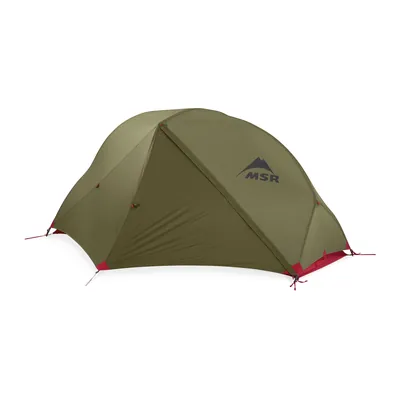
MSR Hubba NX Solo
A freestanding one-person tent, 1.12 kg minimum, with a 216 × 76 cm floor: a small tent to pitch in the evening and strike in the morning, wooden platforms included.
View on Amazon (opens in a new tab)
FAQs
Is wild camping legal in Germany?
There is no nationwide right: the states decide. Brandenburg, Mecklenburg-Western Pomerania and Schleswig-Holstein allow walkers without a motor vehicle one night in a tent in open countryside; the two coastal states only with the owner’s permission, and not in national parks or nature reserves. Other states ban tents in woodland without consent.
What is the fine for wild camping in Germany?
In the laws we read, camping without a right to do so is an administrative offence, not a crime. The laws set maximums: 2,500 euros in Baden-Württemberg, or 10,000 euros in particularly serious cases, 5,000 euros in Saarland, 10,000 euros in Berlin and 25,000 euros in Saxony-Anhalt. The authority sets the actual fine case by case.
Can you bivvy without a tent in Germany?
The laws we read only mention tents; none creates a general right to sleep outdoors. In the Saxon Switzerland landscape protection area, for example, bivvying is allowed in principle, but in the national park it is limited to climbers under approved rock shelters, and it is banned in the nature reserves. If in doubt, ask the relevant authority.
Where can you sleep outdoors legally in Germany?
On bookable trekking sites: 15 in the Palatinate Forest from April to October, wooden platforms with composting toilets in the Eifel, and sites in the Black Forest from 1 May to 31 October. You book ahead and usually stay one night. There are also bivouac sites on the Forststeig trail in Saxon Switzerland, which need a ticket.
Can you pitch a tent in the woods in Germany?
In Baden-Württemberg only with special authorisation; in Hesse, Thuringia and Saarland only with the woodland owner’s consent; in Berlin only on designated land. Brandenburg, Mecklenburg-Western Pomerania and Schleswig-Holstein allow a night in a tent in open countryside; in woodland, their forest laws apply. On trekking sites in the woods, it is allowed.
Sources
- Federal Nature Conservation Act (Bundesnaturschutzgesetz, BNatSchG), section 59 (in German), gesetze-im-internet.de, accessed 23 October 2026. gesetze-im-internet.de https://www.gesetze-im-internet.de/bnatschg_2009/__59.html ↩
- Federal Forest Act (Bundeswaldgesetz, BWaldG), section 14 (in German), gesetze-im-internet.de, accessed 23 October 2026. gesetze-im-internet.de https://www.gesetze-im-internet.de/bwaldg/__14.html ↩
- State of Brandenburg, Nature Conservation Implementation Act (BbgNatSchAG) of 21 January 2013, last amended on 24 July 2025, sections 22 and 40 (in German), accessed 23 October 2026. bravors.brandenburg.de https://bravors.brandenburg.de/gesetze/bbgnatschag ↩
- State of Mecklenburg-Western Pomerania, Nature Conservation Implementation Act (NatSchAG M-V) of 23 February 2010, section 28 (in German), accessed 23 October 2026. landesrecht-mv.de https://www.landesrecht-mv.de/bsmv/document/jlr-NatSchAGMVpP28 ↩
- State of Schleswig-Holstein, Nature Conservation Act (LNatSchG) of 24 February 2010, section 37 as amended on 27 May 2016 (in German), accessed 23 October 2026. gesetze-rechtsprechung.sh.juris.de https://www.gesetze-rechtsprechung.sh.juris.de/perma?j=NatSchG_SH_!_37 ↩
- State of Baden-Württemberg, Forest Act (LWaldG) as published on 31 August 1995, amended on 18 November 2025, sections 37 and 83 (in German), accessed 23 October 2026. landesrecht-bw.de https://www.landesrecht-bw.de/perma?a=WaldG_BW ↩
- State of Hesse, Forest Act (HWaldG) of 27 June 2013, amended on 20 May 2026, sections 15 and 29 (in German), accessed 23 October 2026. rv.hessenrecht.hessen.de https://www.rv.hessenrecht.hessen.de/perma?a=WaldG_HE ↩
- State of Thuringia, Forest Act (ThürWaldG) as published on 18 September 2008, amended on 30 December 2025, sections 6 and 66 (in German), accessed 23 October 2026. landesrecht.thueringen.de https://landesrecht.thueringen.de/perma?a=WaldG_TH ↩
- State of Saarland, Forest Act (LWaldG) of 26 October 1977, amended on 12 June 2024, sections 25 and 50 (in German), accessed 23 October 2026. recht.saarland.de https://recht.saarland.de/perma?a=WaldG_SL ↩
- State of Berlin, Forest Act (LWaldG) of 16 September 2004, amended on 11 December 2024, section 23 (in German), accessed 23 October 2026. gesetze.berlin.de https://gesetze.berlin.de/perma?a=WaldG_BE ↩
- State of Saxony-Anhalt, Forest Act (LWaldG) of 25 February 2016, amended on 2 July 2024, sections 22, 37 and 38 (in German), accessed 23 October 2026. landesrecht.sachsen-anhalt.de https://www.landesrecht.sachsen-anhalt.de/perma?a=WaldG_ST ↩
- State of Bavaria, Nature Conservation Act (BayNatSchG) of 23 February 2011, articles 27 and 29, version in force from 1 April 2026 (in German), accessed 23 October 2026. gesetze-bayern.de https://www.gesetze-bayern.de/Content/Document/BayNatSchG-27 ↩
- Saxon Switzerland National Park Administration, ‘Freiübernachten & Boofen’ (in German), accessed 23 October 2026. nationalpark-saechsische-schweiz.de https://nationalpark-saechsische-schweiz.de/freiuebernachten-boofen ↩
- Südliche Weinstrasse e. V., Trekking Pfalz, home page and rules of the trekking sites (in German), accessed 23 October 2026. trekking-pfalz.de https://www.trekking-pfalz.de/tourenplanung/benutzerordnung ↩
- Eifel Trekking, High Fens-Eifel Nature Park, home page, prices and site rules (in German), accessed 23 October 2026. trekking-eifel.de https://www.trekking-eifel.de/ ↩
- Trekking Schwarzwald, rules of the trekking sites (in German), accessed 23 October 2026. trekking-schwarzwald.de https://trekking-schwarzwald.de/trekking/benutzerordnung ↩
- Administrative Offences Act (Gesetz über Ordnungswidrigkeiten, OWiG), section 17 (in German), gesetze-im-internet.de, accessed 23 October 2026. gesetze-im-internet.de https://www.gesetze-im-internet.de/owig_1968/__17.html ↩
- Federal Nature Conservation Act (BNatSchG), sections 23 and 24 on nature reserves and national parks (in German), gesetze-im-internet.de, accessed 23 October 2026. gesetze-im-internet.de https://www.gesetze-im-internet.de/bnatschg_2009/__23.html ↩
Fact-checking, regulations and safety
Arnaud Couderc reviews our contributors’ articles and writes for Outfarer about regulations, safety, fishing, the sea and outdoor pursuits. He traces every rule back to its official text and every figure to its source, so that you set off with sound benchmarks.


 Guillaume Hoarau