 Français (France)
 English (UK)
 English (US)
 Deutsch (Deutschland)

An ankle turns on the descent, the valley is empty, and the phone shows one bar, then nothing. That’s the moment you want to know, without thinking, what still works. The good news is that there’s almost always a way to raise the alarm, as long as you know it beforehand. Here’s a quick tour of what really works, from the simplest option to the most self-reliant.
999 and 112: your first move
112 is the European emergency number: free, available everywhere in the EU from landlines and mobiles, it puts you through to a trained operator who deals with the call or passes it to the most appropriate service [2]. In France, it sits alongside the 15, 17 and 18; those calls are free, located and given priority, says the French government’s Service-Public website [1]. Austria also has an alpine emergency number, 140, which works anywhere in the country as long as your phone has a signal; 112 has the advantage of getting through on any available network, says the Austrian interior ministry [3]. In the mountains it’s the simplest number to remember: one number for the whole of the EU.
Outside the EU, each country has its own habits. In Switzerland, 112 works, but Rega, the Swiss air rescue service, recommends its own number, 1414, or its app first [4]. In the canton of Valais, though, you call 144, the Valais cantonal rescue organisation (OCVS), instead of 1414, says the Swiss Council for Accident Prevention (BFU) [5]. In the UK, you dial 999 or 112, ask for the police, then for Mountain Rescue, which the police call out [6, 7]. In the United States, it’s 911 [8]. And if the call won’t connect? Rega gives the single most useful rule of all: move, then try again, if necessary on 112 [4]. A few dozen metres towards a ridge or out of a valley floor can be enough to reach a mast.
Texting: less demanding, but not accepted everywhere
A text sometimes gets through where a call fails. Rega puts it simply: a text needs a much weaker connection than a phone call, and it remains an option when the battery is too low to make a call [4]. In exceptional cases it therefore accepts alarm texts on its 1414 number; with a phone from a foreign provider, or near the Swiss border, you should text +41 76 601 14 14 instead [4]. But it warns that a very small number of texts are never delivered, and that a call is always better, because the operator can ask questions [4]. If you do text, give your precise location or GPS coordinates, and a few words on what happened and the injuries [4].
Elsewhere, emergency texting isn’t open to everyone. In the UK, the emergencySMS service is for people with hearing or speech difficulties, and only works once your phone is registered, by texting ‘register’ to 999 [7]. In France, the 114 number takes texts, but it’s for people who are deaf, deafblind, hard of hearing or aphasic [1]. In the United States, texting 911 only works in some areas: elsewhere, an automatic message tells you to call instead, and the Federal Communications Commission, the telecoms regulator, advises always calling when you can [8].
| Country | Emergency number | Mountain rescue | Emergency texts | Official app |
|---|---|---|---|---|
| United Kingdom | 999 or 112 | Ask for the police, then Mountain Rescue | emergencySMS, after registering, for people who have difficulty hearing or speaking | None; a location link is sent by text |
| France | 112 (or 15, 17, 18) | Through 112 | 114, for people who are deaf, hard of hearing or aphasic | Urgence 114, for the same people |
| Switzerland | 112; Rega: 1414; in Valais: 144 | Rega: 1414; in Valais: 144 (OCVS) | To 1414 as a last resort; +41 76 601 14 14 from a foreign mobile | Rega app |
| Germany | 112 (police: 110) | Through 112 | No, but the app lets you raise the alarm without speaking | nora |
| Austria | 112; alpine emergency: 140 | Alpine emergency number 140 (with a signal) or 112 | Written messages through the app | DEC112 |
| United States | 911 | Through 911 | In some areas only | None nationwide |
Based on the European Commission, Service-Public, the Austrian interior ministry, Rega, the BFU, the nora app, DEC112, the British Mountaineering Council, Ordnance Survey and the FCC. In Austria, the app needs a data connection.
Apps and links that send your position
Giving your position is often the hardest part. Rescue services can find which mast your phone last connected to, but in the mountains this method isn’t very accurate and can be out by several dozen kilometres, Rega warns [4]. Hence the tools that pass on your GPS coordinates:
- In the UK, if your smartphone has enough signal and battery, the rescue team will text you a SARLOC or PhoneFind link that sends your GPS position back to them; if that doesn’t work, you’ll need to give a grid reference [6].
- In Switzerland, the Rega app raises the alarm, sends your coordinates and opens a line to its operations centre, as long as location services are on and the phone has adequate reception [4].
- In Germany, nora, the official emergency app of the federal states, sends your position to the right control centre and lets you raise the alarm without speaking; 110 and 112 remain available by voice [9].
- In Austria, the DEC112 app lets you write to emergency control centres, mountain rescue included, and resends your position every 20 seconds; it needs a data connection [10].
- In France, the gendarmerie can text you a GendLoc link: opening it shares your position without installing anything. It helped locate two paragliders stuck in trees in the Allier in June 2020 [11].
What all these tools have in common is also their limit: they need a mobile network. With no mast at all, you have to turn to the sky.
Satellite SOS: when there are no bars left
For a few years now, some phones have been able to text emergency services by satellite. Apple’s Emergency SOS via satellite works on every iPhone 14 or later. It is available in countries including the UK, the US, France, Germany, Austria, Belgium, Ireland, Italy, Spain and Switzerland, according to Apple’s page updated on 5 October 2026 [12]. It only kicks in when you have no mobile or Wi-Fi coverage, and you need to be outside with a clear view of the sky and the horizon [12].
Google’s Satellite SOS works on every Pixel since the Pixel 9, except the Pixel 9a; it’s available in Canada, the US and a list of countries that includes the UK, France, Germany and Spain [13]. Google says to use it only when there’s no other way to reach emergency services, and notes that trees or buildings can block the connection [13]. For both brands, check the current list before you go: it changes, and the feature depends on the country you’re in.

Beacons and radio: options without a phone
A personal locator beacon, or PLB, transmits on 406 MHz to the Cospas-Sarsat satellite system. It’s of little use if nobody knows whose it is, so register it. In the UK, registering is free and takes around 15 minutes, for a personal locator beacon for any use [14]. In the United States, registration with NOAA is required by law and must be renewed every two years [15]. In France, the register of 406 MHz beacons is kept by the national space agency, CNES [16].
Switzerland has a system of its own: an emergency radio channel, on 161.300 MHz, monitored by Rega’s operations centre, for places where phones don’t work. You need a radio set with a 123.0 Hz tone squelch, and the channel doesn’t cover the whole country [4]. Finally, the oldest tool is still the most reliable: the whistle. Six good long blasts in a minute, stop for a minute, then repeat, and don’t stop because you hear a reply: your blasts help rescuers home in on you [7].
Before you go: the smart move
- Note the numbers for the country you’re walking in, and those that accept texts: the table above fits on one screenshot.
- Charge your phone and carry a power bank, as mountain rescuers advise [7].
- Know how to read your position: a map and compass, or GPS coordinates. Exact coordinates avoid long searches [4], and a paper map never runs out of battery [7].
- Register for emergency texting if you’re eligible, and register your beacon if you have one.
- Check satellite SOS: does your phone offer it in the country you’re visiting?
- Clip a whistle to a shoulder strap of your pack.
None of this weighs much, and all of it can be sorted on the sofa the night before. The smart move fits in one sentence: know, before you set off, what you’ll do when the screen says ‘No service’. And to avoid getting there in the first place, an eye on the trail waymarks saves plenty of detours.
Kit related to this article
No affiliation: no commission, no sponsored products.
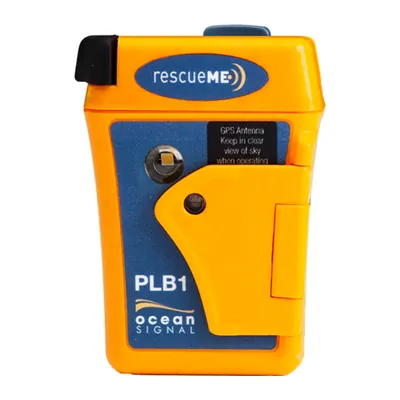
Ocean Signal rescueME PLB1
A 406 MHz personal locator beacon: the alert and GPS position go out through the Cospas-Sarsat system, with no signal or subscription needed. It must be coded and registered for your country.
View on Amazon (opens in a new tab)
Worth watching
Apple Support shows how an iPhone guides you to a satellite connection so you can text the emergency services when you’re out of mobile and Wi-Fi coverage.
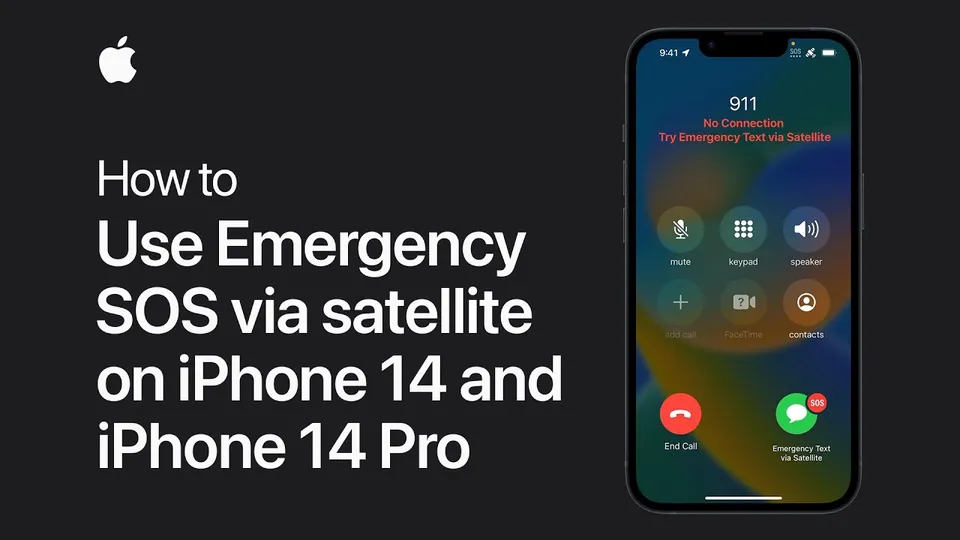
The video is hosted by YouTube (Google): nothing loads until you play it, and Google may then set cookies.
FAQs
Does 112 work without signal?
No: you need at least one mobile network to make a call. If the call won’t connect, Rega advises moving and trying again, on 112 if necessary; a few dozen metres towards a ridge can be enough. With no network at all, you’re left with satellite SOS on iPhone 14 and Pixel 9 or later, a 406 MHz personal locator beacon or, in Switzerland, Rega’s emergency radio channel.
Can I text 999 or 112?
In the UK, only if you’ve registered with emergencySMS first, and the service is for people who have difficulty hearing or speaking: text ‘register’ to 999 to sign up. In Switzerland, Rega accepts texts to 1414 as a last resort, or to +41 76 601 14 14 from a foreign mobile. In France, the 114 number takes texts from people who are deaf, hard of hearing or aphasic. In the US, texting 911 only works in some areas.
How does satellite SOS on a phone work?
On iPhone 14 or later and on Pixel phones since the Pixel 9 (except the 9a), the phone offers to text emergency services by satellite when it has neither mobile coverage nor Wi-Fi. You need to be outside with a clear view of the sky and horizon, away from trees and buildings. It’s only available in certain countries, including the UK, France, Switzerland and Germany: check the list before you go.
Do I need to register a personal locator beacon?
Yes, otherwise rescuers don’t know whose it is. In the UK, registering is free and takes around 15 minutes on the government website. In the United States, registration with NOAA is required by law and must be renewed every two years. In France, the register of 406 MHz beacons is kept by the space agency CNES. Update your details and emergency contacts whenever they change.
What is the distress signal with a whistle?
Six good long blasts in a minute, stop for a minute, then repeat. Mountain rescuers advise carrying on until someone reaches you, and not stopping because you hear a reply: your blasts help them find you. A head torch can be used to give the same signal at night.
Sources
- Service-Public, ‘Quels sont les numéros en cas d’urgence (Samu, pompiers...) et les numéros d’écoute ?’ (in French), checked 25 August 2026, accessed 23 October 2026. service-public.gouv.fr https://www.service-public.gouv.fr/particuliers/actualites/A15841 ↩
- European Commission, ‘112 - the EU’s emergency phone number’, accessed 23 October 2026. digital-strategy.ec.europa.eu https://digital-strategy.ec.europa.eu/en/policies/112 ↩
- oesterreich.gv.at, Austrian Federal Ministry of the Interior, ‘Verhalten bei Lawinenunfällen und Bergunfällen’ (in German), last updated 16 February 2026, accessed 27 October 2026. oesterreich.gv.at https://www.oesterreich.gv.at/de/themen/notfaelle_unfaelle_und_kriminalitaet/katastrophenfaelle/1/Seite.29500327 ↩
- Rega, ‘This is how we help you’, questions and answers on raising the alarm, accessed 23 October 2026. rega.ch https://www.rega.ch/en/our-missions/this-is-how-we-help-you ↩
- Swiss Council for Accident Prevention (BFU), ‘Bien gérer la randonnée’ (in French), ‘Rando en montagne’ campaign, accessed 27 October 2026. rando-en-montagne.ch https://www.rando-en-montagne.ch/fr/bien-gerer-la-randonnee ↩
- British Mountaineering Council, ‘What to do in a hill walking emergency’, accessed 23 October 2026. thebmc.co.uk https://www.thebmc.co.uk/en/what-to-do-in-a-hill-walking-emergency ↩
- Ordnance Survey, ‘Advice from Mountain Rescue’, advice from Mountain Rescue England and Wales, accessed 23 October 2026. osmaps.com https://osmaps.com/discover/guides/mountain-safety/ ↩
- Federal Communications Commission, ‘Text to 911: What You Need to Know’, version archived on 23 September 2026, accessed 23 October 2026. fcc.gov https://www.fcc.gov/consumers/guides/what-you-need-know-about-text-911 ↩
- nora, ‘Die offizielle Notruf-App der Bundesländer’ (in German), accessed 23 October 2026. nora-notruf.de https://www.nora-notruf.de/ ↩
- DEC112, ‘Notruf-App für Smartphones’ (in German), accessed 23 October 2026. dec112.at https://www.dec112.at/ ↩
- Gendarmerie nationale, ‘Allier : deux parapentistes secourus grâce à la gendarmerie’ (in French), 16 June 2020, accessed 23 October 2026. gendarmerie.interieur.gouv.fr https://www.gendarmerie.interieur.gouv.fr/gendinfo/actualites/2020/allier-deux-parapentistes-secourus-grace-a-la-gendarmerie ↩
- Apple, ‘Use Emergency SOS via satellite on your iPhone’, updated 5 October 2026, accessed 23 October 2026. support.apple.com https://support.apple.com/en-gb/101573 ↩
- Google, ‘Get emergency help through satellite with your Pixel phone’, accessed 23 October 2026. support.google.com https://support.google.com/pixelphone/answer/15254448?hl=en-GB ↩
- GOV.UK, ‘Register a UK 406 MHz beacon’, accessed 23 October 2026. gov.uk https://www.gov.uk/register-406-beacons ↩
- NOAA SARSAT, ‘Register your beacon’, accessed 23 October 2026. sarsat.noaa.gov https://www.sarsat.noaa.gov/register-your-beacon/ ↩
- CNES, ‘Registre français des balises de détresse 406 MHz Cospas/Sarsat’ (in French), accessed 23 October 2026. registre406.cnes.fr https://www.registre406.cnes.fr/ ↩

Camping, wild camping, bushcraft and hiking
Guillaume Hoarau writes for Outfarer about camping, wild camping, bushcraft and hiking. A survival-skills enthusiast and a collector of old field manuals, he likes clear explanations, lists that earn their place and other people’s stories, which he tells well.


