 Français (France)
 English (UK)
 English (US)
 Deutsch (Deutschland)

Contents
What the FL1 standard really measures
A figure is only as good as the method behind it. For portable lights, the reference is an American standard, ANSI/PLATO FL1, which sets out the method for six measurements, from light output to water resistance [1]. It is voluntary. But a manufacturer that prints the FL1 logo on its packaging must follow those methods for every figure on the box, not just the most flattering one [1].
| Measurement | What it tells you | How it is measured |
|---|---|---|
| Light output (lumens) | All the light the torch gives out | Between 30 seconds and 2 minutes after switching on, with fresh batteries or a full charge |
| Peak beam intensity (candela) | The light at the heart of the beam, in its brightest direction | In the same window of 30 seconds to 2 minutes |
| Beam distance (metres) | The distance at which the light falls to 0.25 lux | Calculated from the peak beam intensity |
| Run time (hours) | How long it takes to fall to 10% of the starting output | Output re-measured every 15 minutes, with the torch left on continuously |
| Impact resistance (metres) | The drop height it survives without breaking or failing | Six drops onto concrete, from at least 1 m |
| Water resistance (IPX) | Splashing, temporary immersion or prolonged immersion | IPX4, IPX7 or IPX8 tests, based on the IEC 60529 standard |
Based on the presentation of the standard by the manufacturer Streamlight and on Petzl’s Tech Tips (sources at the end of the article).
Run time, the figure that misleads most
On paper, a 40-hour run time promises 40 hours of light. The standard says otherwise: the clock starts 30 seconds after switching on and stops when the output falls to 10% of its initial value [1, 2]. The threshold is not arbitrary: according to the standard, it is the level at which people usually change their batteries [1].
Everything then depends on the shape of the curve. An unregulated torch feeds its LED directly: it is very bright for the first few minutes, then dimmer and dimmer as the hours pass, and the higher its starting output, the faster that output drops [3]. A regulated torch, by contrast, holds a constant output for a set period, which is the run time you can actually use, and then often switches to reserve lighting [3]. Two torches can therefore show the same run time without offering anything like the same night.
Petzl puts things in perspective with an order of magnitude: 100 lumens for 50 hours would take the equivalent of 75 AAA batteries, or 1.1 kg on your head [3]. When a spec sheet pairs a very high output with a very long run time, the two figures often come from different modes: the output from the maximum mode, the run time from the minimum mode [3]. You cannot have both at once.
Lumens, candela, beam distance: three figures for three questions
The lumen figure counts all the light that leaves the torch. The candela figure measures the intensity at the heart of the beam, where it is strongest. Beam distance, finally, is the distance at which the light falls to 0.25 lux, roughly the light of a full moon on a clear night in open country [1, 2]. Two torches with the same output can therefore reach very different distances: beam distance depends on output, but above all on the shape of the beam [2]. A wide beam lights up the camp nicely; a narrow one reaches a long way down the path.
Let’s do the maths: 1,000 candela gives a beam distance of about 63 m, and 2,500 candela a beam distance of 100 m. To double the distance, you need four times the intensity: the inverse square law, on which the standard rests, drives a hard bargain [1].
Water and impact resistance: what IPX4, IPX7 and IPX8 mean
- IPX4: splashing water from any direction must do it no harm. A downpour, yes; a dunk in a mountain stream, no.
- IPX7: temporary immersion, under standardised conditions (the FL1 test is done under 1 m of water).
- IPX8: prolonged immersion, under conditions tougher than for IPX7, which the manufacturer must state [1].
For impact, the standard drops the torch six times onto concrete, from at least 1 m, and it must come out without cracks or failures [1]. A greater height on the packaging means the torch has passed the same tests from that height.
Batteries, rechargeables and the cold
The energy on board governs everything else: for the same energy reserve, more light means less run time, and you never get a high output and a record run time at the same time [3]. In serious cold, the type of battery matters too. According to Petzl, disposable lithium batteries perform better than alkaline and Ni-MH batteries at extreme temperatures, and work from -20 to +50 °C [4]. Before putting them in a torch, check its instructions to make sure it accepts them.

Comparing two head torches in five minutes
- Look for the FL1 logo: without it, nothing tells you how the figures were measured.
- Compare run times in the mode you will actually use, rather than in the weakest mode.
- Check the light-output curve where there is one: a sustained output beats a peak at switch-on.
- Choose the beam distance for the job: camp calls for a wide beam, walking at night for one that reaches far.
- Check the water resistance and, if you are heading into the cold, which batteries the torch accepts.
A figure without a unit is a promise without a contract; a figure without a method is not much better. The FL1 standard supplies the method: reading the small print is up to you.
Kit related to this article
No affiliation: no commission, no sponsored products.
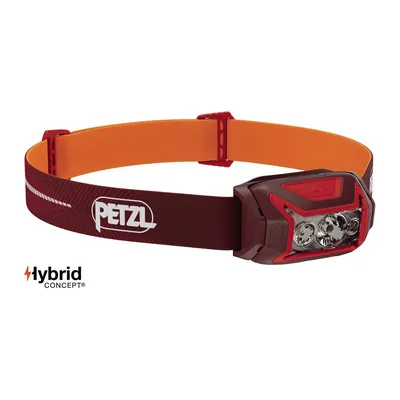
Petzl Actik Core
An 88 g head torch supplied with a rechargeable battery that also runs on three AAA batteries, with a red light that won’t dazzle anyone.
View on Amazon (opens in a new tab)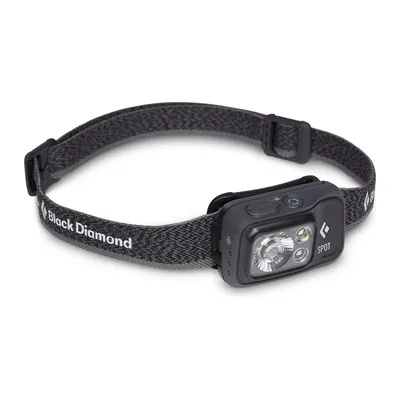
Black Diamond Spot 400
A head torch running on three AAA batteries, waterproof to IPX8 (30 min at 1.1 m underwater). Under FL1: 400 lumens and a 100 m beam for 2.5 h, or 6 lumens for 200 h.
View on Amazon (opens in a new tab)
FAQs
Does the stated run time mean the total time the torch gives light?
No. Under the ANSI/PLATO FL1 standard, run time is measured from 30 seconds after switching on until the output falls to 10% of its initial value. The torch often keeps glowing after that, but weakly, and it may have spent a good part of that time below its maximum output. The light-output curve, when the manufacturer publishes one, shows the detail.
How many lumens do you need for wild camping?
There is no universal figure: it all depends on what you are doing and on the shape of the beam. Around the tent, a wide beam and a moderate output are often enough; for walking at night, beam distance matters more. The most useful comparison is the run time at the level you will use, rather than the maximum printed on the box.
Is IPX4 enough in the rain?
IPX4 means a torch withstands splashing water from all directions, which covers rain. For immersion, however brief, you need IPX7 (temporary immersion, tested under 1 m of water in the FL1 standard) or IPX8 (prolonged immersion, under conditions stated by the manufacturer).
Disposable batteries or a rechargeable for the cold?
A rechargeable battery saves you buying batteries, provided you can recharge it along the way. Disposable batteries can be replaced anywhere. In serious cold, Petzl states that disposable lithium batteries perform better than alkalines and work from -20 to +50 °C. Check the instructions to make sure your torch accepts them.
Do all head torches follow the FL1 standard?
No, the standard is voluntary. A manufacturer that displays the FL1 logo must follow its methods for every figure on the packaging. Without that logo, nothing tells you how the lumens or the run time were measured, and two spec sheets can no longer really be compared.
Sources
- Streamlight, ANSI/PLATO FL 1 Standard, presentation of the standard, accessed 20 October 2026. streamlight.com https://www.streamlight.com/docs/default-source/ansi-documents/ansi-pres.pdf ↩
- Petzl, How is lighting performance measured with the ANSI/PLATO FL1 protocol?, Tech Tips, accessed 20 October 2026. petzl.com https://www.petzl.com/int/en/sport/tech-tips/basic-techniques/how-is-lighting-performance-measured-with-the-ansi-plato-fl1-protocol-/Lighting-ANSI-protocole_SPO_a771r000000PFpHAAW.html ↩
- Petzl, Managing energy: different approaches, Tech Tips, accessed 20 October 2026. petzl.com https://www.petzl.com/int/en/professional/tech-tips/choosing-the-right-equipment/managing-energy--different-approaches/LightingPRO-La-gestion-de-l-energie_PRO_a77w0000000KywoAAC.html ↩
- Petzl, Non-rechargeable energy sources, Tech Tips, accessed 20 October 2026. petzl.com https://www.petzl.com/int/en/sport/tech-tips/product-information-and-specifications/non-rechargeable-energy-sources/LightingSPORT-Les-sources-d-energie-non-rechargeab_SPO_a77w0000000PAz4AAG.html ↩

Campervans, motorhomes, cycling and calculators
Julien de Jurquet writes for Outfarer about campervans, motorhomes, cycling and calculators. He reads instruction manuals to the very end and never lets a figure through without its unit, so that your choices rest on sums rather than promises.

 Nolwenn Bastide


 Guillaume Hoarau