 Français (France)
 English (UK)
 English (US)
 Deutsch (Deutschland)

What surprised me most in my first race run entirely at night was not the dark. It was having to slow down when my legs could still have gone faster. My head torch lit up the trail, but I could not yet read it as well as I can in daylight.
On Saturday 1 November 2025, I had picked the ‘15 km - Trail nocturne’ (a night trail race of about 9.3 miles) at La Belle d’Orgères, in Ille-et-Vilaine, in Brittany. On the programme: a 7pm start and a single aid station on the course. A format short enough for the night to remain the main novelty.
I had come from the Vendée, on France’s Atlantic coast. I had run by head torch before, in training as well as in other races. But a race in the dark from start to finish, with a number pinned on and the urge to keep up with the others, was something else.
At 7pm, faces vanish behind the lamps
At the sports complex in Orgères, beams were sweeping between the runners. Some were finishing their warm-up. Others were checking their lamps one last time, a hand held in front of the light.
It was around 13 °C. The air was damp, but it was not raining [1]. I had brought a light long-sleeved top, my running vest, water and a small backup torch. After a few minutes of jogging, I was no longer cold.
My Petzl Swift RL was charged: the 1,100-lumen model, with its headband that splits in two at the back. I had worn it on two training runs, enough to know the button and change modes without taking it off.
A runner next to me asked a question. I turned towards him with my lamp on. He lowered his head slightly. I pointed the beam at the ground straight away.
‘First night race?’
I said yes. My head torch in his eyes had already answered for me.
Under the start lights, it was hard to judge what my lamp was really doing. I had chosen Reactive Lighting mode, on the middle level: a sensor measures the ambient light, and the lamp adapts its brightness and beam pattern [2]. I planned to start that way and adjust if needed.
When the group set off, I mostly heard shoes. The faces had gone, leaving silhouettes, a few voices and patches of white moving forward together.
I had settled into the middle of the field. I was aiming for around 1 hour 20 minutes, without making it an obligation. The first challenge would be not to run straight away at the pace my legs were asking for.
My Swift RL stayed put standing still, less so on the run
The first few minutes exposed an adjustment my trial runs had not sorted out well enough. The lamp moved slightly with every stride.
It was not slipping down over my eyes, but it moved enough to shift the beam and make me want to push the lamp back up with my fingers. After a few goes, I realised this would soon become tiresome.
I stepped aside to retighten the headband. I had left too much slack, for fear of ending up with a headache across my forehead. Once everything was better adjusted and the rear section properly spread out, the movement dropped off markedly.
The second problem was the angle. The centre of the beam was landing too close to my shoes. I could see the ground right in front of me very clearly, but spotted what came next too late.
I checked the problem on the move first, then stepped aside again to tilt the lamp up slightly. This time, I could look at the next stretch of the path without lifting my chin too far.
I stayed on the middle level of the reactive mode for most of the course. On one stretch where I wanted more light, I briefly switched to the level above. But the most useful change had been mechanical: a steady lamp, pointed in the right place.
Looking back, my training runs had mostly answered the question ‘does the lamp work?’ I should have spent more time on ‘does it stay in place when I run?’
Seeing a root is not the same as judging it
The most unsettling section was nothing spectacular. A narrower path, a few stones and low roots. In daylight, I would probably have gone through without a second thought.
This time, I could pick out the obstacles without always being able to judge their height. A root looked almost flat until I was on top of it. A pale stone caught my eye when the real difficulty lay just beyond it.
At first I stared at the ground far too studiously. I would check one foothold, then hurry to set up the next. My running had turned into a series of small corrections.
A runner passed me without seeming to speed up. He was simply more fluid. I followed him for a few strides, then let the gap open up: copying his footing was not helping me read the trail.
I shortened my stride. That gave me back a less jerky movement, without trying to match my daytime ease straight away. The light was enough to see the roots. What I still lacked was the habit of reading them.
On the more open sections, other runners’ lamps pleasantly widened the area I could see. Then someone would take a bend and part of the path would vanish. The contrast was surprising.
I was also worse at judging distances. A light seemed close, but several bends still lay between us. Conversely, I sometimes caught up with a silhouette sooner than expected. In the end, I paid less attention to the lamps ahead and more to my own rhythm.
The ground was wet in places, but it did not rain during my race. A few surfaces threw back a bright glare. It was not an evening of thick mud or rough weather: my hesitations did not come from the conditions. I was simply learning.
At the aid station, I forgot to lower my head

I had planned to stop briefly at the only aid station on the course. Get my cup out, drink, set off again. Simple enough not to call for a strategy.
Yet I repeated my mistake from the start: looking at the person serving me with my head torch aimed at their face. This time, I realised it on my own.
I lowered my head and held out my cup. My organisation was faultless, as long as you did not count the lighting.
The stop also let me take stock. My legs were still responding well. I was warm while running, with no reason to add a layer. My concentration, though, was starting to slip.
Nothing to do with drowsiness or a big slump: I was simply becoming less precise. I would glance at my watch for no real reason, then look up a little late. Where the terrain changed, those small catch-up strides from the beginning came back.
I set off again a little slower for a few minutes. I did not need a burst of energy, just to get back to running cleanly.
On a more even stretch, I finally stopped thinking about the head torch. It stayed put, gave light and let itself be forgotten. I could hear my breathing and another runner’s footsteps behind me. We ran for a while without talking.
That stretch is what made me want to do it again: no view, no memorable descent, just a few minutes where I had found my place in this different kind of race.
The finish, about 1 hour 20 minutes later
As the finish drew near, the voices came before the lights. Then the lights of the sports complex took over from the head torches.
I finished around 8.20pm, after about 1 hour 20 minutes of running. It was still mild for early November, around 12 °C [1].
Once I had stopped, I loosened the headband. I had not touched the fit since early in the race. The Swift RL had not been what held me back that evening. My reading of the trail at night had.
| When | The problem | The fix |
|---|---|---|
| At the start | My beam in the eyes of a runner who was talking to me | Beam pointed at the ground straight away |
| First few minutes | The lamp moved with every stride | Stopped to one side, headband tightened, rear section properly spread out |
| Shortly after | The centre of the beam fell too close to my shoes | Another stop, lamp tilted up slightly |
| On one stretch | Wanted more light | Level above in reactive mode, briefly |
| At the aid station | Head torch aimed at the face of the person serving | Head lowered, cup held out |
To do this format again, I would keep this lamp. Above all, I would redo my trial runs with a few surges of pace and some changes of gradient, so as to get the fit right before the start.
For a much longer event, I would look first at comfort after several hours, run time in the mode you actually use and whether the battery can be swapped, rather than maximum output.
My pointers for the next night race
My pointers for the next night race fit into a few lines:
- Check the fit while running, in the kit you plan to race in.
- Assess the angle on the move, then stop to one side to change it if need be.
- Plan run time and backup lighting according to the model’s instructions and the race rules.
La Belle d’Orgères gave me an accessible first taste of this format, without leaving me feeling that I had mastered the night. Above all, I found that an ordinary trail could call for some very practical learning.
I thought it was mainly my legs I had to prepare. I also had to learn how to look.
Kit related to this article
No affiliation: no commission, no sponsored products.

HydraPak SpeedCup
A 200 ml, 10 g soft cup, above the 15 cl required by the UTMB and the Eiger. Being collapsible, it will not pass where the rules demand a rigid cup.
View on Amazon (opens in a new tab)
Worth watching
In under four minutes, REI runs through the gear you need for running after dark, the mistakes to avoid and how to make the most of a night run.
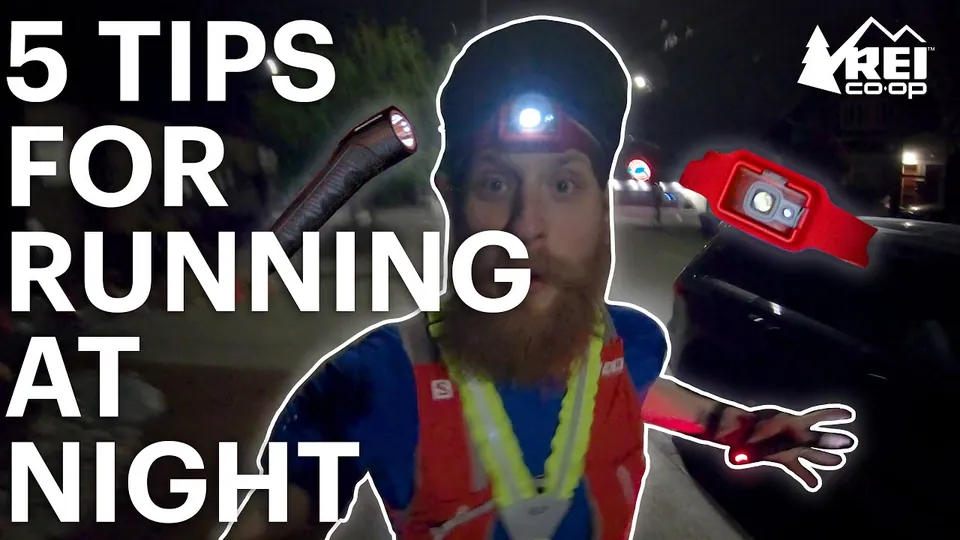
The video is hosted by YouTube (Google): nothing loads until you play it, and Google may then set cookies.
FAQs
How do you set up a head torch for running at night?
Tighten the headband enough that the lamp does not move with every stride, then check the angle while running: a beam aimed too low lights your feet well but shows what comes next too late. Tilt the lamp up slightly so you can read the next stretch without lifting your chin. Do these checks in training, with a few surges of pace, some changes of gradient and the kit you plan to race in.
Do you need a very powerful head torch for a night trail race?
Not necessarily. Over 15 km (about 9.3 miles) at night, Damien Poirier stayed on the middle level of his lamp’s reactive mode almost the whole time, and the lighting did not hold him back. For a longer event, look first at comfort after several hours, run time in the mode you actually use and a swappable battery. Our guide to head torch lumens and run time helps you make sense of the specifications.
How do you avoid dazzling other runners?
By lowering your head, or pointing the beam at the ground, whenever you look at someone: a runner talking to you at the start, a volunteer at an aid station. The habit is easily lost when you are working hard: it was at the aid station that Damien Poirier repeated his mistake from the start, before realising it on his own.
What kit do you need for a night trail race?
Whatever the race rules require, which you should read before the start: at night, a head torch is generally compulsory, sometimes with spare batteries or a second lamp. Damien Poirier also had a small backup torch, a light long-sleeved top, his running vest, water and a cup. Our article on mandatory kit in trail running compares the rules of several races.
Sources
- Infoclimat, Rennes-St Jacques (Ille-et-Vilaine - France) | Archives des relevés météo du samedi 1er novembre 2025 (weather archive for Saturday 1 November 2025), Météo-France station, hourly readings, page in French, accessed 28 October 2026. infoclimat.fr https://www.infoclimat.fr/observations-meteo/archives/1er/novembre/2025/rennes-st-jacques/07130.html ↩
- Petzl, REACTIVE LIGHTING, tech tip, UK website, accessed 28 October 2026. petzl.com https://www.petzl.com/gb/en/sport/tech-tips/product-information-and-specifications/reactive-lighting/Eclairage---Reactive-lighting_SPO_a77w0000000TOnCAAW.html ↩
- Petzl, SWIFT RL, product page, UK website, accessed 28 October 2026. petzl.com https://www.petzl.com/gb/en/sport/products/multisport-headlamps/swift-rl/SWIFT-RL_SPO_a2mTx0000033ql7IAA.html ↩
- La Belle d’Orgères, La grande kermesse du trail, organiser’s website, 2026 programme, page in French, accessed 28 October 2026. labelledorgeres.fr https://labelledorgeres.fr/ ↩

Running, trail running, triathlon and mountains
Damien is the sporty one of the bunch: running and trail running, triathlon, trekking, cycling and the mountains. He spends a huge amount of time outdoors, shares his race reports and reviews our articles on endurance sport and mountain walking.

 Julien de Jurquet

 Nolwenn Bastide
