 Français (France)
 English (UK)
 English (US)
 Deutsch (Deutschland)

How many litres: what seven guides say
Here is a fact that should change how you pack: in a 2024 study, fifteen trained trail runners ran on a treadmill in a vest weighted to 5% and then 10% of their body weight. Going from 0 to 5% had a moderate effect on speed at the effort thresholds; going from 5% to 10% had a very large one. [1] The ideal pack is therefore not the biggest one your budget allows.
To work out what size to aim for, we compared the ranges in seven guides published by brands, retailers and coaches. [2] [3] [4] [5] [6] [7] [8] They overlap more than they contradict each other.
| Guide | Short | Medium | Long |
|---|---|---|---|
| Salomon (updated February 2026) | 1 to 2 h: 2 to 5 L | 3 h and more: 6 to 10 L | Ultra, off-trail: 12 L |
| Campus (updated September 2025) | Up to 2 h: 2 to 4 L | Up to 10 h: 5 to 8 L, or a pack up to 10 L | Ultra: more than 10 L |
| Glisshop | Under 2 h: 2 to 4 L | 2 to 5 h: 5 to 8 L | Ultra: 8 to 15 L, even more |
| Outnorth | Up to 2 h: 1.5 to 5 L | More than 3 h: 6 to 10 L | Ultra and off-trail: more than 10 L |
| Alltricks (March 2026) | Up to 20 km: under 5 L | 20 to 50 or 60 km: 5 to 8 L | 70 to more than 170 km: 10 to 15 L |
| Run The Wild | Up to 2 h: about 2 L | Up to 20 km or half a day: 5 to 8 L | Ultra: 12 to 15 L |
| Sport Conrad (June 2026) | 1 to 2 h: up to 5 L | Longer trails and races: up to 12 L | Lots of kit: more than 12 L |
Each guide slices things its own way: the cells line up neighbouring durations and distances, not identical ones. 1 L of volume is not 1 L of water.
Only one guide recommends a single do-it-all pack: 8 litres, which covers most situations. [7] Another sees 5 to 8 litres as a good compromise for up to about ten hours of effort. [3]
Why the ranges differ: the race kit list
The gap between 8 and 15 litres for ultras is not an arithmetic slip. Salomon says it plainly: capacity depends on the length of your outings and, in races, on how far apart the aid stations are. [2] Glisshop adds weather, terrain, altitude and the mandatory kit list. [4]
The mandatory kit list is the one constraint you cannot negotiate. A race rulebook such as the Zugspitz Ultra Trail’s states that every participant carries everything on the list for the whole event, even without using it, with systematic or random checks and a penalty that can go as far as disqualification. [9] Our article on the mandatory kit for trail races compares the lists of eight races.
A bigger pack is therefore not a safer one: it has to hold the race kit and your food, not fill itself up. Alltricks warns that a pack with room in it will take whatever you give it, and reminds runners to carry the mandatory kit, not surplus kit. [6]
What a loaded pack weighs, and what it costs
Water weighs about 1 kg per litre: Alltricks allows 1 to 1.5 L of water for a 5 to 8 L pack, and 1.5 to 2 L for a 10 to 15 L pack. [6] Add the jacket, the food and the emergency blanket: in trail and ultra races, the mandatory kit, water and food add 3 to 4 kg of load depending on distance and climate, according to the introduction of the study cited above. [1]
For a 72 kg runner, the average weight of the sample, 5% is about 3.6 kg and 10% about 7.2 kg. The study involved fifteen men averaging 38 years old, on a treadmill, in a weighted vest: the speed at which effort thresholds appear drops as the load rises, and not in a straight line. [1] The authors also note that the weighted vest was uncomfortable, and recommend using real trail vests in later studies. [1] These are reference points, not a rulebook.
How to pack: water in front, heavy low, safety within reach
A trail pack is packed like a kitchen: you start with what you use most. Salomon puts it this way: everything should be reachable without taking the pack off, food, water, extra layer, poles. [2] Campus gives the method: rarely used kit at the bottom, the most frequent at the top; REI adds that you should always put each item in the same place, so you find it without thinking when you are tired. [3] [10]
- Flasks in the chest pockets: you can grab them one-handed, check them at a glance and refill them at aid stations. [2] [10]
- Bars, gels and purees in the side pockets or within easy reach. [3] [10]
- The waterproof jacket, phone and emergency blanket accessible in the mountains, because safety is not up for negotiation. [3]
- Kit you will probably not use at the bottom of the back compartment. [3]
- The phone in a waterproof bag or case, against rain and sweat; keys in a zipped pocket with a clip. [10]
- A pocket kept for rubbish, so the wrapper from the last bar does not end up on the ground. [10]

One detail on weight distribution: Outnorth notes that 2 L of water on the back makes the pack feel overloaded at the rear, and the reverse at the front. [5] Adjusting the order by feel is part of running a pack in.
Do you wear the pack over or under your jacket? Campus does not pick a side: over it, you can reach the pockets; under it, the pack stays dry and warm, provided you have a jacket roomy enough to fit over it. [3]

Adjusting the vest so it does not bounce
The choice between a running vest and an ordinary rucksack is settled in the first kilometre. Salomon explains that a vest sits high on the back and hugs the body to limit movement, whereas a multi-activity rucksack, more versatile, moves about more, which can end up irritating you or even causing chafing. [2]
Vest size follows chest measurement, not volume. Alltricks advises measuring your chest, checking the brand’s size chart and, if you are torn between two sizes, taking the smaller: an oversized pack bounces with every stride and rubs. [6] Run The Wild remarks for its part that a vest too big in volume moves about, but that if you doubt the capacity, it is better to aim a little bigger, because a race vest gains little weight from extra capacity. [7] The two pieces of advice do not contradict each other: pick a snug size and a generous capacity.

Glisshop sums it up: a loose vest bounces, a vest that is too tight gets in the way when you are working hard, and tightening systems help hold it even when half full. [4] REI adds that vests have several elastic fastenings to limit bounce. [10] Alltricks advises testing it loaded, with full flasks, jacket and phone, and jumping on the spot to spot anything that bounces, then running it in on a long outing: never debut new kit on race day. [6]
Flasks or a water bladder?
Campus sees in flasks easy refilling at aid stations and an easy check on what is left; the bladder holds up to 3 litres but adds weight on the back. [3] Run The Wild also likes soft flasks: easier to clean, less prone to leaks, and they let you alternate water and energy drink. [7] With a bladder, Salomon recommends wedging it in place to limit movement. [2]
For drinking, Campus’s benchmarks are 400 to 600 mL per hour of effort, with a third 500 mL flask at the back when it is hot and water points are far apart. [3] For a first race, our article on trail running for beginners adds to these benchmarks.
The right pack is the one you forget about by the first kilometre. The rest is the trail waiting for you.
Kit related to this article
No affiliation: no commission, no sponsored products.
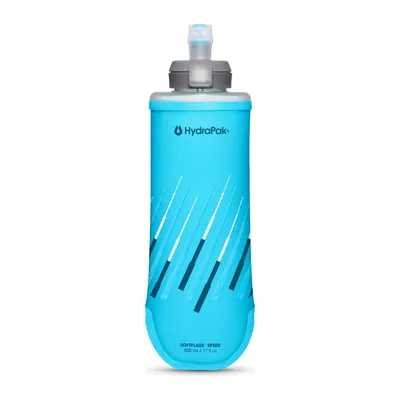
HydraPak SoftFlask Speed 500 ml
A 500 ml, 46 g soft flask that slips into a vest pocket and fills one-handed: the kind of container races now ask runners to bring for refills.
View on Amazon (opens in a new tab)
FAQs
Is a 5 litre pack enough for a 30 km trail race?
It depends on the race kit list and the aid stations. Alltricks puts 5 to 8 L at 20 to 50 or 60 km, Campus 5 to 8 L for up to about ten hours. If the rules demand a jacket, food and 2 L of water, 5 L may be tight: try the pack loaded with the full list before you enter.
What is the difference between volume and the amount of water?
A pack’s volume, in litres, is its total carrying capacity: water, food, jacket and the rest. It does not say how much water it carries. A 5 L vest with two 500 mL flasks carries 1 kg of water, the rest of the space going to food and clothing.
Do I need a running vest or an ordinary rucksack?
A vest is designed for running: it sits high, hugs the chest and bounces little. A multi-activity rucksack is more versatile, and fine for starting out, but it moves about more, which can cause chafing. If you run regularly, go for a vest that fits your chest measurement.
What is the maximum weight to carry while running?
There is no universal rule. In a 2024 study of fifteen trained men, a load of 10% of body weight hurt running clearly more than a load of 5%. Keep your pack as light as the mandatory kit list allows, and count 1 kg for every litre of water you carry.
Sources
- Cartón-Llorente A., Rubio-Peirotén A., Cardiel-Sánchez S., Roche-Seruendo L.E., Jaén-Carrillo D., “Acute Effects of Overload Running on Physiological and Biomechanical Variables in Trained Trail Runners”, Applied Sciences, vol. 14, no. 21, 2024, accessed 9 November 2026. mdpi.com https://www.mdpi.com/2076-3417/14/21/9853 ↩
- Salomon, “How to choose a running backpack” (updated 25 February 2026), accessed 9 November 2026. salomon.com https://www.salomon.com/en-gb/sg/a/how-to-choose-a-running-backpack ↩
- Campus, “Gilet, sac d’hydratation de trail : comment l’utiliser ?” (in French), published 7 March 2025 and updated 4 September 2025, accessed 9 November 2026. campus.coach https://www.campus.coach/blog/gilet-sac-hydratation-de-trail ↩
- Glisshop, “Comment choisir un gilet d’hydratation pour le trail” (in French), accessed 9 November 2026. glisshop.com https://www.glisshop.com/conseils/comment-choisir-un-gilet-d-hydratation-pour-le-trail.html ↩
- Outnorth, “How do I choose the right running backpack?”, accessed 9 November 2026. outnorth.com https://www.outnorth.com/int/guides/training/how-do-i-choose-the-right-running-backpack ↩
- Alltricks, “Comment bien choisir son sac de trail : guide complet” (in French), published 17 March 2026, accessed 9 November 2026. alltricks.fr https://www.alltricks.fr/blog/choisir-sac-trail/ ↩
- Run The Wild, “How to choose the right running vest or backpack”, by Karin Voller, accessed 9 November 2026. runthewild.co.uk https://runthewild.co.uk/how-to-choose-the-right-running-vest/ ↩
- Sport Conrad, “Die besten Laufwesten 2026: Kaufberatung” (in German), 17 June 2026, accessed 9 November 2026. sport-conrad.com https://www.sport-conrad.com/blog/beste-laufwesten ↩
- Zugspitz Ultra Trail by UTMB, “Mandatory gear”, accessed 9 November 2026. zugspitz.utmb.world https://zugspitz.utmb.world/runners/mandatory-gear ↩
- REI Expert Advice, “How to Carry Gear on a Run”, accessed 9 November 2026. rei.com https://www.rei.com/learn/expert-advice/trail-running-gear.html ↩

Trail running, snow, water, nature and destinations
Nolwenn covers trail running, snow, water, nature and destinations for Outfarer. Curious about everything, from meteor showers to night-train timetables, she has a knack for unearthing the one detail that changes everything, and putting it in a single sentence.


