 Français (France)
 English (UK)
 English (US)
 Deutsch (Deutschland)

Contents
Sierre-Zinal: about 31 km (19 miles), 2,200 m of ascent, a mountain race that climbs above 2,000 m. Its rules require no mandatory kit at all [1]. The SaintéLyon, which runs overnight from Saint-Étienne to Lyon across the Monts du Lyonnais, demands a whistle, a survival blanket of at least 1.40 m by 2 m, a hooded waterproof jacket and 1 litre of water [2]. Inconsistent? Not in the slightest. A mandatory kit list measures neither the altitude nor the prestige of a race: it answers a far more down-to-earth question, which is how long a runner might be stuck on their own, not moving, before anyone reaches them.
We read the rules of eight well-known races in France, the UK, Germany, Austria and Switzerland, in their latest published version. Here is what they ask for, item by item, and above all why.
Eight sets of race rules side by side
The requirements below come from the rules and kit lists published by the organisers: the Grand Trail des Templiers [3], the SaintéLyon [2], the UTMB [4], the Lakeland 50 [5], the Mittenwald Trail at the Zugspitz Ultratrail [6], the K42 at the Innsbruck Alpine Trailrun Festival [7], the E51 at the Eiger Ultra Trail [8] and Sierre-Zinal [1]. Several long races are on the list, up to the UTMB’s 100 miles around Mont Blanc: not to send you there, but because their lists are among the most detailed and shed light on all the others.
| Race | Waterproof jacket | Head torch |
|---|---|---|
| Grand Trail des Templiers (France, 80 km or 50 miles, October 2026) | Only if the race director calls for it because of the weather: a long-sleeved waterproof rain jacket | Compulsory at the start, with new batteries (night start) |
| SaintéLyon (France, about 80 km or 50 miles overnight, November 2026) | Waterproof, with a hood; waterproof trousers if the extreme cold kit is activated | One, with spare batteries or a spare power pack |
| UTMB (France, Italy, Switzerland, 100 miles, August 2026) | Hood, waterproof and breathable membrane, welded seams; 20,000 mm and an RET below 13 recommended; waterproof trousers | Two, each with its own backup power; 200 lumens recommended |
| Lakeland 50 (England, 50 miles, July 2027) | Fully waterproof hooded jacket and trousers, with taped seams | One, with spare batteries, or a spare head torch |
| Mittenwald Trail, Zugspitz Ultratrail (Germany, 44 km or 27 miles, June 2027) | Taped seams, at least 10,000 mm of hydrostatic head | Not required |
| K42, Innsbruck Alpine Trailrun Festival (Austria, 43 km or 27 miles, May 2027) | Hood, at least 10,000 mm; waterproof trousers if the cold weather kit is activated | Not required |
| E51, Eiger Ultra Trail (Switzerland, 51 km or 32 miles, July 2027) | Hood, membrane, sealed seams; 20,000 mm recommended | Not required |
| Sierre-Zinal (Switzerland, 31 km or 19 miles, August 2027) | No mandatory kit | Useful for ‘Touristes’ who start in the dark, according to the rules |
Official rules and kit lists accessed 23 October 2026: 2026 editions for the Templiers, the SaintéLyon and the UTMB list, 2027 for the others. Lists change from year to year: only the one for your edition counts.
| Race | Water | Cup | Phone | Survival blanket |
|---|---|---|---|---|
| Grand Trail des Templiers | 0.75 litres | Reusable eco-cup, no cups handed out at aid stations | Recommended | Recommended |
| SaintéLyon | 1 litre | 15 cl minimum | Compulsory, tracking app strongly recommended | 1.40 × 2 m minimum |
| UTMB | 1 litre (1.5 litres recommended), up to 2 litres if the organisers decide | 15 cl minimum, flasks with caps not accepted | Switched on, tracking app, flight mode banned | 1.40 × 2 m minimum |
| Lakeland 50 | Bottle or soft flask, no set volume | Rigid, for hot drinks | Fully charged | Survival blanket or survival bag |
| Mittenwald Trail | 1 litre, in resealable containers | A container to drink from at aid stations | Race rescue service number saved, able to call from abroad | Part of a compulsory minimum first aid kit |
| K42 Innsbruck | 1-litre container | That same container: no cups at aid stations | SOS EU ALP alert app installed | 210 × 160 cm |
| E51 Eiger | 1 litre | Collapsible allowed, 15 cl minimum | Switched on, organiser’s emergency numbers saved | 1.40 × 2 m minimum |
| Sierre-Zinal | Not required | Not required | Not required | Not required |
Same sources and editions as the previous table. The Lakeland 50, the Zugspitz and Innsbruck also require a first aid kit.
Why races impose kit: avoid distress, raise the alarm, wait for help
In France, the 2027 rules for running events issued by the French Athletics Federation (FFA) sum up the logic in a single sentence. The kit imposed for a trail race must allow runners, throughout the event, to avoid ending up in distress (a light, clothing, water, food), then, in the event of an accident, to raise the alarm (a whistle, a phone) and to wait safely for help to arrive (a survival blanket, extra clothing) [9]. The exact list is left to the organiser, described as the person best placed to know what is essential given the location, the time of year and the course [9].
The UTMB puts it in its own numbers: in August, in the Mont Blanc massif, temperatures can go above 30 °C or feel like -10 °C above 2,000 m, with rain, hail or snow, and in an incident your kit must let you wait for rescue in sufficiently safe conditions [4]. The Fell Runners Association, which governs fell racing in England, adds the argument people forget: the kit may not be needed when you are running strongly in good weather, ‘but it could be a life-saver’ if you have to slow down or stop through injury or tiredness, or stop to help another runner [10]. It even reports cases where runners have had to lend their own kit to an injured runner [11]. The Lakeland 50 puts it its own way: heading out without the required kit puts not only you at risk, but also the people who may have to come and help you [5].
Here is the detail that changes everything: what matters is how far help is, more than how high you are. Sierre-Zinal sets out its aid stations every 3 to 5 km or so, from Beauregard at km 4 to Barneuza at km 27 [1]: runners are never on their own for long. The SaintéLyon is run at night, in late November, and the Lakeland 50 crosses the Lake District fells over 50 miles. So I read every list as the organiser’s estimate of how long a runner who cannot move might have to wait, and in what conditions.
The jacket: membrane, hydrostatic head and taped seams
It is the most closely checked item, and the one with the most numbers attached. The Zugspitz Ultratrail requires a waterproof jacket with taped seams and at least 10,000 mm of hydrostatic head [6], Innsbruck a hooded jacket rated at 10,000 mm or more [7]. The UTMB and the Eiger Ultra Trail recommend 20,000 mm, and insist on a hood that is built in or attached with a system designed by the manufacturer, welded or sealed seams, and no panels of non-waterproof fabric [4, 8].

So what does the number measure? The water pressure a fabric can withstand before water gets through, expressed as a height of water in millimetres. In France it is often given in ‘Schmerber’. is determined under the ISO 811 standard, using a hydrostatic pressure method: water pushes against one face of the fabric, and the pressure at which it gets through is recorded [13]. The result is given in millimetres: 10,000 mm is the pressure of a 10 m column of water, roughly 1 bar; 20,000 mm, roughly 2 bar. Breathability has its own index, the Resistance to evaporative heat transfer: how strongly a fabric resists the passage of water vapour, measured under ISO 11092. The lower it is, the more easily sweat escapes., measured under ISO 11092 [14]; the UTMB recommends an RET below 13 [4].
That number describes a fabric, not a jacket. Water also gets in through seams, the hood and the zip: hence the other requirements. The Fell Runners Association explains why it sticks to taped seams, even though some good jackets now do without them. At kit check, the people checking are almost always volunteers, often under time pressure: they need a clear rule, and taped seams normally guarantee a basic, acceptable level of waterproofing [11]. Good news: that particular test needs no spec sheet and no laboratory, just a look inside the jacket.
Head torch, survival blanket, whistle: seeing, being found, waiting
The head torch follows the clock. The Grand Trail des Templiers starts before dawn, so a head torch with new batteries is compulsory at the start [3]. The SaintéLyon, run overnight, asks for one with spare batteries or a spare power pack [2], the Lakeland 50 for a head torch with spare batteries, or a spare head torch [5]. The UTMB requires two, each with its own backup power, recommends 200 lumens and does not accept phones or watches as a light source [4]. The Mittenwald Trail, Innsbruck’s K42 and the Eiger’s E51, which all start in the morning, do not ask for one [6, 7, 8]. The logic is the same everywhere: a torch that dies in the middle of the night leaves its runner in the dark, far from anything. To make sense of a head torch’s claimed run time, our guide to lumens and run time explains the standard behind it.
The survival blanket is for waiting. The SaintéLyon, the UTMB and the Eiger set its minimum size at 1.40 m by 2 m [2, 4, 8], Innsbruck at 210 cm by 160 cm [7]: enough to wrap an adult. The Templiers, which recommend it without making it compulsory, give the reason: to protect yourself or another runner in case of injury [3]. The Lakeland 50 also accepts a survival bag [5].
Water, cup and phone: getting by between aid stations
The water you carry logically tracks the gap between aid stations. The Templiers ask for 0.75 litres on the Grand Trail [3], the SaintéLyon, the Zugspitz, Innsbruck and the Eiger for 1 litre [2, 6, 7, 8]. The UTMB requires 1 litre, recommends 1.5 litres, and reserves the right to raise the minimum to 2 litres before the start [4]. The Lakeland 50 sets no volume, but asks for a bottle or soft flask [5]. And Sierre-Zinal, with its closely spaced aid stations, asks for nothing [1].
The personal cup answers a different concern: waste. The FFA’s 2027 rules ask French trail races to replace plastic containers at aid stations with refills of runners’ own containers [9]. The Templiers have already dropped cups and ask for a reusable eco-cup [3], and the UTMB no longer hands out any disposable utensils [12]. The detail matters at kit check: the UTMB requires 15 cl minimum and turns away flasks with caps [4], the Eiger accepts a 15 cl collapsible cup [8], while the Lakeland 50 wants a rigid cup for hot drinks, with a definition that is hard to argue with: ‘If the cup collapses in any way… it’s not solid’ [5].

The phone is as much about being reached and located as about making calls. The UTMB wants runners reachable before, during and after the race, with their phone switched on and never in flight mode [4], and the Eiger asks runners to save the organiser’s emergency numbers [8]. In Innsbruck, the SOS EU ALP alert app from Tyrol’s emergency control centre is part of the mandatory kit, so that rescuers can locate a runner in difficulty as fast as possible [7, 16]. The festival even lists mountain rescue insurance as mandatory kit: according to the organisers, rescues of this kind often have to be paid for by the people rescued [16]. The Lakeland 50 settles for a fully charged phone, to be switched on if you think you are lost: the organisers watch runners’ GPS trackers and will most likely try to call [5]. English fell racing goes the other way: navigating by GPS is banned outright, and the toughest races require a paper map and a compass [10]. For what works when there is no signal, our guide to calling for help without signal goes through it country by country.
Kit check: when it happens, and what a missing item costs
| Rules | Penalty |
|---|---|
| FFA, scale suggested to organisers | 5 minutes per missing item below 50 km-effort, 10 minutes from 50 to 80, 15 minutes above |
| Grand Trail des Templiers | 30 minutes without water or a head torch; 1 hour without kit demanded at short notice because of the weather |
| UTMB | Disqualification with no water, no compliant hooded jacket, no light, no survival blanket or no smartphone; 1 hour for anything else missing, including a single torch or too little water; 15 minutes for a phone switched off or in flight mode |
| Zugspitz Ultratrail | Disqualification with no water, no hooded jacket, no light, no survival blanket or no smartphone; 1 hour for anything else missing; 15 minutes for a phone switched off or in flight mode |
| Lakeland 50, Innsbruck K42 | No start without the full kit; in Innsbruck, runners can also be pulled from the race |
| Fell Runners Association | Disqualification |
Sources: FFA [9], Templiers [3], UTMB [12], Zugspitz [15], Lakeland 50 [5], Innsbruck [16], Fell Runners Association [10], accessed 23 October 2026. At the UTMB and the Zugspitz, refusing a kit check means disqualification.
Mandatory kit only means something if someone checks it. The Lakeland 50 checks everything at registration, and without the required kit you do not start [5]. Innsbruck checks before the start, then with spot checks during the race [16]. The Zugspitz checks at the entrance to the start area, from 45 to 10 minutes before the start time, and leaves time to fetch a forgotten item [15]. In France, runners undertake to show their kit whenever asked, just before the start, at any point during the race or in the finish area [9].
Why so strict? The Fell Runners Association is refreshingly direct: for the sake of fair competition, the kit must be the same for every runner in a given race [11]. A runner who leaves their jacket in the car sets off lighter, and takes a risk that others may end up paying for. As for haggling at kit check, the Lakeland 50 warns, with admirable bluntness, that anyone who tries to bend the rules or argue their case will lose [5]. The French penalty scales are expressed in km-effort, a unit that adds 1 km to the distance for every 100 m of ascent.
Before you enter: read the list, then carry it
Entries for big races often open months ahead: Innsbruck opened its entries in September 2026 for a race in May 2027 [16]. That is the time to read the rules in full, as our guide to getting into trail running suggests, and to compare the list with what is in your cupboard, item by item. Is the hood built in or attached by the manufacturer? Are the seams taped? Is the hydrostatic head given on the manufacturer’s spec sheet? Is the survival blanket the right size? A question about an item goes to the organiser before the race, not to the volunteer at kit check.
Then carry it. The UTMB strongly advises testing your kit on training runs in a range of conditions [4], and the Zugspitz points out that the list is only basic equipment, to be adapted to your own abilities [15]. A pack loaded with a jacket, water and a blanket does not run like an empty one: fit a few long runs with it into your training plan. And check that your trail shoes will pass kit check too: the Lakeland 50 rules out road shoes, and the Zugspitz requires closed trail running shoes with a lugged sole [5, 6].
A list you understand mostly lightens your mind. On the day, the pack is done up, every item is there for a reason, and all that is left is to listen to footsteps in the dark, watch for the first glow over the ridge and let the long ribbon of head torches carry you along.
Kit related to this article
No affiliation: no commission, no sponsored products.
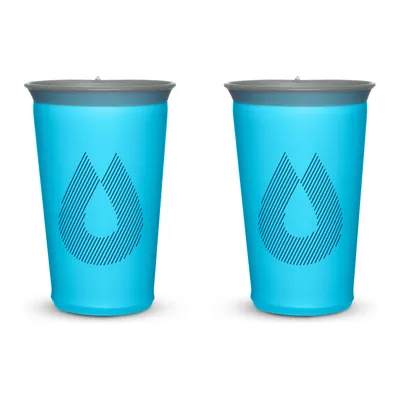
HydraPak SpeedCup
A 200 ml, 10 g soft cup, above the 15 cl required by the UTMB and the Eiger. Being collapsible, it will not pass where the rules demand a rigid cup.
View on Amazon (opens in a new tab)
FAQs
What hydrostatic head does a trail running jacket need?
It depends on the race. The Zugspitz Ultratrail and the Innsbruck Alpine Trailrun Festival require at least 10,000 mm, while the UTMB and the Eiger Ultra Trail recommend 20,000. The number is not enough on its own: most rules also ask for a built-in or factory-fitted hood and taped seams. Check the list for your edition and the manufacturer’s spec sheet.
Does a windproof jacket count as a waterproof?
Not in the rules we read. The Lakeland 50 explicitly rejects jackets that are merely windproof or showerproof, and the UTMB states that a windproof does not replace the hooded waterproof jacket, nor the other way round. A windproof can go in your pack for comfort, but it never stands in for the membrane jacket the rules require.
Will a collapsible cup pass kit check?
Often, but not everywhere. The Eiger Ultra Trail accepts a collapsible cup of at least 15 cl, and the UTMB asks for 15 cl while turning away flasks with caps. The Lakeland 50, on the other hand, requires a rigid cup for hot drinks: if it collapses, it is rejected. Read the exact line in your race’s rules before you buy.
What happens if I don’t have the mandatory kit?
Depending on the race, anything from a time penalty to disqualification. The Templiers add 30 minutes for missing water or a missing head torch; the UTMB disqualifies runners without a compliant jacket, a light, a survival blanket, water or a smartphone. At the Lakeland 50 and in Innsbruck, incomplete kit at the check simply means you cannot start.
Can I put my phone in flight mode during the race?
Not at every race. The UTMB and the Zugspitz Ultratrail hand out a 15-minute penalty for a phone that is switched off or in flight mode, and the Eiger Ultra Trail bans flight mode: the organisers need to be able to reach you. The Lakeland 50 asks for a fully charged phone, to switch on if you think you are lost. Your race’s rules decide.
Sources
- Association Sierre-Zinal, ‘Règlement’ (in French), articles 7 and 15 and list of aid stations, accessed 23 October 2026. sierre-zinal.com https://www.sierre-zinal.com/fr/reglement-340.html ↩
- SaintéLyon (CT Lyon), ‘Règlement’ (in French), ‘Équipement obligatoire’ section, 27 to 29 November 2026 edition, accessed 23 October 2026. saintelyon.com https://www.saintelyon.com/reglement ↩
- Festival des Templiers (Templiers Events Compagnie), ‘Règlement 2026’ (in French), articles 3 and 5, PDF accessed 23 October 2026. eldorun.com https://www.eldorun.com/templiers/reglementtempliers.pdf ↩
- UTMB Mont-Blanc, ‘Matériel obligatoire’ (in French), 2026 list, accessed 23 October 2026. montblanc.utmb.world https://montblanc.utmb.world/fr/races-runners/runners/mandatory-equipment ↩
- Lakeland 50 & 100, ‘Kit requirements’, July 2027 event website, accessed 23 October 2026. lakeland100.com https://lakeland100.com/kit-requirements/ ↩
- Zugspitz Ultratrail, ‘Pflichtausrüstung’ (in German), June 2027 edition, accessed 23 October 2026. zugspitz.utmb.world https://zugspitz.utmb.world/de/runners/mandatory-gear ↩
- Innsbruck Alpine Trailrun Festival, ‘Trailmarathon’, K42 ‘Pflichtausrüstung’ section (in German), May 2027 edition, accessed 23 October 2026. innsbruckalpine.at https://www.innsbruckalpine.at/race/trailmarathon/ ↩
- Eiger Ultra Trail, ‘Pflichtmaterial’, E51 and E35 list (in German), July 2027 edition, accessed 23 October 2026. eiger.utmb.world https://eiger.utmb.world/de/races-runners/runners/mandatory-equipment ↩
- Fédération française d’athlétisme, Règlement des manifestations running 2027 (in French), adopted by the board on 28 and 29 May and 23 and 24 July 2026, safety kit imposed on runners (p. 40) and waste management (p. 52), accessed 23 October 2026. monclub.athle.fr https://monclub.athle.fr/wp-content/uploads/2026/10/Reglementation_Running_2027.pdf ↩
- Fell Runners Association, FRA Requirements for Runners 2026, rule 3 and table 1, accessed 23 October 2026. files.fellrunner.org.uk https://files.fellrunner.org.uk/documents/2026/fra-requirements-for-runners-2026.pdf ↩
- Fell Runners Association, ‘Frequently Asked Questions’, ‘About Kit’ section, accessed 23 October 2026. fellrunner.org.uk https://www.fellrunner.org.uk/faq/frequently-asked-questions ↩
- UTMB Mont-Blanc, ‘Règlement 2027’ (in French), ‘Équipement’ and ‘Pénalités et disqualification’ sections, accessed 23 October 2026. montblanc.utmb.world https://montblanc.utmb.world/fr/races-runners/other-information/regulation ↩
- International Organization for Standardization, ‘ISO 811:2018, Textiles, Determination of resistance to water penetration, Hydrostatic pressure test’, abstract, standard confirmed in 2025, accessed 23 October 2026. committee.iso.org https://committee.iso.org/standard/65149.html ↩
- Hohenstein, ‘Hohenstein Quality Label Breathability’, measurement under ISO 11092, accessed 23 October 2026. hohenstein.com https://www.hohenstein.com/en/trust/hohenstein-quality-labels/from-a-z/breathability ↩
- Zugspitz Ultratrail, ‘Wettkampfordnung’ (in German), mandatory kit checks and penalties, June 2027 edition, accessed 23 October 2026. zugspitz.utmb.world https://zugspitz.utmb.world/de/runners/regulations ↩
- Innsbruck Alpine Trailrun Festival, ‘Sicherheit’ (in German), accessed 23 October 2026. innsbruckalpine.at https://www.innsbruckalpine.at/runners-info/sicherheit/ ↩

Trail running, snow, water, nature and destinations
Nolwenn covers trail running, snow, water, nature and destinations for Outfarer. Curious about everything, from meteor showers to night-train timetables, she has a knack for unearthing the one detail that changes everything, and putting it in a single sentence.


 Damien Poirier-Boucard
