 Français (France)
 English (UK)
 English (US)
 Deutsch (Deutschland)

Contents
It’s -5 °C on the plateau, the sun hasn’t cleared the ridge yet, and the pan has been sitting for long minutes over a flame that looks like a pilot light. The canister isn’t empty, though: it’s cold, like your fingers. How much gas should you carry, and why does the stove flag just when you need it most? The manufacturers’ spec sheets answer the first question, provided you read their test conditions. The second comes down to a little kitchen physics.
This guide follows on from our guide to your first wild camp, where the stove takes the place of a fire. The sum for one night’s gas, meal by meal, is in our guide to wild camping food; here, we look at what makes that figure vary: the stove, the wind, the cold, the gas blend and the canister itself, then travel, recycling and safety.
How much gas to boil 1 litre of water
For each of its stoves, MSR publishes the amount of water brought to the boil with 28 g of gas (1 oz): 1.7 to 2.8 litres for its canister stoves, depending on the model and the pan [1]. Per litre, that works out at roughly 10 to 16 g of gas. The PocketRocket 2, a small stove that screws onto its canister, runs at about 14 g per litre, the figure in our food guide. The 1.7-litre Reactor, an A burner and pan designed together; the pan carries a heat exchanger under its base, fins that catch the heat of the flames., gets down to 10 g.
| MSR stove | Type | Water boiled per 28 g of gas | Gas per litre (approx.) |
|---|---|---|---|
| PocketRocket 2 | Screws onto the canister | 2 L | 14 g |
| PocketRocket Deluxe | Screws on, with pressure regulator | 2.1 L | 13 g |
| WindPro II | Remote canister | 1.8 L | 16 g |
| WindBurner 1.0 L | Integrated system | 2.3 L | 12 g |
| Reactor 1.7 L | Integrated system | 2.8 L | 10 g |
MSR’s figures with its IsoPro gas; the last column is calculated. Stoves are traditionally tested at sea level, at 21 °C and with no wind. [1]
Those are rarely the conditions at a wild camp, as MSR itself acknowledges [1]. Burn time counts too: a 227 g canister lasts about an hour on a PocketRocket 2 [2], and the instructions for Campingaz’s Bivouac stove give a rate of 189 g of gas an hour [3]. Every minute of flame costs gas: that is why semolina or a freeze-dried meal, which swell off the heat, go easier on the canister than pasta, as our food guide explains.
If your water comes from a stream, the boiling time that rids it of germs adds to the total: our guide to water for wild camping goes into the detail.
Wind and cold: what the spec sheet leaves out
Wind is the first thief of gas. On an open-flame burner like the PocketRocket’s, an 8 km/h wind can triple consumption for the same cooking time, according to MSR, which adds that cold, snow to melt and wind can call for three to four times the baseline amount [1]. Icy water from a mountain stream also lengthens the boiling time. The double that our food guide suggests for an ordinary night covers small mishaps; in wind or snow, MSR talks of three or four times as much.
The first instinct, wrapping a windscreen round the stove, depends on the model. MSR recommends one on a A canister set apart from the burner and linked to it by a hose, as on the WindPro II., wrapped about 1.3 cm from the pan, to send the heat up its sides [1]. On a stove that screws onto its canister, it’s the opposite: the PocketRocket 2’s instructions rule out any windscreen [5]. Look for natural shelter instead, a boulder or a fold in the ground, keeping the stove at least 20 cm from any wall or combustible object, as the instructions for Campingaz’s Bivouac require [3], and put a lid on the pan: MSR lists it among the habits that save gas [1].
Butane, isobutane, propane: what’s in the canister
A stove canister holds Propane, butane or isobutane: gases in the open air, kept liquid under pressure inside the canister.: liquid at the bottom, gas on top. The stove burns only the gas, and that gas forms only if the liquid boils. Everything therefore hinges on its The temperature at which a liquid starts to boil, here at the pressure of the surrounding air.: the lower it is, the more pressure the canister keeps in the cold, MSR explains. Propane boils so low that at -42 °C, poured into a mug, it would sit there like water without evaporating [6].
| Gas | Boiling point | What MSR says |
|---|---|---|
| Propane | About -42 °C | The best in the cold, but on its own it needs a much heavier canister |
| Isobutane | About -11 °C | The next best after propane, dearer than butane |
| Butane | About 0 °C | The cheapest and the poorest performer, enough in warm weather for short trips |
Boiling points at atmospheric pressure, NIST averages; MSR gives -42, -12 and -1 °C. [7, 8, 9, 6]
Hence the blends. MSR’s IsoPro contains 80% isobutane and 20% propane [6], and Primus states around 20% propane and 80% isobutane in its Power Gas as in its Winter Gas [10]. Pure propane would need a much heavier canister to withstand its pressure [6], and some stoves won’t take it, such as Soto’s WindMaster [11]. At the other end of the shelf, the cheapest canisters often contain straight butane, according to MSR, which admits it does the job in warm weather, for short trips [6]. The blend is printed on every canister: it’s the first line to read in the shop.
Why the stove struggles below 0 °C
Cold attacks on two fronts. First, it lowers the pressure in the canister and slows the evaporation of the liquid: the flame weakens, or goes out, even though there’s gas left, explains Primus, which adds that the effect grows once the canister is no longer full [10]. Then the canister chills itself as it runs, because a liquid that evaporates takes heat with it, like sweat on skin; with a gas already short of pressure, that cooling finishes off the stove’s performance, according to MSR [6].
Manufacturers’ benchmarks come with their conditions. MSR says a stove that screws onto its canister usually works down to about -6.5 °C, and less and less well below that [1]; the PocketRocket 2’s instructions rule out using or storing it below -18 °C [5]. Some stoves have a A part that keeps the flow of gas to the burner steady as the canister’s pressure drops.: Soto’s catalogue presents it as the answer to the pressure drop of chilled gas [12], and MSR fits one to its WindBurner, which keeps its full output as long as the canister stays above 0 °C [2]. A regulator doesn’t create pressure, though: below freezing, the canister’s pressure can fall lower than it can make up for, MSR warns [13].
Winter canisters work on the contents. Primus lines the inside of its Winter Gas with absorbent paper that increases the surface the liquid evaporates from. In its test, two full canisters kept for 48 hours in a freezer, then burned in a cold room at -20 °C on two identical stoves, its own gave about 9% more power after 60 minutes, and 15% after 120 minutes [10]. A manufacturer’s test of its own product, to be read as such: the gain is real, but the blend comes first.
In the cold, what helps without risk
Nothing spectacular, but it all adds up:
- Choose the canister by its blend: isobutane and propane rather than straight butane [6].
- Keep it warm before cooking, in a jacket pocket or in your sleeping bag, as MSR advises [13].
- Stand it in a container of water that isn’t freezing: as long as the water stays liquid, it keeps the canister warm enough for the stove to keep going [13]. MSR also suggests standing it in warm water before you light the stove [1], never hot: a canister must never go above 50 °C [14].
- Put a lid on the pan, and don’t lift it every other minute: you can hear the water boil [1].
- Only turn the canister upside down on a stove designed for it, a remote-canister model such as the WindPro II, which then runs in liquid mode [1]; on the WindBurner, MSR forbids it, as it can cause dangerous flare-ups [2].
- For a real winter camp, MSR points towards its integrated systems or a liquid-fuel stove [1].
How to tell what’s left in a canister
A canister won’t tell you what’s left in it; kitchen scales will. The principle comes down to two subtractions: the stated full weight minus the stated gas gives the empty weight, and the reading on the scales minus that empty weight gives the gas left. Our food guide applies it to the small 110 g IsoPro; here are all three sizes, from MSR’s product page [15].
| Canister | Stated full weight | Empty weight (approx.) | Half full (approx.) |
|---|---|---|---|
| 110 g of gas | 210 g | 100 g | 155 g |
| 227 g of gas | 371 g | 144 g | 258 g |
| 450 g of gas | 652 g | 202 g | 427 g |
Full weight and contents from MSR; empty and halfway weights calculated. Each brand has its own weights: do the sum with your canister’s. [15]
Example: a 227 g IsoPro that weighs 250 g still holds about 106 g of gas. Without scales, MSR prints a A scale printed on the canister: set in still water, it floats higher or lower depending on the gas left, and the waterline is read off the scale. on its 110 and 227 g canisters [15, 6]. The label helps too: the cartridge below shows 190 g of butane and a gross weight of 280 g, so about 90 g empty. Finally, before throwing a canister away, the instructions for Campingaz’s Bivouac ask you to shake it to check you can no longer hear any liquid [3].
Threaded valve, Campingaz valve, pierceable cartridge
The European standard EN 417, in its 2012 version, covers non-refillable metal cartridges of 50 to 1,000 ml, with or without a valve, for contents whose pressure does not exceed 13.2 bar at 50 °C [16]. The connections, on the other hand, are not all the same, and are not interchangeable.
- The A valve with a screw thread, onto which the stove is screwed., the most common in walking circles. MSR says most of the world’s canisters use this thread, and that a stove designed for it generally accepts well-made canisters from other brands, without being able to guarantee it [17, 6]. The PocketRocket 2’s instructions, for their part, only allow MSR canisters certified to EN 417 [5].
- The Campingaz valve on CV 270 Plus, CV 300 Plus and CV 470 Plus cartridges, which screws on about a sixth of a turn, until it clicks, and can be removed even before the cartridge is empty. It refits on Campingaz appliances from the same range, designed for these cartridges only, and the Bivouac stove’s instructions say it can be dangerous to use other gas containers [3].
- The A valveless cartridge that the appliance pierces as it is fitted., like the 190 g cartridge pictured above. Since the 2012 version of the standard, it must have an internal leakage limiter [16].
Two final warnings from MSR. Never use a refilled canister: you can’t tell what’s in it, or whether enough room has been left for the liquid to expand [17]. And no forced adaptation: the PocketRocket 2’s instructions warn that it may be hazardous to try to fit other types of gas container [5]. For a borrowed stove, our kit list advises checking that the canister fits it before you set off.
Carrying, storing and recycling
In the car and at home
Gas fears heat far more than cold. Campingaz’s safety data sheet says not to expose cartridges to more than 50 °C, not to leave them in a vehicle in the sun, and not to store them below ground level, in a cellar or basement: if there’s a leak, the gas, heavier than air, collects in low-lying spots [14]. The Bivouac’s instructions add a cool, dry, well-ventilated place, out of children’s reach [3]. Put the cap back on after use: Soto insists on it, to keep the valve clean [11].
Where fires are banned
In Scotland, the Scottish Outdoor Access Code asks campers not to light an open fire, even in a fire bowl or barbecue, in times of high fire risk or near forests, farmland, peaty ground or buildings; if needed, use a camping stove, on a level, non-flammable surface away from dry grass, vegetation and your tent, and keep a close watch on it [18]. In France, in the core of the Écrins National Park, the portable gas stove is even the only flame allowed: a 2026 order bans any other combustion device and any open fire [19]. The rules change from one French park to the next, as our park-by-park guide shows, and some French prefectural orders ban even stoves in times of fire danger, as our guide to campfire rules in France explains.
The empty canister
An empty canister stays out of your household bins. Suffolk’s council recycling service explains why: a camping gas canister can hold up to three times the pressure of an ordinary deodorant can, enough to cause serious damage at the reprocessing plant; it takes them at its recycling centres instead, empty pierced-top cartridges in the metal container and valve-top canisters in the gas bottle cage [24]. Cornwall Council also accepts butane camping canisters at its household waste recycling centres, all but one, and notes that some manufacturers and shops take used ones back [25]. Rules vary from one council to the next: check yours. And never pierce or burn a canister, even an empty one, Campingaz warns [14].
Carbon monoxide: the stove stays outside
A gas stove can produce A toxic gas, invisible and odourless, given off by burning.. The PocketRocket 2’s instructions say so up front: a stove made ‘for outdoor use only’, never to be used in an enclosed space such as a camper, a tent, a car or a home [5]; those for the DragonFly, another of the brand’s stoves, add the The area covered by the flysheet in front of the door, outside the inner tent; some makers call it the vestibule. to the list [26]. Campingaz also rules out its Bivouac in a tent, a shelter or any small enclosed space, and while sleeping [3]. The NHS, for its part, says never to use a camping stove indoors or inside a tent [27]. In France, about 3,000 people are accidentally poisoned each year, all appliances combined, and around a hundred die [28].
The same reasoning applies in a converted vehicle: our guide to campervans in winter covers heating, detectors and ventilation.
A good habit to get into before every trip: weigh the canister, read its blend, and check the forecast for dawn rather than for the afternoon. The rest happens outside, always outside.
Kit related to this article
No affiliation: no commission, no sponsored products.
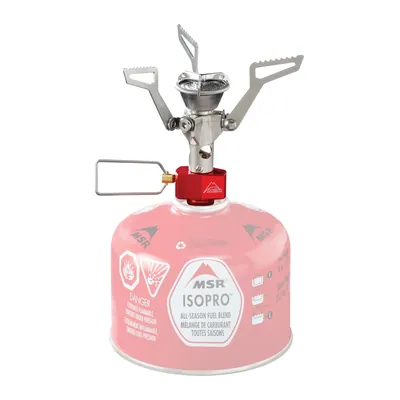
MSR PocketRocket 2
A 73 g gas canister stove that boils a litre of water in 3.5 minutes: where stoves are allowed, it saves lighting a fire, which is often banned.
View on Amazon (opens in a new tab)
FAQs
How many gas canisters for a weekend’s wild camping?
Work out the water you’ll heat, then multiply by your stove’s consumption: 10 to 16 g of gas per litre across MSR’s models, at sea level, at 21 °C and with no wind. Our food guide does the sum for one night. In wind, hard frost or with snow to melt, MSR warns that you may need three to four times as much: weigh the canister before you set off.
Why does my gas stove struggle in the cold?
Cold lowers the pressure in the canister: the liquefied gas struggles to evaporate, and the flame weakens even though there’s gas left. The canister chills further as it runs, because the evaporating liquid takes heat with it. Butane boils at around 0 °C, isobutane at around -11 °C and propane at around -42 °C: in the cold, an isobutane and propane blend copes far better than straight butane.
Will any canister fit my stove?
No. Threaded-valve canisters generally fit stoves designed for that thread, whatever the brand, but Campingaz CV Plus cartridges have their own connection, and pierceable cartridges yet another. Each stove’s instructions say which ones it takes, and both MSR and Campingaz warn that it can be dangerous to use others. Never use a refilled canister.
Can I take a gas canister on a plane?
No. The UK Civil Aviation Authority lists flammables and compressed gas among the items not permitted anywhere on board, and only allows a new or fully purged stove in the hold, with the airline’s approval. In the US, the FAA bans all camp stove fuels, canisters included, in the cabin and the hold alike, and MSR rules canisters out of air travel too. Buy your gas when you land.
Where do I throw away an empty gas canister?
Not in your household bins: Suffolk’s council recycling service warns that a camping gas canister can hold up to three times the pressure of a deodorant can, and takes them at its recycling centres, as does Cornwall Council. Rules vary by council. Shake the canister first: if you can still hear liquid, it isn’t empty. And Campingaz says never to pierce or burn one, even when empty.
Can I use my stove in the tent porch?
No. The instructions for MSR’s DragonFly list the porch, or vestibule, among the enclosed spaces where a stove must never be used, along with the tent and the car, and Campingaz rules out its Bivouac stove in a tent, a shelter or any small enclosed space. The carbon monoxide a stove can produce is invisible and odourless. Cook outside, even in the rain, and turn the stove off before you sleep.
Sources
- MSR (Cascade Designs), ‘Stoves 101: How Much Fuel Should I Carry?’, Summit Register, 8 June 2021 (first published 2 April 2017), accessed 29 October 2026. cascadedesigns.com https://cascadedesigns.com/en-eu/blogs/msr-gear-guides/stoves-101-how-much-fuel-should-i-carry ↩
- MSR (Cascade Designs), PocketRocket 2 stove product page and FAQ, accessed 29 October 2026. cascadedesigns.com https://cascadedesigns.com/en-eu/products/pocketrocket-2-stove ↩
- Campingaz, instructions for the ‘Bivouac’ stove (ref. 4010057703), manufacturer’s leaflet in several languages, accessed 29 October 2026. campingaz.com https://www.campingaz.com/trade/images/SpareParts/01ad513b-3784-4fc5-9430-1d51b5db5b6b/4010057703.pdf ↩
- Primus, ‘The technology behind Primus fuel efficiency’, manufacturer’s page, accessed 29 October 2026. primus.us https://primus.us/pages/fuel-efficiency ↩
- MSR (Cascade Designs), PocketRocket 2 stove instructions (ref. 82-820-5), in several languages, accessed 29 October 2026. cascadedesigns.com https://cascadedesigns.com/cdn/shop/files/82-820-5_PocketRocket2_Instructions.pdf ↩
- MSR (Cascade Designs), ‘The Ins and Outs of Canister Fuels’, Summit Register, 26 June 2023 (first published 11 March 2015), accessed 29 October 2026. cascadedesigns.com https://cascadedesigns.com/en-eu/blogs/msr-gear-guides/ins-outs-canister-fuels ↩
- National Institute of Standards and Technology (NIST), Chemistry WebBook, SRD 69, ‘Propane’, phase change data, accessed 29 October 2026. webbook.nist.gov https://webbook.nist.gov/cgi/cbook.cgi?ID=C74986&Mask=4 ↩
- National Institute of Standards and Technology (NIST), Chemistry WebBook, SRD 69, ‘Isobutane’, phase change data, accessed 29 October 2026. webbook.nist.gov https://webbook.nist.gov/cgi/cbook.cgi?ID=C75285&Mask=4 ↩
- National Institute of Standards and Technology (NIST), Chemistry WebBook, SRD 69, ‘Butane’, phase change data, accessed 29 October 2026. webbook.nist.gov https://webbook.nist.gov/cgi/cbook.cgi?ID=C106978&Mask=4 ↩
- Primus, ‘Winter gas’, manufacturer’s page, accessed 29 October 2026. primus.us https://primus.us/pages/primus-winter-gas ↩
- SOTO, WindMaster with 4Flex stove product page, accessed 29 October 2026. sotooutdoors.com https://sotooutdoors.com/product/windmaster-stove-with-4flex/ ↩
- SOTO, 2025 catalogue, European edition in English, published January 2026, accessed 29 October 2026. sotooutdoors.com https://sotooutdoors.com/wp-content/uploads/2026/01/260114-Soto-Katalog-2025-v13-EN-cs-reduced-size.pdf ↩
- MSR (Cascade Designs), ‘FAQ: In freezing temperatures, should I put my fuel canister in water?’, Summit Register, 28 February 2019, accessed 29 October 2026. cascadedesigns.com https://cascadedesigns.com/en-eu/blogs/msr-gear-guides/faq-how-does-putting-your-fuel-canister-in-water-help-it-work-better-in-freezing-temperatures ↩
- Application des Gaz (Campingaz), safety data sheet ‘Butane et mélanges’, edition 7.1 of 29 January 2015 (in French), accessed 29 October 2026. campingaz.com https://www.campingaz.com/trade/documents/After-Sales%20data/CGZ%20FDS/FDS%20butanem%C3%A9lange_V7_1.pdf ↩
- MSR (Cascade Designs), IsoPro fuel canister product page, accessed 29 October 2026. cascadedesigns.com https://cascadedesigns.com/en-eu/products/msr-isopro-fuel ↩
- BSI, ‘BS EN 417:2012, Non-refillable metallic gas cartridges for liquefied petroleum gases, with or without a valve, for use with portable appliances’, summary of the standard published 31 March 2012, accessed 29 October 2026. knowledge.bsigroup.com https://knowledge.bsigroup.com/products/non-refillable-metallic-gas-cartridges-for-liquefied-petroleum-gases-with-or-without-a-valve-for-use-with-portable-appliances-construction-inspection-testing-and-marking-1 ↩
- MSR (Cascade Designs), ‘The Ultimate Guide to MSR Fuel’, Summit Register, 7 August 2024 (first published 1 September 2022), accessed 29 October 2026. cascadedesigns.com https://cascadedesigns.com/en-eu/blogs/msr-gear-guides/the-ultimate-guide-to-msr-fuel ↩
- NatureScot, Scottish Outdoor Access Code, ‘Camping’, accessed 29 October 2026. outdooraccess-scotland.scot https://www.outdooraccess-scotland.scot/practical-guide-all/camping ↩
- Parc national des Écrins, order No. 148/2026 of 16 June 2026 regulating bivouacking in the core of the park, consolidated version (in French), accessed 29 October 2026. ecrins-parcnational.fr https://www.ecrins-parcnational.fr/sites/ecrins-parcnational.com/files/fiche_doc/27327/2606148arretebivouacvf-rectificatif.pdf ↩
- UK Civil Aviation Authority, ‘Beware! Items not allowed in checked or cabin baggage’, poster CAP1402, version 2 of 5 April 2018, accessed 29 October 2026. caa.co.uk https://www.caa.co.uk/publication/download/15648 ↩
- UK Civil Aviation Authority, ‘What items can I travel with and which are restricted’, accessed 29 October 2026. caa.co.uk https://www.caa.co.uk/air-passengers/about-your-trip/baggage/safety-advice-on-what-to-pack/ ↩
- Federal Aviation Administration (FAA), ‘PackSafe: Fuels’, updated 27 August 2025, accessed 29 October 2026. faa.gov https://www.faa.gov/hazmat/packsafe/fuels ↩
- Federal Aviation Administration (FAA), ‘PackSafe: Outdoor Equipment’, accessed 29 October 2026. faa.gov https://www.faa.gov/hazmat/packsafe/outdoor-equipment ↩
- Suffolk Recycling (Suffolk County Council waste management), ‘Camping gas bottles and canisters’, accessed 29 October 2026. suffolkrecycling.org.uk https://www.suffolkrecycling.org.uk/what-to-do-with-a-z/c/camping-gas-bottles-and-canisters ↩
- Cornwall Council, ‘Camping gas canisters’, accessed 29 October 2026. cornwall.gov.uk https://www.cornwall.gov.uk/rubbish-recycling-and-waste/recycling/recycling-items/camping-gas-canisters/ ↩
- MSR (Cascade Designs), DragonFly stove instructions (ref. 33-950), 2018, accessed 29 October 2026. cascadedesigns.com https://cascadedesigns.com/cdn/shop/files/11774Dragonfly_Instructions_33-950_ENG.pdf ↩
- NHS, ‘Carbon monoxide poisoning’, page last reviewed 16 December 2025, accessed 29 October 2026. nhs.uk https://www.nhs.uk/conditions/carbon-monoxide-poisoning/ ↩
- Direction générale de la santé, Santé publique France and Anses (French health authorities), ‘Intoxications au monoxyde de carbone. Adopter les bons gestes peut sauver des vies’, press release, 26 November 2025 (in French), accessed 29 October 2026. santepubliquefrance.fr https://www.santepubliquefrance.fr/presse/intoxications-au-monoxyde-de-carbone-adopter-les-bons-gestes-peut-sauver-des-vies ↩
- Mountain Rescue England and Wales, ‘In case of emergency’, accessed 29 October 2026. mountain.rescue.org.uk https://www.mountain.rescue.org.uk/how-to-call-out-mr/ ↩

Camping, wild camping, bushcraft and hiking
Guillaume Hoarau writes for Outfarer about camping, wild camping, bushcraft and hiking. A survival-skills enthusiast and a collector of old field manuals, he likes clear explanations, lists that earn their place and other people’s stories, which he tells well.


 Nolwenn Bastide