 Français (France)
 English (UK)
 English (US)
 Deutsch (Deutschland)

Contents
Why a via ferrata has several grades, not one
“It’s a D, you’ll be fine.” Depending on the country where it is said, that sentence describes a very different route. There is no single scale: the UIAA, the international federation of alpine clubs, lists five for via ferrata, the Austrian, two German ones, the French and the Italian [1]. In 2016 its Mountaineering Commission adopted the Italian scale as the international standard, citing its “completeness” [1]. Guidebooks around the world have not switched to it.
One rule holds for all of them: a grade describes the hardest section, not the average of the route. The German Alpine Club (DAV) warns that grades should be treated only as a “rough guideline” [2].
Schall’s letters and Hüsler’s numbers
In the German-speaking Alps two systems dominate. Kurt Schall’s scale runs from A (easy) to E (extremely difficult) and is the one used in Austria; F, kept for exceptional difficulty, is very rare [2]. Eugen Hüsler’s scale, from K1 to K6, is used mainly in Switzerland [2]. A Valais tourist office, Aletsch Arena, sums it up as K1 (easy) to K6 (very difficult), pointing to the Swiss Alpine Club’s scale [3]. In Hüsler’s system K6 means routes with almost no foot aids, on the steel cable alone [2].
Guidebooks usually line the two up: A for K1, B for K2, and so on up to F for K6. The OpenStreetMap community, which needs a common basis for its maps, publishes that table with + and - signs for finer shading [4]. Treat it as a rule of thumb, not an official equivalence.
| Schall (Austria) | Hüsler (Switzerland) | Schall’s word for it |
|---|---|---|
| A | K1 | Easy |
| B | K2 | Moderately difficult |
| C | K3 | Difficult |
| D | K4 | Very difficult |
| E | K5 | Extremely difficult |
| F | K6 | Exceptional difficulty, very rare |
Schall’s wording after the DAV; letter-to-number correspondence after the OpenStreetMap wiki (community-edited).
The French and Italian letters: F to ED
The French grades borrow the letters of alpine climbing: F (easy), PD (a little difficult), AD (fairly difficult), D (difficult), TD (very difficult) and ED (extremely difficult), sometimes refined with a “+” or a “-” [5]. The French outdoor magazine Alti-Mag points out that grades vary from one site to another [5]. The DAV describes a six-level French scale, completed by four criteria marked from 1 to 4: athletic demand, exposure, protection and terrain [2].
The Italian scale, from the Italian Alpine Club (CAI) and now the UIAA’s reference, has two layers. The first gives the overall commitment in five levels, F to ED. The second scores four parameters from 1 to 3: technical demand, physical effort, exposure and environment [1].
| Level | What the scale says |
|---|---|
| F | An equipped path with low exposure and long walking sections; cables and chains are mainly there for safety. |
| PD | A short via ferrata with low exposure: couloirs, chimneys or short vertical sections aided by chains, cables, pitons or stairs. |
| D | A medium to long route needing good fitness and technical skill; often vertical, sometimes with overhangs. |
| TD | Exposed, technical sections needing very good fitness and technical ability; overhangs are climbed with few artificial aids. |
| ED | Several exposed, technical sequences, sometimes deliberately created; few pitons or stairs, so strong fitness and some climbing skill are needed. |
After the UIAA “Via Ferrata” page, which reproduces the CAI wording.
The fourth parameter says what letters forget: the environment. Level 1 is a low-altitude route with generally safe weather and easy escapes; level 3 is high-mountain terrain above 2,000 m (about 6,600 ft), where snow is possible and thunderstorms, wind and cold are hazards [1].
What a grade doesn’t tell you
A grade is that of the hardest section. According to the DAV, a C route with one short vertical pitch at the start is nothing like a C route that stays steep for 400 m (about 1,300 ft) of elevation gain [2]. Some guidebooks therefore rate overall commitment separately; Hüsler adds a “cross” that scores endurance, arm strength, mountain experience and exposure one by one [2].
Another limit: a grade assumes ideal conditions. Wet rock, heat, snow and visibility are not part of it [6]. The approach and the descent are judged separately from the route itself [6]. And size matters: wide gaps between footholds, and a cable set far from the rock, make life harder for smaller people [2].
Hiking trails have scales of their own, read in the same way: see mountain hiking grades. For rock climbing, the climbing grade conversion table does the same job.
What the accident figures say, and what they contradict
The most thorough study, published in 2019, analyzed ten years of the Austrian Alpine Safety Board’s registry: 1,684 people involved in a via ferrata emergency between November 2008 and October 2018 [7]. The first finding: most emergencies came from being stuck through exhaustion or misjudging one’s own abilities, and more than half of the victims were evacuated uninjured [7].
The second is more uncomfortable. Sixty-two people died (3.7%), and the mortality rate was highest on the technically easiest routes: 13.2% on grade A and 4.9% on B. Rescue without injury, by contrast, was most common on difficult routes: 59.9% on D and 62.7% on E. The most common cause of death was falling while climbing unsecured, and men had a 2.5 times higher risk of dying [7]. The authors conclude that correct use of equipment on easy routes could prevent most of these deaths [7].
| Grade (Schall) | Published figure |
|---|---|
| A | 13.2% mortality rate |
| B | 4.9% mortality rate |
| D | 59.9% rescued uninjured |
| E | 62.7% rescued uninjured |
After Ströhle et al., 2019; emergencies reported to the Austrian registry, 2008 to 2018.
These figures come from Austria, using Schall’s scale, and count reported emergencies, not all practitioners: they do not say a D is safer than an A. They say a low letter does not excuse you from the lanyard.
Which grade to start on, and with whom?
Advice varies with the scale, which illustrates the problem. The magazine Bergwelten suggests starting between A and C: A is very suitable for beginners and children, C only to a limited extent [8]. Alti-Mag, on the French side, recommends AD or easier routes to begin with [5]. The manufacturer Mammut considers D or K4 and above to be for trained, experienced climbers, and advises beginners and children to use a climbing rope from B or K2 [9].
Supervision counts for more than the letter. The French Ministry of Sports recommends that beginners be introduced by a professional or a club, and cites 200 m (about 650 ft) of elevation gain as the maximum for a person who is not athletic [11]. In Austria, according to Bergwelten, a intro day starts at around 100 euros and a two-day course costs 300 to 400 euros [8]: a rough guide to be rechecked before booking.
On equipment, the standard for via ferrata lanyards (EN 958) was revised in 2017: sets are now tested for people from 40 to 120 kg (88 to 265 lb), with a lower initial fall shock [14]. Older models need checking against the manufacturer’s stated lifespan and their condition [14].
Worth watching
A short tutorial on the main difficulty scales, how a route gets its grade, and why the approach and a climber’s own limits change the perceived difficulty, taken from its chapter list.
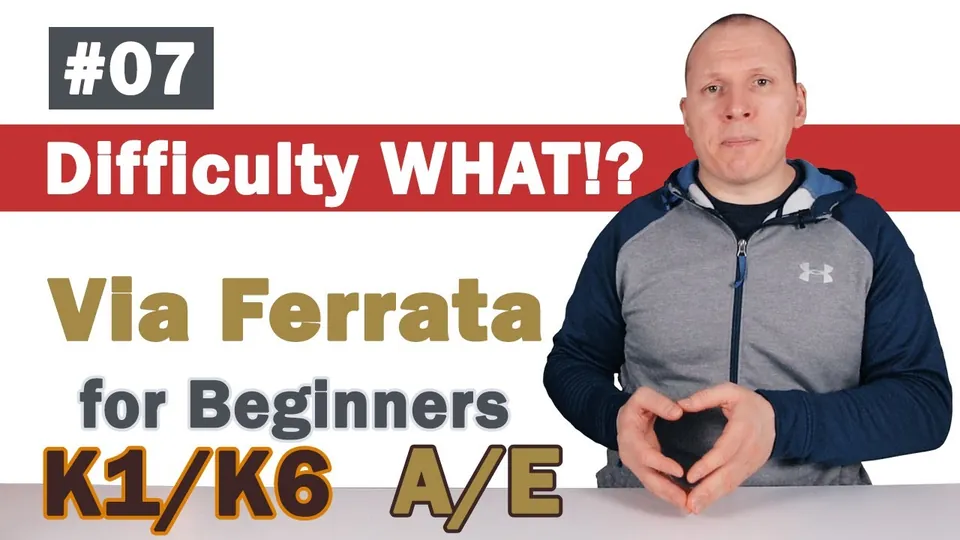
The video is hosted by YouTube (Google): nothing loads until you play it, and Google may then set cookies.
FAQ
What is the difference between A and K1?
Guidebooks usually line them up: A matches K1, B matches K2, up to F for K6. That is a rule of thumb, not an official equivalence: Schall’s scale is mainly Austrian, Hüsler’s mainly Swiss, and the DAV reminds readers that grades are only a rough guideline. Trust the definition given by the guidebook you are reading, not the letter alone.
What do TD and ED mean on a via ferrata?
They are the two highest levels of the French and Italian scales: very difficult (TD) and extremely difficult (ED). In the Italian scale adopted by the UIAA, TD means exposed, technical sections with overhangs climbed using few artificial aids; ED adds several exposed sequences with few pitons or stairs.
Can you do a grade D via ferrata without experience?
No grade can say whether a route suits a particular person. The sources read here place D or K4 and above in the hands of trained, experienced climbers. The French Ministry of Sports recommends an introduction with a professional or a club: that is what lets you judge your level, not the letter in the guidebook.
Why does the same route have two grades?
Because the scales do not measure the same thing: one keeps the hardest section, another the overall commitment, and each country has its own criteria. Guidebooks also differ in their judgment. An Austrian letter and a French one for the same route are not a contradiction, but two readings.
Does the grade take the weather into account?
No: it assumes ideal conditions. Wet rock, heat, snow and poor visibility are not part of it, and the approach and descent are judged separately. As for thunderstorms, the magazine Bergwelten is blunt: via ferrata are off limits, since the steel cable turns you into a lightning rod.
Sources
- UIAA, “Via Ferrata (grades and standards)”, accessed November 16, 2026. theuiaa.org https://www.theuiaa.org/grades-standards/via-ferrata/ ↩
- Deutscher Alpenverein (DAV), “Schwierigkeitsgrade am Klettersteig”, accessed November 16, 2026. alpenverein.de https://www.alpenverein.de/artikel/schwierigkeitsgrade-am-klettersteig_56640cbb-4093-4195-9491-ec2eeb49c1b6 ↩
- Aletsch Arena, “What do the different levels of climbing difficulty mean?”, accessed November 16, 2026. aletscharena.ch https://www.aletscharena.ch/en/here-now/live/news/article/what-do-the-different-levels-of-climbing-difficulty-mean ↩
- OpenStreetMap Wiki, “Key:via ferrata scale”, accessed November 16, 2026. wiki.openstreetmap.org https://wiki.openstreetmap.org/wiki/Key:via_ferrata_scale ↩
- Alti-Mag, “Où et comment débuter en via ferrata”, accessed November 16, 2026. alti-mag.com https://www.alti-mag.com/alti-sport/activites-montagne/ou-et-comment-debuter-en-via-ferrata ↩
- Bergwelten, “Warum sich die Schwierigkeitsbewertung bei Touren verändern kann”, accessed November 16, 2026. bergwelten.com https://www.bergwelten.com/a/warum-sich-die-schwierigkeitsbewertung-bei-touren-veraendern-kann ↩
- Ströhle M. et al., International Journal of Environmental Research and Public Health, 2019, “Mortality in Via Ferrata Emergencies in Austria from 2008 to 2018”, accessed November 16, 2026. pubmed.ncbi.nlm.nih.gov https://pubmed.ncbi.nlm.nih.gov/31877836/ ↩
- Bergwelten, “Klettersteig-Basics: 11 Fragen, 11 Antworten”, accessed November 16, 2026. bergwelten.com https://www.bergwelten.com/a/klettersteig-basics-11-fragen-11-antworten ↩
- Mammut, “What is via ferrata? A beginner’s guide”, accessed November 16, 2026. mammut.com https://www.mammut.com/es/en/stories-guides/what-is-via-ferrata-beginners-guide ↩
- Field Mag, “What Is a Via Ferrata & the 12 Best Spots to Try It in the US”, accessed November 16, 2026. fieldmag.com https://www.fieldmag.com/articles/via-ferrata-guide-united-states ↩
- Ministère des Sports (France), “Via ferrata”, accessed November 16, 2026. sports.gouv.fr https://www.sports.gouv.fr/ferrata-9831 ↩
- VAUDE, “Via ferrata: equipment, difficulty scale and safety”, accessed November 16, 2026. vaude.com https://www.vaude.com/int/en/blog/post/via-ferrata-this-is-how-the-entry-goes-into-the-climb.html ↩
- Deutscher Alpenverein (DAV), “Ausrüstung am Klettersteig”, accessed November 16, 2026. alpenverein.de https://www.alpenverein.de/artikel/ausruestung-am-klettersteig_fa8c706e-b2fe-4174-8672-ec5594f0bd69 ↩
- Deutscher Alpenverein (DAV), “Neue Norm für Klettersteigsets”, accessed November 16, 2026. alpenverein.de https://www.alpenverein.de/artikel/neue-norm-fur-klettersteigsets_581397a2-9dad-40c4-aaa6-e9180216a41e ↩

Camping, backpacking, bushcraft and hiking
Guillaume Hoarau writes for Outfarer about camping, backpacking, bushcraft, and hiking. A survival-skills buff and a collector of vintage field manuals, he loves clear explanations, lists that actually help and other people’s stories, which he tells well.


