 Français (France)
 English (UK)
 English (US)
 Deutsch (Deutschland)

Contents
What a climbing grade actually tells you
Picture a Saturday morning at the foot of a climbing gym wall, where the tag on the first hold says 5.10a. A few weeks later, a European guidebook lists the same difficulty as 6a. Same route, same level? Roughly. And that “roughly” deserves a moment before you compare numbers with your climbing buddies, who will round in their own favor.
A grade answers one question only: how hard is the hardest part? The French mountaineering and climbing federation (FFME) describes its grades as an index of the difficulty of the boulder problems (short climbs without a rope) or routes you’re taking on [1]. An index, then, not a measurement: it says nothing about height, the danger of a fall, or the quality of the protection.
Where does the number come from? The first person to climb the route proposes a grade, and those who follow adjust it. A German coach and guidebook author, Markus Stadler, reckons a grade settles after five to ten repeats: it’s an average of subjective opinions, not an instrument reading [2]. The UIAA, the international federation behind the Roman-numeral scale, adds that difficulty is judged in the ideal conditions of the rock face: on wet rock, the same route is a different animal [3].
The four scales worth knowing
There are others (the Elbe sandstone scale in Germany, the Scandinavian scales, the Australian one...) [4] [3], but four will let you read most of the guidebooks you’re likely to meet, at home or abroad. Two of them look odd to American eyes, so here’s how to read them.
- United States (Yosemite Decimal System, YDS): Five classes, of which only the fifth is technical climbing; it’s subdivided from 5.0 to 5.15, with letters from a to d from 5.10 upward. You say 5.10a as “five ten A” [5] [6]. A route’s class comes from its hardest section, the crux [6].
- France: A number from 3 to 9, followed by a letter a, b, or c and sometimes a +. You say 6a as “six A.” A 6c+ route is harder than a 6c and easier than a 7a. For bouldering, the FFME uses the same system, from 1b to 8c [1].
- UIAA: Roman numerals with + and -, so VI+ reads “six plus.” The scale became official in 1967, VII was recognized in 1978, and the scale was opened upward in 1985 [4].
- United Kingdom: Two parts: an adjective (Moderate, Difficult, Severe, Very Severe, then E1, E2...) for the route as a whole, and a technical grade (4a, 4b, 5a...) for the hardest move [7].
The conversion chart, and why to be wary of it
Here’s a conversion table, built from the Mountain Project grid and cross-checked against the UIAA’s [5] [3]. Read it as a neighborhood: each row brings together grades that are close, not identical.
| YDS (United States) | French | UIAA | British |
|---|---|---|---|
| 5.4 | 4a | IV | VD 3c |
| 5.6 | 4c | V | S 4b |
| 5.8 | 5b | VI- | VS to HVS 4c |
| 5.9 | 5c | VI | HVS 5a |
| 5.10a | 6a | VI+ | E1 5a |
| 5.10c | 6b | VII- to VII | E2 5b |
| 5.11a to 5.11b | 6c | VII+ to VIII- | E3 5c |
| 5.11d | 7a | VIII | E4 6a |
| 5.12b | 7b | VIII+ | E5 6a to 6b |
| 5.12d | 7c | IX | E6 6b |
| 5.13b | 8a | IX+ to X- | E7 6c |
Source: Mountain Project, international grade chart, cross-checked against the UIAA table. The British cells pair the adjective with the technical grade, which don’t convert as neatly as the other three.
The tables don’t always agree. The UIAA’s “pleasure” table puts UIAA V+ at French 5b; Mountain Project puts it at 5a [3] [5]. The UIAA also admits that 6a, first matched with VI+, is now matched with VI, depending on the place and the regulars [3]. It presents its own equivalences as approximate rather than absolute [4].
The same caution applies on the British side: the British Mountaineering Council (BMC) pairs S with 4a on average, HS with 4b, VS with 4c, HVS with 5a, E1 with 5b, and E2 with 5c, then adds that these rules are broken more often than they’re followed [7]. And don’t mistake the bottom of the scale for a playground: the Swiss Alpine Club describes UIAA V as a level at which the long high-mountain routes already count among the big undertakings of the Alps [8].
Gym grades and crag grades
Is a 5.10a in a gym the same as a 5.10a at a crag? Not necessarily. Markus Stadler points out that the character of a route shouldn’t matter, but that an overhang with good holds and a wide crack are hard to compare, and that everyone ends up specializing [2]. After a long approach, far from the last piece of protection, almost nobody pulls the same moves as at the foot of a short crag, with the last quickdraw (the short sling that links the rope to a bolt) at knee height [2].
The same author notes a trend toward more “human” grades at recent crags: you’re surprised how well you climb, then find harder grades again on the classics [2]. Conversely, the first route of a new grade is often rated severely, to justify the grade [2]. In the United States the debate is the same: some grades are judged too high or too low because standards have moved [6].
Difficulty and commitment: what a grade doesn’t say
A grade gives the difficulty of one move. It doesn’t tell you what you’re committing to: length, remoteness, quality of protection, descent. Each country answers that in its own way [9].
- United States: The National Climbing Classification System rates the time required: Grade I takes less than half a day of technical climbing, Grade V generally a night on the route, and Grade VII covers big, remote walls [9]. Don’t confuse these Roman numerals with the UIAA’s: a Grade V route isn’t a UIAA V. Guidebooks may add a rating for seriousness [9].
- France (and across the Alps): On adventure terrain or in the high mountains, a qualitative overall grade: F (facile, easy), PD (peu difficile, not very difficult), AD (assez difficile, fairly difficult), D (difficile, difficult), TD (très difficile, very difficult), ED (extrêmement difficile, extremely difficult), ABO (abominable) [1]. The FFME also distinguishes sport routes, permanently equipped to its standards, from “adventure terrain” routes, which aren’t [1].
- United Kingdom: The adjective already blends seriousness, length of effort, exposure, quality of rock, and technical difficulty. A technical grade that’s low for the adjective (HVS 4c, E3 5b) signals a very sustained route, or an easy one in a serious position [7].
- Aid climbing: A separate scale, from A0 to A5, based on how hard it is to place good-quality protection [1].
Starting out: climbing gyms, clubs, and instruction
This article explains how to read numbers; it doesn’t teach you to climb. The way in is an artificial structure (a bouldering gym, a rope wall at a climbing gym), with a club or the gym’s own supervision and instruction. Ask what they offer before you tie in.
When you’re ready for multi-pitch climbing, the American Mountain Guides Association (AMGA) is where to look. Its Rock Guide Program certifies guides who lead clients on technical, multi-pitch rock [10]. The first course, the Rock Guide Course, aims at guiding routes up to Grade III and 5.9+, and candidates need, among other things, AMGA membership, a CPR certificate, and a Wilderness First Responder certificate [10]. You won’t take that course, but it shows what stands behind a certified guide.
At a crag, climbing means a rope and specific belay equipment, in a natural setting that’s never uniform and can send rocks down [1]. The FFME, writing about French sites, is blunt about it: by using them, climbers accept the normal and reasonably foreseeable risks of the activity [1]. Before you climb in a national park, check the National Park Service’s climbing page for authorizations and closures: it points to the parks where you can climb, the types of climbing, safety tips, local closures, and regulations, and it asks you to climb only where it’s allowed [11].
Before you head out: how to read a grade
- Identify the scale in use: the guidebook key will say (6a and VI aren’t the same thing, and neither is 5.10).
- Check whether the grade covers the whole route or only the hardest move.
- Look for a commitment rating: an overall grade (F to ED), a grade for duration, or the British adjective.
- Don’t convert in your head: a chart gives a neighborhood, never an equality.
- Ask your instructor what that number means at that particular crag.
The smart move fits in one sentence: a grade answers “how hard is the hardest move?”, never “should I go up there?”. That second question is one for you and your instructor, not for a chart.
Worth watching
A short magazine-style episode that decodes the grading systems used around the world and explains why countries grade differently, a spoken companion to our comparison of the scales.
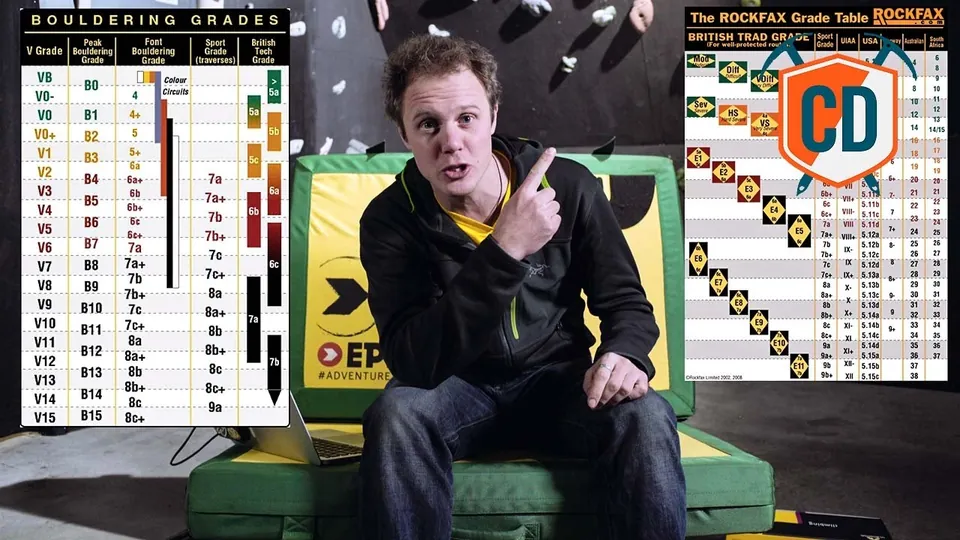
The video is hosted by YouTube (Google): nothing loads until you play it, and Google may then set cookies.
FAQ
What level is a 6a?
It’s a French grade, close to 5.10a in the American YDS and UIAA VI+, according to Mountain Project. It isn’t a “beginner” or “expert” level in itself: place, style, and era all matter. Ask your gym or club what a given grade means at its own wall or crag.
Why do conversion tables disagree?
Because the scales don’t measure the same thing, and grades change over time. The UIAA’s “pleasure” table puts V+ at 5b, Mountain Project at 5a. The UIAA now matches 6a with VI, whereas it was first matched with VI+. It presents its equivalences as indicative, so read them as a neighborhood.
What do F, PD, AD, D, TD, ED, and ABO mean?
This is the French overall grade: easy, not very difficult, fairly difficult, difficult, very difficult, extremely difficult, abominable. It’s used mainly on adventure terrain and in the high mountains, and it rates the whole outing (difficulty and commitment) rather than a single move. The signs + and - refine each step.
Is a gym 5.10a the same as a crag 5.10a?
Not necessarily. Gym grades are set by the route setters, crag grades by the first ascensionists and then by those who repeat the route. The character of the route, the length of the approach, and the protection all change how it feels. A grade is an average of subjective opinions, and it varies from one crag to another.
What does E1 5b mean in British grading?
It’s a two-part grade. E1 (Extremely Severe, first step) is the adjective: it judges the route as a whole, difficulty, seriousness, and effort included. 5b is the technical grade of the hardest move. The BMC gives 5b as the average technical grade of an E1, whereas Mountain Project puts E1 5a near 6a: an average isn’t an equivalence. The gap between the two parts tells you about the character of the route.
Sources
- FFME, “Norme de classement des voies et des sites naturels d’escalade” (standard for classifying routes and natural climbing sites, in French), adopted December 2, 2023. ffme.fr https://www.ffme.fr/wp-content/uploads/2024/05/231202-Norme-de-classement.pdf ↩
- Markus Stadler, “Schwierigkeiten mit der Schwierigkeit” (in German), Bayerländer (a section of the German Alpine Club), 2008. alpenverein-bayerland.de https://www.alpenverein-bayerland.de/module_requirements/bayerlaender/2008/pdf/357-362%20Schwierigkeiten%20mit%20der%20Schwierigkeit,%20M.%20Stadler.pdf ↩
- G. Mandelli and A. Angriman (Italian Alpine Club), “Scales of Difficulty in Climbing,” published by the UIAA, accessed November 7, 2026. theuiaa.org https://www.theuiaa.org/documents/sport/THE-SCALES-OF-DIFFICULTY-IN-CLIMBING_p1b.pdf ↩
- UIAA, “Rock Climbing: a point of reference in the world of rock climbing,” page accessed November 7, 2026. theuiaa.org https://www.theuiaa.org/mountaineering/uiaa-grades-for-rock-climbing/ ↩
- Mountain Project (onX), “International Climbing Grade Comparison Chart,” accessed November 7, 2026. mountainproject.com https://www.mountainproject.com/international-climbing-grades ↩
- Climber.org, “The Yosemite Decimal System,” accessed November 7, 2026. climber.org https://climber.org/data/decimal.html ↩
- British Mountaineering Council, “A brief explanation of UK traditional climbing grades,” accessed November 7, 2026. thebmc.co.uk https://www.thebmc.co.uk/a-brief-explanation-of-uk-traditional-climbing-grades ↩
- Swiss Alpine Club (Zofingen section), “Vergleich UIAA-Skala / Französische Skala” (in German), accessed November 7, 2026. sac-zofingen.ch https://www.sac-zofingen.ch/pdf/verschiedenes/Kletterskala-UIAA.pdf ↩
- American Alpine Club, “International Grade Comparison Chart,” American Alpine Journal, 1999. publications.americanalpineclub.org https://publications.americanalpineclub.org/articles/13201212386/International-Grade-Comparison-Chart ↩
- American Mountain Guides Association, “Rock Guide Program,” accessed November 7, 2026. amga.com https://www.amga.com/rock-guide ↩
- U.S. National Park Service, “Climbing,” accessed November 7, 2026. nps.gov https://www.nps.gov/subjects/climbing/index.htm ↩
- DAV Sicherheitsforschung and KLEVER, “Kletterhallenunfallstatistik 2024” (indoor climbing gym accident statistics 2024, in German), accessed November 7, 2026. alpenverein.de https://www.alpenverein.de/verband/bergsport/sicherheitsforschung/kletterhallen-unfallstatistik/kletterhallenunfallstatistik-2024 ↩

Camping, backpacking, bushcraft and hiking
Guillaume Hoarau writes for Outfarer about camping, backpacking, bushcraft, and hiking. A survival-skills buff and a collector of vintage field manuals, he loves clear explanations, lists that actually help and other people’s stories, which he tells well.


