 Français (France)
 English (UK)
 English (US)
 Deutsch (Deutschland)

An unstaffed cabin isn’t a free room in the mountains. You may find a roof, a stove, and a place to sleep. For everything else, you work with what’s there and with whoever’s already settled in. At Aoulhet, on Tuesday, September 27, 2022, there were three of us sharing the place.
I’d set out alone for two days, with no summit to bag and no climbing time to beat. My wife knew my route and that I planned to be back the next day. My plan fit in a few words: hike, eat something hot, sleep, then take my time heading back down.
I’d planned on possibly sharing the cabin. I’d just pictured myself there alone.
Not far, but plenty of climbing
At the trailhead in Peyras, near the Bethléem monastery, I tightened my pack straps under a sky that was still heavy with clouds. The morning’s rain had left the leaves glistening. Drops were still falling from the branches as I started up, in the early afternoon.
The tourist office lists about 2 hours of hiking, 1.9 miles (3 km), and 2,490 feet (760 m) of elevation gain to the cabin [2]. The distance looks modest. The grade, on the other hand, keeps your legs plenty busy.
I took it easy on the way up, with one break for a drink and another to shed a layer. Under the beech trees, I mostly heard my own footsteps and dripping water. That’s exactly what I’d wanted: to keep moving without having to answer to anyone.
Where the forest ended, patches of fog were drifting across the pastures. The cabin would appear, then lose its outline. I didn’t wander around it any longer: the grass was soaked, and I’d already put my jacket back on.
Two pairs of shoes were waiting under cover outside the door. I knocked, then opened the door a crack.
“How many of you are there?”
The question came from inside, in English.
“Just me. Is there any room left?”
One of the two men waved toward the stairs. Yes, plenty. We spent most of the evening talking in English.
I’d asked permission to walk into a cabin that’s open to everyone. At the time, it had seemed perfectly normal.
Settling in without spreading out
The two occupants were Danish friends on vacation in the Pyrenees. They’d set up their sleeping gear on part of the loft. Downstairs, a jacket hung away from the stove, and their food took up one end of the table.
Nothing intrusive, but enough stuff to make me feel like I was walking into someone’s place.
I asked where to put my backpack. One of them moved his to clear a path. Then I did the same with my trekking poles, which were already threatening to block the entrance.
At 3,822 feet (1,165 m), the Aoulhet cabin has a large common room with a wood stove. The tourist office describes a loft with six sleeping spots, free access year-round, and no reservations [2]. In other words, it’s first come, first served: those six spots aren’t six places you can book before you head up.
That evening, we had room to spare. I kept my things together anyway: someone else might still show up.
I took my dry top, socks, and warm layer out of the dry bag. My damp clothes joined the others, without hogging the space. The feeling of pulling on dry clothes was already worth a good chunk of the climb.
A few plates and kitchen utensils were there to use, but I’d brought my own cook kit and eating utensils. I also had my sleeping bag, a compact sleeping pad, food and a way to cook it, my headlamp, and a small tent. Not to mention earplugs, tucked into a pocket that was easy to find.
I didn’t know exactly what I’d find there, or how many of us there would be. The tourist office actually advises bringing a tent depending on how busy it is, and notes that backcountry camping in the nature reserve is only allowed between 8 p.m. and 8 a.m. [2, 3] That night, my tent stayed at the bottom of my pack.
Fetching water, and seeing what’s there
Before unpacking dinner, I took care of water. The cabin has a drinking water source, shut off in winter so it doesn’t freeze [2].
That evening, it was running. I filled my filter bottle there and came back with my pant legs wet from the grass.
Next time, I’d double-check this before setting out. A water source in a listing doesn’t guarantee it’ll be working the day you show up.
Inside, the stove was already going when I came in, and I’d enjoyed its warmth before I even took off my jacket. There were a few logs that evening, but I hadn’t counted on finding any to stay warm through the night.
One of the Danes pointed to a door on the side. He wondered if there was more stuff behind it. We checked the description I’d saved: the west side is reserved for livestock herding [2]. We left it alone.
I’d settled in for a vacation evening in a building that was also a workplace, and that closed door was a reminder.
Downstairs, it’s cozy. Upstairs is another story
Late in the afternoon, we talked about the previous legs of their trip and our plans for the next day. I tried a few sentences in Norwegian. One of them had worked in Norway; with him, it more or less flowed. With his friend, we quickly switched back to English.
We didn’t swap life stories: the trails, the weather, and whatever was about to go into the pots gave us plenty to talk about.
Then one of them picked up a log. His friend raised a hand.
“Wait. Have you been up there to check?”
I was pretty much in favor of the extra wood. The clothes I’d hung up to dry were still damp, and I felt comfortable near the table. I went up to grab something from my pack.
Up in the loft, the heat surprised me. I stayed a few seconds, then came back down, pulling off my fleece.
We left the log where it was.
The one who was cold put on another layer. The other finished setting up his bed. I moved my damp clothes to leave more room for theirs. Just a few yards apart, we clearly didn’t need the same amount of heat.
| Need | At the cabin | In my pack |
|---|---|---|
| Sleeping | A loft with six sleeping spots, no reservations | Sleeping bag, compact sleeping pad, small tent just in case |
| Staying warm | The wood stove, a few logs | Dry clothes and a warm layer in a dry bag |
| Drinking | The drinking water source, running that evening | A filter water bottle |
| Eating | A few plates and kitchen utensils | Cook kit, eating utensils, pouch meal, cheese, and chocolate |
| Night | Two neighbors in the loft | Earplugs, headlamp within reach |
| Leaving | A broom | A trash bag |
Dinner really starts with a spoonful
I’d brought a single-serving pouch meal. Practical, compact, totally defensible when you’re packing. Once opened next to their pot, a lot less appealing.
They had pasta with a thick sauce and chunks of vegetables. One of them looked at my meal, then at his pot.
“Want some?”
I said yes without pretending to hesitate.
I had cheese and chocolate. I set them in the middle of the table, with my knife. We didn’t decide to share all our food or make plans together for the next day. Everyone kept their own things and their own plans, but dinner went on longer than expected.
We compared our hiking habits. One liked to start early. The other hated a rushed breakfast. I admitted that my solo meals sometimes looked more like refueling than dinner.
Later, I pulled out my map to show them my route back to Peyras. A drawing by one of my twins fell out of the map case. It showed a mountain and a figure with arms that were way too long.
I explained. They asked how old the kids were, then we picked up the conversation again.
The table wasn’t big. Between the map, the bowls, and the wrappers, something had to move whenever someone else wanted to rest their elbows. We ended up clearing the table before heading up to bed.
At night, mostly you hear everyone else trying to sleep
I’d gotten my morning things ready: water, warm layer, and headlamp within reach. I didn’t want to be emptying my pack first thing in the morning over two sleeping people.
Up in the loft, I unzipped my sleeping bag partway. The warmth was plenty for me.
Then the little noises started. A crinkling pad. A zipper. Someone rolling over carefully, which takes twice as long and makes almost as much noise.
I made a point of moving quietly, only to find out that my own sleeping setup was anything but silent. I put in my earplugs.
I didn’t sleep straight through. A few wake-ups, the need to shift position, the awareness of having neighbors very close. At one point, I heard rain against the building. I stayed put, glad I didn’t have to go outside.
Early in the morning, the first one up went quietly downstairs. I waited a bit before joining him. Downstairs, we talked in low voices until the third one appeared.
We had breakfast without rushing. My two neighbors still had a few things to pack up. As for me, all I had left to do was pack up my sleeping gear and head back down the way I’d come the day before.
One last look under the table
The two friends left before me. We traded a few words about our routes, then a handshake, with no promise to see each other again: we’d had a good evening, and that was enough.
I finished my drink in a room that had suddenly gone very quiet.
Before shouldering my pack again, I cleaned my spot, put away what I’d used, and checked the loft. The town relies on everyone’s sense of civic responsibility to keep the cabin clean and pleasant [2].
I swept up where we’d left a mess, then looked around the table. My leftover cheese went back down with me, along with all my wrappers.

Outside, the pastures were still wet. No spectacular sunrise was waiting for me. I pulled my jacket tighter and checked that I hadn’t left anything by the entrance.
Then I came back for one last look under the table.
There was a small scrap of packaging, wedged against a table leg. Not mine, or at least I didn’t recognize it.
I slipped it into my trash bag and headed back down.
Gear related to this article
No affiliation: no commission, no sponsored products.
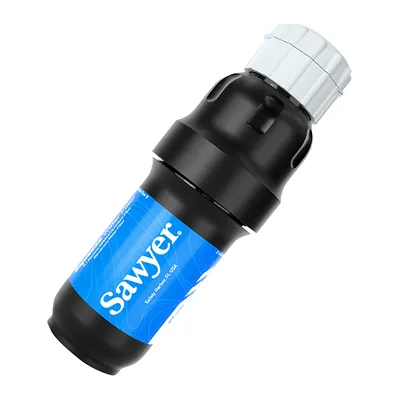
Sawyer Squeeze
A hollow-fiber filter rated at 0.1 micron absolute that removes bacteria and protozoa, but not viruses: follow up with a disinfectant, as the CDC advises. Keep it from freezing.
View on Amazon (opens in a new tab)
FAQ
Do you need to reserve an unstaffed cabin?
Not the Aoulhet cabin: access is free, year-round, with no reservations, and the six sleeping spots in the loft can’t be booked ahead of time. That’s why the tourist office advises bringing a tent depending on how busy it is. Staffed mountain huts in France, on the other hand, do take reservations: our guide to French mountain huts explains how.
Can you drink the water at an unstaffed cabin?
Only if a drinking water source is listed, and only if it’s working the day you arrive: the one at Aoulhet is shut off in winter so it doesn’t freeze. Clear water can still carry germs: when in doubt, boil it, or filter it and then disinfect it, as the CDC advises. Always carry enough water, or a way to treat it.
Can you camp near the Aoulhet cabin?
Yes, during the allowed hours: the cabin is in the regional nature reserve of the Pibeste-Aoulhet massif, where backcountry camping is allowed from 8 p.m. to 8 a.m. The tourist office actually advises bringing a tent depending on how busy it is. Elsewhere in France, the rules change from place to place: see our article on backcountry camping in France.
How do you share a cabin well with other hikers?
Keep your gear together even if there’s room to spare, ask before adding wood, since the loft can get much warmer than the room below, and get your morning things ready the night before so you’re not digging through your pack over sleeping people. Earplugs help. When you leave, sweep up, and pack out all the trash.
Sources
- Fédération française de la randonnée pédestre (FFRandonnée), France’s national hiking federation, Recommandations pour la randonnée en montagne l’été (recommendations for summer hiking in the mountains), page in French, accessed October 29, 2026. ffrandonnee.fr https://www.ffrandonnee.fr/randonner/securite/recommandations-pour-la-randonnee-en-montagne-l-ete ↩
- Saint-Pé-de-Bigorre tourist office, Balades & randonnées à Saint-Pé-de-Bigorre (walks and hikes in Saint-Pé-de-Bigorre), description of the Aoulhet cabin, page in French, accessed October 29, 2026. saintpedebigorre-tourisme.com https://www.saintpedebigorre-tourisme.com/randonnees/ ↩
- Saint-Pé-de-Bigorre tourist office, Réserve naturelle régionale du Pibeste-Aoulhet (Pibeste-Aoulhet regional nature reserve), rules of the reserve, page in French, accessed October 29, 2026. saintpedebigorre-tourisme.com https://www.saintpedebigorre-tourisme.com/pibeste-aoulhet/ ↩
- Centers for Disease Control and Prevention (CDC), About Water Treatment Options When Hiking, Camping, or Traveling, page dated January 30, 2025, accessed October 29, 2026. cdc.gov https://www.cdc.gov/drinking-water/prevention/water-treatment-hiking-camping-traveling.html ↩
- Regional nature reserve of the Pibeste-Aoulhet massif, Les activités de loisir (recreational activities), page in French, accessed October 29, 2026. pibeste-aoulhet.fr https://pibeste-aoulhet.fr/massif/acitivite-loisir ↩
Water, camper vans, backcountry camping and the Nordic countries
From Brittany, Alex spends as much time outdoors as he can, ideally on the water: kayaking, paddleboarding, sailing, fishing. He also loves van life, backcountry camping, and nights under the stars, and he knows the Nordic countries well, speaking two of their languages.

 Guillaume Hoarau


 Arnaud Couderc