 Français (France)
 English (UK)
 English (US)
 Deutsch (Deutschland)

26.3 litres or 52.5: for a 75 kg surfer, Firewire’s chart doubles the volume of a board from one end of the ability scale to the other [1]. The tool above makes that chart usable at any weight; what is left is to find out what its answer is worth. Let’s do the sum.
What the tool calculates
The tool guesses nothing: it reads Firewire’s volume chart, which gives one volume per weight and per ability level, from advanced to beginner [1]. Between two rows it interpolates in a straight line. For 75 kg at intermediate level, the default values, it lands on a row of the chart: 32.8 litres, or about 0.44 litre per kilo. For 70 kg it joins the 68 and 75 kg rows and shows 30.7 litres.
Over the usual range, 59 to 91 kg, the chart amounts to multiplying your weight by a coefficient: about 0.35 for an advanced surfer, 0.37, 0.44 and 0.53 for the in-between levels, 0.70 for a beginner [1].
The coefficient moves at the extremes
Outside that range the coefficient changes. Firewire’s full chart goes down to 36 kg (80 lb) and up to 109 kg (240 lb): an advanced surfer of 36 kg is given 16 litres, or 0.44 litre per kilo; at 100 kg, 36 litres, or 0.36 [1].
The tool has only five rows, from 59 to 91 kg. Below and above them it scales proportionally to weight, which amounts to keeping the coefficient of the outermost row. Its result then drifts away from the full chart:
| Weight | Advanced (tool) | Advanced (chart) | Beginner (tool) | Beginner (chart) |
|---|---|---|---|---|
| 50 kg | 18.1 | 19.5 | 36.1 | 39.0 |
| 75 kg | 26.3 | 26.3 | 52.5 | 52.5 |
| 100 kg | 34.9 | 36.0 | 69.9 | 72.0 |
Sources: Firewire Surfboards, full chart (110, 165 and 220 lb rows); tool values calculated proportionally from its outermost rows.
The gap runs from 1.1 to 2.9 litres in these three examples: below 59 kg and above 91 kg, Firewire’s chart is the reference, and the tool comes out a little low.
Firewire and Lost: two scales that part ways
Firewire’s chart is not the only reference. Lost publishes a The ratio of a board’s volume, in litres, to the surfer’s weight, in kilos; Lost’s calculator credits it to Whitney Guild, in 2013. for each type of surfer, for shortboards only: 0.34 to 0.36 for an advanced, very fit surfer, 0.36 to 0.38 for average to good fitness and ability, 0.38 to 0.42 for the weekend surfer, 0.40 to 0.50 for a novice or in tough conditions [2].
At 75 kg that gives 25.5 to 27 litres at Lost for the advanced surfer, against 26.3 at Firewire: the two agree. Then they drift apart. Firewire’s beginner, 52.5 litres, is 15 litres above the top of Lost’s range for a novice, 37.5 litres [2]. Lost keeps its ratios for shortboards; a beginner on a bulkier board falls outside them.
What the figure cannot know
Conditions shift the result. Lost recommends the low end of its range in warm water and good waves, the high end in poor conditions, in a crowd or in a thick wetsuit [2]. The French Surfing Federation points out that a wetsuit protects against the cold and gives better buoyancy [3].
More volume also makes paddling easier. In a 2017 study, twenty surfers paddled in a swim flume on five boards that differed only in thickness, from 28.4 to 37.4 litres: on the thicker ones, oxygen consumption and heart rate fell, as did pitch and roll [4]. The study measures paddling, not how easily a board turns: it does not say how far to go.
Finally, there is the water. According to NOAA, seawater averages 35 grams of salt per litre, from 33 to 37 depending on the sea, and its density rises with salinity and as the temperature falls [5]. The same board therefore carries a little more in cold, salty water than in warm or fresh water. We do not put a figure on this effect: keep the direction, not the value.

From the figure to a board
What is left is turning litres into a size. Torq’s spec sheets publish the volume of every size: for 32.8 litres, these are the closest [6] [7].
| Model | Size | Volume | Gap |
|---|---|---|---|
| PG-R (TEC) | 5’8 (1.73 m) | 32.2 L | -0.6 L |
| Summer Fish | 5’8 (1.73 m) | 34.4 L | +1.6 L |
| Summer Fish | 5’6 (1.68 m) | 31 L | -1.8 L |
| PG-R (ACT) | 5’10 (1.78 m) | 35.3 L | +2.5 L |
Sources: Torq Surfboards, Summer Fish and PG-R spec sheets, dimensions published in feet and inches; gap against 32.8 L.
At 5’8 the PG-R holds 32.2 litres and the Summer Fish 34.4: a 2.2-litre gap at the same length, which no length would let you guess. Compare the litres on the spec sheets, not the feet.
For a beginner, the tool’s result is not the size of a foam learner board. The French Surfing Federation advises starting on a foam learner board [3]; at Torq, the soft-deck longboard is listed at 66 to 95 litres [8], well above the 52.5 litres of our 75 kg example. For those boards, read the volume on the model’s spec sheet.
For shapes and conditions, see our guide on surfboard volume; for cold water, wetsuit thickness by water temperature; for your first session, the beginner’s guide.
The rule fits in one sentence: work out the volume, pick the board that comes within a few litres of it, then judge it in the water rather than on paper.
Kit related to this article
No affiliation: no commission, no sponsored products.
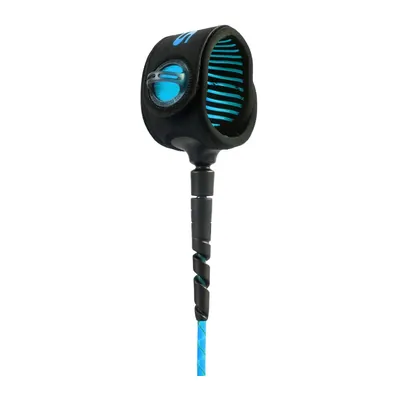
FCS Freedom Helix Longboard
A 9 ft (2.74 m) longboard leash with a 6.5 mm cord whose inner helix absorbs shock, ankle cuff: it keeps the board within reach after a wipeout.
View on Amazon (opens in a new tab)
Worth watching
Surf Simply’s animated series shows how an online calculator links weight to volume through a ratio, an 80 kg surfer on a 40-litre board being at 50%, then how to place yourself on its level system.
The video is hosted by YouTube (Google): nothing loads until you play it, and Google may then set cookies.
FAQs
How do I use the surfboard volume calculator?
Enter your weight, between 50 and 100 kg, and pick your level out of five, from advanced to beginner. The tool reads Firewire’s chart, interpolates between its rows and shows a volume in litres. Treat it as a starting point: wetsuit, waves and how you feel on the day move it, and a beginner should look at the spec sheet of a learner board.
Why do Firewire and Lost give different volumes?
Their scales are built differently: Firewire publishes one value per level and weight, Lost a guild factor range for shortboards. At 75 kg the two agree for the advanced surfer, around 26 litres, then part: 52.5 litres for a beginner at Firewire, 37.5 at most at Lost.
Does the calculator suit a longboard or a foam board?
That is not what it is built for. Lost keeps its ratios for shortboards, and foam learner boards hold far more: 66 to 95 litres for Torq’s soft-deck longboard. For those boards, compare the litres on the model’s spec sheet, and ask a professional for advice, as the French Surfing Federation recommends.
Is more volume better for paddling?
Yes, according to a 2017 study: twenty surfers paddled on five boards from 28.4 to 37.4 litres that differed only in thickness, and the bulkier boards took less oxygen and a lower heart rate. The study does not measure manoeuvrability, which also counts when choosing.
Sources
- Firewire Surfboards, Surfboard Volume Calculator, full chart of volumes by weight and skill level, accessed 27 October 2026. firewiresurfboards.com https://www.firewiresurfboards.com/pages/prestige-surfboard-volume-calculator ↩
- Lost Surfboards by Mayhem, Volume Calculator, Whitney Guild’s Guild factor (2013), accessed 27 October 2026. lostsurfboards.net https://lostsurfboards.net/volume-calculator/ ↩
- Fédération française de surf (French Surfing Federation), Bien choisir sa planche de surf, accessed 27 October 2026. surfingfrance.com https://www.surfingfrance.com/federation/comment-choisir-sa-planche.html ↩
- Ekmecic V., Jia N., Cleveland T. G., Saulino M., Nessler J. A., Crocker G. H. and Newcomer S. C., Increasing surfboard volume reduces energy expenditure during paddling, Ergonomics, vol. 60, no. 9, 2017, pp. 1255-1260 (abstract accessed 27 October 2026). doi.org https://doi.org/10.1080/00140139.2016.1261188 ↩
- NOAA, JetStream, Sea Water, accessed 27 October 2026. noaa.gov https://www.noaa.gov/jetstream/ocean/sea-water ↩
- Torq Surfboards, Summer Fish, model spec sheet, accessed 27 October 2026. torq-surfboards.com https://www.torq-surfboards.com/fish/summer-fish.html ↩
- Torq Surfboards, PG-R, model spec sheet, accessed 27 October 2026. torq-surfboards.com https://www.torq-surfboards.com/shortboard/pg-r.html ↩
- Torq Surfboards, Longboard Soft Deck, model spec sheet, accessed 27 October 2026. torq-surfboards.com https://www.torq-surfboards.com/longboard-soft-deck.html ↩

Campervans, motorhomes, cycling and calculators
Julien de Jurquet writes for Outfarer about campervans, motorhomes, cycling and calculators. He reads instruction manuals to the very end and never lets a figure through without its unit, so that your choices rest on sums rather than promises.

 Nolwenn Bastide

 Arnaud Couderc
