 Français (France)
 English (UK)
 English (US)
 Deutsch (Deutschland)

What 3/2, 4/3 and 5/4 mean
17.3 °C. That is the average sea temperature off Newquay, on the north coast of Cornwall, in August, the warmest month of the year, according to our calculation from ten years of satellite readings by the US National Oceanic and Atmospheric Administration (NOAA) [1]. For a wetsuit maker such as Rip Curl, that is full-suit territory, a 3/2, not a shorty [2]. Before choosing, though, you need to know how to read those two numbers.
A wetsuit’s thickness is written as two numbers separated by a slash. The first gives the thickness in millimetres of the torso panels, the second that of the arms and legs: a 4/3 is 4 mm on the torso and 3 mm on the limbs [2]. The logic is simple: thick neoprene insulates better, but it gets in the way when you paddle, pop up on the board or swim, so the thickness goes where the body loses the most heat, the torso, and is pared back where you need flexibility, at the shoulders, elbows and knees [2].
Which thickness for which water temperature
Rip Curl’s rule fits in one sentence: the warmer the water, the less neoprene you need, and every 2 °C drop usually moves you up one thickness [2]. The brand publishes the chart it uses as its baseline.
| Water temperature | Thickness | Type of wetsuit | Accessories |
|---|---|---|---|
| Above 24 °C | 0 to 1 mm | Boardshorts or rash vest | None |
| 18 to 24 °C | 2 mm | Shorty or top | None |
| 16 to 18 °C | 3/2 mm | Full suit | Boots optional |
| 13 to 16 °C | 4/3 mm | Full suit | Boots recommended |
| 9 to 13 °C | 4/3 or 5/4 mm | Full suit | Boots and gloves |
| Below 9 °C | 5/4 or 6/5 mm | Hooded full suit | Boots, gloves and hood |
Rip Curl’s chart, designed for surfing. The brand adds that a 3/2 suits water of about 14 to 20 °C and a 4/3 water of 11 to 17 °C: between 14 and 17 °C, the choice is yours.
The chart is only a starting point. Rip Curl lists the factors that call for the next thickness up: a cold wind at first light, a session of more than 90 minutes, since heat loss adds up, and how much you personally feel the cold. In 13 °C water, some surfers get by in a 3/2, while others reach for a 4/3 well above 16 °C [2].
Boots, gloves and hood: at what temperature
Below 15 °C, accessories do the real work: hands, feet and head lose heat fastest, and covering them well can extend a session by an hour or more without changing wetsuits [2].
- Boots: below 15 °C, or sooner if you face a long walk over cold sand or sharp rocks [2].
- Gloves: below 13 °C, they become essential for sessions of more than an hour [2].
- Hood: below 10 °C, your head becomes the biggest source of heat loss; below 7 °C, a hood built into the wetsuit seals the neck better [2].
Cornwall, the Channel, the North Sea: Britain’s waters, season by season
The detail that changes everything is which coast you are on. To know what to expect, we calculated the average sea surface temperature, month by month, from 2016 to 2025, at five points off the coast of Great Britain, from Cornwall to the north of Scotland, from NOAA’s daily satellite data (the OISST dataset, version 2.1) [1].
| Location | Coldest month | Warmest month | Thickness in the coldest month | Thickness in the warmest month |
|---|---|---|---|---|
| Cornwall, off Newquay | 9.9 °C (March) | 17.3 °C (August) | 4/3 or 5/4, boots and gloves | 3/2 |
| English Channel, off Brighton | 8.9 °C (March) | 17.9 °C (August) | 5/4 or 6/5, boots, gloves and hood | 3/2 |
| Pembrokeshire, off St Davids | 9.2 °C (March) | 16.4 °C (August) | 4/3 or 5/4, boots and gloves | 3/2 |
| North Sea, off Scarborough | 6.9 °C (March) | 15.7 °C (August) | 5/4 or 6/5, boots, gloves and hood | 4/3 |
| North coast of Scotland, off Thurso | 7.9 °C (February and March) | 13.4 °C (August) | 5/4 or 6/5, boots, gloves and hood | 4/3 |
Calculation: average of NOAA OISST v2.1 satellite readings (one reading every five days, on a grid of about 25 km), at one point offshore. Thicknesses taken from Rip Curl’s chart. Close to the shore, the water can differ from these averages, and no two years are alike.
Three lessons stand out. Even in August, the warmest month, none of these five points goes above 18 °C: a 3/2 is the summer standard in Cornwall, Pembrokeshire and on the south coast, and a 4/3 is nothing excessive in the North Sea or off Thurso, where the August average stops at 13.4 °C. In late winter, the sea drops below 9 °C off Brighton, Scarborough and Thurso, the point at which Rip Curl’s chart adds a hood. Finally, the coldest month is March, or February and March off Thurso, never January: the sea takes months to lose the summer’s heat [1].
The same reasoning works on any coast: find the monthly average for your own stretch of sea, then read it against the chart. It travels well, too: off Biarritz, on France’s Atlantic coast, the August average reaches 22.7 °C, shorty weather, while off Brest, in Brittany, it stays at 16 °C [1]. These averages don’t replace the temperature on the day, which shifts with the weather of the moment. And before heading to a tidal beach, a look at the tide times is part of the same habit.
Cold water: dangerous from the very first minutes
The cold is not only a risk after two hours in the water. The US National Weather Service points out that on contact with cold water, cold shock can cause involuntary gasping and very rapid breathing during the first 2 to 3 minutes, which puts even strong swimmers at risk of drowning; water at 10 to 15 °C can cause a shock as severe as water at 2 °C, and gasping can be triggered in water as warm as 25 °C [3].

Once you have found the right thickness, the cold sea is on your side: almost empty beaches, low winter light, and that gentle warmth creeping back into your wetsuit after the first few waves.
Kit related to this article
No affiliation: no commission, no sponsored products.
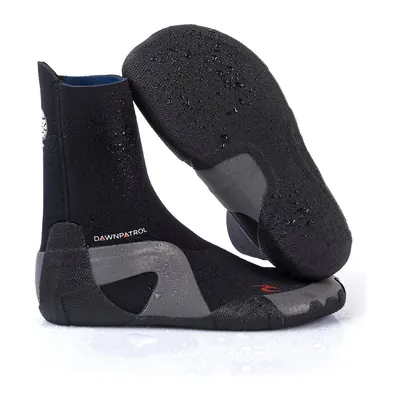
Rip Curl Dawn Patrol 3 mm
Round-toe 3 mm neoprene boots with a 0.8 mm sole to keep feel on the board: the companion to a 4/3 when the water drops towards 15 °C.
View on Amazon (opens in a new tab)
FAQs
What does 4/3 mean on a wetsuit?
It is the thickness of the neoprene in millimetres: 4 mm on the torso, 3 mm on the arms and legs. The thickness is concentrated on the torso, where the body loses the most heat, and reduced on the limbs to keep you flexible. According to Rip Curl’s chart, a 4/3 suits water of about 11 to 17 °C.
What wetsuit do I need for 15 °C water?
According to Rip Curl’s chart, water of 13 to 16 °C calls for a 4/3 full suit, with boots recommended. Between 14 and 17 °C, a 3/2 can be enough if you cope well with the cold, the session is short and there is no wind. The brand advises going up a thickness for long sessions or in a cold wind.
How warm is the sea in Cornwall in summer?
Off Newquay, our calculation for 2016 to 2025, based on NOAA satellite data, gives an average of 17.3 °C in August, the warmest month, and 9.9 °C in March, the coldest. Close to the shore, the water can differ. According to Rip Curl’s chart, a 3/2 is the right call in high summer, and a 4/3 or 5/4 with boots and gloves at the end of winter.
At what temperature does water become dangerous?
Higher than you might think. The US National Weather Service says cold shock can be as severe in water at 10 to 15 °C as at 2 °C, and that involuntary gasping can be triggered in water as warm as 25 °C. Ease yourself in, don’t go out alone, and get out as soon as you start shivering.
Sources
- NOAA, NCEI, ‘Daily Optimum Interpolation Sea Surface Temperature (OISST), version 2.1’, data for 2016 to 2025 queried on 22 and 23 October 2026 from NOAA’s ERDDAP server, averages calculated by the editorial team. coastwatch.pfeg.noaa.gov https://coastwatch.pfeg.noaa.gov/erddap/info/ncdcOisst21Agg_LonPM180/index.html ↩
- Rip Curl, ‘Wetsuit Temperature & Thickness Guide’, accessed 22 October 2026. ripcurl.com.au https://www.ripcurl.com.au/blogs/products/wetsuit-thickness-guide ↩
- National Weather Service (NOAA), ‘Cold Water Hazards and Safety’, accessed 22 October 2026. weather.gov https://www.weather.gov/safety/coldwater ↩

Trail running, snow, water, nature and destinations
Nolwenn covers trail running, snow, water, nature and destinations for Outfarer. Curious about everything, from meteor showers to night-train timetables, she has a knack for unearthing the one detail that changes everything, and putting it in a single sentence.


 Arnaud Couderc
