 Français (France)
 English (UK)
 English (US)
 Deutsch (Deutschland)

High water, low water, tidal range: the vocabulary
One port, and a whole coastline that relies on it. France’s tidal coefficient is calculated for Brest alone; it is the precision of that one figure that allows it to be used on every coast of mainland France, provided you take account of the time difference between high water at Brest and high water at the port you are interested in [1]. Before you read it, a few words are all you need.
High water is the moment the sea reaches its highest level, low water its lowest. The difference in height between the two is the The difference in height between high water and the low water that follows or precedes it.. When the tide is rising, it is the flood; when it is falling, the ebb [1]. Heights in tide tables are measured from chart datum, the common reference for nautical charts and tide tables, which in France is set close to the level of the lowest tides, a level the sea drops below only very exceptionally [1].
On France’s Channel and Atlantic coasts, the tide is semi-diurnal: two high waters and two low waters a day [2]. By tidal range, the SHOM, the French Navy’s hydrographic and oceanographic service, classifies tides as microtidal, under 2 m, mesotidal, from 2 to 4 m, and macrotidal, above 4 m [1].
The coefficient: Laplace’s idea, calculated for Brest
The tidal coefficient is a French way of describing the tide, and if you think in spring and neap tides, you already have the idea: it grades each tide on a single scale, from the smallest neaps to the biggest springs. It was the mathematician Laplace who devised it, to characterise each port by a unit of height, taken from the biggest tide that follows shortly after the full or new moon around the equinoxes. By convention, a coefficient of 100 is given to the average range of equinoctial spring tides; the accepted extremes today run from 20 to 120 [1].
| Coefficient | Type of tide |
|---|---|
| 20 | Extreme neap tide |
| 45 | Average neap tide |
| Below 70 | Neap tide |
| Above 70 | Spring tide |
| 95 | Average spring tide |
| 120 | Extreme spring tide |
Source: SHOM, ‘Prédiction de marée’ fact sheet, May 2024. The coefficient is calculated for Brest, from the semi-diurnal components of the tide alone. ‘Neap’ and ‘spring’ stand for the French ‘morte-eau’ and ‘vive-eau’.
So a high coefficient means a big tide: the sea rises higher, falls lower and uncovers more of the foreshore. The coefficient does not give a height in metres; it is calculated from the semi-diurnal constituents alone [2], and the SHOM points out that it is hardly used outside France [1]. For a height, you need the tide table for the port.
The rule of twelfths, step by step
Good news: you don’t need a calculator to know how much water there will be in an hour’s time. Sailors use the rule of twelfths, which even comes up in France’s professional maritime exams [3] [4]. You divide the duration of the tide, between high water and low water, into six ‘tidal hours’. Over those six intervals, the sea rises or falls by 1, 2, 3, 3, 2 and then 1 twelfth of the tidal range [4].
Take a high water at 6.12am, at 5.20 m, and the following low water at 12.24pm, at 1.10 m. The tide runs for 6 hours 12 minutes, so each tidal hour lasts 1 hour 2 minutes. The tidal range is 4.10 m, and one twelfth is about 34 cm.
| End of tidal hour | Time | Twelfths so far | Height of tide |
|---|---|---|---|
| High water | 6.12am | 0 | 5.20 m |
| 1st | 7.14am | 1 | 4.86 m |
| 2nd | 8.16am | 3 | 4.18 m |
| 3rd | 9.18am | 6 | 3.15 m |
| 4th | 10.20am | 9 | 2.13 m |
| 5th | 11.22am | 11 | 1.44 m |
| Low water | 12.24pm | 12 | 1.10 m |
Worked example: high water 5.20 m, low water 1.10 m, tidal range 4.10 m, tidal hour of 1 hour 2 minutes. An approximation, to be checked against the official tide table for the port.
The rule is an approximation: it swaps the cosine curve the tide follows for straight segments. Before calculators, it was a remarkable tool, and it is still excellent for a rough estimate in your head [4]. It assumes a regular tide; in ports where the curve is distorted, the tide table and its curves are the better bet.
Where to find official tide times
In France, the SHOM publishes tide times for its ports free of charge on a dedicated website [6]. Its predictions are based on the analysis of long series of measurements and are accurate to within a few centimetres; but the weather can shift sea level by a few tens of centimetres, which cannot be forecast in the medium or long term [1]. In its prediction service, the coefficient option is only offered for mainland French ports on the Channel and the Atlantic [7].
Outside France, each country has its own official service. In the UK, the UK Hydrographic Office publishes ADMIRALTY EasyTide [8]; in Germany, the federal maritime and hydrographic agency, the BSH, publishes its tide predictions [9]; in the United States, NOAA publishes its own on Tides and Currents [10]. These services give no coefficient: you read the times and heights of high and low water directly.
| Country | Service | Website |
|---|---|---|
| France | SHOM | maree.shom.fr |
| United Kingdom | UK Hydrographic Office | ADMIRALTY EasyTide |
| Germany | BSH (Bundesamt für Seeschifffahrt und Hydrographie) | bsh.de, ‘Gezeiten’ (tides) section |
| United States | NOAA | Tides and Currents |
Addresses opened and checked on 22 October 2026.
Before a sea fishing trip or a swim in cool water, in the right wetsuit thickness, checking the tide times is part of the same habit as checking the weather.

So, with a big spring tide on the way (a three-figure coefficient, in France), the tide table in your pocket and your return time worked out, all that is left is to head down onto the foreshore, where the sea has just left its treasures behind.
Worth watching
A tide diagram works through the rule of twelfths hour by hour, turning tide times and the tidal range into a water height at any time between high and low water.
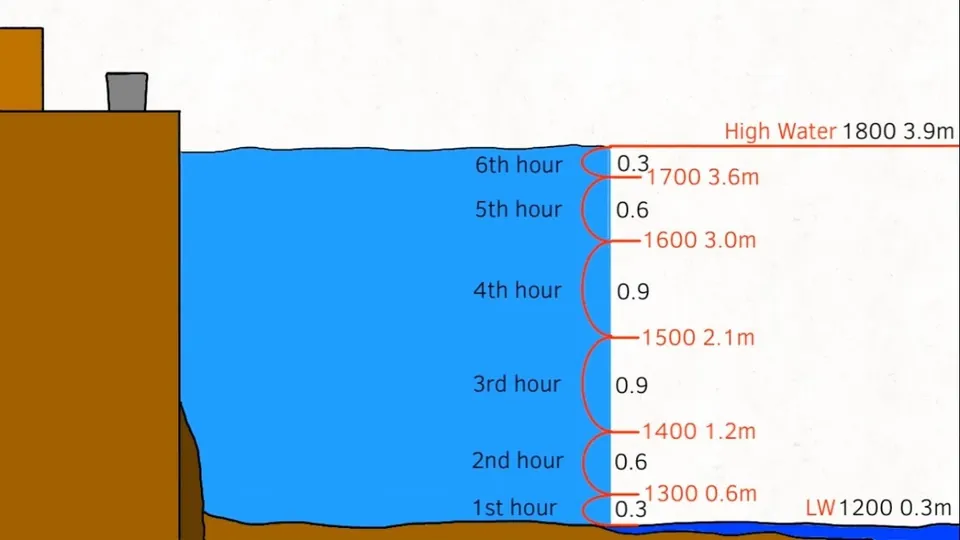
The video is hosted by YouTube (Google): nothing loads until you play it, and Google may then set cookies.
FAQs
What is the tidal coefficient in French tide tables?
It is an indicator of the size of the tide, calculated for the port of Brest and used on every coast of mainland France. It runs from 20 to 120: 45 corresponds to an average neap tide, 95 to an average spring tide, 120 to an extreme spring tide. The higher it is, the higher the sea rises and the lower it falls. It does not give a height in metres.
How do you use the rule of twelfths?
Divide the duration of the tide, between high and low water, into six tidal hours, and the tidal range into twelve. Over those six intervals, the sea rises or falls by 1, 2, 3, 3, 2 and then 1 twelfth of the range. With a 4.10 m range, one twelfth is about 34 cm: after two tidal hours, the sea has moved 3 twelfths, about 1 m.
When does the tide come in fastest?
At mid-tide. According to the rule of twelfths, the sea covers half the tidal range during the third and fourth tidal hours. On a flat foreshore, the water can then cover large areas in very little time. When gathering shellfish, set off on the ebb and be back well before the flood. In an emergency in France, call 196 or 112; in the UK, call 999 and ask for the Coastguard.
Where can I find official tide times?
In France, on the SHOM website, which publishes tide times for its ports free of charge. In the UK, on ADMIRALTY EasyTide, from the UK Hydrographic Office; in Germany, on the BSH website; in the United States, on NOAA’s Tides and Currents. These predictions do not take account of the weather, which can change the level by a few tens of centimetres.
Sources
- SHOM, Refmar, ‘Prédiction de marée’ fact sheet, May 2024 (in French), accessed 22 October 2026. refmar.shom.fr https://refmar.shom.fr/sites/default/files/2025-01/GT-TSH_CatD_Fiche_Prediction_maree.pdf ↩
- SHOM, Refmar, glossary of the ‘Tempêtes et submersions historiques’ working group (historical storms and coastal flooding), provisional version of July 2024 (in French), accessed 22 October 2026. refmar.shom.fr https://refmar.shom.fr/sites/default/files/2024-07/GT_TSH_Glossaire_Version-provisoire_Juillet2024.pdf ↩
- French Ministry of the Sea, national exam board (Comité national de sélection des sujets), ‘PNCM 1 2026, CM-3 Navigation, météorologie’ exam paper (in French), accessed 22 October 2026. formations.mer.gouv.fr https://formations.mer.gouv.fr/sites/default/files/2026-07/20247253_PNCM1_CM3.pdf ↩
- Michel Soufflet, ‘Les marées’, educational paper published by the Publimath digital library (in French), accessed 22 October 2026. bibnum.publimath.fr https://bibnum.publimath.fr/ICA/ICA17004.pdf ↩
- Service-Public.fr, ‘Quels sont les numéros en cas d’urgence (Samu, pompiers...) et les numéros d’écoute ?’, checked 25 August 2026 (in French), accessed 22 October 2026. service-public.gouv.fr https://www.service-public.gouv.fr/particuliers/vosdroits/F33954 ↩
- SHOM, ‘Horaires de marées gratuits du SHOM’ (in French), accessed 22 October 2026. maree.shom.fr https://maree.shom.fr/ ↩
- SHOM, ‘Comment calculer les prédictions de marée’, guide to the prediction service for 1,000 ports (in French), accessed 22 October 2026. services.data.shom.fr https://services.data.shom.fr/static/specifications/Notice_1000_ports_SHOM.pdf ↩
- UK Hydrographic Office, ‘ADMIRALTY EasyTide’, accessed 22 October 2026. easytide.admiralty.co.uk https://easytide.admiralty.co.uk/ ↩
- Bundesamt für Seeschifffahrt und Hydrographie (BSH), ‘Gezeiten’ (in German), accessed 22 October 2026. bsh.de https://www.bsh.de/DE/DATEN/Vorhersagen/Gezeiten/gezeiten_node.html ↩
- NOAA, ‘Tides and Currents’, accessed 22 October 2026. tidesandcurrents.noaa.gov https://tidesandcurrents.noaa.gov/ ↩
- GOV.UK, ‘Maritime and Coastguard Agency’, accessed 22 October 2026. gov.uk https://www.gov.uk/government/organisations/maritime-and-coastguard-agency ↩

Trail running, snow, water, nature and destinations
Nolwenn covers trail running, snow, water, nature and destinations for Outfarer. Curious about everything, from meteor showers to night-train timetables, she has a knack for unearthing the one detail that changes everything, and putting it in a single sentence.


 Arnaud Couderc
