 Français (France)
 English (UK)
 English (US)
 Deutsch (Deutschland)

Contents
52.5 liters for a beginner, 26.3 for an advanced surfer: for the same 165 lb (75 kg) rider, board maker Firewire’s chart recommends a volume that doubles from one end of the scale to the other [1]. That’s the whole logic of volume, the number that makers like Torq print right next to a board’s dimensions [2]: the newer you are to surfing, the more of it you need.
Volume: what it measures
A board’s volume, in liters, measures how well it floats. Board maker Lost turned it into a ratio, the The ratio between a board’s volume, in liters, and the surfer’s weight, in kilograms; Lost’s calculator credits it to Whitney Guild, in 2013.: the board’s volume divided by the surfer’s weight in kilograms. If you know the volume of a board that felt too floaty, or not floaty enough, this ratio tells you which way to adjust [3].
The French Surfing Federation (FFSurf), France’s national federation for the sport, sums up how to choose a board in four criteria: how well the board suits the surfer’s build, their skill level, their style, and the quality and size of the waves they ride [4]. Volume covers the first two; shape and conditions cover the last two.
The calculation: your weight times a coefficient
The formula fits on one line: volume in liters = weight in kilograms × coefficient. The coefficients are set per kilogram, so divide your weight in pounds by 2.2 first: 165 lb comes out at 75 kg. Everything hinges on the coefficient, which each maker sets its own way. Firewire’s chart gives five, one per skill level: from about 155 to 220 lb (70 to 100 kg), they come to roughly 0.35, 0.37, 0.44, 0.53, and 0.70, and a little more for lighter or heavier surfers [1].
| Weight | Advanced | Advanced to intermediate | Intermediate | Intermediate to beginner | Beginner |
|---|---|---|---|---|---|
| 130 lb (59 kg) | 21.3 | 22.3 | 26.6 | 31.9 | 42.6 |
| 150 lb (68 kg) | 23.9 | 25.1 | 29.8 | 35.8 | 47.7 |
| 165 lb (75 kg) | 26.3 | 27.6 | 32.8 | 39.4 | 52.5 |
| 175 lb (80 kg) | 27.8 | 29.2 | 34.8 | 41.8 | 55.7 |
| 200 lb (91 kg) | 31.8 | 33.4 | 39.8 | 47.7 | 63.6 |
Source: Firewire Surfboards, volume calculator, which lists weights in pounds and kilograms; chart values rounded to one decimal place. A ballpark figure, not a prescription.
Lighter surfers aren’t left out: for an 80 lb (36 kg) teenager, the same chart runs from 16 liters for an advanced surfer to 32 liters for a beginner [1].
Lost gives ranges rather than fixed values, for shortboards: 0.34 to 0.36 for an advanced, very fit surfer, 0.36 to 0.38 for average to above-average fitness and skills, 0.38 to 0.42 for the weekend warrior, and 0.40 to 0.50 for a novice or in tough conditions [3]. For a 165 lb (75 kg) surfer, that works out to 27 to 28.5 liters at an average level, and 30 to 37.5 liters for a novice.
Starting out: foam, and lots of liters
For a first board, the French Surfing Federation is clear: a foam beginner board, or soft-top, is easier and safer. Only after that should you ask a professional for advice on a higher-performance board. The federation also warns against an overly pointed nose and fins with sharp edges [4].
These beginner boards pack a lot of volume. Torq’s soft-deck longboard, for example, goes from 66 liters in the 8’0 to 95 liters in the 9’6 [2]. Even the shortest one beats the volume Firewire recommends for a 200 lb (91 kg) beginner, 63.6 liters [1].
| Length | Width | Thickness | Volume |
|---|---|---|---|
| 8’0 (2.44 m) | 22 3/8 in (56.8 cm) | 3 1/4 in (8.3 cm) | 66 L |
| 8’6 (2.59 m) | 22 3/4 in (57.8 cm) | 3 1/2 in (8.9 cm) | 71 L |
| 9’0 (2.74 m) | 23 1/8 in (58.7 cm) | 3 1/2 in (8.9 cm) | 79 L |
| 9’1 (2.77 m) | 23 3/8 in (59.4 cm) | 3 1/2 in (8.9 cm) | 84 L |
| 9’6 (2.90 m) | 23 7/8 in (60.6 cm) | 3 5/8 in (9.2 cm) | 95 L |
Source: Torq Surfboards, Longboard Soft Deck spec sheet. Dimensions as Torq publishes them, in feet and inches; metric conversions to the nearest millimeter.
Length, width, thickness: volume isn’t the whole story
Here’s the detail that changes everything: length alone won’t tell you how a board floats. At Torq, two 6’0 (1.83 m) models have different volumes: 38.8 liters for the PG-R shortboard, 41.7 liters for the Summer Fish, which is 3/4 inch (1.9 cm) wider and 1/8 inch (3 mm) thicker, for 2.9 more liters [5] [6]. Flip it around, and two boards with the same volume can have very different lengths.
| Model | Length | Width | Thickness | Volume |
|---|---|---|---|---|
| PG-R (shortboard) | 5’6 (1.68 m) | 20 1/2 in (52.1 cm) | 2 3/8 in (6.0 cm) | 30.6 L |
| Summer Fish | 5’6 (1.68 m) | 20 3/4 in (52.7 cm) | 2 3/8 in (6.0 cm) | 31 L |
| PG-R (shortboard) | 6’0 (1.83 m) | 21 1/2 in (54.6 cm) | 2 5/8 in (6.7 cm) | 38.8 L |
| Summer Fish | 6’0 (1.83 m) | 22 1/4 in (56.5 cm) | 2 3/4 in (7.0 cm) | 41.7 L |
Sources: Torq Surfboards, PG-R and Summer Fish spec sheets. Dimensions as published, in feet and inches, with metric conversions.
Don’t bother trying to work out the volume from the dimensions, though: a board isn’t a box. Across every size listed for the three Torq models cited here, the published volume comes to 53 to 59% of length × width × thickness, by our calculations [2] [5] [6]. The nose, tail, and rails, which all taper, account for the rest.
So use volume as your first benchmark, then factor in your style and the waves, the federation’s two other criteria [4].
Adjusting for the water, the waves, and your wetsuit
The same surfer doesn’t need the same volume everywhere. Lost recommends the low end of its range in warm water and good waves, and the high end in poor conditions, in a crowded lineup, or in a thick wetsuit [3]. As for the wetsuit, the French Surfing Federation advises wearing one even in nice weather: it protects you from the cold and gives you better flotation [4]. If you surf in winter, check out our guide to wetsuit thickness by water temperature.

A two-minute calculation (the volume calculator does it for you), a board that floats enough, and the next wave could be the one where you finally pop up: all that’s left is to wax up and paddle out to the peak.
Gear related to this article
No affiliation: no commission, no sponsored products.
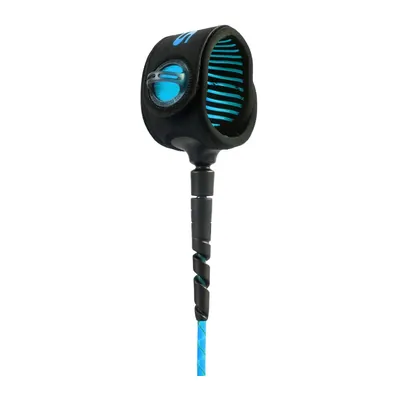
FCS Freedom Helix Longboard
A 9 ft longboard leash with a 6.5 mm (about 1/4-inch) cord whose inner helix absorbs shock, ankle cuff: it keeps the board within reach after a wipeout.
View on Amazon (opens in a new tab)
Worth watching
Surf Simply’s animated surf-science series explains what volume measures, why a board isn’t a simple box, how liters affect paddling and catching waves, and the volume-to-weight ratio.
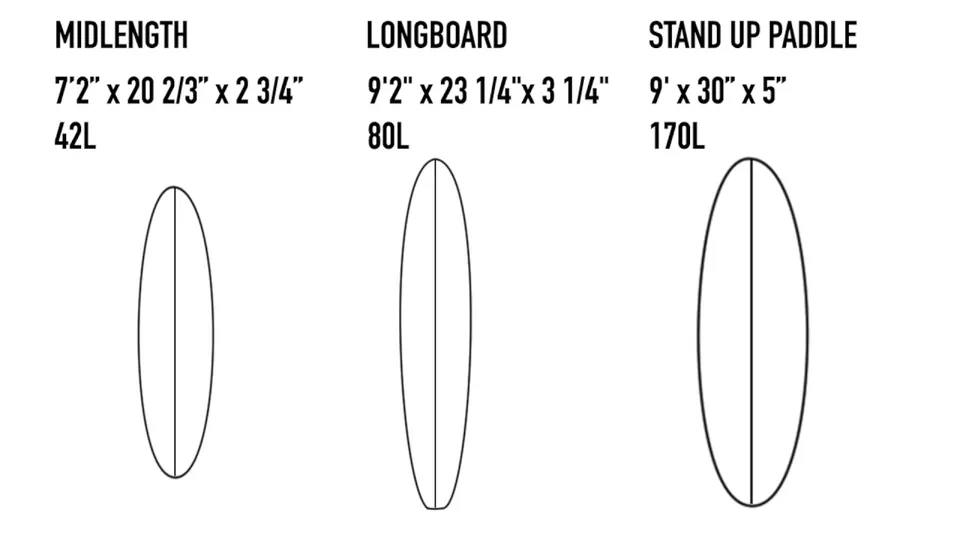
The video is hosted by YouTube (Google): nothing loads until you play it, and Google may then set cookies.
FAQ
What volume surfboard do I need as a beginner?
Plenty. In board maker Firewire’s chart, a beginner aims for about 0.70 liters per kilogram, or 52.5 liters for a 165 lb (75 kg) surfer. The French Surfing Federation advises starting on a foam beginner board, or soft-top, which is easier and safer, then asking a professional for advice before moving up to a higher-performance board.
How do I calculate my surfboard volume?
Multiply your weight in kilograms (pounds divided by 2.2) by a coefficient that depends on your skill level: at Firewire, from 0.35 for an advanced surfer to 0.70 for a beginner; at Lost, from 0.34 to 0.50 for shortboards, depending on skill, fitness, and conditions. The result is a ballpark figure, to adjust for the waves.
What surfboard volume do I need at 155 pounds?
According to Firewire’s calculator, for 155 lb (70.5 kg): about 49 liters for a beginner, 37 liters between beginner and intermediate, 31 liters for an intermediate, and 25 liters for an advanced surfer. Using Lost’s ranges, an average-level surfer at 155 lb should look at 25 to 27 liters in a shortboard.
Does a board’s volume depend on its length?
Only partly. Width and thickness matter just as much: at Torq, at 6’0 (1.83 m), a PG-R shortboard has 38.8 liters of volume and a Summer Fish, which is wider and thicker, has 41.7 liters. That’s why it’s better to compare liters than lengths.
Sources
- Firewire Surfboards, Surfboard Volume Calculator, volume chart by skill level, accessed October 22, 2026. firewiresurfboards.com https://www.firewiresurfboards.com/pages/prestige-surfboard-volume-calculator ↩
- Torq Surfboards, Longboard Soft Deck, model spec sheet, accessed October 22, 2026. torq-surfboards.com https://www.torq-surfboards.com/longboard-soft-deck.html ↩
- Lost Surfboards by Mayhem, Volume Calculator, Whitney Guild’s Guild factor (2013), accessed October 22, 2026. lostsurfboards.net https://lostsurfboards.net/volume-calculator/ ↩
- Fédération française de surf (French Surfing Federation), Bien choisir sa planche de surf, accessed October 22, 2026. surfingfrance.com https://www.surfingfrance.com/federation/comment-choisir-sa-planche.html ↩
- Torq Surfboards, PG-R, model spec sheet, accessed October 22, 2026. torq-surfboards.com https://www.torq-surfboards.com/shortboard/pg-r.html ↩
- Torq Surfboards, Summer Fish, model spec sheet, accessed October 22, 2026. torq-surfboards.com https://www.torq-surfboards.com/fish/summer-fish.html ↩

Trail running, snow, water, nature and destinations
Nolwenn covers trail running, snow, water, nature and destinations for Outfarer. Curious about everything, from meteor showers to night-train schedules, she has a knack for digging up the one detail that changes everything, and nailing it in a single sentence.

 Julien de Jurquet

 Arnaud Couderc
