 Français (France)
 English (UK)
 English (US)
 Deutsch (Deutschland)

1867. That year, a Scotsman named John MacGregor arrived in France aboard the “Rob Roy,” a wooden kayak inspired by ancestral designs: for France’s canoe-kayak federation, the FFCK, that marks the start of the sport’s modern era. A century and a half later, the federation has more than 700 clubs and over half a million paddlers [1], and the beginner’s question hasn’t changed: canoe or kayak?
The real difference: the paddle
The two words don’t describe a material or a hull shape, but a way of paddling. Here, “canoe” means the open canoe, paddled with a single blade. The international federation sums it up for sprint racing: in a canoe, the paddle has a single blade and the paddler kneels on one knee, other foot forward, pulling the paddle down whichever side they prefer; in a kayak, the paddler sits and uses a double-bladed paddle, one blade in the water on one side, then on the other [2]. France’s federation also points out that flatwater paddling began with the Indigenous peoples of the Americas, and that back then it was done with single-blade paddles only [3].
| Canoe | Kayak | |
|---|---|---|
| Paddle | Single, one blade | Double, a blade at each end |
| Racing position | One knee down in the boat | Seated |
| Paddling side | One only, paddler’s choice | Both, alternating |
Source: Paddle Worldwide, the international federation, on sprint racing.
For recreation, the most popular kind of paddling is flatwater touring. It’s done in fairly long boats, roughly 15 feet (4.5 m) or more, that track very well, with watertight compartments for hauling plenty of gear; they glide along without intense physical effort, at the pace of the scenery [3]. A boat that tracks well holds its line: great for going straight, less so for tight turns.
What should drive your choice
No rule says canoes or kayaks are for one kind of paddler or another. The choice comes down to a few simple questions, and to trying them out: the French federation even teaches its first levels boat by boat, canoe on one side, kayak on the other [4].
- Bringing gear, or going for two days: you need dry storage. Touring boats have watertight compartments [3], and canoe outfitters on the Ardèche River provide waterproof barrels [5]; for a trip with an overnight camp, check out our guide to two-day canoe camping.
- Bringing a child: the rules are local. On the Ardèche, a prefectural order (a rule set by the French government’s local representative) puts the minimum age at 7 and requires paddlers to know how to swim; younger kids who can swim can go down with a certified guide [5]. At outfitters in France, the PFD (personal flotation device) then has to provide extra buoyancy for anyone under 55 lb (25 kg) [6].
- Judging the effort: the boat doesn’t move on its own, and your arms do a lot of the work; a short route beats an outing that’s too long [5].
- Fishing from the boat: in France, on freshwater, you need a fishing card just like you would from the bank; see our guide to the French fishing card.
My take, for a first time out: with a partner, a child, or some gear, a two-person rental canoe is the easiest way in; on your own, for a paddle on a lake, a kayak is just as quick to get the hang of. Either way, trying them beats any advice.
Rent first: what an outfitter in France has to provide
Renting is the way to try before you buy. In France, outfitters and other operators that organize canoeing and kayaking for people without a federation license fall under articles A322-42 and following of the Code du sport, France’s sports code [7] [6]. In practice, every paddler gets [6]:
- a PFD with a performance level of at least 50 newtons, with extra buoyancy for anyone under 55 lb (25 kg); inflatable and hybrid PFDs are banned;
- closed-toe shoes and clothing suited to the conditions of the day;
- a helmet, but only on rivers of Class III and up;
- a boat designed to float even when full of water, and easy to get out of if it flips.
Outings take the weather, the water level, and the paddlers’ skills into account: if conditions put health or safety at risk, the operator adapts or cancels the activity. On calm flatwater, the instructor can make some gear optional when conditions allow, but the PFD always stays within reach [6]. These rules apply in France; elsewhere, they’re different.
| Paddler’s weight | Minimum buoyancy |
|---|---|
| 33 lb (15 kg) or less | 30 N |
| 33 to 66 lb (15 to 30 kg) | 40 N |
| 66 to 88 lb (30 to 40 kg) | 50 N |
| 88 to 110 lb (40 to 50 kg) | 60 N |
| 110 to 132 lb (50 to 60 kg) | 70 N |
| 132 to 154 lb (60 to 70 kg) | 80 N |
| Over 154 lb (70 kg) | 100 N |
Source: Code du sport, article A322-47, which sets weights in kilograms (the pound figures are our conversions) and buoyancy in newtons. This reinforced scale applies to paddlers under 55 lb (25 kg) and to inflatable boats on rivers of Class III and up; in all other cases, the minimum performance level is 50 N.
To give you a ballpark, the Gorges de l’Ardèche tourist office publishes typical prices: €25 to €40 per adult between Vogüé and Vallon-Pont-d’Arc, from €35 for a one-day trip through the gorges, and from €60 for two days. It figures two hours for about 4 to 5 miles (6 to 8 km), half a day for about 7.5 to 9 miles (12 to 14 km), and a full day beyond that. The outfitter provides the canoe, paddles, PFDs, and waterproof barrels, and runs a bus shuttle to the put-in or back from the take-out; in high season, it’s best to book a few days ahead [5].

What about stand-up paddleboarding?
A third option, stand-up paddleboarding (SUP), is done standing up, with a single paddle 59 to 79 inches (1.5 to 2 m) long. The French federation calls it easy to get into and fun; for beginners and easy outings, boards are long and wide, for maximum stability [3]. One big difference when it comes to rules: the articles of the Code du sport that govern canoeing and kayaking at outfitters specifically exclude stand-up paddleboarding [6].
Start on flatwater, and only there
The federation counts lakes, ponds, canals, and Class I rivers as flatwater [3]. Whitewater starts at Class II, and for it, the federation considers it essential for beginners to learn with a club or an instructor [8]. When the federation hasn’t published a rating, the instructor rates the stretch of river themselves, using the criteria in the Code du sport [6].
Even a calm river picks up speed in places. On the Ardèche, the tourist office warns that ending up in the water in a rapid isn’t out of the question. If it happens: let your gear go, get on your back, feet first, in line with the current, then recover the boat farther down, where the water calms [5].
Another, lesser-known risk comes from the freshwater itself: leptospirosis. A French Ministry of Health leaflet, distributed by the federation, lists canoeing and kayaking among the activities at risk. The bacteria live in rodent urine and in the freshwater it contaminates, even when the water is clear, and get in mainly through the mucous membranes or through a cut, however small. The leaflet says to wash any wound with drinking water and soap, disinfect it, and cover it with a waterproof bandage; if a high fever shows up within one to two weeks of an outing, see a doctor right away and tell them what activity you were doing [11].
Progressing at a club: the Pagaies Couleurs
To go further, the federation created a method in the 1990s that works for both teaching and certification: the Pagaies Couleurs, or “colored paddles.” Since the 2021 version, the first levels, white and yellow, are earned boat by boat, canoe or kayak for example; after that, you progress by discipline, from flatwater touring to open canoe. These levels also lead to an equivalent certificate in the European countries that belong to the Euro Paddle Pass [4].
With more than 700 clubs [1], the federation offers the easiest way to try both boats in France, with an instructor, before choosing your own.
Outside clubs, two programs make first attempts easier. Flatwater centers, which appeared in France in the 1970s, set up a lake or a beach for paddle sports, with an operator who guarantees the services and the safety of the site [12]. The Sentiers Nautiques, a federation program of water trails, offer discovery routes by canoe, kayak, or paddleboard, either with a certified guide or described in a guidebook published by a federation-approved center [13].

A single or double paddle, a PFD buckled up, a quiet stretch of water early in the morning: the rest you’ll learn as you go, and hardly anyone comes back from a first outing without planning a second.
Gear related to this article
No affiliation: no commission, no sponsored products.
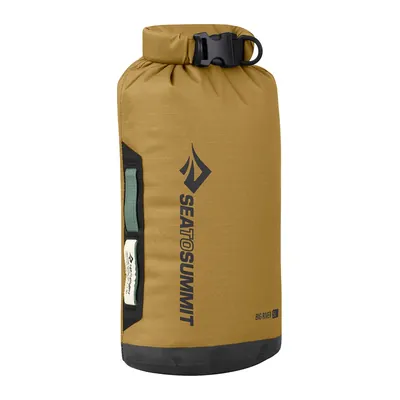
Sea to Summit Big River Dry Bag
A roll-top dry bag in 420D nylon with a TPU laminate, taped seams and lash points: to keep the tent, sleeping bag and evening clothes dry. Sizes from 5 to 65 liters.
View on Amazon (opens in a new tab)
Worth watching
Paddling Magazine sizes up both boats: room for people and gear, kneeling or sitting in a canoe; a lower seat, more speed and easier steering with two blades in a kayak.
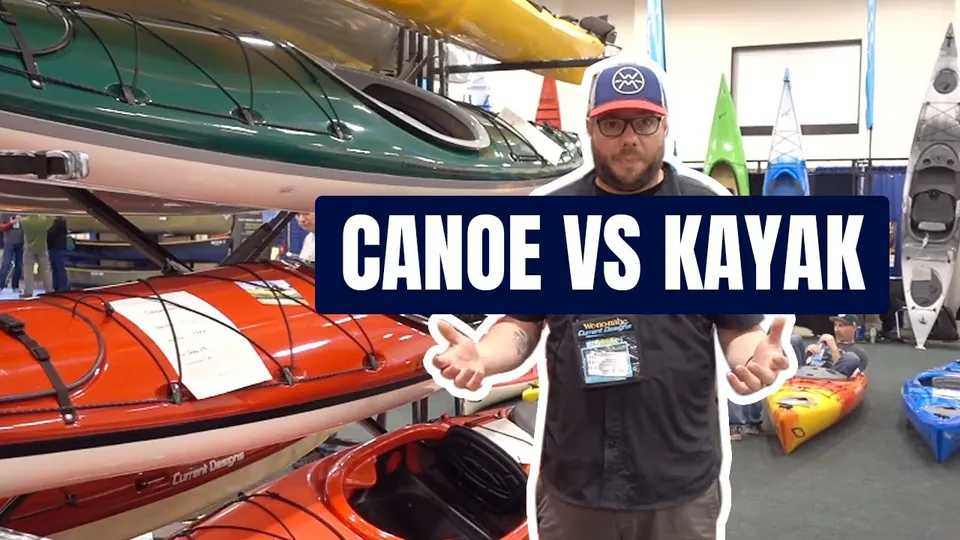
The video is hosted by YouTube (Google): nothing loads until you play it, and Google may then set cookies.
FAQ
What’s the difference between a canoe and a kayak?
Mainly the paddle: single, with one blade, in a canoe; double, with a blade at each end, in a kayak. In sprint racing, according to the international federation, the canoeist kneels on one knee in the boat and paddles on one side only, while the kayaker sits and paddles on both sides, alternating.
Canoe or kayak: which is better for beginners?
On flatwater, either one works for a beginner. With a partner, a child, or luggage, a two-person rental canoe is, in our view, the easiest; on your own, on a lake, a kayak is quick to pick up. Best of all, try both, renting or at a club, where the first levels are taught boat by boat.
How old do kids have to be to go canoeing?
It depends on where you go. On France’s Ardèche River, a prefectural order sets the minimum age at 7, and paddlers must know how to swim; younger kids who can swim can go down with a certified guide. At outfitters in France, a child under 55 lb (25 kg) has to wear a PFD with extra buoyancy, at least 30 or 40 newtons depending on weight.
What kind of PFD do you need for canoeing or kayaking?
A CE-marked PFD meeting ISO 12402-5 or 12402-4, rated at 50 newtons or more, according to the French federation. At outfitters in France, the Code du sport bans inflatable and hybrid PFDs, and requires extra buoyancy for anyone under 55 lb (25 kg) and for inflatable boats on rivers of Class III and up.
How much does it cost to rent a canoe?
On France’s Ardèche River, the tourist office gives typical prices of €25 to €40 per adult between Vogüé and Vallon-Pont-d’Arc, from €35 for a one-day trip through the gorges, and from €60 for two days. The outfitter provides the canoe, paddles, PFDs, and waterproof barrels, and runs a bus shuttle.
Sources
- Fédération française de canoë-kayak et sports de pagaie (FFCK, France’s canoe-kayak federation), Histoire (in French), accessed October 22, 2026. ffck.org https://www.ffck.org/federation/ffck/histoire/ ↩
- Paddle Worldwide (International Canoe Federation), Canoe Sprint, accessed October 22, 2026. paddleworldwide.com https://paddleworldwide.com/disciplines/canoe-sprint ↩
- FFCK, Eau calme (in French), accessed October 22, 2026. ffck.org https://www.ffck.org/pratiquer/loisirs/eau-calme/ ↩
- FFCK, Pagaies Couleurs, 2021 program (in French), accessed October 22, 2026. ffck.org https://www.ffck.org/formation/pagaies-couleurs/pagaies-couleurs-2021/ ↩
- Office de tourisme Gorges de l’Ardèche Pont d’Arc (tourist office), Canoë en Ardèche : toutes les infos pour se lancer (in French), accessed October 22, 2026. gorges-ardeche-pontdarc.fr https://www.gorges-ardeche-pontdarc.fr/canoe-en-ardeche-toutes-les-infos-pour-se-lancer/ ↩
- Code du sport (French sports code), articles A322-42 to A322-52 (establishments organizing certain water sports), current version, Légifrance, accessed October 22, 2026. legifrance.gouv.fr https://www.legifrance.gouv.fr/codes/section_lc/LEGITEXT000006071318/LEGISCTA000018751549/ ↩
- FFCK, Activités (regulations, in French), accessed October 22, 2026. ffck.org https://www.ffck.org/nos-sites/reglementation/activites/ ↩
- FFCK, Eaux vives (in French), accessed October 22, 2026. ffck.org https://www.ffck.org/pratiquer/loisirs/eaux-vives/ ↩
- FFCK, Sécurité (in French), accessed October 22, 2026. ffck.org https://www.ffck.org/nos-sites/reglementation/prevention/ ↩
- Service-public.fr (official French government information site), Quels sont les numéros en cas d’urgence (Samu, pompiers...) et les numéros d’écoute ? (in French), checked by Service-public.fr on August 25, 2026, accessed October 22, 2026. service-public.gouv.fr https://www.service-public.gouv.fr/particuliers/vosdroits/F33954 ↩
- French Ministry of Health, Directorate General for Health (Direction générale de la Santé), leaflet La leptospirose (in French), June 2008, distributed by the FFCK, accessed October 22, 2026. ffck.org https://www.ffck.org/wp-content/uploads/2023/11/64_Depliant_Leptospirose_2008-copie-copie.pdf ↩
- FFCK, Espaces d’eau calme et mer (in French), accessed October 22, 2026. ffck.org https://www.ffck.org/nos-sites/equipements/espaces-eau-calme-mer/ ↩
- FFCK, Les Sentiers Nautiques, program website (in French), accessed October 22, 2026. sentiersnautiques.fr https://www.sentiersnautiques.fr/ ↩

Trail running, snow, water, nature and destinations
Nolwenn covers trail running, snow, water, nature and destinations for Outfarer. Curious about everything, from meteor showers to night-train schedules, she has a knack for digging up the one detail that changes everything, and nailing it in a single sentence.


