 Français (France)
 English (UK)
 English (US)
 Deutsch (Deutschland)

Contents
What does the number on a fly rod mean? It is not the weight of the rod, and it is not a measure of the fish it can land. It is a line weight: a standard number that tells you which fly line the rod was designed to throw [1]. Get that right and the rest of a first outfit follows.
What the number on a fly rod and line actually measures
The system numbers fly lines from 1, the lightest, to 15. Each number is a target weight for the first 30 feet (about 9 m) of the line, not counting the level tip, and the table is now published by the American Fly Fishing Trade Association (AFFTA) [1]. The unit is the A unit of mass of about 0.065 g, in which fly line weights are quoted.: a #5 line should weigh 140 grains, and one that lands between 134 and 146 grains still counts as a #5 [1].
| Line weight | Target (grains) | Allowed range (grains) | Target (g) |
|---|---|---|---|
| #3 | 100 | 94 to 106 | 6.5 |
| #4 | 120 | 114 to 126 | 7.8 |
| #5 | 140 | 134 to 146 | 9.1 |
| #6 | 160 | 152 to 168 | 10.4 |
| #7 | 185 | 177 to 193 | 12 |
| #8 | 210 | 202 to 218 | 13.6 |
| #9 | 240 | 230 to 250 | 15.55 |
| #10 | 280 | 270 to 290 | 18.15 |
| #12 | 380 | 368 to 392 | 24.6 |
AFFTA Approved Fly Line Weight Specification (January 2022), as reproduced in Wikipedia’s ‘Fly line’ entry. The full table runs from #1 (60 grains) to #15 (550 grains).
Why the line matters more than the rod
Fly casting turns ordinary angling round. With a spinning outfit the lure drags the line out; here the line carries the fly. Scientific Anglers puts it plainly: what you throw is the weight of the line, and the fly just goes along for the ride [2]. The rod has to bend under that weight to cast, which is why it is rated by the line it suits.
An Orvis tutorial makes the same point from the other end: the question of which rod size you need is really about the line, and the line depends on the flies. Casting size 2 streamers takes a heavier line, and therefore a heavier rod, than dry flies for brook trout [3].
Which line weight for which fish?
Makers’ charts and shops broadly agree, with overlaps. Scientific Anglers lists trout and panfish at 4 to 6, bass at 7 to 9, pike at 8 to 10, steelhead at 7 to 9 and tarpon at 10 to 12 [5]. Orvis, for a first rod, suggests a 5 or 6 for trout, a 6 or 7 for bass, and 7 to 9 for steelhead and salmon [6]. Scientific Anglers sums up the scale: weights 2 to 6 are smaller gear suited to trout and panfish, and 11 to 15 are built for tarpon, billfish and other big saltwater species [5].
Why do the numbers climb with the size of the fish? Because the weight of the line decides the size of fly that can be cast: the larger or more air-resistant the fly, the heavier the line must be. A heavy line can still cast a small fly, but a line that is too light simply cannot carry one that catches the air [2].
What should a beginner buy first?
If you are not sure what you will fish for, Orvis names a graphite 9 ft 6-weight as the most common first fly rod: not too light, not too heavy, sensitive enough for dry flies and strong enough to turn over streamers [6]. Five checks narrow the choice.
- Choose the fish first. Trout in a river points to a 5 or 6; small streams favour shorter rods of 6 to 7 ft, which are easier to handle in brush [6].
- Match the numbers. Rod, line and reel carry the same number: Scientific Anglers pairs a 5-weight line with a 5-weight rod and a reel marked 4/5/6 [5].
- Pick the length. About 9 ft is the most common and most versatile [6]; for trout, Scientific Anglers lists rods of 8 to 9 ft [5].
- Start with a floating, weight-forward line. Most lines sold today are weight-forward, with the mass pushed to the front; double taper survives mainly for light-line, short-range dry-fly fishing [2].
- Leave room for backing. For trout, Scientific Anglers lists 50 yd (about 46 m) of 20 lb backing [5].

Spend what you can afford. Graphite is the lightest and most common material, and fibreglass suits a slower casting stroke [6]. Few anglers stay with one rod for long; a first outfit is a way to find out what you actually like to fish.
Can you put a 6 line on a 5 rod?
The number on the rod is the maker’s recommendation, not a law of physics. A reply under Scientific Anglers’ article on tapers says modern rods handle a range of weights, and that an overlined rod is generally easier for a novice to cast, because the deeper bend opens up the casting arc [2]. The company’s own advice on building a balanced system is firmer: match the line weight to the rod weight [5]. Both can be true: start matched, and treat a size up as an experiment rather than a rule.
Some lines do without the number. Rio sells its sinking-tip lines by grain weight and publishes its own conversion: 150 grains for a 5-weight rod, 200 for a 6, 250 for a 7, 300 for an 8 [7].
Is your 5-weight really a 5-weight?
Not always. The Sexyloops casting site observes that many manufacturers have drifted away from the AFFTA rating, while its older survey of makers found most ‘standard’ lines close to their number [4]. The site also weighs lines at home, with kitchen scales reading to 0.05 g over exactly 30 ft from the tip, and reports labelled lines that land between two sizes [8].
What this means for you: look for the head weight in grains on the maker’s page (Rio’s product pages have a ‘30ft head weight’ field [9]), compare it with the table above, and remember that a matched rod and line remain a safe starting point.
Before the first cast: licence and permission
Fly fishing follows the same licence rules as any rod fishing. In England and Wales you need a rod fishing licence to fish for salmon, trout, freshwater fish, smelt or eel with a rod and line, including on private club waters. Children under 13 do not need one, and juniors aged 13 to 16 get a free licence [10]. You can be fined up to £2,500 if you cannot show a valid licence when asked [10].
A licence is not permission: you also need leave from the landowner or fishery owner, usually as a fishing permit [10]. Scotland and Northern Ireland have different rules, so check them before you travel [10].
Before you leave, check three things: the number on the rod, the number on the line and the licence in your pocket. Leader and knot questions come next, and our guide to five fishing knots is a good start.
Kit related to this article
No affiliation: no commission, no sponsored products.
 Lyons Press (Tom Rosenbauer, Orvis)
The Orvis Fly-Fishing Guide, Revised (Tom Rosenbauer)
Tom Rosenbauer’s guide to fly fishing, revised in 2017 by Lyons Press: tackle, casting, flies and techniques, with photographs and illustrations.
View on Amazon (opens in a new tab)
Worth watching
Tom Rosenbauer discusses why fly line weight matters for the fishing you do: a short spoken companion to the numbers explained above.
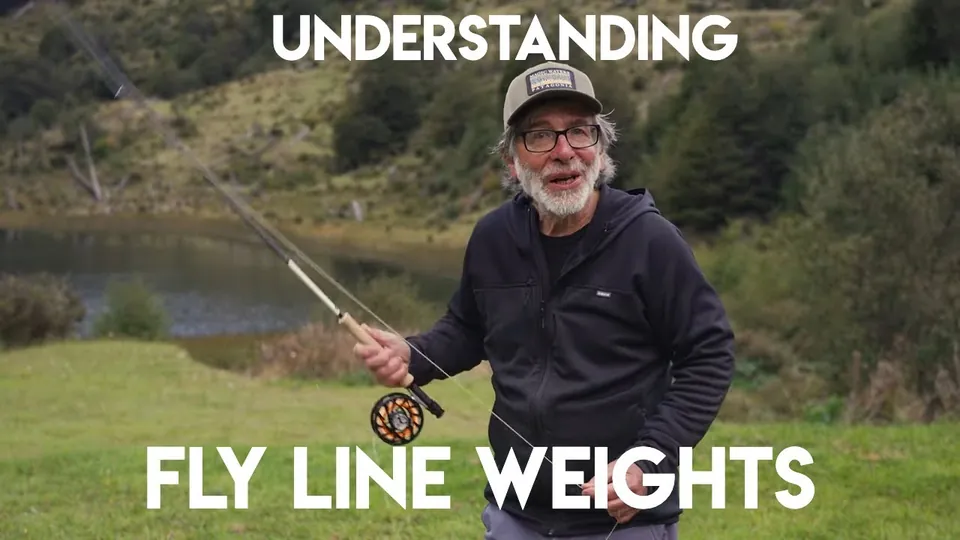
The video is hosted by YouTube (Google): nothing loads until you play it, and Google may then set cookies.
FAQs
What does the number on a fly rod mean?
It names the line weight the rod was designed to cast, not the weight of the rod. The AFFTA table fixes that weight over the first 30 feet of line, from 60 grains for a #1 to 550 grains for a #15. A #5 line should weigh 140 grains, give or take 6. The number on the rod is the maker’s recommendation.
What fly rod weight is best for trout?
Most guides put trout at 4 to 6. Scientific Anglers’ chart lists 4, 5 and 6, and Orvis suggests a 5 or 6 for a first rod, or a 9 ft 6-weight if you cannot decide. Small streams favour shorter rods of 6 to 7 ft, while 9 ft is the most common and most versatile length.
Can I use a heavier line than the number on my rod?
Often, yes. A reply under Scientific Anglers’ article on tapers says modern rods handle a range of weights, and that an overlined rod is generally easier for a novice to cast. The company’s own advice on a balanced system is to match line and rod weight, so start matched and treat a size up as an experiment.
What length should a first fly rod be?
About 9 ft is the most common and most versatile length. For trout, Scientific Anglers lists rods of 8 to 9 ft, and Orvis says small-stream anglers tend to like 6 to 7 ft rods, which are easier to handle in brush and ideal for short casts.
Do I need a licence for fly fishing in England?
Yes, if you fish for salmon, trout, freshwater fish, smelt or eel with a rod and line in England, including on private club waters. Children under 13 need none, and juniors aged 13 to 16 get a free licence. You also need the owner’s permission, usually a fishing permit.
Sources
- Wikipedia, ‘Fly line’ (AFFTA Approved Fly Line Weight Specification, January 2022, table of line weights), accessed 2 November 2026. en.wikipedia.org https://en.wikipedia.org/wiki/Fly_line ↩
- Scientific Anglers, ‘Understanding Fly Line Tapers’, accessed 2 November 2026. scientificanglers.com https://scientificanglers.com/understanding-fly-line-tapers/ ↩
- Orvis News, ‘Pro Tips: How To Choose the Right Fly Rod Size’, accessed 2 November 2026. news.orvis.com https://news.orvis.com/fly-fishing/tuesday-tip-how-to-choose-the-right-fly-rod-size ↩
- Sexyloops, ‘Line ratings’, accessed 2 November 2026. sexyloops.com https://www.sexyloops.com/index.php/ps/line-ratings ↩
- Scientific Anglers, ‘Putting Together a Balanced Fly Fishing System’, 16 February 2015, accessed 2 November 2026. scientificanglers.com https://scientificanglers.com/putting-together-balanced-fly-fishing-system/ ↩
- Orvis, ‘How Do I Choose My First Fly Rod?’, accessed 2 November 2026. orvis.com https://www.orvis.com/how-do-i-choose-my-first-fly-rod.html ↩
- RIO Products, ‘24ft Sink Tip Fly Line’, product page with grain-to-rod conversion, accessed 2 November 2026. rioproducts.com https://www.rioproducts.com/products/premier-24ft-sink-tip ↩
- Sexyloops, ‘When your #5 is actually a #5.5, #6, #7 or an #8’, accessed 2 November 2026. sexyloops.com https://www.sexyloops.com/index.php/ps/when-your-5-is-actually-a-55-6-7or-an-8 ↩
- RIO Products, ‘RIO Gold Fly Line’, product page, accessed 2 November 2026. rioproducts.com https://www.rioproducts.com/products/premier-rio-gold ↩
- GOV.UK, ‘Buy a rod fishing licence: When you need a licence’, accessed 2 November 2026. gov.uk https://www.gov.uk/fishing-licences ↩

Fact-checking, regulations and safety
Arnaud Couderc reviews our contributors’ articles and writes for Outfarer about regulations, safety, fishing, the sea and outdoor pursuits. He traces every rule back to its official text and every figure to its source, so that you set off with sound benchmarks.


 Nolwenn Bastide