 Français (France)
 English (UK)
 English (US)
 Deutsch (Deutschland)

Is a size 4 hook bigger than a size 8? Yes: the higher the number, the smaller the hook. Then you reach 1 and the series turns round: a 1/0, said ‘one-aught’, is bigger than a 1, a 2/0 is bigger than a 1/0, and so on [1]. Here is how to read that scale, what it means in millimetres for one maker, and the sizes public agencies suggest for each fish and bait.
Why the number rises as the hook shrinks
The series counts down to 1 and then changes notation: on one maker’s product page, sizes 1, 1/0, 2/0 and 3/0 grow one after the other [1]. North American agency guides work the same way: sizes 10, 8 and 6 suit small-mouthed fish such as panfish and stream trout, while 2, 1 and 1/0 are for bigger fish such as walleye, northern pike, muskellunge and largemouth bass [2].
The table gives the real dimensions of one specific model, the Mustad 39940NP offset circle hook. From the 1 to the 10/0, the gape goes from 8.8 to 23.1 mm and the length from 17.6 to 46.4 mm, about 2.6 times more; the wire goes from 1.07 to 2.64 mm [1]. The steps are not even: 0.9 mm of gape between the 1 and the 1/0, but 2.1 mm between the 8/0 and the 9/0.
| Size | Gape (mm) | Length (mm) | Wire (mm) |
|---|---|---|---|
| 1 | 8.8 | 17.6 | 1.07 |
| 1/0 | 9.6 | 19.3 | 1.15 |
| 2/0 | 10.5 | 21.1 | 1.25 |
| 3/0 | 11.6 | 23.2 | 1.32 |
| 4/0 | 12.7 | 25.4 | 1.42 |
| 6/0 | 15.3 | 30.5 | 1.82 |
| 8/0 | 18.6 | 37.1 | 2.18 |
| 10/0 | 23.1 | 46.4 | 2.64 |
Maker’s dimensions for this model only: another model or another brand gives other values.
Three dimensions matter. The The distance between the point of the hook and the shank, also called the gap. tells you what the fish’s mouth can take; the length runs from the eye to the bottom of the bend; and the wire diameter tells you how strong the hook is [3]. The drawing below names each part, on a J hook and on a circle hook.
The same number, two different hooks
No standard fixes these sizes. The Atlantic States Marine Fisheries Commission says so plainly: the measuring convention varies widely between manufacturers, and even between hooks from one manufacturer, so that a 5/0 from one company may be the same size as an 8/0 from another [4]. A fishing site gives a milder example: a 3/0 Gamakatsu weighted hook has a wider gap than a 3/0 Owner weighted hook [3].
Shank length matters as much as the number. Minnesota recommends a long shank for bulky baits such as nightcrawlers [2], and New York notes that a long-shank pattern can help when you need to remove a swallowed hook [5].
Which number for which fish?
We found no table from a British or Irish public body: the most precise beginner guides come from North American agencies and describe North American fish. Take them as a guide to how mouth size relates to hook number. They agree on the pattern: small hooks (6 to 12) for sunfish, perch and stream trout, hooks of one to a few aughts for big predators [2, 5, 6, 7, 8, 9].
| Fish (name used in the guide) | Suggested size | Bait or detail |
|---|---|---|
| Sunfish (bluegill) | 10 (Minnesota); 8 or 10 (New York); 6 to 12 (Pennsylvania) | Piece of nightcrawler, wax worm or meal worm under a bobber |
| Yellow perch | 8 (Minnesota); 6 (New York) | Small minnows, worms, wax worms |
| Crappie | 6 (Minnesota and New York) | Small minnows or wax worms |
| Stream trout | 6 (Minnesota); 6 to 10 depending on bait size (New York) | Worms, fish eggs, maggots |
| Trout | Single hook, 10 to 16 (Missouri) | Salmon eggs |
| Trout | Treble, 16 to 18 (Missouri) | Cheese or dough bait |
| Bullhead | 2 (Minnesota); 4 or 6 (New York) | Dough balls, nightcrawlers, chicken liver, fished on the bottom |
| Walleye | 2 (Minnesota) | Nightcrawlers, leeches, minnows of 5 to 10 cm (2 to 4 in) |
| Smallmouth bass | 1 (Minnesota) | Crayfish, minnows of 5 to 10 cm (2 to 4 in), nightcrawlers |
| Largemouth bass | 1/0 (Minnesota) | Frogs, minnows of 8 to 15 cm (3 to 6 in), crayfish |
| Catfish | 1/0 (Minnesota); 2 to 1/0, a stout hook (New York) | Frogs, nightcrawlers, crayfish, minnows |
| Northern pike | 1/0 or larger (Minnesota) | Minnows of 10 to 20 cm (4 to 8 in) |
| Big-river catfish | 6/0 to 8/0 circle hooks on a rod; 8/0 or 12/0 circle hooks when drifting (Missouri) | Two hooks about 45 cm (18 in) apart for drifting |
North American fish, guides from 2010 (Minnesota) to today: a rough guide, not an instruction for your waters.
The right number depends on the bait as much as on the fish. For trout, Missouri gives a single hook of 10 to 16 for salmon eggs and a treble of 16 to 18 for cheese or dough baits [10], while New York suggests 6 to 10 for worms and other natural baits, depending on the bait’s size [7]. Minnesota sums up the rule: a hook big enough to hold the bait, small enough to fit in the fish’s mouth [2].
The circle hook, which sets itself
A circle hook has its point turned back toward the shank: the ASMFC defines it as a non-offset hook with the point turned perpendicularly back to the shank [4]. It sets in the corner of the mouth as the fish moves off, so you do not strike; Missouri makes that point for big-river catfish [9]. In striped bass trials summarised by the ASMFC, deep hooking was nearly three times less frequent with non-offset circle hooks than with J hooks (5.6% against 15.0%) [4].
| Measure | J hook | Non-offset circle hook |
|---|---|---|
| Deep hooking (2001 trial) | 15.0% | 5.6% |
| Fish landed per detected strike (2002 trial) | 42% | 27% |
Two different trials, from the ASMFC Special Report No. 77 (2003).
The same report flags a downside: in another trial, anglers using J hooks landed a fish on 42% of detected strikes, against 27% with non-offset circle hooks [4]. More fish released unharmed, a few fewer in the net: it is a choice, not a given.
Barbless hooks: what the byelaws say
On the cross-border Dee and Wye, the Environment Agency’s 2020 byelaws require all hooks to be barbless or de-barbed. There are no trebles on spinners, spoons or plugs (single hooks only, with a gape of 13 mm), up to three singles on a plug, and on flies small trebles are allowed up to a 7 mm gape, which the agency puts at about size 8 [11]. On the Mustad model above, a 13 mm gape falls between the 4/0 (12.7 mm) and the 5/0 (13.9 mm): a rough guide for that one model, not a conversion.
Before you go: three checks
- The rules of the water: byelaws, fishery rules, barbless requirements, hook type and number.
- The hook’s dimensions: gape and length in millimetres from the maker’s page, not only the number.
- The fish’s mouth and the bait: big enough to hold the bait, small enough to fit in the mouth.
A rule is read with its date: the sizes here come from guides published from 2010 to today, and the Dee and Wye byelaws from June 2020. Before the next trip, reopen the text that applies to your water.
Kit related to this article
No affiliation: no commission, no sponsored products.
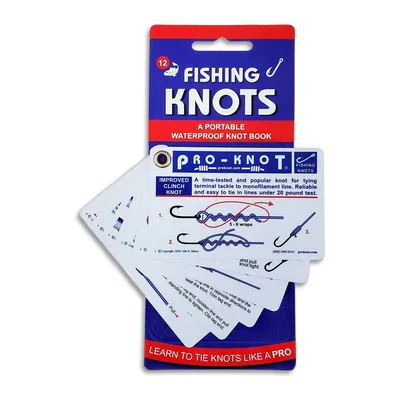
Pro-Knot Fishing Knots (waterproof knot cards)
Twelve fishing knots, the improved clinch among them, illustrated on six waterproof plastic cards held by a brass grommet: pocket-sized (9 x 6 cm), to keep in the tackle box.
View on Amazon (opens in a new tab)
Worth watching
A fishing-media video on hook sizing, gauge, gap and length, and on why one number can mean different sizes between makers: the same point the ASMFC report makes. Published by a US tackle-and-tips company.
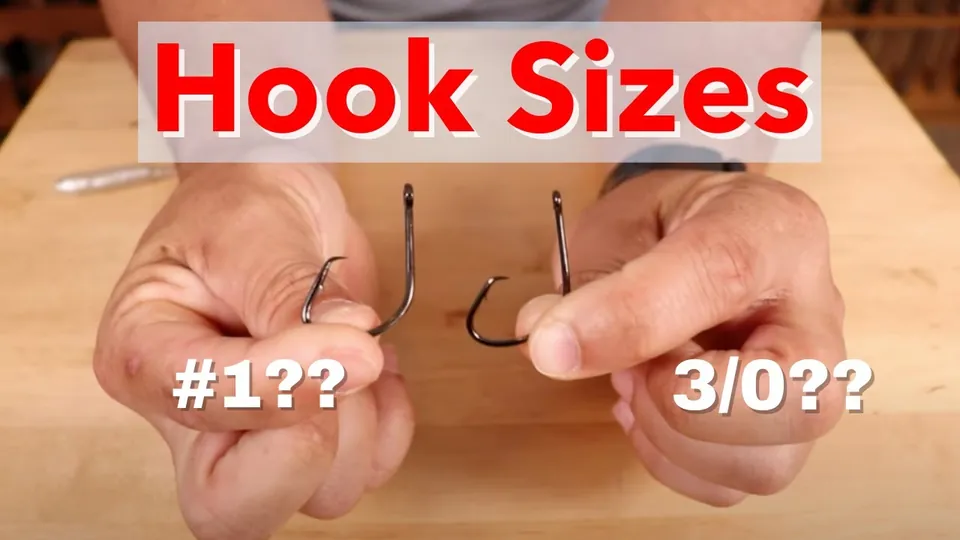
The video is hosted by YouTube (Google): nothing loads until you play it, and Google may then set cookies.
FAQs
Is a 1/0 hook bigger or smaller than a 1?
Bigger. The series counts down to 1 (the higher the number, the smaller the hook), then the 1/0, 2/0 and 3/0 sizes grow. On Mustad’s product page the gape goes from 8.8 mm for the 1 to 9.6 mm for the 1/0 and 10.5 mm for the 2/0. The 10/0 reaches 23.1 mm.
What hook size should a beginner buy?
Minnesota and New York beginner guides suggest sizes 6 to 10 for small-mouthed fish such as sunfish and stream trout, with worms or eggs. Those guides describe North American fish, so check local habits with a fishery, a club or a tackle shop, and read the fishery rules on hook type.
Is a size 6 the same from every brand?
No. The ASMFC says the measuring convention varies widely between manufacturers, and even between models from one manufacturer: a 5/0 from one company may equal an 8/0 from another. Compare gape and length in millimetres when the maker publishes them rather than trusting the number alone.
Do I need barbless hooks in England and Wales?
On some waters, yes. On the cross-border Dee and Wye all hooks must be barbless or de-barbed, and Wales asks for barbless hooks for salmon and sea trout. Other waters, including private fisheries, set their own rules, so read the fishery rules and local byelaws before you fish.
Why choose a circle hook?
Its point turned toward the shank makes it set in the corner of the mouth. In striped bass trials summarised by the ASMFC, deep hooking was nearly three times less frequent than with a J hook (5.6% against 15.0%), though anglers also landed fewer fish.
Sources
- Mustad, product page for the Demon Offset Circle Hook 1X Strong (39940NP), size and dimension table, accessed 5 November 2026. bedrift.mustad.no https://bedrift.mustad.no/uk/products/39940np ↩
- Minnesota Department of Natural Resources, MinnAqua programme, “Tackling Your Tackle Box”, leader’s guide, chapter 5, lesson 4, 2010, accessed 5 November 2026. files.dnr.state.mn.us https://files.dnr.state.mn.us/education_safety/education/minnaqua/leadersguide/chapter_5/5_4_tackling_your_tackle_box.pdf ↩
- Salt Strong, “The Truth About Hook Sizes (And What You Need To Know)”, accessed 5 November 2026. saltstrong.com https://www.saltstrong.com/?p=38583 ↩
- Atlantic States Marine Fisheries Commission, “Circle Hook Definition and Research Issues”, Special Report No. 77, July 2003, accessed 5 November 2026. mrc.virginia.gov https://mrc.virginia.gov/Notices/ASMFC_SR77_Circle-Hook-Definition.pdf ↩
- New York State Department of Environmental Conservation, “Fishing for Panfish”, accessed 5 November 2026. dec.ny.gov https://dec.ny.gov/things-to-do/freshwater-fishing/learn-to-fish/tips-skills/panfish ↩
- Pennsylvania Fish & Boat Commission, “All About Bluegill”, accessed 5 November 2026. pa.gov https://www.pa.gov/agencies/fishandboat/fishing/all-about-fish/catch-pa-fish/bluegill ↩
- New York State Department of Environmental Conservation, “Fishing for Stream Trout”, accessed 5 November 2026. dec.ny.gov https://dec.ny.gov/things-to-do/freshwater-fishing/learn-to-fish/tips-skills/stream-trout ↩
- New York State Department of Environmental Conservation, “Fishing for New York’s Big Cats”, accessed 5 November 2026. dec.ny.gov https://dec.ny.gov/things-to-do/freshwater-fishing/learn-to-fish/tips-skills/fishing-for-new-york-big-cats ↩
- Missouri Department of Conservation, “Big River Catfishing”, accessed 5 November 2026. mdc.mo.gov https://mdc.mo.gov/fishing/species/catfish/big-river-catfishing ↩
- Missouri Department of Conservation, “Trout: Fishing Tips”, accessed 5 November 2026. mdc.mo.gov https://mdc.mo.gov/fishing/species/trout/trout-fishing-tips ↩
- Environment Agency, “New cross border byelaws to protect salmon and sea trout”, press release, 26 June 2020, accessed 5 November 2026. gov.uk https://www.gov.uk/government/news/new-cross-border-byelaws-to-protect-salmon-and-sea-trout ↩
- Natural Resources Wales, “Using lures and baits”, accessed 5 November 2026. naturalresourceswales.gov.uk https://www.naturalresourceswales.gov.uk/guidance-and-advice/business-sectors/fisheries/angling-byelaws/using-lures-and-baits/?lang=en ↩

Fact-checking, regulations and safety
Arnaud Couderc reviews our contributors’ articles and writes for Outfarer about regulations, safety, fishing, the sea and outdoor pursuits. He traces every rule back to its official text and every figure to its source, so that you set off with sound benchmarks.


