 Français (France)
 English (UK)
 English (US)
 Deutsch (Deutschland)

45 mm (1.8 in). That’s the difference in reach between sizes S and L of the same mountain bike, the Commencal Clash V3: 435 mm (17.1 in) versus 480 mm (18.9 in) [1]. On paper, that’s not much. On the bike, it’s the difference between feeling cramped and riding with room to move, and it’s why a mountain bike’s size is about more than a letter.
Why size charts don’t compare across brands
The easiest way to choose, Trek says, is still to start with your height, using the size chart each manufacturer publishes for its bikes. But lots of riders land between two sizes, and many are used to sizing a bike by inseam or seat tube length. Those numbers still matter, but for comparing mountain bikes, Trek puts more weight on reach and effective top tube, meaning the top tube length measured horizontally [2].
| Measurement | What it measures | What it tells you about your position |
|---|---|---|
| Reach | The horizontal distance from the center of the head tube to a vertical line through the bottom bracket | Your position standing on the pedals, on descents |
| Effective top tube | The horizontal distance from the center of the head tube to the center of the seatpost | Your position seated, while pedaling |
| Stack | The height from the bottom bracket to the top of the head tube | The height of the front end, and so of the handlebars |
Sources: Trek for reach and effective top tube; Commencal also lists reach and stack in its geometry charts and recommends comparing them with your current bike’s.
Trek explains why reach is the benchmark across brands: most trail riders spend more time standing on the pedals than sitting in the saddle. Effective top tube matters more if you ride cross-country and put pedaling efficiency first [2].
Example: one mountain bike in three sizes
Manufacturers’ geometry charts show what actually changes from one size to the next. Here’s the chart for the Commencal Clash V3, a long-travel freeride bike [1].
| Measurement | S | M | L |
|---|---|---|---|
| Reach | 435 | 455 | 480 |
| Stack | 618 | 623 | 627 |
| Effective top tube | 572 | 593 | 619 |
| Wheelbase | 1,211 | 1,233 | 1,260 |
| Head tube length | 115 | 120 | 125 |
Source: Commencal, Clash V3 product page. The head angle (63.8°) and seat tube angle (77.5°) are the same in all three sizes. To convert, 25.4 mm = 1 in.
From one size to the next, reach grows by 20 mm, then 25 mm, and wheelbase by 22 mm, then 27 mm: 0.8 to 1.1 in per step. Stack rises by just 5 mm, then 4 mm (0.2 in or less). So going up a size mostly gets you a longer bike that’s barely any taller. And the angles don’t change: the bike keeps its personality, and only the room it gives you changes [1].
Between two sizes: let your riding style and build decide
Manufacturers give the same advice. A longer reach means a longer wheelbase, so the bike gets more stable, especially on fast descents, which suits riders who’d rather plow straight through. A shorter reach makes it less stable but more agile and easier to throw around, ideal for a playful style that loves getting both wheels off the ground [2]. Commencal points out the trade-off: on a longer bike, that added sense of security costs you maneuverability and extra effort to move the bike [1].
Your build matters too. Two riders of the same height can have different proportions: with long legs and a shorter-than-average torso, a shorter reach may work; with long arms and a bigger upper body, the next size up may fit better [1] [2]. A test ride is still the best judge; if you can’t get one, Commencal recommends comparing the reach and stack of your current bike with those of the bike you’re eyeing [1].

Smaller frames, smaller wheels
Frame size can also determine wheel size. Cube, for example, uses what it calls “Size Split”: 27.5-inch wheels on frames for the shortest riders, 29-inch wheels for the tallest, so every size stays both stable and responsive [3]. When you compare two bikes, make sure the size that fits you actually comes with the wheels in the spec.
Once you have the size: saddle height
Once you’ve picked a size, you still need to set your saddle height. A 2011 literature review found a wide variety of methods, based on leg length or inseam, like the LeMond method or the heel method, or on a knee flexion angle, and noted there was no consensus on any of them. It also pointed out that overuse knee pain affects half of all cyclists [4].
A more recent systematic review, from 2022, found strong evidence for setting saddle height from your knee angle measured while pedaling, rather than from a simple formula. It adds that a change of less than 4% of leg length makes very little difference to the loads on your legs, and none to oxygen uptake [5]. In practice, a bike fit at a bike shop or with a fitter is still the surest way to start from a good setup. And if your next mountain bike is electric, our guide to e-MTB range will help you choose its battery.
Kids’ bikes: wheel size follows height
For kids, bike size comes down first to wheel diameter, which follows the child’s height. Kids’ bike maker woom warns against buying a bike too big so it’ll last: an inch or two can make the difference between joy and frustration. With the saddle all the way down, your child should be able to put both feet on the ground without shifting position, with enough clearance between the top tube and their crotch. And woom advises against skipping a size [6].
| Wheels | Child’s height | Approximate age |
|---|---|---|
| 12-inch (balance bike) | 82 to 100 cm | 1.5 to 3.5 years |
| 14-inch | 95 to 110 cm | 3 to 4.5 years |
| 16-inch | 105 to 120 cm | 4 to 6 years |
| 20-inch | 115 to 130 cm | 6 to 8 years |
| 24-inch | 125 to 145 cm | 7 to 11 years |
Source: woom, “Quelle taille de vélo choisir pour mon enfant ?” (in French). Heights in centimeters, as woom lists them: 82 cm is about 2 ft 8 in, 100 cm about 3 ft 3 in, 120 cm about 3 ft 11 in, and 145 cm about 4 ft 9 in. The ranges overlap; where they do, your child’s riding skills help decide.
The same company stresses that a child’s riding skills matter more than their inseam: a very confident kid can handle a bike that’s a little big, while another will quickly struggle on it [6].

Remember one rule: the manufacturer’s chart gives you the size, your riding style breaks the tie between two, and a test ride always gets the final say.
Worth watching
GMBN Tech walks through the key geometry numbers, reach and top tube included, that tell you which frame size fits, going beyond the height chart on a manufacturer’s website.
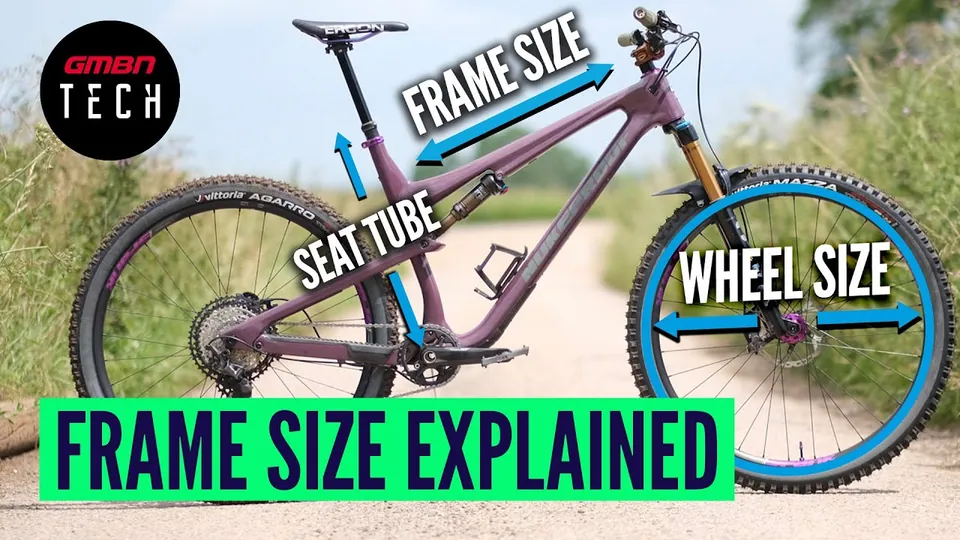
The video is hosted by YouTube (Google): nothing loads until you play it, and Google may then set cookies.
FAQ
What size mountain bike do I need if I’m 5 ft 11 in (1.80 m)?
There’s no answer that works for every brand: each manufacturer publishes its own size chart based on rider height, and an “M” or “L” doesn’t give you the same reach from one brand to the next. Start with the chart for the bike you’re considering, then compare its reach and stack with those of a bike you feel good on.
What is reach on a mountain bike?
It’s the horizontal distance from the center of the head tube to a vertical line through the bottom bracket. It reflects your position standing on the pedals, the one trail riders use most, and it’s the number Trek recommends comparing across brands.
How do I choose between two mountain bike sizes?
Base it on how you ride and how you’re built. The bigger size, with its longer reach, is more stable at speed; the smaller one is more agile and easier to throw around. If you have long legs and a short torso, a shorter reach often works; with long arms and a bigger upper body, go with the size up.
What size bike does a 6-year-old need?
It depends on their height more than their age. At woom, 16-inch wheels are for kids 3 ft 5 in to 3 ft 11 in (105 to 120 cm), around ages 4 to 6, and 20-inch wheels for kids 3 ft 9 in to 4 ft 3 in (115 to 130 cm), around ages 6 to 8. With the saddle all the way down, your child should be able to put both feet on the ground.
How do I set saddle height on a mountain bike?
There are plenty of inseam-based methods, like the LeMond method, and there’s no consensus on any of them. A 2022 systematic review concludes that the best-supported approach is based on your knee angle measured while pedaling; a bike fit with a specialist is the surest way to get there.
Sources
- Commencal, Clash V3 Signature product page: geometry and size guide (French website, in French), accessed October 22, 2026. commencal.com https://www.commencal.com/fr/commencal-clash-v3-signature-pure-black-vtt-gravity-longue-course/BT7CLAV3SGEU1S.html ↩
- Trek, Quelle taille de VTT me convient le mieux ?, buyer’s guide (French website, in French), accessed October 22, 2026. trekbikes.com https://www.trekbikes.com/fr/fr_FR/mountain_buyers_guide/size/ ↩
- Cube, Aim SLT product page, “Size Split” section (French website, in French), accessed October 22, 2026. cube.eu https://www.cube.eu/fr/cube-aim-slt-soot-n-black/1140900 ↩
- Bini R., Hume P. A., Croft J. L., Effects of bicycle saddle height on knee injury risk and cycling performance, Sports Medicine, June 2011, accessed October 22, 2026. pubmed.ncbi.nlm.nih.gov https://pubmed.ncbi.nlm.nih.gov/21615188/ ↩
- Bini R., Priego-Quesada J., Methods to determine saddle height in cycling and implications of changes in saddle height in performance and injury risk: A systematic review, Journal of Sports Sciences, February 2022, accessed October 22, 2026. pubmed.ncbi.nlm.nih.gov https://pubmed.ncbi.nlm.nih.gov/34706617/ ↩
- woom, Quelle taille de vélo choisir pour mon enfant ?, April 9, 2025 (French website, in French), accessed October 22, 2026. woom.com https://woom.com/fr_FR/quelle-est-la-bonne-taille ↩

Vans, RVs, biking and calculators
Julien de Jurquet writes for Outfarer about camper vans, RVs, biking, and calculators. He reads manuals cover to cover and never lets a number slide without its unit, so your choices rest on math, not promises.


