 Français (France)
 English (UK)
 English (US)
 Deutsch (Deutschland)

Releasing a fish is an act of conservation, but letting it go does not guarantee it survives. A review of 53 studies of mortality after release, 274 estimates in all, gives a median of 11%, a mean of 18% and cases from 0 to 95% [1]. A great deal of that gap comes down to how you hook, unhook and return the fish. This guide gives the steps that matter first, then what the law says country by country, with the local rules to check before you go.
How many fish survive after release?
In Bartholomew and Bohnsack’s 2005 review, salmonids, marine species and freshwater species had similar mortality distributions, and the mean varied widely from one species to another [1]. The most important factor was where the hook lodged. Mortality also rose with natural bait, with removing the hook from a deeply hooked fish, with J-hooks rather than circle hooks, with capture at depth, with warm water, and with long fights or long handling [1]. Barbed hooks had only marginally higher mortality than barbless ones; across these estimates, neither fish size nor hook size, nor venting fish brought up from depth, nor treble rather than single hooks showed a significant effect [1].
Warm water weighs heavily. For Atlantic salmon, the international organisation NASCO says survival after release is high but mortality can exceed 30% when the water is above 64 °F (18 °C) [3]. WWF Germany puts the threshold at 68 °F (20 °C) for fish adapted to cooler water, such as brown trout, pike or salmon, and recommends not releasing them voluntarily in hot summer water unless the law requires it [2].
Depth matters too. In species whose swim bladder is not connected to the gut, such as perch or zander, WWF Germany reports mortality starting to rise from a capture depth of 10 m (about 33 ft) [2]. NOAA says a fish caught deeper than 30 feet (about 9 m) will generally suffer some effects: bulging eyes, stomach pushed out of the mouth, a bloated belly, sluggish swimming [4].
The steps that cut the damage, in order
Before the bite: tackle. NOAA recommends circle hooks, barbless hooks or hooks with crimped barbs, which can improve survival and come out more easily, and tackle strong enough to land the target fish quickly [4]. WWF Germany adds that a barbless hook comes out faster, sometimes in the water, but you lose more fish, and that with natural bait a circle hook cuts deep hooking [2]. With predatory fish, artificial lures, which hook less deeply, come out faster and with less injury [2]. For salmon, NASCO advises small barbless hooks, an artificial fly rather than bait where there is a choice, and avoiding treble hooks [3]. See also how to read hook sizes.
During the fight. Never fight a fish to exhaustion and never gaff a fish you mean to release [4]. WWF Germany advises fishing with tackle that lets you land the fish quickly: a long fight stresses it [2].
In the net. A soft knotless mesh net, or a rubber one, does less damage to the eyes, fins, scales and the mucus that protects the skin [4]. For salmon, NASCO asks for a soft material with small mesh [3].
When unhooking. Unhook the fish in the water whenever you can, with wet hands, and do not touch its eyes or gills [4]. WWF Germany advises against holding it in a towel, which damages the mucus and encourages fungus and infection; it recommends wet hands on a clean, wet unhooking mat [2]. If you have to lift it out, NOAA calls under 60 seconds in the air ideal [4]. For the allis shad, a fragile fish, the Breton fishing federations recommend no more than 15 seconds [5]. Support the fish along its whole length and never hang it by the lip [4]. Skip the long photo session: NASCO warns that exposing a salmon to the air, even briefly, as for a photograph, can sharply reduce its chance of survival [3].
If the hook is swallowed. Do not tear it out: cut the line as close to the fish as you can [4]. According to WWF Germany, removing a deep hook takes time and often injures the fish, whereas cutting the line and leaving the hook in generally means lower mortality [2].
At release. Lower the fish gently instead of throwing it [2], facing the current, and support it until it swims off on its own [4].
One more step when the fish may be undersized: measure it without taking it out of the water if you can. France measures a fish from the tip of the snout to the end of the spread tail [6], and an adhesive ruler stuck to the side of a boat or the lid of a cool box saves handling it for longer.
| Situation | Do | Avoid |
|---|---|---|
| Hook | Single, barbless or with a crimped barb [4] | Treble hook, swallowed bait [3] |
| Net | Soft knotless mesh, or rubber [4] | Knotted mesh, gaff [4] |
| Hands | Wet, on a wet mat [2] | Dry towel, dry hands [2] |
| Swallowed hook | Cut the line close to the hook [4] | Tearing the hook out [2] |
| Air | Fish in the water; under 60 s if lifted [4] | Long photo session [3] |
| Keepnet | Release at once [2] | Keeping the fish in a keepnet, then releasing it [2] |
| Warm water | Fish cooler, shallower water [2] | Releasing salmonids on purpose in very warm water [2] |
Fragile fish, warm water and great depths
The allis shad is an example of a fish that is fragile to the stress and fatigue of capture. Bretagne Grands Migrateurs and the Breton fishing federations recommend eight rules for release: equipment within reach, a short fight, the fish kept in the water, no more than 15 seconds in the air, the fish placed facing the current, never lifted by the tail, supported with one hand under the belly and the other at the base of the tail [5]. WWF Germany goes further for the European eel, which the IUCN lists as threatened with extinction: it asks anglers not to fish for it at all, whatever the current rules say [2].
For a fish brought up from depth, NOAA advises returning it as quickly as possible to the depth it was caught at, with a descender, a release weight or a recompression basket; venting is a second choice, following established guidelines [4].
The law country by country: what is compulsory
No international rule says when to release a fish. Each country, and in some places each state, département or Land, sets its own sizes, seasons and special stretches, and the local rule always overrides this guide. Here are the texts we read on November 20, 2026, starting with the United States: they do not replace your state’s regulations, the rules of your water or legal advice.
| Species | Minimum size (approx. inches) |
|---|---|
| Huchen (Danube salmon) | 70 cm (28 in) |
| Pike | 50 cm (20 in) |
| Lake trout | 35 cm (14 in) |
| Zander (category 2 waters) | 40 cm (16 in) |
| Grayling, whitefish | 30 cm (12 in) |
| River lamprey | 20 cm (8 in) |
| Sea lamprey | 40 cm (16 in) |
| Trout (other than sea trout, brook trout and Arctic char) | 23 cm (9 in) |
| Black bass (category 2 waters) | 30 cm (12 in) |
| Mullet | 20 cm (8 in) |
| Crayfish of the species in article R. 436-10 | 9 cm (3.5 in) |
| Frogs of the species in article R. 436-11 (body length) | 8 cm (3 in) |
Keep or release: decide before you cast
- Read the rules of the water: sizes, seasons, “no kill” stretches, permitted hooks [10, 15].
- Bring what you need to act fast: a soft net, pliers or a dehooker, something to measure with, something to cut the line [4].
- Decide before the bite: what you keep, what you release, and the water temperature at which you stop [2].
- Move on if lots of undersized or protected fish keep biting [2].
Gear related to this article
No affiliation: no commission, no sponsored products.
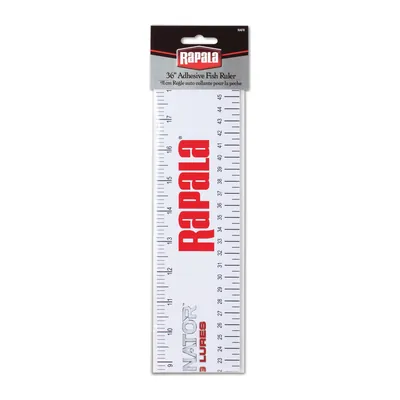
Rapala 36-inch adhesive fish ruler
Adhesive 36-inch ruler marked in inches and centimeters, to stick on a boat or the lid of a cooler so a fish can be measured without handling it for long.
View on Amazon (opens in a new tab)
Worth watching
The Michigan Department of Natural Resources walks through catch and release step by step, with chapters on choosing hooks, netting, handling fish for photos and what stresses a fish: it shows the gestures the text describes.
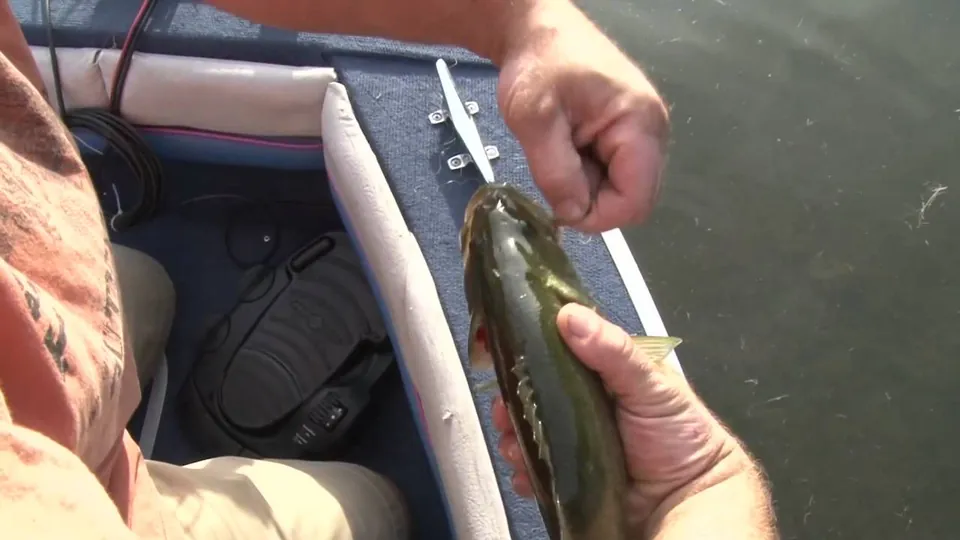
The video is hosted by YouTube (Google): nothing loads until you play it, and Google may then set cookies.
FAQ
Do I have to release every fish I catch?
No. State rules decide: Oregon, for example, says undersized, oversized or unwanted fish must be released immediately and unharmed, and Connecticut makes release compulsory once the daily limit for a species is zero or reached. Fish you may keep can be kept within the limits. In Germany, the DAFV and WWF judge releasing everything with no intention of eating any to be unacceptable.
Does a released fish really survive?
Most of the time, but not always: across 274 estimates in one review, median mortality was 11% (mean 18%, range 0 to 95%). It rises with natural bait, a swallowed hook, depth, warm water, and long fights or handling. It falls when you unhook quickly, in the water, with wet hands.
How long can a fish stay out of the water?
As briefly as possible. NOAA calls under 60 seconds in the air ideal, and the Breton fishing federations recommend no more than 15 seconds for the allis shad. These benchmarks vary by species: warm water, a long fight or a fragile species call for moving faster, and the best course is to unhook without lifting the fish out at all.
Is a barbless hook required?
Not everywhere, but some waters require it: four stretches of the North Platte River in Wyoming for 2026, for example, and the “no kill” stretches in the French département of Ariège. NOAA says circle hooks are required in some fisheries. In the 2005 review, barbs raised mortality only marginally; removing the barb mainly lets you unhook faster.
Should I keep a badly injured fish instead of releasing it?
NASCO’s salmon guidelines advise keeping a seriously injured fish (heavy bleeding, hook in the gills or eyes) and releasing only fish in good condition, unless a national or local rule forbids it. Check your state’s rule for undersized fish first: Oregon, for instance, requires unwanted fish to be released unharmed.
What if lots of undersized fish keep biting?
WWF Germany advises moving to another spot when many undersized or protected fish bite, to protect the stock. Return each one immediately, as state rules such as Oregon’s require, and keep pliers, a measure and line cutters within reach so you can act fast.
Sources
- Bartholomew, A. and Bohnsack, J. A., “A Review of Catch-and-Release Angling Mortality with Implications for No-take Reserves”, Reviews in Fish Biology and Fisheries, vol. 15, 2005, pp. 129-154, abstract, read on November 20, 2026. link.springer.com https://link.springer.com/article/10.1007/s11160-005-2175-1 ↩
- WWF Germany, leaflet “Fische angeln und wieder zurücksetzen” (in German, May 2024, with scientific review by R. Arlinghaus), read on November 20, 2026. wwf.de https://wwf.de/fileadmin/fm-wwf/Publikationen-PDF/Deutschland/WWF-Fische-angeln-und-wieder-zuruecksetzen.pdf ↩
- North Atlantic Salmon Conservation Organization (NASCO), Guidelines for the Catch and Release of Wild Atlantic Salmon (French-language version, which we read), read on November 20, 2026. nasco.int https://nasco.int/wp-content/uploads/2020/06/CR_guidelines_french.pdf ↩
- NOAA Fisheries, “Catch and Release Fishing Best Practices”, read on November 20, 2026. fisheries.noaa.gov https://www.fisheries.noaa.gov/national/resources-fishing/catch-and-release-fishing-best-practices ↩
- Bretagne Grands Migrateurs (Brittany migratory fish observatory), “Une année avec la grande alose ! Épisode 3 : attention, espèce fragile !” (in French), read on November 20, 2026. observatoire-poissons-migrateurs-bretagne.fr https://www.observatoire-poissons-migrateurs-bretagne.fr/actus/1445-une-annee-avec-la-grande-alose-episode-3-attention-espece-fragile ↩
- France, Code de l’environnement, article R. 436-18 (minimum sizes of fish, frogs and crayfish), in force since April 26, 2019 (in French), read on November 20, 2026. legifrance.gouv.fr https://www.legifrance.gouv.fr/codes/article_lc/LEGIARTI000038416171 ↩
- Oregon Department of Fish and Wildlife, “General Statewide Regulations” (eRegulations), read on November 20, 2026. eregulations.com https://www.eregulations.com/oregon/fishing/general-statewide-regulations ↩
- Connecticut Department of Energy and Environmental Protection, “Freshwater Fishing Guide: Definitions”, read on November 20, 2026. portal.ct.gov https://portal.ct.gov/deep/fishing/freshwater-fishing-guide/definitions ↩
- Wyoming Game and Fish Department, “Fishing regulation changes taking effect for 2026”, read on November 20, 2026. wgfd.wyo.gov https://wgfd.wyo.gov/es/node/13641 ↩
- Environment Agency, “National rod fishing byelaws for England: freshwater fishing with a rod and line”, published June 7, 2019, updated December 12, 2023, read on November 20, 2026. gov.uk https://www.gov.uk/government/publications/environment-agency-rod-fishing-byelaws-full-national-byelaws-for-england ↩
- Scottish Government, “Conservation of wild salmon”, read on November 20, 2026. gov.scot https://www.gov.scot/policies/salmon-and-recreational-fisheries/conservation/ ↩
- Environment Agency and Hull International Fisheries Institute, “Impact of catch and release angling practices on survival of salmon”, summary, August 2017, read on November 20, 2026. assets.publishing.service.gov.uk https://assets.publishing.service.gov.uk/media/5a82d94eed915d74e6237f03/Impact_of_catch_and_release_angling_practices_on_survival_of_salmon_-_summary.pdf ↩
- France, Code de l’environnement, article R. 436-19 (minimum sizes changed by the prefect), in force since April 26, 2019 (in French), read on November 20, 2026. legifrance.gouv.fr https://www.legifrance.gouv.fr/codes/article_lc/LEGIARTI000038416177 ↩
- France, Code de l’environnement, article R. 436-8 (fishing for a species banned by the prefect or the minister), in force since April 10, 2016 (in French), read on November 20, 2026. legifrance.gouv.fr https://www.legifrance.gouv.fr/codes/article_lc/LEGIARTI000032384517 ↩
- Préfecture de l’Ariège, order of February 21, 2024 creating “no kill” stretches (a local example, in French), read on November 20, 2026. ariege.gouv.fr https://www.ariege.gouv.fr/index.php/contenu/telechargement/29390/199638/file/Arrêté_pêche_parcoursnokill2024_mentionsigne.pdf ↩
- Deutscher Angelfischerverband (DAFV), Arbeitskreis Angeln, publication no. 6 “Catch and Release” (in German, November 29, 2025), read on November 20, 2026. dafv.de https://www.dafv.de/images/dafv/Angeln_und_Fischen/AKA-Veroeffentlichungen/Ver%C3%B6ffentlichung_Nr._6_AKA_-_Catch_and_Release.pdf ↩
- Germany, Animal Welfare Act (Tierschutzgesetz), sections 1, 4 and 17 (in German), read on November 20, 2026. gesetze-im-internet.de https://www.gesetze-im-internet.de/tierschg/__17.html ↩

Fact-checking, regulations, and safety
Arnaud Couderc reviews our contributors’ articles and writes for Outfarer about regulations, safety, fishing, the ocean, and outdoor activities. He traces every rule back to its official text and every number to its source, so you head out with solid benchmarks.


