 Français (France)
 English (UK)
 English (US)
 Deutsch (Deutschland)

Contents
Here’s a trail where summer 2027 goes on sale before Thanksgiving 2026. By mid-November, next season’s hut nights on the Laugavegur could be booked, while the campgrounds couldn’t yet [1]. The trail itself is anything but a rush: six stops, colorful rhyolite mountains at the start, the black sands of Mælifellssandur on day three, birch woods on the way into Þórsmörk [2]. But beds are limited, and Ferðafélag Íslands (FÍ), the Iceland Touring Association that runs the huts, warns that they often sell out quickly in peak season [2].
This guide covers what you need for 2027: the stages, booking, camping, the season, the river crossings, the buses, and the budget, plus the passport and insurance points for a trip from the US. For Iceland’s general rules on camping, see our guide to what Iceland’s law allows for hiking and camping.
The Laugavegur at a glance
| Laugavegur | |
|---|---|
| Start and finish | Landmannalaugar, then Þórsmörk |
| Distance | 54 km (page banner) or 55 km (text and FAQ), about 34 miles |
| Usual length | 4 days of hiking; 5 nights for most hikers |
| Booking direction | North to south only |
| Sleeping | FÍ huts or designated campgrounds, booked before you set out |
| Season | On average June 25 to September 15 |
Even FÍ’s own figures vary from page to page: 54 km on the trail page’s banner, 55 km in its text [2]. Most hikers spend five nights on the trail, says FÍ’s FAQ [3], and its five-night hut package shows why: a first night in Landmannalaugar, then one at each stop down to Þórsmörk, for four days of hiking [1]. FÍ only books its huts in one direction, from Landmannalaugar to Þórsmörk [3]. The trail is well marked and busy enough that getting lost is unlikely, except in bad weather and fog, when, in FÍ’s words, everything changes [2].
The four stages, from Landmannalaugar to Þórsmörk
| Stage | Distance | Hiking time | Elevation |
|---|---|---|---|
| Landmannalaugar to Hrafntinnusker | 7.5 mi (12 km) | 4 to 5 hr | 1,540 ft (470 m) of gain |
| Hrafntinnusker to Álftavatn | 7.5 mi (12 km) | 4 to 5 hr | 1,610 ft (490 m) of loss |
| Álftavatn to Emstrur | 9.9 mi (16 km) | 6 to 7 hr | 130 ft (40 m) of loss |
| Emstrur to Þórsmörk | 9.3 mi (15 km) | 6 to 7 hr | 980 ft (300 m) of loss |
FÍ doesn’t give every figure: only the main direction of each stage is shown. Miles and feet: our conversion. [2]
Other splits exist. FÍ suggests a variant via Hvanngil, a three-day version with a first day of 15 miles (24 km) to Álftavatn, and even two days of 17 miles (28 km) each for fast hikers [2]. In its four-day program, FÍ counts 17 km from Álftavatn to Emstrur, against 16 km in the stage description: the trail’s manager doesn’t always agree with itself to the kilometer [2].
Day one has the most climbing, with patches of snow as you approach Hrafntinnusker. Day two is the snowy one: on the slopes of Reykjafjöll, FÍ describes numerous snow-filled ravines and thin snow bridges to cross with care [2]. Hrafntinnusker is the only stop without showers, and it has a latrine instead of flush toilets [3].
Booking the huts for 2027
If you’re used to first-come, first-served shelters on US trails, forget the idea here: the huts are staffed by wardens, you book a bunk ahead, and you pay by the night. The six FÍ stops sleep 52 to 78 people each: 78 at Landmannalaugar, 52 at Hrafntinnusker, 72 in the two huts at Álftavatn, 60 at Hvanngil, 60 in the three huts at Emstrur, and 73 at Þórsmörk [2]. FÍ expects hikers to have a confirmed booking, for a hut or a campground, before they start [2].
As of November 14, 2026, FÍ’s booking site was already selling the 2027 huts, by the night at some stops and as packages of three to five nights; Hrafntinnusker, Emstrur, and Þórsmörk were only sold as part of a package, and camping for 2027 wasn’t open for booking yet [1]. FÍ hasn’t published an opening date for it, so the safest plan is to book the huts as soon as your dates are set.
| Item | 2026 | 2027 | 2027, FÍ member |
|---|---|---|---|
| Night in a hut | 17,000 ISK | 18,000 ISK | 9,000 ISK |
| Night in a tent | 3,400 ISK | 3,600 ISK | 1,800 ISK |
| Shower | 1,100 ISK | 1,100 ISK | 800 ISK |
| 5-night hut package | 90,000 ISK |
Tourist tax included, meals not included. The 2027 price list applies from May 1, 2027 to April 30, 2028. [4, 5, 1]
FÍ members pay half price, and the discount also covers a spouse and children under 18 traveling with them; the 2026 membership fee was 9,900 ISK [4, 6]. Children under 18 traveling with a parent or guardian pay half price, and kids 6 and under sleep free [4].
Inside, you sleep in bunks, and FÍ warns that you can expect to share one with another hiker; there’s no electricity in any hut along the way, but power banks are for sale [3]. Bring your own sleeping bag, since neither sleeping bags nor blankets are provided; the huts are slightly heated, so it doesn’t need to be an arctic bag [7], but FÍ adds that the gas heaters are turned off at night for safety [3]. Tap water is safe to drink in every hut [3]. Good news for 2027: at Þórsmörk, a new Skagfjörðsskáli replaces the hut that has stood there since 1954, with indoor toilets, and FÍ aims to open it on June 17, 2027, in its centennial year [8].
Camping: only next to the huts
The Laugavegur isn’t a dispersed camping trail. FÍ only allows overnight stays in huts and on the designated campgrounds at each stop [9]; Iceland’s Environment Agency says the same for the Fjallabak Nature Reserve, where the trail starts, and camping anywhere else there requires a ranger’s permission [10]. Campers can’t use the hut kitchens, but they do have access to the bathrooms and drinking water, and FÍ asks them to talk to the warden before pitching a tent [9]. At Hrafntinnusker, you pitch on snow or on sand and gravel [2].
When to go: a short window
Access to the trail varies from year to year with the weather, the snow, and the date when the Icelandic Road Administration opens the mountain roads to the huts [2]. On average, FÍ figures the trail is open from June 25 to September 15, and calls July and August the most popular and reliable period [2, 3]. In 2026, FÍ announced on July 2 that the trail was open, with a good deal of snow still on the path, mainly between Landmannalaugar and Álftavatn [11].
| Road | 2023 | 2024 | 2025 |
|---|---|---|---|
| F208, Sigalda to Landmannalaugar | June 1 | June 12 | May 23 |
| F210, Keldur to Hvanngil | June 23 | July 4 | July 14 |
| F261, Emstruleið | June 23 | June 26 | July 14 |
From Vegagerðin, the Icelandic Road Administration. [12]
The Icelandic summer stays cool: from June to August, daytime temperatures typically range from 41°F to 57°F (5°C to 14°C), and nights from 32°F to 50°F (0°C to 10°C); FÍ adds that any wind above 10 to 12 meters per second makes hiking hard [2]. Before June 20 and after September 15, the huts may have no running water, and you then have to bring your own [5].
River crossings, and staying safe in the Icelandic highlands
Some rivers have footbridges, but at least three have to be waded; they’re generally not difficult, FÍ says, but they can rise quickly if it rains a lot [2]. FÍ describes the Bláfjallakvísl, shortly after Hvanngil on the way to Emstrur, and the Þröngá, just before Þórsmörk, as challenging or tricky, especially after rain; in early summer, the Grashagakvísl can sometimes be crossed on snow bridges, though it’s usually waded [2]. For the crossings, FÍ suggests light sneakers that dry quickly, or sandals [2].
In an emergency, call 112, not 911, or 00 354 570 2112 from a satellite phone [13]. ICE-SAR asks you to leave a travel plan on Safetravel, with your return date, your overnight stops, and an emergency contact who isn’t on the trip [14]. Cell service is patchy on the trail, and you may have to climb the nearest hilltop to find a signal [2]. For the highlands, Safetravel also suggests renting a personal locator beacon or a Garmin inReach [13], and our guide to calling for help without cell service explains the options.
Before you book your flight, a word on paperwork. Iceland is one of the 29 European countries using the EU’s Entry/Exit System, fully operational since April 10, 2026: as a non-EU traveler on a short stay, up to 90 days in any 180-day period, you’ll have your passport data, fingerprints, and a facial image recorded at the border [15]. ETIAS, the travel authorization announced for visa-exempt visitors, isn’t running yet: no applications are being collected, the fee has been set at €20, and the EU says it will announce the start date several months ahead [16].
Getting to Landmannalaugar, and back from Þórsmörk
The two ends of the trail are only served by highland buses or 4x4s, and Trex has no bus running directly between Þórsmörk and Landmannalaugar [18]. Both bus companies have already published their 2027 timetables. With a 7 a.m. departure from Reykjavík, the simplest plan after a transatlantic flight is at least one night in the capital before the bus.
| Operator | Route | 2027 season | Times |
|---|---|---|---|
| Highland Bus (Icelandia) | Reykjavík (BSÍ) to Landmannalaugar | June 18 to September 12 | Leaves 7 a.m., arrives 11:30 a.m. |
| Highland Bus (Icelandia) | Þórsmörk to Reykjavík (BSÍ) | June 11 to September 15 | Leaves Langidalur 3:15 p.m., arrives 7:30 p.m. |
| Trex | Reykjavík to Landmannalaugar | June 18 to September 3 | First bus on June 18 |
| Trex | Reykjavík to Þórsmörk and back | June 20 to September 5 | First bus on June 20 |
2027 timetables published by the operators in October and November 2026. [19, 18]
Trex sells a Hikers Bus Pass, to the start and back from the finish, for 29,900 ISK per person [20]. Icelandia cancels a trip if nobody has booked 24 hours before departure, and points out that road and weather conditions decide when the highland roads open [19]. To drive to Landmannalaugar, you need a 4x4 that your rental company allows on F-roads, Iceland’s mountain roads; for Þórsmörk, FÍ recommends the bus, because the river crossings call for an experienced driver [2, 21].
Going on over Fimmvörðuháls: check before 2027
You can extend the hike from Þórsmörk to Skógar over the Fimmvörðuháls pass: 16 miles (25 km) and 8 to 12 hours according to FÍ, best from early July to early September [21]. On August 25, 2026, FÍ, the Útivist association, and the local rescue team, Dagrenning, strongly advised against setting out across Fimmvörðuháls: the retreating glacier is opening new ravines and crevasses [22]. On September 2, 2026, FÍ described a marked detour, the blue route, which follows the road between the Baldvinsskáli hut and the bridge over the Skógá [23]. For 2027, check the state of the route just before you go.
What the Laugavegur costs in 2027
The math, without food: the five-night hut package at 90,000 ISK plus Trex’s bus pass at 29,900 ISK comes to 119,900 ISK; with the three-night package, at 54,000 ISK, the total drops to 83,900 ISK, our calculation. In a tent, four nights at 3,600 ISK and the same bus come to 44,300 ISK, with the tent on your back [1, 4, 20]. Every hut sells some food; they take cards and Icelandic cash, but when the connection drops, cards stop working, so carry some cash [3]. Prices stay in krónur here, as published: check the exchange rate when you budget. For the weight of four days of food, see our guide to backpack weight on multi-day hikes.
For a guidebook in English, Cicerone’s “Walking and Trekking in Iceland,” by Paddy Dillon, published on October 22, 2026, includes the Laugavegur among its 10 multi-day treks [24].
And then comes the moment when the valley of Þórsmörk opens up below you, green and sheltered, after three days of mineral colors. Book that first night; the rest will follow.
Gallery: the Laugavegur in six landscapes
Six real photos of the trail and its stops, from north to south, from Hrafntinnusker to the Markarfljót canyon, published under free licenses on Wikimedia Commons by their photographers, who are credited under each image. Tap or click a photo to enlarge it.
Worth watching
A thru-hiker’s film of the Laugavegur from Landmannalaugar to Þórsmörk, chaptered by hut: Álftavatn, Emstrur and the final descent into the green valley.
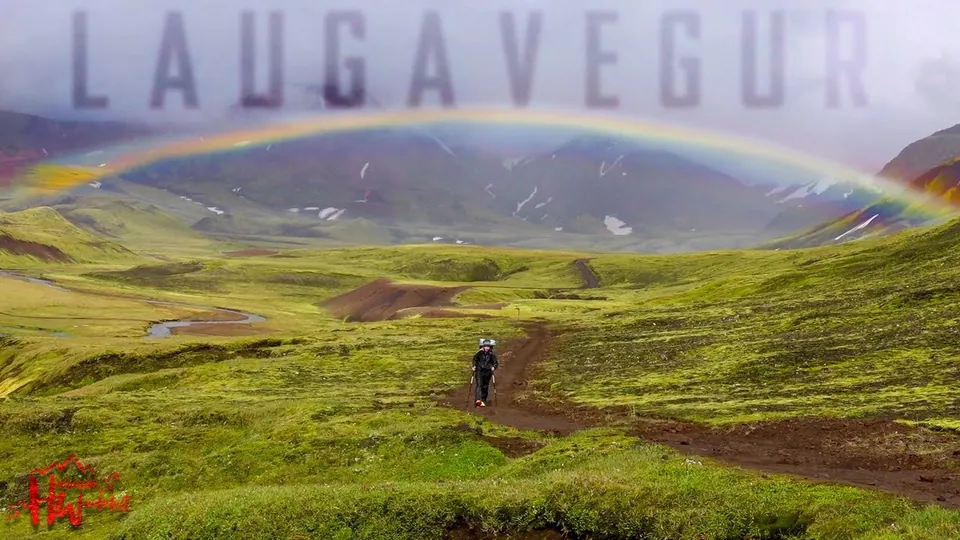
The video is hosted by YouTube (Google): nothing loads until you play it, and Google may then set cookies.
FAQ
When should I book the Laugavegur huts for 2027?
As early as you can. As of November 14, 2026, the Ferðafélag Íslands booking site was already selling the 2027 huts, by the night or as packages of three to five nights, but not yet the campgrounds. FÍ hasn’t published a date for camping, and it warns that the huts often sell out quickly in peak season.
How many days does the Laugavegur take?
Usually four days from Landmannalaugar to Þórsmörk, which FÍ puts at 54 to 56 km, about 34 to 35 miles, depending on the page. Most hikers spend five nights on the trail, the first in Landmannalaugar. FÍ also suggests a three-day version, with a first day of 15 miles (24 km), and two days of 17 miles (28 km) for fast hikers.
Can I camp anywhere along the Laugavegur?
No. FÍ only allows overnight stays in huts or on the designated campgrounds next to them, and Iceland’s Environment Agency sets the same rule in the Fjallabak Nature Reserve. In 2027, a night in a tent costs 3,600 ISK per person, or 1,800 ISK for an FÍ member; campers can use the bathrooms and the drinking water.
Are the river crossings on the Laugavegur dangerous?
At least three rivers have to be waded. FÍ says they’re generally not difficult but rise quickly after heavy rain, and singles out the Bláfjallakvísl and the Þröngá. ICE-SAR advises crossing in the morning, backpack straps loosened, with two or three other people and arms linked, and only if you’re sure of reaching the other bank.
How do I get to Landmannalaugar without a car?
By highland bus from Reykjavík. In 2027, Highland Bus leaves the BSÍ bus terminal at 7 a.m. and arrives at 11:30 a.m., from June 18 to September 12, and Trex runs from June 18 to September 3. Trex sells a hikers’ pass, there and back, for 29,900 ISK. Trex has no direct bus between Þórsmörk and Landmannalaugar.
Sources
- Ferðafélag Íslands (FÍ), booking site, 2027 season, accessed November 14, 2026. vinna.fi.is https://vinna.fi.is/en/boka/?ar=2027 ↩
- Ferðafélag Íslands (FÍ), “Laugavegur,” trail page, accessed November 14, 2026. fi.is https://www.fi.is/en/hiking-trails/trails/view/laugavegur ↩
- Ferðafélag Íslands (FÍ), “Laugavegur huts FAQ,” accessed November 14, 2026. fi.is https://www.fi.is/en/mountain-huts/faq ↩
- Ferðafélag Íslands (FÍ), “Gistiskilmálar,” 2026 and 2027 price lists with member prices (in Icelandic), accessed November 14, 2026. fi.is https://www.fi.is/is/skalar/gistiskilmalar ↩
- Ferðafélag Íslands (FÍ), “Terms and conditions,” booking terms and 2027 price list, accessed November 14, 2026. fi.is https://www.fi.is/en/mountain-huts/terms-and-conditions ↩
- Ferðafélag Íslands (FÍ), “Skráning í FÍ,” 2026 membership fee (in Icelandic), accessed November 14, 2026. fi.is https://www.fi.is/is/fi/skraning-i-fi ↩
- Ferðafélag Íslands (FÍ), “About the Huts,” accessed November 14, 2026. fi.is https://www.fi.is/en/mountain-huts/hut-rules ↩
- Ferðafélag Íslands (FÍ), “Gamla góða sálin í nýjum Skagfjörðsskála,” October 28, 2026 (in Icelandic), accessed November 14, 2026. fi.is https://www.fi.is/is/fi/frettir/gamla-goda-salin-i-nyjum-skagfjordsskala ↩
- Ferðafélag Íslands (FÍ), “Camping,” accessed November 14, 2026. fi.is https://www.fi.is/en/mountain-huts/camping ↩
- Environment Agency of Iceland (Umhverfisstofnun), “Where can you camp?,” accessed November 14, 2026. ust.is https://ust.is/english/visiting-iceland/travel-information/where-can-you-camp/ ↩
- Ferðafélag Íslands (FÍ), “Laugavegurinn er opinn,” July 2, 2026 (in Icelandic), accessed November 14, 2026. fi.is https://www.fi.is/is/fi/frettir/laugavegurinn-er-opinn-skalaverdir-maettir-i-alla-skala-fi-a-laugaveginum ↩
- Vegagerðin (Icelandic Road Administration), “Opening of mountain roads,” accessed November 14, 2026. vegagerdin.is https://www.vegagerdin.is/en/the-transportation-system/the-road-system/roads/opening-of-mountain-roads ↩
- Safetravel (Landsbjörg, ICE-SAR), “Hiking and trekking,” accessed November 14, 2026. safetravel.is https://safetravel.is/outdoors/hiking-trekking/ ↩
- Safetravel (Landsbjörg, ICE-SAR), “Travel plans,” accessed November 14, 2026. safetravel.is https://safetravel.is/travel-plans/ ↩
- European Union, Travel to Europe, “A Modern, More Efficient Border Management System for Europe,” EES leaflet (PDF), accessed November 14, 2026. travel-europe.europa.eu https://travel-europe.europa.eu/dam/jcr:578477d1-2e2d-4546-80c5-040570ae2bbc/Leaflet-A5_en.pdf ↩
- European Commission, Migration and Home Affairs, “European Travel Information and Authorisation System (ETIAS),” accessed November 14, 2026. home-affairs.ec.europa.eu https://home-affairs.ec.europa.eu/policies/schengen/smart-borders/european-travel-information-authorisation-system_en ↩
- Medicare.gov, “Travel outside the U.S.,” accessed November 14, 2026. medicare.gov https://www.medicare.gov/coverage/travel-outside-the-u.s. ↩
- Trex, “FAQ,” 2027 season, accessed November 14, 2026. trex.is https://trex.is/faq/ ↩
- Icelandia (Reykjavik Excursions), “Highland Bus 2027,” timetable PDF dated October 28, 2026, accessed November 14, 2026. cdn.sanity.io https://cdn.sanity.io/files/lf2d8f6r/production/be31c4dd5dd3f84b29cfd4e6a2f74827850edb90.pdf ↩
- Trex, “Hikers Bus Pass,” accessed November 14, 2026. trex.is https://trex.is/hikers-buss-pass/ ↩
- Ferðafélag Íslands (FÍ), “Þórsmörk and Fimmvörðuháls,” accessed November 14, 2026. fi.is https://www.fi.is/en/hiking-trails/thorsmork-and-fimmvorduhals ↩
- Ferðafélag Íslands (FÍ), Útivist, and Dagrenning, “Viðvörun vegna hættulegra aðstæðna á gönguleiðinni yfir Fimmvörðuháls,” August 25, 2026 (in Icelandic and English), accessed November 14, 2026. fi.is https://www.fi.is/is/fi/frettir/vidvorun-vegna-haettulegra-adstaedna-a-gonguleidinni-yfir-fimmvorduhals ↩
- Ferðafélag Íslands (FÍ), “Leiðin yfir Fimmvörðuháls,” September 2, 2026 (in Icelandic), accessed November 14, 2026. fi.is https://www.fi.is/is/fi/frettir/leidin-yfir-fimmvorduhals ↩
- Cicerone, “Walking and Trekking in Iceland,” Paddy Dillon, published October 22, 2026, ISBN 9781786311856, accessed November 14, 2026. cicerone.co.uk https://www.cicerone.co.uk/products/walking-and-trekking-in-iceland ↩

Trail running, snow, water, nature and destinations
Nolwenn covers trail running, snow, water, nature and destinations for Outfarer. Curious about everything, from meteor showers to night-train schedules, she has a knack for digging up the one detail that changes everything, and nailing it in a single sentence.

 Alex Aubert

 Guillaume Hoarau
