 Français (France)
 English (UK)
 English (US)
 Deutsch (Deutschland)

Contents
Wild camping, Icelandic style, is nearly gone
The reference text is Nature Conservation Act No. 60/2013, which sets out to protect the country’s biological, geological, and landscape diversity while securing a public right to travel through nature [1]. Its Article 22, which lays down the camping rules, was rewritten by Amendment No. 109/2015, effective November 14, 2015 [2]. The rules have tightened as tourism has grown [3].
The rule for anything on wheels is unambiguous. It is, in the words of the Environment Agency, “illegal to spend the night in tent trailers, tent campers, caravans, camper vans or similar outside organised campsites or urban areas unless the land owner or rightholder has given their permission” [4]. A traditional camping tent keeps a narrow tolerance, detailed below.
What a tent is allowed, and on what conditions
The Environment Agency of Iceland (Umhverfisstofnun), the body that applies the Act, details the conditions under which a traditional tent may stand [4]:
- one night only;
- on uncultivated land;
- with no campground in the immediate vicinity;
- where the landowner has posted no sign barring access, passage, or staying the night.

In uninhabited areas, the tolerance covers private land and state land alike, along public routes and away from them, unless special rules apply to that specific area [4].
The agreement of the owner or the rightholder becomes mandatory in five cases [4]:
- near a home or a farm;
- to stay more than one night;
- to pitch more than three tents;
- on cultivated land;
- for any wheeled accommodation, tent trailer, travel trailer, or campervan, away from an organized campground.
The landowner may also forbid camping where nature risks significant damage, or direct campers toward a designated area they have laid out, in which case the area is chargeable. The same applies wherever a campground exists in the vicinity [4].
Campervans and motorhomes: paying is the legal route
For anything with wheels, the lawful options shrink to two: an organized campground, or private land with the owner’s explicit agreement [4]. The network counts roughly 180 registered campgrounds across the island [3].
On price, most sites charge per person, typically between 1,500 and 2,500 ISK a night, about $12 to $20 at late 2026 rates; showers and electricity often come as extras of roughly 500 to 1,000 ISK, and an accommodation tax of 400 ISK per night per camping unit applies on top [3].
| Item | Indicative Amount, Summer 2026 | In Dollars, Roughly |
|---|---|---|
| Night at a campground, per person | 1,500 to 2,500 ISK | $12 to $20 |
| Shower or electricity, extra | 500 to 1,000 ISK | $4 to $8 |
| Accommodation tax, per night and unit | 400 ISK | about $3 |
| Camping Card, full season | $207 (26,000 ISK) | $207 |
The Camping Card costs €179 ($207) for the 2026 season, according to a campervan rental company [5]. It covers up to 28 nights at partner sites (about thirty on the official list [6], more than 40 according to two commercial sites), for two adults and up to four children under 16, and its validity ends in mid-September [3] [5]. One address is capped at four consecutive nights [5], and neither the accommodation tax nor showers and electricity are included [3] [5]. The card covers a single unit, a tent or a van [6]. By the arithmetic published by Guide to Iceland, the card starts paying for itself beyond 7 to 10 paid nights for a couple or a family [3].
The parks and hotspots where the tolerance does not apply
In the national parks and at many heavily visited sites, the regime tightens and the local rule overrides the general tolerance. The Environment Agency publishes the rule for each site [4]. Its pages mention two new agencies being set up, one for environment and energy, one for nature protection: the responsible body may change, so check the page before you go [4].
| Area | Overnight Regime, as Published by the Agency |
|---|---|
| Þingvellir National Park | forbidden outside the marked camping areas |
| Vatnajökull National Park | organized campgrounds mandatory; a traditional tent tolerated one night elsewhere in the park; ten tents or more needs the ranger’s consent; sector bans at Jökulsárgljúfur, in the protected areas of Askja, on the Hoffell and Heinaberg plains, and at Skaftafellsheiði, Bæjarstaðarskógur, and Morsárdalur |
| Snæfellsjökull National Park | hikers and self-sufficient cyclists: one night on designated areas; from three tents, or for more than one night: an Agency permit |
| Hornstrandir Nature Reserve | forbidden outside the marked camping areas |
| Fjallabak | nights only in huts or on designated grounds; beyond that, the ranger’s consent |
| Mývatn, Arnarstapi and Hellnar, Skógafoss, Vatnsfjörður | forbidden outside the marked areas |
| Dyrhólaey, Dimmuborgir, Hverfjall, Kirkjugólf, Álafoss, and several other sites | no overnight stay anywhere |
| Dynjandi | forbidden, except hikers and cyclists admitted for one night |
Walking: a real right of access, with duties attached
Unlike camping, walking remains broadly free. The Act grants everyone the right to travel around the country and enjoy its nature, provided they do so carefully and cause no damage [7]. Crossing uncultivated private property needs no special permission, but the landowner may mark access limits, and state lands stay open except in special cases, for instance bird-nesting periods or times of fragile growth [7].
Three duties structure this right of access, [7]:
- follow marked trails where they exist, and close gates behind you;
- carry your trash out to a settled area;
- leave wildlife undisturbed and keep your dog under control.
Two clarifications matter to the hiker: a landowner may not block walkers passing along rivers, lakes, and the ocean [7]. Picking berries, mushrooms, or seaweed for immediate consumption is allowed on public lands and highland pastures; on private property it requires the owner’s consent, and certain protected wild species may never be taken [7].
Driving: F-roads in season, off-road driving punishable by law
Article 31 of the Act bans motor vehicles off recognized roads and tracks. For the traveler, the exception that matters is ground frozen hard and covered in sufficient snow, where it is clear that no damage can result [7] [8]; the Act allows others, for example for farming, rescue and police work [8]. The Agency puts it bluntly: off-road driving “is strictly prohibited and is punishable by fines or imprisonment” [9]. Ragnheiður Bragadóttir, professor of law at the University of Iceland, in a study of how Iceland protects the environment through criminal law, sets the scale: a fine or up to two years in prison under Article 90(1), and off-road driving is “by far the most common offense” against this Act; by mid-summer 2019 the Agency had already brought fourteen prosecutions [8].
The deterrence makes sense given the fragility of volcanic ground: wheel tracks imprint quickly, channel water, speed up erosion, and can remain visible for decades, the growing season being very short [9].
What remains are the F-roads, the mountain roads of the interior. They generally open from June or July to mid-September, then close to all unmodified vehicles [10]. The official safety portal SafeTravel adds two warnings: not every 4WD suits every F-road, and no insurance covers damage suffered while crossing an unbridged river [10]. Opening status is on umferdin.is, and road conditions on the 1777 information line [9] [10].

Icelandic freedom, in the end, fits in one sentence: you may hike almost anywhere, but sleep almost nowhere outside the grounds laid out for it.
Gear related to this article
No affiliation: no commission, no sponsored products.
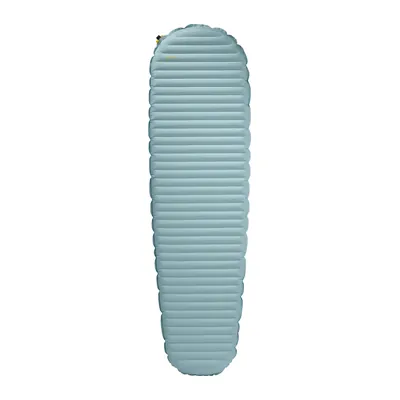
Therm-a-Rest NeoAir XTherm NXT
A 3-inch winter air pad: an R-value of 7.3 under ASTM F3340, above the 6.5 Exped recommends, at 15.5 oz in Regular, 2.5 oz more than the XLite NXT.
View on Amazon (opens in a new tab)
FAQ
Can you pull over and sleep anywhere in a campervan in Iceland?
No. Act No. 60/2013 forbids overnight stays in a campervan, motorhome, travel trailer, or tent trailer outside organized campgrounds and urban areas, unless the landowner has given permission [4]. The one-night tolerance reserved for a traditional tent never extends to vehicles. A roadside pullout is not enough: you need to reach one of the country’s roughly 180 registered campgrounds [3].
Is wild camping with a tent legal in Iceland?
Can you build a campfire in Iceland?
What do you risk for driving off the tracks?
A fine or up to two years in prison: off-road driving is the most common offense against the 2013 Act, and its traces can mark volcanic ground for decades [8] [9]. For the traveler, the exception that matters is ground frozen and covered in enough snow that no damage to nature can follow [7]; the Act allows others, for example for farming or rescue [8].
Do you need a 4WD for the F-roads?
The F-roads, mountain roads of the interior, open only in season, generally from June or July to mid-September [10]. SafeTravel warns that not every 4WD is enough for every track, and that no insurance covers damage suffered during a river crossing [10]. Before setting out, check the day’s opening on umferdin.is and the vehicle your rental contract allows [10].
Is the Camping Card worth it?
Expect $207 for 2026, that is 26,000 ISK, for 28 nights valid at partner campgrounds, with two adults and up to four children under 16 included [3] [6] [5]. With nights charged at 1,500 to 2,500 ISK per person, Guide to Iceland puts the break-even at around 7 to 10 nights for a couple or a family; the accommodation tax, showers, and electricity stay extra [3].
Sources
- United Nations Environment Programme (UNEP), LEAP platform, Nature Conservation Act (No. 60 of 2013), accessed November 3, 2026. leap.unep.org https://leap.unep.org/en/countries/is/national-legislation/nature-conservation-act-no-60-2013 ↩
- Althingi (Icelandic parliament), via AECO, Lög um náttúruvernd nr. 60/2013, consolidated version of April 13, 2021, machine translation into English, accessed November 3, 2026. aeco.no https://www.aeco.no/wp-content/uploads/2021/07/icelandic-conservation-act-nr-60-10-april-2013.pdf ↩
- Guide to Iceland, Camping in Iceland: All You Need to Know, updated October 19, 2026, accessed November 3, 2026. guidetoiceland.is https://guidetoiceland.is/travel-info/camping-in-iceland ↩
- Environment Agency of Iceland (Umhverfisstofnun), Where Can You Camp?, accessed November 3, 2026. ust.is https://ust.is/english/visiting-iceland/travel-information/where-can-you-camp/ ↩
- Camper Rental Iceland, a campervan hire company, Iceland Camping Card: Is It Worth It for Camper Drivers?, published April 14, 2026, accessed November 3, 2026. camperrentaliceland.com https://www.camperrentaliceland.com/blog/camping/camping-card ↩
- Útilegukortið (Camping Card), Camping Card Q&A, accessed November 3, 2026. utilegukortid.is https://utilegukortid.is/camping-card-qa/?lang=en ↩
- Environment Agency of Iceland (Umhverfisstofnun), Access Rights, accessed November 3, 2026. ust.is https://ust.is/english/visiting-iceland/travel-information/access-rights/ ↩
- Ragnheiður Bragadóttir, University of Iceland, Protecting the Environment with Criminal Law: The Case of Iceland, Nordisk Tidsskrift for Kriminalvidenskab, no. 1/2023, accessed November 3, 2026. tidsskrift.dk https://tidsskrift.dk/NTfK/article/download/136734/181244/295689 ↩
- Environment Agency of Iceland (Umhverfisstofnun), Driving in Uninhabited Areas, accessed November 3, 2026. ust.is https://ust.is/english/visiting-iceland/travel-information/driving-in-uninhabited-areas/ ↩
- SafeTravel, Iceland’s official safety portal, Highland driving, accessed November 3, 2026. safetravel.is https://safetravel.is/driving/summer/highland-driving/ ↩
- SafeTravel, Iceland’s official safety portal, Camping in Iceland, accessed November 3, 2026. safetravel.is https://safetravel.is/camping/ ↩
Water, camper vans, backcountry camping and the Nordic countries
From Brittany, Alex spends as much time outdoors as he can, ideally on the water: kayaking, paddleboarding, sailing, fishing. He also loves van life, backcountry camping, and nights under the stars, and he knows the Nordic countries well, speaking two of their languages.

 Arnaud Couderc


 Guillaume Hoarau