 Français (France)
 English (UK)
 English (US)
 Deutsch (Deutschland)

Contents
The path of totality: from the Strait of Gibraltar to the Red Sea
Of the 68 total solar eclipses of the 21st century, only one lasts longer than the one on Monday, August 2, 2027. That day, the Moon will cover the Sun completely for up to 6 min 23 s, according to Fred Espenak’s calculations for NASA [1]. Only the eclipse of July 22, 2009, did better, at 6 min 39 s: we went through his tables decade by decade [2], and the US National Solar Observatory comes up with the same ranking [3].
The Moon’s shadow first touches Earth over the Atlantic, crosses the Strait of Gibraltar, runs along the North African coast, sweeps across Egypt and the Red Sea, grazes Saudi Arabia, Yemen, and the northeastern tip of Somalia, then fades out over the Indian Ocean [4]. In North Africa, it passes over Morocco, Algeria, Tunisia, and Libya [3]. In Europe, The phase when the Moon completely hides the Sun’s bright disk. You can only see it inside a narrow band, the path of totality; everywhere else, the eclipse stays partial. touches only Gibraltar [3], a British Overseas Territory, and the southern tip of Spain: Ceuta, Melilla, almost all of the province of Cádiz, much of the province of Málaga, and the far south of the provinces of Granada and Almería, according to Spain’s National Geographic Institute (IGN) [4].
The path is about 150 miles (240 km) wide over the Strait, and about 160 miles (a little over 250 km) wide in Egypt [5]. It’s in Upper Egypt, under a nearly overhead Sun, that totality lasts longest: 6 min 23 s on the centerline south of Asyut, and 6 min 22 s at the point of greatest eclipse, east of Luxor, where the Sun stands 82° above the horizon [5]. In Luxor itself, Egypt’s National Research Institute of Astronomy and Geophysics (NRIAG) announces more than 6 minutes of totality, starting at 1:02 p.m. local time [6].
Times and durations of totality, place by place
How long totality lasts depends on where you stand in the path: it’s longest on the centerline and shrinks toward the edges, down to a few seconds. Málaga, near the northern edge, gets only 1 min 48 s of totality, while Tarifa gets 4 min 38 s and Ceuta 4 min 48 s, the record for Spain [4]. The detail that changes everything: Almería sits just north of the limit. The IGN gives it a The share of the Sun’s diameter covered by the Moon at maximum eclipse: 0.50 for half the diameter, more than 1 during totality. of 1.00, rounded to two decimal places, but not a single second of totality [4].
| Place | Time zone | Totality begins | Duration | Sun’s altitude |
|---|---|---|---|---|
| Cádiz (Spain) | UTC+2 | 10:45 a.m. | 2 min 54 s | 37° |
| Tarifa (Spain) | UTC+2 | 10:45 a.m. | 4 min 38 s | 38° |
| Málaga (Spain) | UTC+2 | 10:48 a.m. | 1 min 48 s | 39° |
| Ceuta (Spain) | UTC+2 | 10:45 a.m. | 4 min 48 s | 38° |
| Gibraltar | UTC+2 | 10:45 a.m. | about 4 min 25 s | 38° |
| Tangier (Morocco) | UTC+1 | 9:45 a.m. | about 4 min 50 s | 38° |
| Luxor (Egypt) | UTC+3 | 1:02 p.m. | about 6 min 20 s | 82° |
Spain: IGN calculations [4]. Gibraltar, Tangier, and Luxor: our own calculation with NASA’s “Javascript Solar Eclipse Explorer” [8], which matches the IGN’s durations for Cádiz, Tarifa, Málaga, and Ceuta within 2 seconds, and the time announced by NRIAG for Luxor [6]. Mountains and valleys on the Moon’s edge can shift the limits of the path by 0.6 to 2 miles (1 to 3 km) and durations by 1 to 3 seconds [5].
Before and after, the partial phase lasts more than an hour on each side: in Cádiz, the Moon takes its first bite out of the Sun at 9:41 a.m. and leaves it at 11:59 a.m. [4] Following along on a livestream from the East Coast? Totality in Cádiz starts at 4:45 a.m. EDT, and in Luxor at 6:02 a.m. For any other town in Spain, the IGN’s online viewer gives times down to the second.
What you’ll see during totality, and why 99% isn’t enough
If you’ve ever waited up for the northern lights, you know the uncertainty; totality, on the other hand, shows up right on schedule. But it isn’t the nighttime you might picture. With 99% of the Sun covered, it’s still daytime: about 1,000 lux, the light of an overcast day, reports the American Astronomical Society (AAS). Everything flips in the final minute: during totality, the light drops to around 5 lux, like twilight, with a sunset glow all around the horizon [9].
The signs show up well before. Once more than three-quarters of the Sun is covered, the light takes on an odd tint, the temperature drops, the wind may shift, and birds and insects act as if evening were falling [10]. If you like counting backyard birds, watch how they react. Then come Baily’s beads, the last glints of sunlight through the valleys on the Moon’s edge, the diamond ring, and finally the corona, the Sun’s outer atmosphere, glowing around the black disk [10]. In Luxor, Venus will shine about 3° from the Sun [6].
Outside the path: a partial eclipse in Europe, nothing in the US
Outside the path, the eclipse is partial over almost all of Europe, much of Africa, and southwest Asia [4]. In the United States, though, there’s nothing to see, not even a partial eclipse: NASA’s tables and its calculator show no eclipse at all for New York, Boston, Miami, Washington, or any of the 171 US cities on its list [1, 8]. In Europe, the Moon will cover 85% of the Sun in Madrid, about half in Paris at 11:01 a.m. local time, and 42% in London [4, 8].
| City | Begins | Maximum | Ends | Share of the Sun covered |
|---|---|---|---|---|
| Seville | 9:41 a.m. | 10:47 a.m. | 12:00 p.m. | 98% |
| Lisbon (UTC+1) | 8:41 a.m. | 9:45 a.m. | 10:55 a.m. | 93% |
| Madrid | 9:45 a.m. | 10:51 a.m. | 12:03 p.m. | 85% |
| Barcelona | 9:51 a.m. | 10:58 a.m. | 12:11 p.m. | 82% |
| Rome | 10:02 a.m. | 11:13 a.m. | 12:27 p.m. | 75% |
| Paris | 10:01 a.m. | 11:01 a.m. | 12:05 p.m. | 51% |
| London (UTC+1) | 9:03 a.m. | 10:00 a.m. | 10:59 a.m. | 42% |
| Berlin | 10:17 a.m. | 11:14 a.m. | 12:12 p.m. | 34% |
Central European Summer Time (UTC+2), except Lisbon and London (UTC+1). Madrid: IGN [4]. Other cities: our own calculation with NASA’s program [8], which matches the IGN’s times for Madrid, Seville, and Barcelona within 2 seconds.
A partial eclipse, even at 75%, doesn’t bring nightfall: until three-quarters of the Sun is covered, your pupils compensate so well that you barely notice the light fading [10]. And from the first minute to the last, the Sun should only be viewed through proper eclipse glasses [11].
Protecting your eyes: ISO 12312-2 glasses and nothing else
An eclipse doesn’t make the Sun any less dangerous, just more tempting to look at. And your retina gives no warning: a burn doesn’t hurt, as the European Space Agency (ESA) and the IGN point out [12, 13]. The damage can be permanent, stresses Germany’s Federal Office for Radiation Protection (BfS) [14], and symptoms such as blurred vision or a blind spot in the center of your vision sometimes show up only hours or days later, warns the Spanish government’s official website [7].
When can you take your glasses off? Only inside the path, during totality, once no part of the Sun shows through them [15]. At the first flash of returning sunlight, the diamond ring, they go right back on [7]. Outside the path, that moment never comes: from first contact to last, the glasses stay on [11].
The rest of the time, the rules are the same everywhere, as laid out by NASA, the AAS, ESA, and the BfS:
- Eclipse glasses that meet the ISO 12312-2 standard, with “EN ISO 12312-2:2015” on the frame, packaging, or instructions, plus the CE mark if they’re sold in the European Union [7, 14]. A reference to “ISO 12312-1” means ordinary sunglasses [7].
- Never sunglasses, however dark, and no homemade filters: smoked glass, X-ray film, CDs, aluminum foil, photographic film [11, 12, 13]. A real solar filter cuts visible light by a factor of at least 30,000 [13].
- Undamaged glasses: if they’re scratched, punctured, torn, or coming loose from the frame, throw them out [11].
- No optics without their own filter: looking at the Sun through binoculars, a telescope, or a camera viewfinder without a solar filter mounted on the front instantly causes severe eye injury, and eclipse glasses offer no protection behind optics [15].
- Kids supervised, and your regular eyeglasses kept on under the eclipse glasses [11].
How can you tell if a pair is safe? You can’t, says the AAS; you can only spot the ones that aren’t: worn indoors, they should let nothing through except a very bright lamp, and even that very faint [16]. So buy from a reputable manufacturer or dealer; the AAS keeps a vetted list [16]. Good news if you kept your glasses from the April 2024 eclipse or the one in August 2026: according to the AAS, compliant glasses less than 10 years old and in perfect condition can be reused [11]. Just check the expiration date some manufacturers print [7].
No glasses? Projection is the only safe workaround
No glasses? Don’t look at the Sun, look at the ground. With your back to the Sun, a small hole in a piece of cardboard, the holes in a colander, or the gaps between the leaves of a tree cast dozens of tiny crescent Suns on the ground or a wall [11, 15]. The BfS considers projection the safest method of all [14]. Just one rule: never look at the Sun through the hole [11].
Weather on August 2: what the statistics say
Nobody can forecast the sky for August 2, 2027, yet: the IGN points to forecasts from AEMET, Spain’s national weather service, a few days ahead [19]. The statistics, though, are out there, and they look good. According to Jay Anderson, who specializes in eclipse weather and runs the Eclipsophile website, the cloud cover expected along this track is among the lowest he has analyzed in 45 years [20].
In Spain, the main risk comes off the ocean: in the morning, low clouds and sea fog can hang around on the Atlantic coast. On satellite images taken as close as possible to the time of totality, from July 12 to August 18 in 2024 and 2025, Jay Anderson saw the Sun on 88% of days in Cádiz, compared with an average of 74% for three sites farther south, including Atlanterra and Tarifa. His advice: head a little inland, where average cloud cover drops below 15%, while the Mediterranean coast around Marbella usually escapes the Atlantic clouds [20]. The IGN, working from average August cloud cover from 2001 to 2017, also describes a mostly clear area, only slightly cloudier in the west of the province of Cádiz, where humid Atlantic air moves in [19].
| Site | Published statistic | Data |
|---|---|---|
| Cádiz | Sun visible on 88% of days | satellite images, July 12 to August 18, 2024 and 2025 |
| Three sites farther south, including Atlanterra and Tarifa | 74% on average | same images |
| Gibraltar | 74%, a figure he calls too pessimistic for anyone who can move | same images |
| Inland Spain | average cloud cover below 15% | satellites, August averages |
| Melilla | 61% of possible sunshine | sunshine measurements |
| Libya and western Egypt | no clouds on August 2 for 23 years, along parts of the track | records from the past 23 years |
Source: Jay Anderson, Eclipsophile, page updated August 2025 [20]. Statistics, not a forecast.
Farther east, Egypt is close to a sure thing: in Luxor, the main threat is thin cirrus clouds. The heat, on the other hand, is a given: in Luxor, the high on August 2 has averaged 108 °F (42 °C) over the past 17 years, with a record of 115 °F (46 °C) [20]. In southern Spain too, an August morning in full sun takes some planning: shade, water, a hat [17].
Staying home means waiting for August 23, 2044, over Montana and North Dakota, or August 12, 2045, across the southern US [21]. Otherwise, all that’s left is to choose: the Strait and its 4-plus minutes, the hills behind Cádiz, away from the sea fog, or Luxor, its temples, and its 6 minutes under a nearly overhead Sun. Whichever you pick, tuck a pair of compliant glasses into your backpack, keep an eye on the last forecasts, and let yourself be swept up by that rare moment when, on a summer morning, the day holds its breath.
Gear related to this article
No affiliation: no commission, no sponsored products.
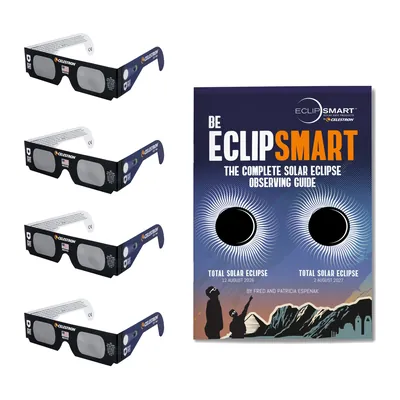
Celestron EclipSmart observing kit
Four pairs of eclipse glasses that meet ISO 12312-2:2015, plus an observing booklet. Use them only if undamaged, and never behind binoculars or a telescope.
View on Amazon (opens in a new tab)
Worth watching
NASA’s Goddard Space Flight Center shows, step by step, how to turn a cereal box into a pinhole projector, so you can watch the partial phases on a screen without ever looking at the Sun.

The video is hosted by YouTube (Google): nothing loads until you play it, and Google may then set cookies.
FAQ
Will the 2027 eclipse be visible from the US?
No, not even as a partial eclipse. NASA’s tables limit visibility to Africa, Europe, the Middle East, and western and southern Asia, and its calculator shows no eclipse for New York, Boston, Miami, or Washington. To see it, you’ll need to travel: totality crosses the southern tip of Spain, Gibraltar, and North Africa. The next total eclipses visible from the US come in 2044 and 2045.
Where will totality last longest?
In Upper Egypt: up to 6 min 23 s on the centerline, according to NASA, and a little over 6 minutes in Luxor, starting at 1:02 p.m. local time. In Europe, the record goes to Ceuta, with 4 min 48 s, ahead of Tarifa at 4 min 38 s; Gibraltar gets about 4 min 25 s. Cádiz will have 2 min 54 s of totality and Málaga 1 min 48 s, according to Spain’s National Geographic Institute.
What time is the eclipse in Spain?
Inside the path, totality starts around 10:45 a.m. local time in Cádiz, Tarifa, and Ceuta, and at 10:48 a.m. in Málaga, which is 4:45 and 4:48 a.m. EDT. The partial phase lasts more than an hour on each side: in Cádiz, from 9:41 to 11:59 a.m. In Madrid, where the eclipse is partial, maximum comes at 10:51 a.m., with 85% of the Sun covered, according to the IGN.
Can you watch the eclipse with sunglasses?
No. Even very dark sunglasses let through far too much light, NASA and the American Astronomical Society warn. Only eclipse glasses that meet the ISO 12312-2 standard, and are undamaged, protect your eyes; in the European Union, they also carry the CE mark. Without them, watch the eclipse by projection, with your back to the Sun, through a colander or a piece of cardboard with a hole in it.
Can you reuse eclipse glasses from 2024 or 2026?
Yes, if they’re in perfect condition and meet the ISO 12312-2 standard: according to the American Astronomical Society, glasses less than 10 years old, tested by an accredited lab, can be reused. Toss them at the first scratch, tear, or hole, and check the expiration date some manufacturers print, as the Spanish government’s official website advises.
When can you take your glasses off during the eclipse?
Only during totality, inside the path, once no part of the Sun shows through the glasses, NASA explains. Put them back on at the first flash of returning sunlight. Outside the path, in Paris or in Madrid, that moment never comes: the glasses stay on from the start of the eclipse to the end.
Sources
- Fred Espenak, NASA Goddard Space Flight Center, Solar Eclipses: 2021 - 2030, decade table, accessed October 23, 2026. eclipse.gsfc.nasa.gov https://eclipse.gsfc.nasa.gov/SEdecade/SEdecade2021.html ↩
- Fred Espenak, NASA Goddard Space Flight Center, Solar Eclipses: 2001 - 2010, accessed October 23, 2026; our own count across the ten decade tables from 2001 to 2100. eclipse.gsfc.nasa.gov https://eclipse.gsfc.nasa.gov/SEdecade/SEdecade2001.html ↩
- National Solar Observatory (NSF), August 2, 2027 Solar Eclipse Map, accessed October 23, 2026. nso.edu https://nso.edu/eclipse-map-2027-aug2/ ↩
- Instituto Geográfico Nacional, El eclipse total del 2 de agosto de 2027 (in Spanish), based on calculations by the Observatorio Astronómico Nacional, accessed October 23, 2026. eclipses.ign.es https://eclipses.ign.es/eclipse-total-sol-de-2-de-agosto-2027.html ↩
- Fred Espenak, NASA Goddard Space Flight Center, Path of the Total Solar Eclipse of 2027 Aug 02, accessed October 23, 2026. eclipse.gsfc.nasa.gov https://eclipse.gsfc.nasa.gov/SEpath/SEpath2001/SE2027Aug02Tpath.html ↩
- National Research Institute of Astronomy and Geophysics (NRIAG), Helwan Observatory, Total Solar Eclipse 2027 in Luxor, Egypt, accessed October 23, 2026. nriag.sci.eg https://www.nriag.sci.eg/luxoreclipse/ ↩
- Spanish Ministry of Science, Innovation and Universities, Trío de Eclipses official website, How to protect your eyes during an eclipse, 2026, accessed October 23, 2026. trioeclipses.es https://trioeclipses.es/en/salud ↩
- Chris O’Byrne and Fred Espenak, NASA Goddard Space Flight Center, Javascript Solar Eclipse Explorer, our calculations of October 23, 2026, for each place mentioned. eclipse.gsfc.nasa.gov https://eclipse.gsfc.nasa.gov/JSEX/JSEX-index.html ↩
- Rick Fienberg, American Astronomical Society, How Dark Does It Get During a Total Solar Eclipse?, accessed October 23, 2026. eclipse.aas.org https://eclipse.aas.org/eclipse-basics/totality-darkness ↩
- American Astronomical Society, Phenomena You’ll Experience at a Total or Annular Eclipse, accessed October 23, 2026. eclipse.aas.org https://eclipse.aas.org/eclipse-basics/eclipse-phenomena ↩
- American Astronomical Society, How to View a Solar Eclipse Safely, accessed October 23, 2026. eclipse.aas.org https://eclipse.aas.org/eye-safety ↩
- European Space Agency, CESAR, How to observe a solar eclipse safely?, accessed October 23, 2026. cosmos.esa.int https://www.cosmos.esa.int/web/cesar/safe-observation ↩
- Instituto Geográfico Nacional, Cómo observar los eclipses: Protege tus ojos (in Spanish), accessed October 23, 2026. eclipses.ign.es https://eclipses.ign.es/como-observar-eclipses.html ↩
- Bundesamt für Strahlenschutz (BfS), Tipp zur Sonnenfinsternis (in German), as of August 11, 2026. bfs.de https://www.bfs.de/DE/themen/opt/uv/schutz/sonnenfinsternis/sonnenfinsternis_node.html ↩
- NASA Science, Eclipse Viewing Safety, updated March 20, 2026. science.nasa.gov https://science.nasa.gov/eclipses/safety/ ↩
- American Astronomical Society, How Can You Tell If Your Eclipse Glasses or Handheld Solar Viewers Are Safe?, accessed October 23, 2026. eclipse.aas.org https://eclipse.aas.org/eye-safety/how-to-tell-if-viewers-are-safe ↩
- Trío de Eclipses official website, Otros riesgos sanitarios (English version), 2026, accessed October 23, 2026. trioeclipses.es https://trioeclipses.es/en/otros-riesgos-sanitarios ↩
- Trío de Eclipses official website, Prevención y Riesgos (English version), guidance published for the eclipse of August 12, 2026, accessed October 23, 2026. trioeclipses.es https://trioeclipses.es/en/prevention-and-civil-protection ↩
- Instituto Geográfico Nacional, Información meteorológica (in Spanish), accessed October 23, 2026. eclipses.ign.es https://eclipses.ign.es/informacion-meteorologica.html ↩
- Jay Anderson, Eclipsophile, Total Solar Eclipse 2027 August 2, updated August 2025. eclipsophile.com https://eclipsophile.com/tse2027/ ↩
- Fred Espenak, NASA Goddard Space Flight Center, Solar Eclipses: 2041 - 2050, decade table, accessed October 23, 2026. eclipse.gsfc.nasa.gov https://eclipse.gsfc.nasa.gov/SEdecade/SEdecade2041.html ↩

Trail running, snow, water, nature and destinations
Nolwenn covers trail running, snow, water, nature and destinations for Outfarer. Curious about everything, from meteor showers to night-train schedules, she has a knack for digging up the one detail that changes everything, and nailing it in a single sentence.


