 Français (France)
 English (UK)
 English (US)
 Deutsch (Deutschland)

Contents
When to start feeding birds, and when to stop
In Wisconsin, black-capped chickadees had feeders for 25 winters straight before researchers took them away. In the 26th winter, they survived no worse than chickadees in a nearby area that had no feeders either. Even when they were being fed, they still got nearly 80% of their food from the wild [1]. A feeder, in other words, is less a life-support line than a helping hand, and that hand matters most when the cold locks the pantry.
In the US, the calendar is more relaxed than in Europe. Seed-eating birds get their food from many sources over a day, so starting or stopping at any particular time of year won’t have much of an impact on them, says Audubon. The exception is a bad snow or ice storm that buries natural food, when the seed you put out could be lifesaving. Some people feed only in winter, others year-round, and continued feeding won’t keep migrants from leaving on schedule [18].
Timing within the day helps too. Birds are hungriest first thing in the morning, after a long night without food, and the Swiss Ornithological Institute suggests topping up in the evening, with enough to last 24 hours [5].
Summer has its own rules. The Cornell Lab of Ornithology considers leaving feeders up year-round not a problem, with a few precautions: where bears live, take feeders down in the warmer months (New York State recommends doing it on April 1), and don’t offer raw or homemade suet in summer [19]. In Florida, feeding the threatened Florida scrub-jay is illegal without a permit: fed birds nest too early, and their young hatch before the caterpillars they need [20].
What to feed: seed, suet, and fruit
Good news: one seed does most of the work. Black-oil sunflower seed appeals to the greatest number of birds, says Audubon, which suggests offering sunflower, nyjer (thistle), and peanuts in separate feeders, and picking blends built on sunflower seed, millet, and cracked corn, the three most popular types. Relatively few species prefer the milo, wheat, and oats found in cheaper blends [22]. Dark sunflower seeds also have softer shells than light-colored ones, so birds crack them more easily [5].
Different birds feed at different levels: sparrows, juncos, and towhees on the ground, finches and cardinals in shrubs, chickadees, titmice, and woodpeckers in trees. Audubon suggests matching feeders to those levels, and mixtures of peanuts, nuts, and dried fruit draw woodpeckers, nuthatches, and titmice [22]. Fruit is fine too, as long as it’s never moldy [5].
Suet, which is beef fat, draws insect-eating birds such as woodpeckers, wrens, chickadees, nuthatches, and titmice, but Audubon recommends it during cool weather only: in the heat it turns rancid, and dripping fat can damage the natural waterproofing of feathers [22]. Soft fats and cooking oils are out for the same reasons [23], and France’s LPO adds that fat from cooked meat breeds bacteria [4], while steering clear of palm oil [2].
| Food | Offer it? |
|---|---|
| Black-oil sunflower seed | Yes: it appeals to the greatest number of birds |
| Nyjer (thistle), peanuts | Yes, each in its own feeder |
| Seed blends | Yes, if based on sunflower, millet, and cracked corn |
| Blends heavy in milo, wheat, and oats | Few species want them |
| Suet (beef fat) | In cool weather only |
| Raw or homemade suet | Not in summer |
| Fruit | Yes, never moldy |
| Bread | No: little nutritional value |
| Milk | Never: birds can’t digest it |
| Salty foods (chips, salted nuts) | No |
| Soft fats, cooking oils | No |
Based on the National Audubon Society and the Cornell Lab of Ornithology, with British guidance for milk, salty foods, and fats [5, 19, 20, 22, 23].
Bread, milk, leftovers: what never to put out
Bread is the classic mistake. Audubon calls it one of the least healthy foods, and one of the most popular, especially in parks with resident waterfowl: it has little nutritional value and may cause a condition called “angel wing.” Cracked corn or oats, in moderation, are better options for ducks [20]. France’s LPO is even firmer: never bread, which birds don’t digest, which swells in the stomach [4], and whose salt can kill them [2]. Milk is out too, since birds can’t digest it and the LPO warns it can cause fatal digestive trouble [3, 23], and so are salty leftovers [2].
At the pond, the LPO goes further still: it asks people not to feed ducks, swans, coots, and moorhens at all, since they live mainly on plant matter, unless the water is completely frozen, and then only with suitable food such as duck pellets. Bread can also cause a wing deformity in their growing young that keeps them from flying [4, 6].
Another trap: the netting around suet balls. Birds can get their feet caught in it, and woodpeckers even their beaks or tongues, with serious injuries as a result, so British and French wildlife groups rule nets out [4, 23]. Audubon’s tips still mention onion bags for suet [22]; a rigid suet cage is the safer choice.
Peanuts, finally, can carry aflatoxin, a naturally occurring toxin. Britain’s BTO advises buying them from a reputable supplier, in small quantities, storing them cool and dry, tossing any with signs of mold, and offering them behind wire mesh so that a bird can’t carry off a whole nut [8]: whole peanuts can choke small birds [23].
Where to put your feeder
To outwit squirrels, Audubon suggests pole-mounted feeders in an open area, about 5 feet (1.5 m) off the ground, with a cone-shaped baffle at least 17 inches (43 cm) across below, and at least 10 feet (3 m) from the nearest shrub, tree, or other tall structure [22]. Europe worries more about cats: the Swiss Ornithological Institute wants a clear radius of 6.6 to 16 feet (2 to 5 m) around the feeder, with trees or shrubs close enough for birds to escape to [5]. Several small feeding spots beat one big one, says France’s LPO [3], and spilled seed should be raked up, since it attracts rodents [6, 22].
Why feeders spread disease
A feeder brings many birds together in a small space, which helps disease spread [5]. The common ones at US feeders, according to Audubon, are house finch eye disease (mycoplasmal conjunctivitis), salmonellosis, aspergillosis (a fungal respiratory disease), avian pox, and avian flu [25]. House finch eye disease was first reported by FeederWatch participants around Washington, D.C., in the winter of 1994, spread along the East Coast, and crossed the Rockies in 2006 [26]. In Europe, France’s LPO lists trichomonosis, scaly leg, avian pox, and salmonellosis [4], and worries most about flocking species such as finches, siskins, and sparrows [2].
Europe’s most closely watched is A bird disease caused by Trichomonas gallinae, a single-celled parasite that infects the upper digestive tract. [10]. A sick bird struggles to swallow and brings up its food; healthy birds catch the disease by eating food contaminated with its saliva [11]. Fluffed up and lethargic, it drinks a lot and often dies within a few days. The parasite poses no known health risk to people, dogs, or cats [10, 12].
It first appeared in British finches in the summer of 2005. From 2006 to 2009, the UK’s breeding greenfinch population fell from about 4.3 million to 2.8 million birds, the largest-scale mortality of British birds from infectious disease on record [12]. France hasn’t been spared either: local outbreaks have been confirmed since the late 2000s, including a well-documented winter episode near Boulogne-sur-Mer in 2016-2017 [10].
That’s why Europe has turned against platform feeders. On a flat tray, birds face each other, jostle, and soil the food with saliva, debris, and droppings [10]; a bird with trichomonosis perches there and brings up the food it can’t swallow, right where others feed [11]. Britain’s RSPB now advises against bird tables and other flat feeders, and its shops suspended their sale in December 2025 [11, 16]. France’s LPO prefers selective vertical feeders [6], and insists that any tray has a roof, since standing rain or meltwater breeds disease [4]. Audubon still suggests table-like feeders for ground-feeding birds [22]: if you use one, keep it covered and clean it often.
Cleaning feeders, and what to do about a sick bird
Project FeederWatch, run by the Cornell Lab and Birds Canada, recommends cleaning seed feeders every two weeks or so, and twice as often if you suspect disease. The National Wildlife Health Center recommends a solution of nine parts water to one part bleach: scrub off any visible debris first, and let the feeder dry before hanging it back up [25]. FeederWatch suggests a 10-minute soak in that solution [27], and a 2018 study found that bleach soaks beat soap alone against Salmonella [28]. Audubon also offers a vinegar option: soap and water, then a 15-minute soak in a 50-50 vinegar-and-water solution [21]. Rake up droppings and hulls below the feeder [25], and empty out old food before refilling [7].
Water in winter, without letting it freeze
We think of seed and forget water. Yet birds need to drink in winter, when their diet turns more seed-based, and frost often cuts them off from natural water: some resort to “drinking” snow, burning precious energy to melt it [13]. In freezing climates, a birdbath heater will keep ice from forming, Project FeederWatch notes [27].
A shallow container works best. France’s LPO recommends 1.2 to 1.6 inches (3 to 4 cm) of water for small species, up to 3.5 inches (9 cm) for larger ones, with gently sloping, non-slip edges and a stone in the middle to perch on [13].
Above all, add nothing to keep it from freezing: never antifreeze, which is extremely toxic to birds and to cats and dogs [23], nor salt, alcohol, or oil. Without a heater, the LPO’s tip is to pour in lukewarm water at regular times, so birds learn to come and drink before it freezes over. A sheltered spot and a hollow base that insulates the dish from the ground also delay freezing [13].
Here’s the detail that changes everything in a hard freeze: keep birds from bathing. Soaked birds may not dry fast enough, chill suddenly, and die [13]; Belgium’s Natagora suggests covering the bath with medium-mesh wire at such times [14]. The rest of the time, keep the water fresh and the container clean: the LPO changes it at least three times a week in winter and every day in midsummer [13].
Why the advice differs from one country to another
Cross the Atlantic and the advice changes. Nobody is contradicting anyone for the fun of it: each organization works from its own evidence, and from the threat that worries it most.
| Organization | When to feed | The reason given |
|---|---|---|
| Audubon and the Cornell Lab (US) | Any time of year, with precautions (bears, summer heat) | Seed-eaters use many food sources; snow and ice storms are the exception |
| RSPB and BTO (UK) | Seed and peanuts from November through April; mealworms and fat year-round | Trichomonosis outbreaks peak in summer and fall |
| LPO (France) | Mid-November through the end of March, especially in prolonged cold | The risks of feeding during the breeding season are still poorly assessed |
| Swiss Ornithological Institute | Winter, in moderation, especially in long freezes, freezing rain, or lasting snow | Not needed to protect species that aren’t threatened; in summer, heat helps disease spread |
| NABU (Germany) | Mainly November through February | Help and a nature experience, benefiting only 10 to 15 species, none of them threatened |
Pages accessed October 22, 2026; Cornell’s and NABU’s in their latest archived versions. Sources: Audubon [18], Cornell Lab [19], RSPB and BTO [8, 11], LPO [3, 4], Swiss Ornithological Institute [5], NABU [15].
The biggest shift came in Britain. Since the late 1980s, the RSPB had encouraged year-round feeding [1]; since April 2026, it asks people, like the BTO, to pause seed and peanuts from May 1 to October 31 [8, 11]. Trichomonosis mainly hits seed-eating finches and peaks in summer and fall; mealworms and fat, considered low-risk, are still fine year-round in small amounts, and the pause applies even to people who clean their feeders every day [11]. France’s LPO is stricter still: winter only, even in a summer drought [6], for want of a clear scientific assessment of the risks of feeding during the breeding season [3], when pairs fed by people lay earlier and their chicks’ needs fall out of step with the natural food peak [4]. As spring returns, it suggests cutting back before stopping [2].
So the disagreements are mostly about timing and a few foods. On hygiene, the advice converges: clean feeders, and a pause as soon as birds fall ill [4, 5, 7, 14]. In an American backyard, Audubon’s flexible calendar applies, with two exceptions: bears in the warm months, and local guidance during bird flu outbreaks.
Which birds visit feeders in winter
Over the 2024-25 Project FeederWatch season, chickadees (black-capped and Carolina combined) showed up at 91% of the 10,268 sites reporting in the Northeast, ahead of the dark-eyed junco at 90%, the northern cardinal at 89%, and the downy woodpecker at 87%. In the Southeast, the northern cardinal led at 92% of 2,579 sites, ahead of the house finch and the Carolina chickadee, both at 79% [24]. In France, great tits, robins, and blue tits were seen in more than 70% of gardens at the January 2025 national count [10].
Want to know who visits yours? Winter is counting season across the Americas, and our guide explains how to join the winter bird counts. Bring a frosty morning and a hot cup of tea: the little black-capped flash darting to the seed will do the rest.
Gear related to this article
No affiliation: no commission, no sponsored products.
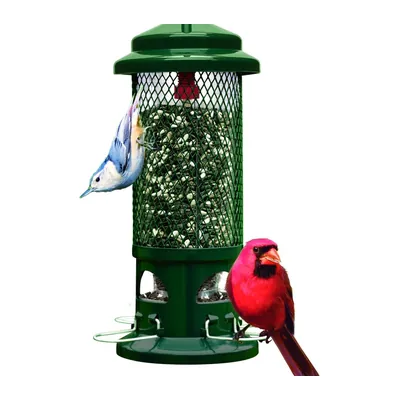
Brome Squirrel Buster Standard
A tube feeder holding 1.3 lb of seed: birds feed through the ports without trampling the food, which France’s LPO prefers to platform feeders. Cleans with a bottle brush.
View on Amazon (opens in a new tab)
FAQ
When should I stop feeding birds?
In most of the US, there’s no fixed date: Audubon says stopping at any particular time of year won’t have much of an impact on seed-eating birds, and continued feeding won’t keep migrants from leaving. The main exception is bear country, where feeders should come down in the warm months; New York State recommends April 1. In Europe, France’s LPO stops at the end of March, and Britain pauses seed from May through October.
Can I feed birds year-round?
In most of the US, yes: the Cornell Lab of Ornithology considers leaving feeders up year-round not a problem, with precautions. Skip raw or homemade suet in summer, since heat turns it rancid, take feeders down where bears are active, and keep an eye on seed spoiling in the heat. Britain now advises the opposite for seed and peanuts, pausing them from May through October to curb a finch disease.
Is it OK to feed bread to ducks or birds?
Better not. Audubon calls bread one of the least healthy foods, with little nutritional value, and it can cause a wing deformity called “angel wing” in waterfowl. For ducks and geese, Audubon suggests cracked corn or oats, in moderation. For backyard birds, black-oil sunflower seed is the crowd-pleaser, and France’s LPO rules bread out entirely, as birds digest it poorly.
What can I do for birds during a heat wave?
Offer water rather than food: in extreme heat, the Cornell Lab notes, birds may stop visiting feeders anyway. A shallow birdbath, 1.2 to 1.6 inches (3 to 4 cm) deep for small birds, refreshed every day and kept clean, is the better gift. Add nothing to the water, and take raw or homemade suet down, since it turns rancid in the heat.
Why aren’t any birds coming to my feeder?
Usually because there’s plenty to eat elsewhere: every two or three years, trees and shrubs are loaded with fruit, notes the Swiss Ornithological Institute. Check the food and the spot all the same: black-oil sunflower seed draws the most species, and cheap blends heavy in milo, wheat, and oats draw few. Birds can also take a little while to get used to a new feeder.
Should I take my feeders down because of bird flu?
Not as a rule. Experts told Audubon that feeders don’t currently present a major risk, as the virus doesn’t commonly infect the songbirds that visit them. Audubon does recommend taking feeders down if at least one of your local agencies advises it, and keeping up with regular cleaning. Don’t handle sick or dead birds yourself: contact a local wildlife rehabilitator.
Sources
- RSPB (W. Peach et al.), Literature review of the effects of supplementary feeding on birds and people, RSPB Research Report 85, April 2026, accessed October 22, 2026. base-prod.rspb-prod.magnolia-platform.com https://base-prod.rspb-prod.magnolia-platform.com/author/dam/jcr:d4d83d62-14a9-4f68-913e-7ef27963939d/RSPB%20Supplementary%20Feeding%20Literature%20Review.pdf ↩
- LPO (Ligue pour la Protection des Oiseaux, France), Nourrir les oiseaux de son jardin en hiver, news item of January 6, 2026, accessed October 22, 2026. lpo.fr https://www.lpo.fr/qui-sommes-nous/toutes-nos-actualites/articles/actus-2026/nourrir-les-oiseaux-de-son-jardin-en-hiver ↩
- LPO, Quand nourrir les oiseaux ?, wildlife advice page, accessed October 22, 2026. lpo.fr https://www.lpo.fr/decouvrir-la-nature/conseils-biodiversite/conseils-biodiversite/accueillir-la-faune-sauvage/quand-nourrir-les-oiseaux ↩
- LPO, Nourrissage et maladies des oiseaux, wildlife advice page, accessed October 22, 2026. lpo.fr https://www.lpo.fr/decouvrir-la-nature/conseils-biodiversite/conseils-biodiversite/accueillir-la-faune-sauvage/nourrissage-et-maladies-des-oiseaux ↩
- Swiss Ornithological Institute, Nourrissage des passereaux, page updated August 25, 2025, accessed October 22, 2026. vogelwarte.ch https://www.vogelwarte.ch/fr/conseils/nourrissage-des-passereaux/ ↩
- LPO, Médiation faune sauvage, Nourrissage, advice sheet, August 2024, accessed October 22, 2026. lpo.fr https://www.lpo.fr/media/read/9846/file/FM_NOURRISSAGE_aout2024_WEB.pdf ↩
- RSPB (UK), Feeding birds near you, page dated October 1, 2026, accessed October 22, 2026. rspb.org.uk https://www.rspb.org.uk/birds-and-wildlife/feeding-birds-near-you ↩
- British Trust for Ornithology, Feeding garden birds, accessed October 22, 2026. bto.org https://www.bto.org/learn/helping-birds/feeding ↩
- Swiss Ornithological Institute, Oiseaux et verre : éviter les collisions, accessed October 22, 2026. vogelwarte.ch https://www.vogelwarte.ch/fr/conseils/oiseaux-et-verre-eviter-les-collisions/ ↩
- LPO and French National Museum of Natural History, Garden Birds Observatory, Bilan 2025, accessed October 22, 2026. cdnfiles1.biolovision.net https://cdnfiles1.biolovision.net/www.oiseauxdesjardins.fr/userfiles/BilanOiseauxOiseauxDesJardins2025V5BWEB1.pdf ↩
- RSPB, Ask an RSPB Expert special: All about bird feeding, accessed October 22, 2026. rspb.org.uk https://www.rspb.org.uk/birds-and-wildlife/ask-an-rspb-expert/all-about-bird-feeding ↩
- Garden Wildlife Health (ZSL, BTO, Froglife, RSPB), Trichomonosis in Garden Birds, fact sheet updated September 2017, accessed October 22, 2026. gardenwildlifehealth.org https://www.gardenwildlifehealth.org/wp-content/uploads/sites/12/2018/02/Garden-bird-Trichomonosis-factsheet_GWH_2017.pdf ↩
- LPO, Refuges LPO program, L’eau et les oiseaux, advice sheet, accessed October 22, 2026. champagne-ardenne.lpo.fr https://champagne-ardenne.lpo.fr/images/mediatheque/fichiers/actualites/2026/ficherefugeslpo_leau-et-loiseau.pdf ↩
- Natagora (Belgium), Réseau Nature, Le nourrissage des oiseaux, garden advice sheet updated November 2021, archived copy of June 18, 2026 (site under maintenance on October 22, 2026). web.archive.org https://web.archive.org/web/20260618163628/https://reseaunature.natagora.be/fileadmin/Projet_Reseau_Nature/Fiches_JNat/JNat_nourrissage_oiseaux.pdf ↩
- NABU (Germany), Tipps zur Vogelfütterung, archived copy of October 13, 2026 (site offline on October 22, 2026). web.archive.org https://web.archive.org/web/20261013203005/https://www.nabu.de/tiere-und-pflanzen/voegel/helfen/vogelfuetterung/index.html ↩
- RSPB, The science of bird feeding, March 31, 2026, accessed October 22, 2026. rspb.org.uk https://www.rspb.org.uk/whats-happening/news/the-science-of-bird-feeding ↩
- K. E. Plummer et al., Winter food provisioning reduces future breeding performance in a wild bird, Scientific Reports, vol. 3, article 2002, 2013. nature.com https://www.nature.com/articles/srep02002 ↩
- National Audubon Society, Frequently Asked Questions About Birds, accessed October 22, 2026. audubon.org https://www.audubon.org/birding/faq ↩
- Cornell Lab of Ornithology, All About Birds, Should I take my feeder down when the weather starts to warm up?, archived copy of April 2, 2026 (the site blocks automated access). web.archive.org https://web.archive.org/web/20260402213448/https://www.allaboutbirds.org/news/should-i-take-my-feeder-down-when-the-weather-starts-to-warm-up/ ↩
- National Audubon Society, When It’s Okay (or Not) to Feed Birds, accessed October 22, 2026. audubon.org https://www.audubon.org/magazine/when-its-okay-or-not-feed-birds ↩
- National Audubon Society, What Does the Avian Flu Surge Mean for Your Bird Feeders?, accessed October 22, 2026. audubon.org https://www.audubon.org/magazine/what-does-avian-flu-surge-mean-your-bird-feeders ↩
- National Audubon Society, 11 Tips for Feeding Backyard Birds, first published 2011, updated February 13, 2025, accessed October 22, 2026. audubon.org https://www.audubon.org/magazine/11-tips-feeding-backyard-birds ↩
- Garden Wildlife Health (UK), Feeding Garden Birds Best Practice Guidance, April 2021, accessed October 22, 2026. gardenwildlifehealth.org https://www.gardenwildlifehealth.org/wp-content/uploads/sites/12/2021/04/Feeding-Garden-Birds-Best-Practice-Guidance.pdf ↩
- Project FeederWatch (Cornell Lab of Ornithology and Birds Canada), Winter Bird Highlights, 2024-25 season, December 22, 2025, accessed October 22, 2026. cdn.feederwatch.org https://cdn.feederwatch.org/wp-content/uploads/2025/12/Winter-Bird-Highlights-2025_12.22.2025.pdf ↩
- National Audubon Society, Three Easy but Important Ways to Keep Your Bird Feeders Disease-Free, accessed October 22, 2026. audubon.org https://www.audubon.org/news/three-easy-important-ways-keep-your-bird-feeder-disease-free ↩
- Project FeederWatch, About the disease (house finch eye disease), archived copy of November 11, 2024 (the site blocks automated access). web.archive.org https://web.archive.org/web/20241111143221/https://feederwatch.org/learn/house-finch-eye-disease/disease/ ↩
- Project FeederWatch, Feeding Birds, archived copy of October 11, 2026 (the site blocks automated access). web.archive.org https://web.archive.org/web/20261011153003/https://feederwatch.org/learn/feeding-birds/ ↩
- Project FeederWatch, Preventing disease: What’s the best way to clean your bird feeders?, archived copy of May 20, 2026 (the site blocks automated access). web.archive.org https://web.archive.org/web/20260520161822/https://feederwatch.org/research-news/cleaning-preventing-disease/ ↩
- Centers for Disease Control and Prevention, 2021 Salmonella Outbreak Linked to Wild Songbirds: Investigation Details, final update of May 28, 2021, CDC archive, accessed October 22, 2026. archive.cdc.gov https://archive.cdc.gov/www_cdc_gov/salmonella/typhimurium-04-21/details.html ↩

Trail running, snow, water, nature and destinations
Nolwenn covers trail running, snow, water, nature and destinations for Outfarer. Curious about everything, from meteor showers to night-train schedules, she has a knack for digging up the one detail that changes everything, and nailing it in a single sentence.


 Joséphine Garand
