 Français (France)
 English (UK)
 English (US)
 Deutsch (Deutschland)

Contents
The meteor shower calendar, November 2026 to November 2027
The Geminids don’t come from an ordinary comet, but from the dust of a 3-mile (5 km) asteroid, 3200 Phaethon, which NASA describes as a possible “rock comet” [1]. The International Meteor Organization (IMO), which publishes the reference calendar for meteor observers every year, ranks them as the best and most reliable of the major annual showers [2]. In 2026, they also land on a nearly moonless night.
Each shower seems to burst from a single point in the sky, its The point in the sky that all the meteors of a shower seem to come from. Their paths are parallel: perspective makes them converge, like railroad tracks in the distance., which gives the shower its name: the Geminids come from Gemini, the Perseids from Perseus [3]. The table gives, for each major shower, the night to circle, the time of the predicted peak, and its The number of meteors an ideal observer would see in an hour under a perfectly dark, clear sky, with the radiant straight overhead. It’s abbreviated ZHR., or ZHR [2]. The last column matters as much as the others: moonlight washes out the faintest meteors [3], and it’s often what turns a great shower into a disappointing night.
| Shower | Night to circle | Predicted peak (Central Time) | ZHR | The Moon that night |
|---|---|---|---|---|
| Leonids | November 17-18, 2026 | November 17, 5:45 p.m., before the radiant rises | 15 | Just past first quarter, sets around 12:25 a.m.: no Moon for the rest of the night |
| Geminids | December 13-14, 2026 | December 14, 8 a.m., after sunrise | 150 | Thin crescent, 19% lit, sets around 9:10 p.m.: ideal |
| Ursids | December 22-23, 2026 | December 22, 4 p.m., in daylight | 10 | 97% lit, up all night: poor |
| Quadrantids | January 3-4, 2027 | January 3, 9:25 p.m. | 80 | Thin crescent, 9% lit, not up until around 5:15 a.m.: no Moon, but a low radiant at peak time |
| Lyrids | April 22-23, 2027 | April 22, 8:40 p.m. | 18 | More than 90% lit, rises around 10:30 p.m.: poor |
| Eta Aquariids | May 5-6, 2027 | May 6, 4 a.m. | 50 | New Moon, no interference; low radiant, higher the farther south you are |
| Perseids | August 12-13, 2027 | August 13, between 3 a.m. and 5 a.m. | 110 to 120 | Gibbous, more than 80% lit, sets around 2:50 a.m.: fair |
| Orionids | October 21-22 and 22-23, 2027 | October 22, peak spread over about a day | 20 | About half lit, rises between 11:30 p.m. and 12:45 a.m.: mediocre |
| Leonids | November 17-18, 2027 | November 18, midnight | 15 | Gibbous, about 80% lit, rises around 8:20 p.m.: poor |
Dates, peaks, and ZHR: IMO calendars for 2026 and 2027 [2, 4], converted from Universal Time to Central Time (CST in winter, CDT in summer); add an hour for Eastern Time, subtract one for Mountain Time and two for Pacific Time. The Quadrantids’ ZHR varies from 60 to 200 from year to year. Moon: phases, rise, set, and illuminated fraction calculated for Kansas City by the U.S. Naval Observatory (USNO) [5, 6], phases cross-checked against NASA’s table [7]. Elsewhere in the Lower 48, local moonrise and moonset times generally differ from these by less than an hour: on the nights we checked with the same tool, by no more than about 45 minutes in Seattle and Miami.
Geminids 2026: the night of December 13-14, under a thin crescent
You’ll often see them billed as peaking “on the night of December 13-14.” The IMO calendar is more precise: the peak is expected on December 14 around 14:00 UT, which is 9 a.m. EST, 8 a.m. CST, and 6 a.m. PST [2], so after sunrise in Kansas City [6]. The detail that changes everything is its width. The Geminids stay above a ZHR of 100 for 10 to 12 hours, and their best-observed peaks of the past 20 years all fell between 3 p.m. on December 13 and noon on the 14th, Central Time [2]. The night of December 13-14 sits right inside that window.
On the Moon front, they live up to their reputation. The new Moon falls on December 8 in US time zones, December 9 in Universal Time [5, 7]. On the 13th, all that’s left is a crescent 19% lit, which sets in Kansas City around 9:10 p.m.; on the 14th, 27% lit, it goes down around 10:15 p.m. [6]. The IMO calls it a broad, moon-free maximum [2]. The radiant rises around sunset and is usable from the evening on [2]. By our calculation for Kansas City, it culminates around 2:15 a.m., nearly overhead at about 84° above the southern horizon, and it’s still at 46° when dawn begins to break, around 5:55 a.m. That’s nearly nine hours of dark, moonless night.
The Geminids travel at 22 miles per second (35 km/s), a fairly moderate speed: the IMO puts the average at around 25 mi/s (40 km/s), on a scale from about 7 to 45 mi/s (11 to 72 km/s) [2]. They’re known for bright meteors and Exceptionally bright meteors., and the share of bright Geminids often rises toward the end of the peak [2]: the evening of the 14th, once the Moon sets around 10:15 p.m., deserves a look too. Under dark skies, NASA says to expect 40 to 50 Geminids an hour, and up to 120 in perfect conditions [1].
Leonids and Ursids: the other two dates for late 2026
Before the Geminids, the Leonids kick off the season in mid-November 2026. Their peak is expected on November 17 around 23:45 UT, which is 6:45 p.m. EST, 5:45 p.m. CST, and 3:45 p.m. PST, with a modest ZHR of about 15 [2]. Across the US, that’s before their radiant, in Leo, has even risen, so the night that follows, November 17-18, is the one to try. The Moon, just past first quarter, sets in Kansas City around 12:25 a.m. [6], barely an hour after the radiant comes up. The rest of the night is moon-free, and the radiant climbs to nearly 70° before dawn, by our calculation. The Leonids are among the fastest meteors, at 44 miles per second (71 km/s) [2].
The Ursids peak on December 22 around 22:00 UT, 4 p.m. CST, in daylight, with a ZHR of about 10 [2]. Their radiant, near the Little Dipper, never sets anywhere in the Lower 48, but the Moon, 97% lit, is up all night [2, 6]. The IMO rates the chances of good observations as slim [2].
Winter and spring 2027: Quadrantids too early in the evening, Lyrids drowned in moonlight
Quadrantids: January 3, around 9:25 p.m. CST
The Quadrantids have a very short peak, just a few hours long, and fine fireballs, according to NASA [10]. In 2027, that peak is expected on January 4 around 03:25 UT, give or take about 2.5 hours, with a ZHR of 80 that can range from 60 to 200 from one year to the next [4]. That’s the middle of the night in Europe, but the evening of January 3 in the US: 10:25 p.m. EST, 9:25 p.m. CST, 7:25 p.m. PST. The Moon, a thin crescent 9% lit, doesn’t rise until around 5:15 a.m. [6], and the IMO calls the conditions perfect [4]. The catch for North America is the radiant, in Boötes. By our calculation, at peak time it sits just below the northern horizon as seen from Kansas City, and it’s still under 10° even if the peak runs 2.5 hours late; farther north it stays up, but low. It only clears 20° after about 1:45 a.m., and reaches about 60° when dawn begins, several hours past a peak that doesn’t last, so expect fewer meteors than the ZHR suggests. Their source, the asteroid 2003 EH1, may be, like Phaethon, an extinct or “rock” comet [10].
Lyrids: April 22, but under the Moon
The Lyrids peak on April 23, 2027, around 01:40 UT, which is 9:40 p.m. EDT, 8:40 p.m. CDT, and 6:40 p.m. PDT on April 22, with a ZHR of about 18 [4]. They sometimes pull a surprise: in 1982, a brief outburst reached a ZHR of 90 [2]. But in 2027, the peak comes just after the full Moon of April 20 [5], and the IMO gives it the worst observing conditions in its 2027 calendar [4]. In Kansas City, by our calculation, the peak even comes before the radiant has risen, and the Moon, more than 90% lit, rises around 10:30 p.m. and stays up until morning [6].
Eta Aquariids: no Moon, and the farther south, the better
Offspring of Halley’s comet, like the October Orionids [11], the Eta Aquariids peak on May 6, 2027, around 09:00 UT, which is 5 a.m. EDT, 4 a.m. CDT, and 2 a.m. PDT, with a ZHR of about 50, closer to 40 in recent years [4]. The new Moon falls the same day [5]. Their radiant only rises at the very end of the night, and the IMO places useful observations south of about 40° north, roughly the latitude of Denver and Philadelphia [4]. By our calculation, from Kansas City, just south of that line, the radiant is only about 18° up when the sky starts to pale, around 4:30 a.m. CDT; from Miami, it’s about 30° up around 5:15 a.m. EDT, while from Seattle it barely reaches 7°. As for Halley’s comet itself, it won’t be back until 2061 [11].
Summer and fall 2027: Perseids under the Moon, Leonids worth watching
Perseids: the night of August 12-13, after 2:50 a.m.
The Perseids, born of comet 109P/Swift-Tuttle, which takes 133 years to complete its orbit [12], are still the big summer show. For 2027, the IMO expects a peak on August 13 between 08:00 and 10:00 UT [4]. That’s 4 to 6 a.m. EDT, 3 to 5 a.m. CDT, and 1 to 3 a.m. PDT: this time, the predicted peak lands in the dark hours over much of the country. Their traditional maximum is broad anyway: depending on the year, it has ranged from 03:00 to 16:00 UT, or from 10 p.m. CDT on the 12th to 11 a.m. CDT on the 13th [4]. And activity could run a little higher than usual: this year, Earth passes through a part of the dust cloud that Jupiter has nudged closer to its orbit, which could raise the ZHR by 10 to 20%, to around 110 to 120 [4].
The downside is the Moon. On August 12, it’s gibbous, more than 80% lit, and doesn’t set in Kansas City until around 2:50 a.m. [6]. The IMO warns that the moon-free window will be short [4]: by our calculation, about two hours of dark sky are left before dawn, with the radiant already high, between 45 and 60° up, right as the predicted peak arrives. That’s the slot to aim for. Models cited by the IMO also mention a possible encounter with old dust trails at 23:46 UT on August 12, of very uncertain strength [4]: that’s 6:46 p.m. CDT, before dark anywhere in the US. Other calculations cited by the IMO point to around 02:00 to 02:16 UT on August 13, which is 9 to 9:15 p.m. CDT on the 12th, with the radiant still low and the Moon up: at best a slight boost [4]. The following night, the Moon sets later still, around 3:50 a.m. [6].
| Time (CDT) | What’s happening | Radiant height |
|---|---|---|
| 10 p.m. | End of twilight: the sky is dark, but the Moon, more than 80% lit, is up | 14° |
| Midnight | The radiant climbs, the Moon is still there | 25° |
| 2:50 a.m. | Moonset: real darkness begins | 46° |
| 3 a.m. | Start of the IMO’s predicted peak window, which runs until 5 a.m. | 47° |
| 4:50 a.m. | Dawn begins: the sky starts to pale | 61° |
Central Daylight Time. IMO predictions [4]; Moon from the USNO [6]; approximate radiant height, end of twilight, and start of dawn (Sun 18° below the horizon): our calculation for Kansas City.
Here’s a twist: this month’s new Moon is the one that brings the total solar eclipse of August 2, 2027 [7], 10 days too early for the Perseids.
Orionids: around October 22, with a waning Moon
A second date with Halley’s dust, the Orionids peak around October 22, over about a day, with a ZHR of 20 and fast meteors, at 41 miles per second (66 km/s) [4]. In 2027, the waning Moon, about half lit, rises in Kansas City between 11:30 p.m. and 12:45 a.m. [6], and the IMO notes that it lights up the sky while the radiant is up [4].
Leonids: possible outbursts, mostly out of reach
The regular 2027 Leonid peak is expected on November 18 around 06:00 UT [4]: midnight CST, when the radiant is only just rising in Kansas City, by our calculation. Models cited by the IMO consider two bursts with a ZHR of 40 to 50 [4], but both mostly miss North America: the first, around 22:00 UT on the 17th, at 4 p.m. CST, in daylight; the second, around 04:20 UT on the 20th, at 10:20 p.m. CST on the 19th, before the radiant rises in Kansas City. That second burst would come from a very old dust trail, and one of the calculation’s authors calls its details really uncertain [4]. On those nights, a gibbous Moon, more than half lit, is up most of the night [6].
What you’ll really see: the ZHR is a ceiling
A ZHR of 150 doesn’t promise 150 meteors an hour. It’s a rate calculated for an ideal observer under a perfect sky, with a The brightness of the faintest stars visible to the naked eye. A value of 6.5 means a very dark sky; the lower the number, the fewer stars you can see. of 6.5 and the radiant straight overhead [2]. The American Meteor Society puts it plainly: it’s a guide, not a promise, and the number you see is almost always lower [3].
First culprit: the height of the radiant. For a shower with a ZHR of 100, the IMO gives what you can hope to see in an hour, under a perfect sky:
| Radiant height | Meteors per hour |
|---|---|
| 90°, straight overhead | 100 |
| 70° | 94 |
| 50° | 77 |
| 40° | 64 |
| 30° | 50 |
| 20° | 34 |
| 10° | 17 |
Perfect sky, limiting magnitude 6.5, according to the IMO [13]. The numbers scale with the ZHR: for a ZHR of 150, multiply them by 1.5.
That’s why timing matters so much. The French Astronomical Society (Société astronomique de France) shows it with the Perseids: for the same activity, you see 10 to 15 an hour early in the night, when Perseus is low, versus 60 to 80 late in the night [14]. In Germany, the Arbeitskreis Meteore, an association of meteor observers, spells out the basic rule: you only see a shower’s meteors if its radiant is above the horizon, and most radiants are only well placed after midnight [15]. The Geminids are the exception, with a radiant that’s usable from the evening on [2].
Second culprit: light. The Moon, outdoor lighting, twilight, or haze cost you a good share of the faintest meteors [13, 15]. Third: impatience. Even during the major showers, 5 can fall in a minute, then nothing for 5 minutes; the IMO advises watching for at least an hour to get a feel for both [16].
Where and how to look: darkness, time, and your eyes halfway up
Good news: you don’t need any gear. Binoculars and telescopes narrow your field of view, while meteors pop up anywhere in the sky [3]. Save your binoculars for birds or the Moon, and give your eyes the whole sky.
The most important thing is darkness. According to the world atlas of light pollution published in 2016, nearly 80% of North Americans can’t see the Milky Way from where they live; in the US, that’s 78% of the population, even though those bright skies cover less than 4% of the country [17]. They cluster around cities, so getting away is often enough. For the darkest skies, head for a protected one: the National Park Service counts dozens of park units certified as Dark Sky Places, and in 2007, Natural Bridges National Monument, in Utah, became the world’s first certified International Dark Sky Park [18]. Before you go, check national park reservations and entrance fees.
Next, let your eyes adjust to the dark: at least 20 minutes after a lit room, according to the IMO, and 20 to 30 minutes according to the AMS, which adds that full adaptation takes longer and that you should stay off your phone screen [13, 3]. To find the thermos, a headlamp on a dim red setting, used briefly, does the trick [3]. It’s the same routine as for chasing the northern lights.
All that’s left is knowing where to look. Lying down or in a reclining chair, aim at a clear patch of sky halfway between the horizon and the zenith, away from lights and the Moon [3]. There’s no point staring at the radiant: meteors near it leave short trails, which get longer the farther away they are [3]. IMO observers center their field of view between 50 and 70° up, 20 to 40° away from the radiant [13].
On December 13, check the forecast in the afternoon. If the sky is clearing, head out before the Moon sets, turn your back on the city lights, give your eyes time to adjust, and wait. The first Geminid has a knack for streaking by just as you look away: the second, you’ll be waiting for with your eyes wide open.
Gear related to this article
No affiliation: no commission, no sponsored products.
 David Chandler Company
The Night Sky 40°-50° Planisphere (Small)
A pocket-size plastic planisphere for 40° to 50° north latitude, with a 5-inch map: dial in the date and time to see which constellations are up and where the radiant sits.
View on Amazon (opens in a new tab)
Petzl Actik Core
A 3.1 oz headlamp that ships with a rechargeable battery and also runs on three AAA batteries, with a red light that won’t blind anyone.
View on Amazon (opens in a new tab)
Worth watching
EarthSky, the long-running astronomy news site, sums up its tips for watching a meteor shower in three minutes: a handy companion to the calendar and to our section on where and how to look.
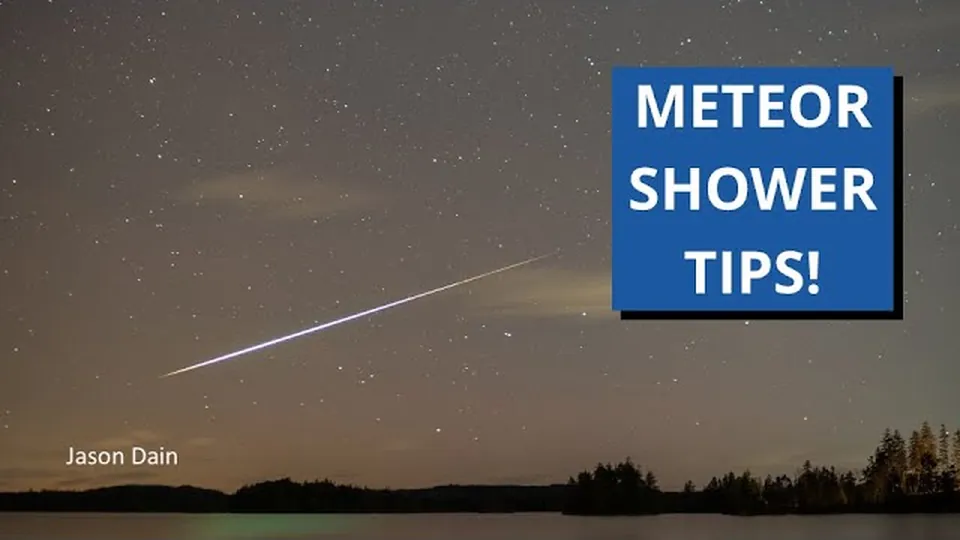
The video is hosted by YouTube (Google): nothing loads until you play it, and Google may then set cookies.
FAQ
When can you see the Geminids in 2026?
On the night of December 13-14, 2026. The peak is expected on the 14th around 8 a.m. Central Time, after sunrise, but it’s broad: the best-observed peaks of the past 20 years fell between 3 p.m. on the 13th and noon on the 14th, Central Time. In Kansas City, the thin crescent Moon sets around 9:10 p.m. on the 13th. The evening of the 14th is still worth it once the Moon sets, around 10:15 p.m.
Can you see shooting stars tonight?
Yes, on any clear night: with no major shower going on, about one meteor shows up every 10 minutes, according to the UK’s Royal Observatory Greenwich, a few more late at night. To see more, check the calendar for an active shower, make sure the Moon has set or is faint, and get away from city lights.
What time of night is best for meteors?
Usually the second half of the night, between midnight and dawn: that’s when the radiant of most showers is higher, and stray meteors are more frequent. The Geminids are the exception, with a radiant that’s usable from the evening on. Check moonrise and moonset times too, since they often decide the best window.
Which direction should you look to see meteors?
Not necessarily toward the radiant. Aim at a dark, clear patch of sky, halfway between the horizon and the zenith, away from lights and the Moon. Near the radiant, trails are short; farther away, they get longer. International Meteor Organization observers look between 50 and 70° up, 20 to 40° away from the radiant.
Will the 2027 Perseids be worth watching?
Yes, though the Moon will get in the way. The IMO expects the peak on August 13, 2027, between 3 and 5 a.m. CDT (1 to 3 a.m. PDT), and the night of August 12-13 is the one to pick. The Moon, more than 80% lit, doesn’t set in Kansas City until around 2:50 a.m.: that leaves about two hours of dark sky before dawn, with the radiant already high. The IMO expects a ZHR of 110 to 120.
Do you need binoculars to see meteors?
No. Your eyes are the best instrument: binoculars and telescopes narrow your field of view, while meteors show up all over the sky. What you mostly need is a dark sky, 20 to 30 minutes for your eyes to adjust, something to keep you warm, and patience, since meteors often arrive in bunches, between long lulls.
Sources
- NASA Science, Geminids, updated August 13, 2026. science.nasa.gov https://science.nasa.gov/solar-system/meteors-meteorites/geminids/ ↩
- International Meteor Organization, Jürgen Rendtel (ed.), 2026 Meteor Shower Calendar, IMO INFO(3-25), working list of June 2025. imo.net https://www.imo.net/files/meteor-shower/cal2026.pdf ↩
- American Meteor Society, Meteors FAQ, accessed October 26, 2026. amsmeteors.org https://www.amsmeteors.org/faq/ ↩
- International Meteor Organization, Jürgen Rendtel (ed.), 2027 Meteor Shower Calendar, IMO INFO(3-26), working list of June 2026. imo.net https://www.imo.net/files/meteor-shower/cal2027.pdf ↩
- U.S. Naval Observatory, Dates of Primary Phases of the Moon, November 2026 to December 2027, in Universal Time, calculated on October 26, 2026. aa.usno.navy.mil https://aa.usno.navy.mil/calculated/moon/phases?date=2026-11-01&nump=56&format=p&submit=Get+Data ↩
- U.S. Naval Observatory, Complete Sun and Moon Data for One Day, Kansas City (39.10° N, 94.58° W), in Central Time, calculated on October 26, 2026, for each night cited (here, December 13, 2026), with Seattle and Miami for comparison. aa.usno.navy.mil https://aa.usno.navy.mil/calculated/rstt/oneday?date=2026-12-13&lat=39.10&lon=-94.58&label=Kansas+City&tz=6.00&tz_sign=-1&tz_label=false&dst=false&submit=Get+Data ↩
- NASA Goddard Space Flight Center, Fred Espenak, Phases of the Moon: 2001 to 2100, accessed October 26, 2026. eclipse.gsfc.nasa.gov https://eclipse.gsfc.nasa.gov/phase/phases2001.html ↩
- Royal Museums Greenwich, Royal Observatory (UK), Meteor shower calendar 2026, accessed October 26, 2026. rmg.co.uk https://www.rmg.co.uk/stories/space-astronomy/meteor-shower-guide-2026 ↩
- NASA Science, Leonids, updated August 13, 2026. science.nasa.gov https://science.nasa.gov/solar-system/meteors-meteorites/leonids/ ↩
- NASA Science, Quadrantids, updated August 13, 2026. science.nasa.gov https://science.nasa.gov/solar-system/meteors-meteorites/quadrantids/ ↩
- NASA Science, Orionids, updated August 13, 2026. science.nasa.gov https://science.nasa.gov/solar-system/meteors-meteorites/orionids/ ↩
- NASA Science, Perseids, updated August 13, 2026. science.nasa.gov https://science.nasa.gov/solar-system/meteors-meteorites/perseids/ ↩
- International Meteor Organization, Observing major showers, visual observing method, accessed October 26, 2026. imo.net https://www.imo.net/observations/methods/visual-observation/major/ ↩
- Société astronomique de France, Karl Antier, chair of its meteors, meteorites, and impacts committee, Des Perséides 2026 sous les meilleurs auspices (in French), 2026. saf-astronomie.fr https://saf-astronomie.fr/des-perseides-2026-sous-les-meilleurs-auspices/ ↩
- Arbeitskreis Meteore e.V., Meteore beobachten (in German), accessed October 26, 2026. meteoros.de https://www.meteoros.de/themen/meteore/beobachtung ↩
- International Meteor Organization, Visual Observations, accessed October 26, 2026. imo.net https://www.imo.net/observations/methods/visual-observation/ ↩
- Fabio Falchi et al., The new world atlas of artificial night sky brightness, Science Advances, vol. 2, 2016, table 2 (United States), PubMed Central version. pmc.ncbi.nlm.nih.gov https://pmc.ncbi.nlm.nih.gov/articles/PMC4928945/ ↩
- National Park Service, Natural Sounds and Night Skies Division, Partnerships to Protect Night Skies, accessed October 26, 2026. home.nps.gov https://home.nps.gov/subjects/nightskies/partnerships.htm ↩

Trail running, snow, water, nature and destinations
Nolwenn covers trail running, snow, water, nature and destinations for Outfarer. Curious about everything, from meteor showers to night-train schedules, she has a knack for digging up the one detail that changes everything, and nailing it in a single sentence.


 Erik Vadas-Gauden