 Français (France)
 English (UK)
 English (US)
 Deutsch (Deutschland)

Contents
Blacklegged ticks wait low: they cling to tall grass, brush, and shrubs, usually no more than 18 to 24 inches off the ground, then climb upward once they’re on you until they reach a protected spot, behind an ear, in an armpit, in your hair, the New York State Department of Health explains [1]. And they keep busy: in 2022, 62,551 Lyme disease cases were reported to the CDC, 1.7 times the yearly average for 2017 to 2019, a jump that CDC authors say likely reflects a new way of counting cases in high-incidence areas rather than a real change in risk [2]. The good news? Protecting yourself comes down to four verbs: cover, check, remove, watch.
This guide builds on our guide to planning a hike, where the tick check is part of getting home.
Where and when you’ll run into ticks
Most tick bites happen in the warmer months, April through September, when ticks are most active and people spend more time outdoors, but you can also get bitten the rest of the year, especially when it’s warmer than usual, MedlinePlus notes. The blacklegged ticks (or deer ticks) that spread Lyme disease are usually found in the Northeast, the mid-Atlantic, the upper Midwest, and on the Pacific coast, especially northern California [3]. Hard ticks prefer wooded and brushy areas with high grass and leaf litter, and in parks they’re more likely on the edge of a trail or off it, says the National Park Service. Adults measure about 3 to 5 millimeters, from a sesame seed to an apple seed; larvae and nymphs are even smaller [4].
In 2022, 95.5% of reported Lyme cases came from the 15 high-incidence jurisdictions, in the Northeast, the mid-Atlantic, and the upper Midwest [2]. Lyme isn’t the only one: MedlinePlus also lists alpha-gal syndrome, a red meat allergy triggered by tick bites, along with babesiosis, ehrlichiosis, Rocky Mountain spotted fever, and tularemia [5].
Before and during the hike: protect yourself
The National Park Service’s advice fits in one list [4]:
- long sleeves and long pants, with pants tucked into your socks, and a hat or cap;
- light-colored clothes, so you can easily spot ticks;
- an EPA-registered repellent, with DEET or picaridin, for example, used as the label directs [3];
- clothing and gear treated with permethrin, never your skin, the Minnesota Department of Health warns [6];
- a small tick kit in your pack: repellent, tweezers, rubbing alcohol or soap and water, and a mirror.
On the trail, hike in the center to avoid brushing against vegetation, and don’t sit on logs [4], stone walls, or the bare ground, adds New York’s health department [1]. The EPA registration number means the maker gave the agency data on the product’s safety and effectiveness against mosquitoes, ticks, or both; its search tool filters by ticks and by protection time [7]. The detail that changes everything: pants tucked into socks. Not a runway look, but a tick crawling up your leg hits a dead end. Fine-tipped tweezers belong on our day hike packing list.
After the hike: the tick check
Shower soon after spending time in tick habitat [4]: New York’s health department suggests within two hours, to wash off ticks and find them more easily [1]. Then check your body, especially under the arms, in and around the ears, inside the belly button, the backs of the knees, in and around the hair, between the legs, and around the waist, along with your clothing, shoelaces included, your gear, and your pets [4]. A tick can look like a speck of dirt, so use a mirror, and check at least once a day, Minnesota’s health department advises [6]. Then dry your clothes on high heat for at least 10 minutes to kill any ticks [4].
Removing a tick: fast, and no twisting
Speed matters. A tick can stay attached for several days, and if it’s infected, it can pass along germs once it starts feeding; catch it and remove it before it has filled up on your blood, and you’re less likely to get infected, MedlinePlus explains [5]. For Lyme disease, the tick usually has to be attached for more than 24 hours to spread the bacterium [3]. The steps:
- Skip the folk remedies. Petroleum jelly, nail polish remover, and burning matches are not a safe or effective way to remove ticks, the Minnesota Department of Health warns [6].
- Grab the tick with fine-tipped tweezers or a tick removal device, as close to your skin as possible [5].
- Pull upward with steady, even pressure, and don’t twist or jerk the tick: you want it out in one piece [4, 5].
- If the mouthparts break off and stay in the skin, try to remove them; if you can’t remove them easily, leave them [5].
- Clean the bite area and your hands with rubbing alcohol or soap and water [5].
Pick a real tool: the Park Service says not to try to remove a tick without one [4], and New York’s health department recommends a pair of pointed tweezers, grasping the tick right where it enters the skin. It adds two steps of its own: drop the tick into a small container of rubbing alcohol to kill it, and clean the bite with rubbing alcohol or hydrogen peroxide [1].
Worth knowing: the Park Service suggests keeping the tick in a sealed bag or container in case it needs to be identified later. And if you think an illness may be related to a park visit, it asks visitors to report it by email, on top of contacting their health care provider [4].
The weeks after: watch your skin
Early symptoms of Lyme disease start 3 to 30 days after an infected tick bites you, says MedlinePlus. Most people get a red rash called erythema migrans: it gets bigger over several days, may feel warm, and is usually not painful or itchy; as it starts to get better, parts of it may fade, which sometimes makes it look like a “bull’s-eye.” Fever, chills, headache, fatigue, muscle and joint aches, and swollen lymph nodes can come with it [3]. New York’s health department suggests watching the site of the bite for the next 30 days [1].
What about tick-borne encephalitis?
This one is a European and Asian story, and a rare one for Americans. Tick-borne encephalitis (TBE) is caused by a virus found in parts of Europe and Asia, spread mostly by tick bites and less often through unpasteurized dairy products; when it causes acute neurologic disease, that usually means a hospital stay, often permanent neurologic or cognitive after-effects, and sometimes death, according to the CDC report on the recommendations of its Advisory Committee on Immunization Practices (ACIP) [8]. For most U.S. travelers, the risk is very low: 12 cases were reported among U.S. civilian travelers from 1979 to 2021, and all eight with data on their activities reported things like hiking, camping, fishing, or trail running. Risk is highest during the April to November transmission season, for people heading into woodland in areas where TBE is endemic [8].
A vaccine is licensed in the U.S.: the FDA approved it in August 2021 for people aged 1 year and older. ACIP recommends it for Americans moving or traveling to an area where TBE is endemic who will have extensive exposure to ticks, for example on a trip of less than a month with daily or frequent time outdoors in tick habitat; it may be considered for others who plan outdoor activities where ticks are likely, depending on their itinerary, their health, and their tolerance of risk [8]. Plan ahead: the primary series takes 3 doses, the third given 5 to 12 months after the second, and it should be completed at least 1 week before possible exposure [8]. Talk to your doctor or a travel clinic well before a hiking trip to an affected area.
In the end, ticks just ask for a little method: cover, check, remove, watch. Hiking with a dog? It gets the same check, and our guide to hiking with your dog covers the rest. Then go enjoy the woods, minus the hitchhikers.
Gear related to this article
No affiliation: no commission, no sponsored products.
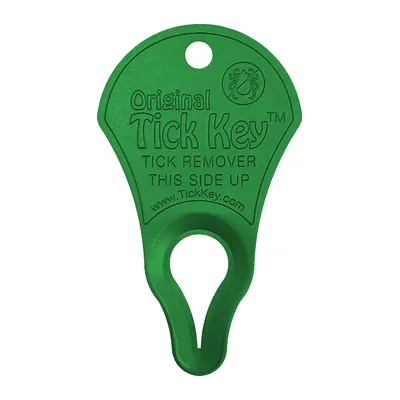
Original Tick Key (3-pack)
An anodized aluminum key with a teardrop slot: set it over the tick, then slide it flat along the skin to lift the tick out, head and all. Flat enough for any first aid kit.
View on Amazon (opens in a new tab)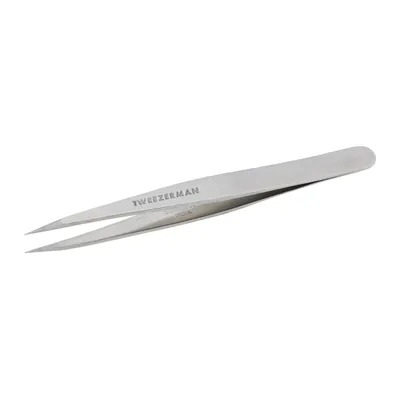
Tweezerman Point Tweezer
Stainless steel tweezers with finely tapered, hand-filed, aligned points: the fine tips grab a tick right at the skin, so you can pull straight up with steady pressure.
View on Amazon (opens in a new tab)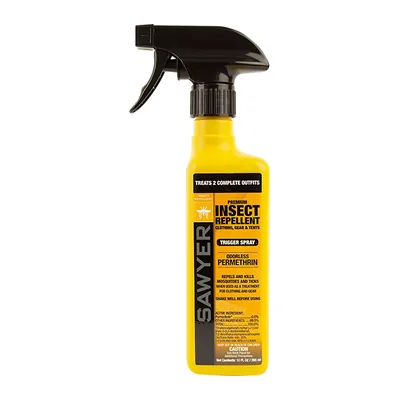
Sawyer Permethrin Fabric Treatment, 12 oz
A permethrin spray for clothing, shoes and gear, never for skin: once dry, one treatment keeps repelling ticks and mosquitoes for 6 weeks or 6 washes, according to Sawyer.
View on Amazon (opens in a new tab)
Worth watching
Proper tick removal, shown by the New York State Department of Health, one of the agencies this guide relies on, in under two minutes: check yourself, then promptly remove any attached tick.
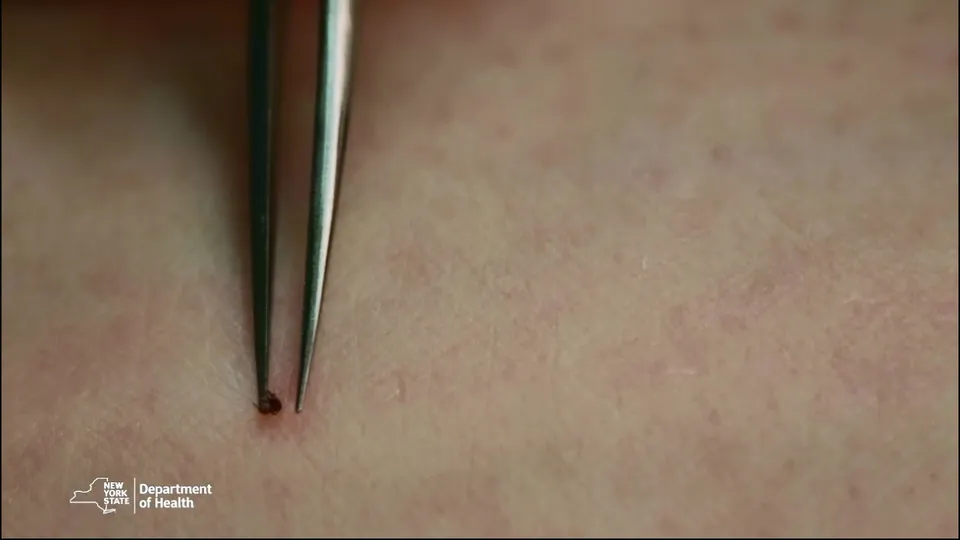
The video is hosted by YouTube (Google): nothing loads until you play it, and Google may then set cookies.
FAQ
Should I twist a tick to get it out?
No. MedlinePlus says to grab the tick with fine-tipped tweezers as close to the skin as possible and pull upward with steady, even pressure, without twisting or jerking, so it comes out in one piece; the National Park Service says the same. If the mouthparts break off and you can’t remove them easily, leave them. Then clean the bite and your hands with rubbing alcohol or soap and water.
Do I need to see a doctor after a tick bite?
Not automatically, but watch the bite for 30 days, as New York’s health department advises. Contact your health care provider right away if you develop a rash or flu-like symptoms, such as fever, chills, or aches, and tell them about the bite. Lyme disease is treated with antibiotics, and the earlier the treatment, the better your chance of recovering quickly, MedlinePlus says.
When are ticks most active?
Most tick bites happen in the warmer months, April through September, according to MedlinePlus, but you can get bitten year-round when it’s warmer than usual. Timing varies by species and state: in Minnesota, blacklegged tick nymphs peak from mid-May through mid-July, and adults in the spring and fall. Your state or local health department’s website is the place to check before a hike.
Which bug spray works against ticks?
Pick an EPA-registered repellent that covers ticks, not just mosquitoes: registration means the maker gave the agency data on its safety and effectiveness. MedlinePlus lists DEET, picaridin, IR3535, oil of lemon eucalyptus, and para-menthane-diol as active ingredients to look for. Choose a protection time that fits your hike, follow the label, and treat clothing and gear, never skin, with permethrin.
Do I need a tick-borne encephalitis vaccine for Europe?
Only in some cases. ACIP recommends it for Americans traveling to areas where TBE is endemic who will have extensive tick exposure, such as daily or frequent time in woodland during a trip; it may be considered for others. The primary series is 3 doses and should be completed at least 1 week before exposure, so plan months ahead. Switzerland treats the whole country except Ticino as a risk area.
Sources
- New York State Department of Health, “Lyme Disease and Other Diseases Carried by Ticks,” revised July 2026, accessed October 28, 2026. health.ny.gov https://www.health.ny.gov/diseases/communicable/lyme/ ↩
- Centers for Disease Control and Prevention (CDC), “Surveillance for Lyme Disease After Implementation of a Revised Case Definition, United States, 2022,” Morbidity and Mortality Weekly Report, February 15, 2024, via PubMed Central (National Library of Medicine), accessed October 28, 2026. pmc.ncbi.nlm.nih.gov https://pmc.ncbi.nlm.nih.gov/articles/PMC10899080/ ↩
- MedlinePlus (National Library of Medicine), “Lyme Disease,” updated June 25, 2024, accessed October 28, 2026. medlineplus.gov https://medlineplus.gov/lymedisease.html ↩
- National Park Service, “Ticks and Tickborne Diseases,” updated April 11, 2023, accessed October 28, 2026. nps.gov https://www.nps.gov/articles/000/ticks-and-tickborne-diseases.htm ↩
- MedlinePlus (National Library of Medicine), “Tick Bites,” updated June 24, 2024, accessed October 28, 2026. medlineplus.gov https://medlineplus.gov/tickbites.html ↩
- Minnesota Department of Health, “Preventing Tickborne Disease,” updated May 31, 2024, accessed October 28, 2026. health.state.mn.us https://www.health.state.mn.us/diseases/tickborne/prevention.html ↩
- U.S. Environmental Protection Agency, “Find the Repellent that is Right for You,” updated September 8, 2026, accessed October 28, 2026. epa.gov https://www.epa.gov/insect-repellents/find-repellent-right-you ↩
- CDC, “Tick-Borne Encephalitis Vaccine: Recommendations of the Advisory Committee on Immunization Practices, United States, 2023,” MMWR Recommendations and Reports, November 10, 2023, via PubMed Central (National Library of Medicine), accessed October 28, 2026. pmc.ncbi.nlm.nih.gov https://pmc.ncbi.nlm.nih.gov/articles/PMC10651317/ ↩
- Santé publique France, “Maladies vectorielles à tique : bien se protéger pendant la saison d’activité des tiques” (in French), updated August 2, 2024, accessed October 28, 2026. santepubliquefrance.fr https://www.santepubliquefrance.fr/les-actualites/maladies-vectorielles-a-tique-bien-se-proteger-pendant-la-saison-dactivite-des-tiques ↩
- Federal Office of Public Health (FOPH, Switzerland), “Tick-borne encephalitis (TBE),” accessed October 28, 2026. bag.admin.ch https://www.bag.admin.ch/en/tick-borne-encephalitis-tbe ↩

Trail running, snow, water, nature and destinations
Nolwenn covers trail running, snow, water, nature and destinations for Outfarer. Curious about everything, from meteor showers to night-train schedules, she has a knack for digging up the one detail that changes everything, and nailing it in a single sentence.

 Guillaume Hoarau

