 Français (France)
 English (UK)
 English (US)
 Deutsch (Deutschland)

A tick can be as small as a tiny freckle, and a fully fed female is about the size of a baked bean, says the UK Health Security Agency (UKHSA) [1]. Easy to miss, in other words. Lyme disease, the bacterial infection some ticks carry, is not common in the UK: the UKHSA estimates 2,000 to 3,000 new cases a year in England and Wales [2]. In Ireland, though, it is commonest among hill-walkers, hikers and campers, notes the HSE’s Health Protection Surveillance Centre (HPSC) [3]. Good news: the official advice fits in four verbs. Cover up, check, remove, watch.
This guide completes our guide to planning a walk, where the tick check is part of getting home.
Where and when you meet ticks
Ticks are found throughout the year, but are most active between spring and autumn, says the UKHSA. They prefer moist places with leaf litter or longer grass: woodland, grassland, moorland, heathland, and even some urban parks and gardens [1]. They don’t fly or jump: they wait on vegetation for a host to pass by, then climb on [1]. The HPSC adds walking paths, especially those bordered by long grasses, and vegetation close to lakes and seaside beaches [3].
The risk is not the same everywhere. Ticks that may cause Lyme disease are found all over the UK, says the NHS, but high-risk places include grassy and wooded areas in southern England and the Scottish Highlands [4]. Not every tick is a threat, either: only a small minority of UK ticks carry the bacteria that cause Lyme disease, and being bitten by an infected one does not necessarily mean you will get it, the UKHSA adds [2]. In Ireland, the HPSC reckons that several hundred cases of the milder forms of Lyme disease probably occur each year [3].
Before and during the walk: protect yourself
The NHS advice comes down to four habits [4]:
- cover your skin while walking outdoors, and tuck your trousers into your socks;
- use insect repellent on your clothes and skin: products containing DEET are best, says the NHS;
- stay on clear paths whenever possible;
- wear light-coloured clothing, so ticks are easier to see and brush off.
Ireland’s HPSC adds closed-toe shoes or boots rather than sandals, and a look at your skin and clothes every 3 to 4 hours while you are in an area where ticks are found [3]. The detail that changes everything? Trousers tucked into socks. Not this season’s look, admittedly, but a tick climbing your leg finds the way barred. As for fine-tipped tweezers or a tick-removal tool, they have their place in our day walk kit list.
Back home: the tick check
This is the step that matters most. Make it a habit, says the UKHSA, to check your clothes and body regularly while outdoors and again when you get home, and to check your children and pets as well [1]. Ticks are often found in skin folds, the armpits, the groin, the waistband area, the back of the neck and the hairline, but bites can occur anywhere on the body, and more than one tick can be attached at a time [1]. The HPSC suggests a bath or shower as soon as possible after coming indoors, preferably within 2 hours, then a full-body check with a hand-held or full-length mirror [3].
Removing a tick: promptly, and without twisting
Time counts. In general, says the HPSC, the longer a tick has been attached, the greater the chance of infection: the evidence suggests ticks need to be attached and feeding for quite some time, as long as 24 hours, before there is a risk, and if a tick is removed as soon as it bites, the risk of infection is very low [3]. The steps, according to the NHS, the UKHSA, Public Health Scotland and the HPSC:
- Don’t try to force the tick out with a lit cigarette end, a match head, or substances such as alcohol or petroleum jelly, warns the HPSC [3].
- Slide the tool under the tick, or grasp it with fine-tipped tweezers, as close to the skin as possible [4, 5].
- Pull upwards slowly and firmly, without twisting, and take care not to squeeze or crush the tick: mouthparts left in the skin can cause a local infection [1, 3, 5].
- Get rid of the tick, unless you want to send it to the UKHSA (see below): Public Health Scotland suggests crushing it, so it can’t reattach to you [5].
- Clean the bite with antiseptic or soap and water [4], then keep an eye on it for several weeks [1].
No tick-removal tool to hand? Fine-tipped tweezers do the job: Public Health Scotland says they can be used if you don’t have a tick card or a tick twister, two common types of removal tool [5]. Whichever you use, the NHS reassures: the chance of getting ill is low, and you don’t need to do anything else unless you notice a rash or become unwell [4].
You can also lend science a hand. The UKHSA’s Tick Surveillance Scheme, set up in 2005 to map and monitor ticks across the UK, accepts ticks removed from people or animals, sent by post with a recording form. It identifies the species but does not test ticks for disease, and it warns that the results of commercial tick-testing services should not be used to decide on diagnosis or treatment after a bite [6].
The weeks after: keep an eye on your skin
The sign to look for is a rash. A circular or oval rash around a tick bite can be an early symptom of Lyme disease in some people, says the NHS: it usually appears within 1 to 4 weeks, but can take up to 3 months, and can last several weeks. It may have a darker or lighter centre and gradually spread; it is not usually hot or itchy, and on brown and black skin it can be harder to see and may look like a bruise [4]. Some people also get flu-like symptoms a few days or weeks after the bite: a high temperature, a headache, muscle and joint pain, tiredness [4]. And in the UK, about a third of cases do not notice a rash at all, the UKHSA points out [2].
And tick-borne encephalitis?
Rarer than Lyme disease, tick-borne encephalitis (TBE) is a viral infection. It causes no symptoms or only mild ones in most people, but in rare cases it attacks the central nervous system, which can occasionally lead to long-term neurological symptoms and, in severe cases, death. It is usually caught from a tick bite, more rarely from unpasteurised dairy products [10]. And it has reached the UK: the virus was first detected in UK ticks in 2019, and infected ticks have been found in Thetford Forest, on the Hampshire-Dorset border and in parts of the North York Moors; as of August 2026, the UKHSA counts 10 cases acquired in the UK [10]. The risk of catching it here remains very low, says the NHS [7].
A vaccine exists, and it is meant for travel. The NHS recommends it if you’re visiting a country where the infection is common and you plan outdoor activities there: you need at least 2 injections, given at least 2 weeks apart, the first at least 1 month before you travel, and you’ll pay for it at a travel health clinic or a pharmacy with travel health services [7]. TravelHealthPro, the site of the National Travel Health Network and Centre, lists hiking and camping among the activities that justify it in risk areas, and suggests starting the course in winter, so you are protected before the tick season begins in spring [11]. Planning a walking holiday in central Europe? Ask a travel health clinic before you book.
In the end, a tick asks for nothing more than a little method: cover up, check, remove, watch. With a dog, the check applies to it too, and our guide to walking with your dog has the rest. After that, the woods and the moors are all yours, minus the hitchhikers.
Kit related to this article
No affiliation: no commission, no sponsored products.
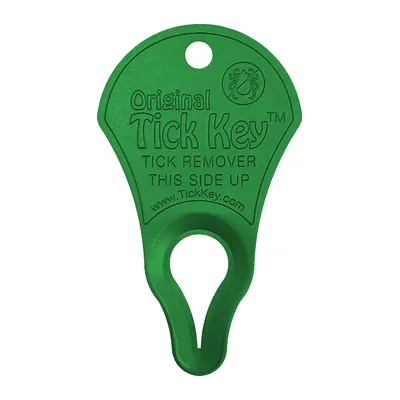
Original Tick Key (pack of 3)
An anodised aluminium plate with a teardrop slot: set it over the tick, then slide it flat along the skin to lift the tick out, head and all. Flat enough for any first aid kit.
View on Amazon (opens in a new tab)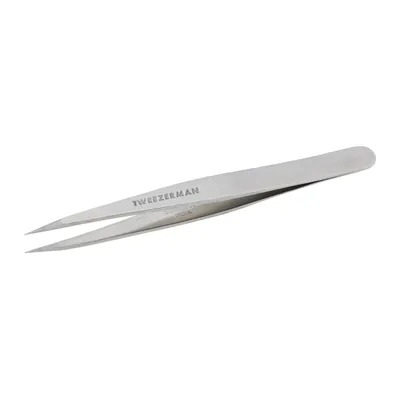
Tweezerman Point Tweezer
Stainless steel tweezers with finely tapered, hand-filed and aligned points: the fine tips grip a tick close to the skin, so you can pull it upwards slowly, without twisting.
View on Amazon (opens in a new tab)
Worth watching
An NHS pharmacist shows how to spot a tick on your skin, remove it safely and treat the bite, then how to prevent bites and when to seek help, all in under a minute and a half.
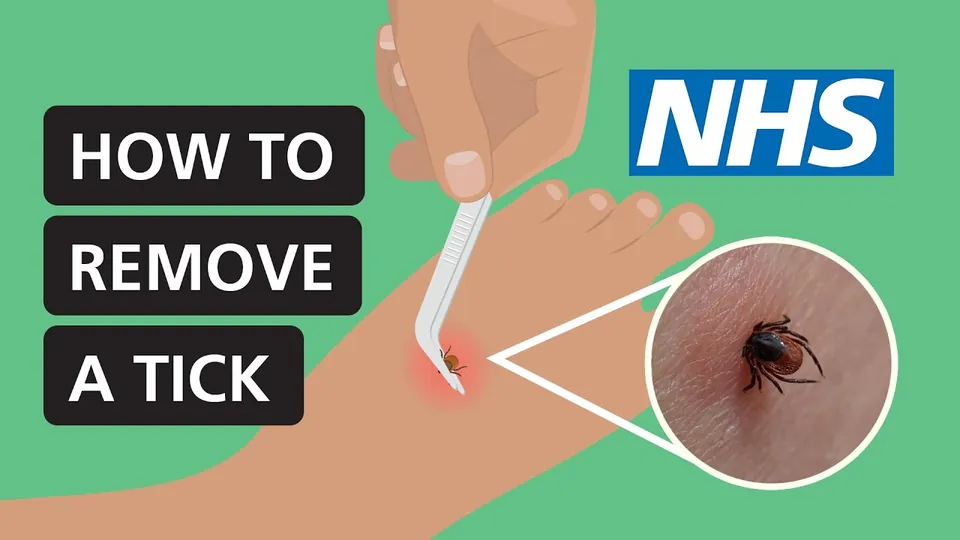
The video is hosted by YouTube (Google): nothing loads until you play it, and Google may then set cookies.
FAQs
How do I remove a tick without a tick-removal tool?
Use fine-tipped tweezers. Grasp the tick as close to the skin as possible and pull upwards slowly and firmly, without squeezing or crushing it, as the NHS advises; Ireland’s HPSC and Public Health Scotland add: without twisting. Don’t use a lit cigarette end, a match head, alcohol or petroleum jelly. Clean the bite with antiseptic or soap and water. Tools are sold by some pharmacies, vets and pet shops.
Should I see a GP after a tick bite?
Not automatically: the NHS says the chance of getting ill is low, and you need do nothing else unless you notice a rash or become unwell. Ask for an urgent GP appointment or contact NHS 111 if, within 3 months, you develop a round or oval rash or flu-like symptoms, and mention the bite. In Ireland, the HPSC says to visit your GP if symptoms such as a rash appear, and to mention the bite.
When are ticks most active?
Between spring and autumn, according to the UKHSA, although they are found all year round. They like moist places with leaf litter or longer grass: woodland, grassland, moorland, heathland and some parks and gardens. In Ireland, the HPSC notes that most Lyme disease cases occur in summer and autumn. So the check after a walk is worth keeping up from early spring to late autumn.
Do I need the tick-borne encephalitis vaccine?
In the UK, the NHS says the risk of TBE is very low. The vaccine is recommended if you’re visiting a country where the infection is common and plan outdoor activities, such as hiking or camping in risk areas of Austria, Switzerland or parts of Germany. You need at least 2 injections, 2 weeks apart, the first at least 1 month before you go, and you pay for it.
Should I send the tick off to be tested?
The UKHSA’s Tick Surveillance Scheme welcomes ticks by post to map where they live, but it identifies the species and does not test them for disease. It warns that results from commercial tick-testing services should not be used to decide on diagnosis or treatment. What counts is your skin and how you feel in the following weeks: a spreading rash or flu-like symptoms mean a visit to a GP.
Sources
- UK Health Security Agency (UKHSA), ‘Tick awareness’ leaflet, updated March 2023, accessed 28 October 2026. assets.publishing.service.gov.uk https://assets.publishing.service.gov.uk/media/642bec29fbe620000f17dbbe/Tick-awareness-A5-leaflet-April-2023.pdf ↩
- UK Health Security Agency (UKHSA), ‘Lyme disease: resources and guidance’, GOV.UK, updated 14 April 2022, accessed 28 October 2026. gov.uk https://www.gov.uk/government/collections/lyme-disease-guidance-data-and-analysis ↩
- HSE Health Protection Surveillance Centre (HPSC, Ireland), ‘Lyme disease’, information for the public, updated 5 February 2026, accessed 28 October 2026. hpsc.ie https://www.hpsc.ie/a-z/vectorborne/lymedisease/ ↩
- NHS, ‘Lyme disease’, page last reviewed 3 June 2025, accessed 28 October 2026. nhs.uk https://www.nhs.uk/conditions/lyme-disease/ ↩
- Public Health Scotland, ‘Let’s talk ticks: Lyme disease awareness’, blog, 13 May 2026, accessed 28 October 2026. publichealthscotland.scot https://publichealthscotland.scot/our-blog/2026/may/let-s-talk-ticks-lyme-disease-awareness/ ↩
- UK Health Security Agency (UKHSA), ‘Send a tick to UKHSA’s Tick Surveillance Scheme’, GOV.UK, updated 7 October 2025, accessed 28 October 2026. gov.uk https://www.gov.uk/guidance/tick-surveillance-scheme ↩
- NHS, ‘Tick-borne encephalitis (TBE)’, page last reviewed 19 July 2024, accessed 28 October 2026. nhs.uk https://www.nhs.uk/conditions/tick-borne-encephalitis/ ↩
- Department of the Taoiseach, ‘How to contact emergency services in Ireland’, gov.ie, updated 11 April 2025, accessed 28 October 2026. gov.ie https://www.gov.ie/en/department-of-the-taoiseach/services/how-to-contact-emergency-services-in-ireland/ ↩
- Department for Science, Innovation and Technology, Home Office and others, ‘999 and 112: the UK’s national emergency numbers’, GOV.UK, updated 1 April 2025, accessed 28 October 2026. gov.uk https://www.gov.uk/guidance/999-and-112-the-uks-national-emergency-numbers ↩
- UK Health Security Agency (UKHSA), ‘Tick-borne encephalitis: epidemiology, diagnosis and prevention’, GOV.UK, updated 17 August 2026, accessed 28 October 2026. gov.uk https://www.gov.uk/guidance/tick-borne-encephalitis-epidemiology-diagnosis-and-prevention ↩
- TravelHealthPro (National Travel Health Network and Centre, NaTHNaC), ‘Tick-borne encephalitis’ factsheet, last updated 16 May 2024, accessed 28 October 2026. travelhealthpro.org.uk https://travelhealthpro.org.uk/factsheets/tick-borne-encephalitis ↩
- Santé publique France, ‘Maladies vectorielles à tique : bien se protéger pendant la saison d’activité des tiques’ (in French), updated 2 August 2024, accessed 28 October 2026. santepubliquefrance.fr https://www.santepubliquefrance.fr/les-actualites/maladies-vectorielles-a-tique-bien-se-proteger-pendant-la-saison-dactivite-des-tiques ↩
- TravelHealthPro (NaTHNaC), ‘France’, country information, tick-borne encephalitis section, accessed 28 October 2026. travelhealthpro.org.uk https://travelhealthpro.org.uk/countries/france ↩
- Federal Office of Public Health (FOPH, Switzerland), ‘Tick-borne encephalitis (TBE)’, accessed 28 October 2026. bag.admin.ch https://www.bag.admin.ch/en/tick-borne-encephalitis-tbe ↩
- TravelHealthPro (NaTHNaC), ‘Austria’, country information, tick-borne encephalitis section, accessed 28 October 2026. travelhealthpro.org.uk https://travelhealthpro.org.uk/countries/austria ↩
- TravelHealthPro (NaTHNaC), ‘Germany’, country information, tick-borne encephalitis section, accessed 28 October 2026. travelhealthpro.org.uk https://travelhealthpro.org.uk/countries/germany ↩

Trail running, snow, water, nature and destinations
Nolwenn covers trail running, snow, water, nature and destinations for Outfarer. Curious about everything, from meteor showers to night-train timetables, she has a knack for unearthing the one detail that changes everything, and putting it in a single sentence.

 Guillaume Hoarau

