 Français (France)
 English (UK)
 English (US)
 Deutsch (Deutschland)

Contents
A field of cows between you and the next stile: do you walk on, or turn back? Most of the time, you walk on, calmly and at a distance. But the Health and Safety Executive (HSE), which regularly investigates incidents involving cattle and members of the public, some of them resulting in death or serious injury, names the two most common factors: cows with calves, and walkers with dogs [1]. That is where the rules are worth knowing.
This guide completes our guide to planning a walk. It gathers the advice of the HSE, the countryside codes of each nation and walkers’ organisations, starting with cattle, which graze many of the fields that British and Irish paths cross, then the guardian dogs you may meet if you walk in the Alps.
Cows with calves: the risk on British and Irish paths
What the HSE says, first. All large animals are potentially dangerous, and even normally placid cattle can become aggressive under stress: bad weather, illness, unusual disturbance, or maternal instincts aroused. Even a gentle knock from a cow can injure someone [1]. Cattle with calves at foot can be a risk because of those protective instincts, especially when a dog is present, and the HSE warns farmers that walkers may not realise it [1]. Suisse Rando, the Swiss walking paths association, puts the stakes plainly: suckler cows often weigh more than 600 kg and can run at up to 40 km/h (about 25 mph) [2].
Bulls are a matter of law. In England and Wales, the Wildlife and Countryside Act 1981 makes it an offence for the occupier of a field crossed by a public right of way to let a bull over ten months be at large in it, unless it is not of a recognised dairy breed, such as British Friesian, British Holstein or Jersey, and is out with cows or heifers [3]. What it means for you: a beef bull with its herd can lawfully be in a field you cross. The HSE asks farmers to put a sign at the gates when a bull, or cows with calves, are in such a field [1].
For the Ramblers, the walkers’ charity, cows with calves are the most common cause of problems for walkers. Look at the field from its edge before going in, they advise, and keep a good distance from the animals: if they are on the path, you are allowed to leave it to walk round them [4].
Crossing the field: the right moves, in order
The Countryside Code, the statutory guidance of Natural England and Natural Resources Wales, asks you to give livestock and horses plenty of space: their behaviour can be unpredictable, especially when they are with their young, and you could get hurt [5].
In Scotland, access rights extend to fields with farm animals, and the Scottish Outdoor Access Code, published by NatureScot, breaks the crossing down into a few steps, which the Ramblers echo [4, 6]:
- Look before you go in, and check what alternatives there are; with a dog, do not take it into a field where there are calves, lambs or other young farm animals [6, 7].
- Keep a safe distance and watch the animals carefully as you cross [6].
- Never come between a cow and her calf: the Access Code asks you to avoid separating them, and not to drive the animals over the land [8].
- Walk on quickly and quietly, without panicking: if you run, the Ramblers warn, the cattle may start running too [4].
- If cattle react aggressively and move towards you, keep calm, let your dog go and take the shortest, safest route out of the field [7].
Austria’s agriculture ministry says much the same in its ten rules for a safe holiday around cattle. If a cow approaches you, stay calm, don’t turn your back on it and give it a wide berth; at the first sign that the animals are unsettled, stay calm and leave the area quickly. And if grazing animals block the path, go round them, on foot or by bike, at the greatest possible distance, pushing the bike if necessary [9]. In England and Wales, the Countryside Code asks cyclists to slow down or stop for livestock [5].
With your dog: on the lead, until it’s time to let go
What the text says, for England and Wales. The Countryside Code calls it good practice to keep your dog on a lead around livestock wherever you are; on open access land and at the coast, it is a legal requirement, and between 1 March and 31 July a lead is compulsory on open access land even with no livestock about [5]. Under the Dogs (Protection of Livestock) Act 1953, the owner commits an offence if their dog attacks or worries livestock on agricultural land or, since 18 March 2026, on a road or path; a dog off the lead and not under close control in a field with sheep in it already counts as worrying [11]. And a farmer can shoot a dog that is attacking or chasing livestock [5].
What it means for you: the lead stays on until cattle come at you. Then let it go: releasing your dog makes it easier for you both to reach safety, says the Countryside Code [5], and taking it out of the situation will calm the cattle, add the Ramblers [4]. Our guide to walking with your dog covers the rest.
Walking in the Alps: the guardian dog
Walking in the French mountains in summer? On the high pastures, you are very likely to meet a A large dog that lives day and night with a flock of sheep or goats to keep predators and intruders away; in France it is often called a ‘patou’., warns France’s hiking federation (FFRandonnée). Massive and barking, it can be frightening, but it was selected to deter, not to attack, and it guards goats and cows as well as sheep [12].
Why are they there? Because of the wolf. The Luberon Regional Nature Park, in Provence, explains that its livestock farmers have to protect their flocks against the grey wolf, with guardian dogs that walkers may come across almost anywhere, even near villages. Trained to work on their own, often in groups, the dogs are not guided by voice [13]. To the dog, a walker is an intruder, says the FFRandonnée [14]: the whole point is to show it that you are no threat.
Its weapon is deterrence. A guardian dog comes to meet you, barking, to mark out a safety zone around the flock, then spends a few minutes ‘checking’ you to make sure you pose no threat; in most cases there is no problem, once you understand and accept its work. The first rule, in the Luberon park’s leaflet updated in March 2024: never walk through a flock, but round it, as widely as possible. If a dog comes up to you [13]:
- Don’t run or turn your back; don’t shout or make threatening gestures.
- Stay still and calm, facing the dog, and let it look you over without challenging it: don’t stare it in the eye, don’t stroke it.
- Talk to it calmly: the park even suggests telling it that it’s doing a good job and can go back to the sheep.
- Wait for the ‘check’ to end, then move off calmly, walking round the flock.
- On a bike, stop and get off: speed and the noise of the chain wind the dogs up. Wait for the end of the check, then push the bike round the flock.
- If a dog gets too pushy, put something between you and it, without sudden movements: rucksack, jacket or bike. If it stays aggressive, or the ground won’t let you go round, turn back: always leave the dog the last word.
- With your own dog, don’t pick it up or step in between; let the dogs communicate, and drop the lead if need be. Better still, the park suggests, leave it at home.
| Cow with a calf | Guardian dog | |
|---|---|---|
| The signal | She lowers her head, paws the ground or froths at the mouth | It comes up barking to ‘check’ you |
| The distance | Keep a safe distance, never between a cow and her calf | Walk round the flock as widely as possible |
| Your reaction | Keep calm and leave by the shortest, safest route | Stop, stay still and calm, don’t run |
| Your dog | On a lead; let it go if cattle come at you | On a lead; drop it if need be while the dogs communicate |
After Suisse Rando [2], the Scottish Outdoor Access Code [6, 7, 8] and the Luberon Regional Nature Park. [13]
Scotland, Northern Ireland and Ireland
The moves are the same everywhere; what changes is your right to cross the land, and the rules for the dog.
If something goes wrong
Once you are safe, the Ramblers suggest reporting an incident with cattle to the local authority and to the HSE, with the location (a grid reference, path number or farm name), a description of what happened and any photographs. If an animal injures you, someone with you or your dog, report it to the police straight away [4].
Abroad, the procedure changes. In France, the Luberon park says an incident with a guardian dog, a nip, a bite or an injury to your dog, can be reported to the département’s directorate of territories (DDT), by filling in an incident form [13].
In the end, it all comes down to one sentence: a herd is walked round, not through. The cow lowering her head is defending her calf, the dog barking at you is doing its job; yours is to give them room, without hurrying. And if you meet the farmer or the shepherd, a friendly word costs nothing: in the Luberon, the park reminds walkers that shepherds have a great deal of work and can’t look after every passing visitor [13].
Kit related to this article
No affiliation: no commission, no sponsored products.
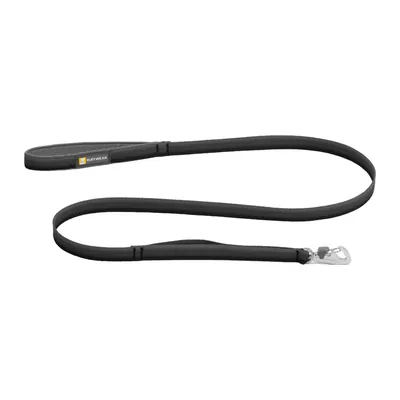
Ruffwear Front Range Leash
A fixed 1.5 m lead with a padded handle and a locking clip: it keeps your dog close where leads are required on the trail and whenever you pass livestock.
View on Amazon (opens in a new tab)
FAQs
What should I do if cows walk towards me?
Keep calm and keep walking, without running: if you panic or run, the Ramblers warn, cattle may start running too. Keep a good distance and never come between a cow and her calf. If cattle react aggressively and move towards you, the Scottish Outdoor Access Code says to let your dog go and take the shortest, safest route out of the field.
Can a farmer keep a bull in a field with a public footpath?
In England and Wales, only in some cases. The Wildlife and Countryside Act 1981 bans bulls over ten months from fields crossed by a public right of way, unless they are not of a recognised dairy breed and are out with cows or heifers. The HSE adds that dairy bulls must never be kept in such fields, and asks farmers to put up a sign when a bull is there.
Should I let go of my dog if cattle chase us?
Yes. The Countryside Code advises letting your dog off the lead if you feel threatened by livestock: releasing it makes it easier for you both to reach safety. The Scottish Outdoor Access Code and Austria’s rules for alpine pastures say the same. The rest of the time, keep it on a short lead near livestock, and keep it out of fields with calves or lambs.
What should I do if a guardian dog runs at me barking?
Stop and stay calm, facing the dog, without running or turning your back. It is coming to check that you are not a threat: let it look you over without staring at it or stroking it, and talk to it calmly. When it goes back to the flock, move off slowly, walking round the sheep as widely as possible. On a bike, get off and push it, advises France’s Luberon park.
Can I take my dog onto the hills in Ireland?
Often not. Mountaineering Ireland says that, because of farm animals, dogs are not welcome on farmland and in most upland areas, and asks walkers not to take them onto the hills. Most land is privately owned. Under the Control of Dogs Act 1986, a dog must be kept under effectual control, and its owner commits an offence if it worries livestock.
Sources
- Health and Safety Executive (HSE), ‘Cattle and public access in England and Wales: advice for farmers, landowners and other livestock keepers’, Agriculture Information Sheet No 17EW, revised May 2019, accessed 28 October 2026. hse.gov.uk https://www.hse.gov.uk/pubns/ais17ew.pdf ↩
- Suisse Rando, ‘Pour des rencontres paisibles entre vaches et randonneurs’ (in French), press release, Bern, 19 May 2021, accessed 28 October 2026. swisshiking.ch https://www.swisshiking.ch/fr/media/download/1aff805c5f0ed76ed57722a123b92a9a76224f47 ↩
- Wildlife and Countryside Act 1981, section 59, legislation.gov.uk, accessed 28 October 2026. legislation.gov.uk https://www.legislation.gov.uk/ukpga/1981/69/section/59 ↩
- The Ramblers, ‘How to walk through a field of animals’, accessed 28 October 2026. ramblers.org.uk https://www.ramblers.org.uk/go-walking-hub/how-walk-through-field-animals ↩
- Natural England and Natural Resources Wales, ‘The Countryside Code: advice for countryside visitors’, GOV.UK, updated 26 May 2023, accessed 28 October 2026. gov.uk https://www.gov.uk/government/publications/the-countryside-code/the-countryside-code-advice-for-countryside-visitors ↩
- NatureScot, Scottish Outdoor Access Code, ‘Farm animals’, updated 11 August 2023, accessed 28 October 2026. outdooraccess-scotland.scot https://www.outdooraccess-scotland.scot/practical-guide-all/farm-animals ↩
- NatureScot, Scottish Outdoor Access Code, ‘Dog walking’, updated 14 July 2025, accessed 28 October 2026. outdooraccess-scotland.scot https://www.outdooraccess-scotland.scot/practical-guide-all/dog-walking ↩
- NatureScot, Scottish Outdoor Access Code, ‘Unfenced grassland with farm animals’, updated 11 August 2023, accessed 28 October 2026. outdooraccess-scotland.scot https://www.outdooraccess-scotland.scot/practical-guide-all/farm-animals/unfenced-grassland-farm-animals ↩
- Austrian Federal Ministry of Agriculture and Forestry, Climate and Environmental Protection, Regions and Water Management (BMLUK), ‘Mind the Cows: ten rules for a safe and enjoyable holiday around cattle’, Sichere Almen campaign leaflet, Vienna, May 2025, accessed 28 October 2026. bmluk.gv.at https://www.bmluk.gv.at/dam/jcr:4f9b10c0-5d2d-46c9-b9dc-6f679c404dae/Folder_Sichere%20Almen_EN_2026_BF_.pdf ↩
- NatureScot, Scottish Outdoor Access Code, ‘Fields with young animals present’, updated 11 August 2023, accessed 28 October 2026. outdooraccess-scotland.scot https://www.outdooraccess-scotland.scot/practical-guide-all/farm-animals/fields-young-animals-present ↩
- Dogs (Protection of Livestock) Act 1953, section 1, as amended by the Dogs (Protection of Livestock) (Amendment) Act 2025, legislation.gov.uk, accessed 28 October 2026. legislation.gov.uk https://www.legislation.gov.uk/ukpga/Eliz2/1-2/28/section/1 ↩
- French Hiking Federation (FFRandonnée), ‘Quel comportement adopter face aux chiens de troupeau ?’ (in French), 15 July 2023, accessed 28 October 2026. ffrandonnee.fr https://www.ffrandonnee.fr/s-informer/actualites/quel-comportement-adopter-face-aux-chiens-de-troupeau ↩
- Luberon Regional Nature Park (France), ‘Troupeaux et chiens de protection : quelques réflexes à adopter’ (in French), ‘Luberon attitude’ leaflet, updated March 2024, accessed 28 October 2026. parcduluberon.fr https://www.parcduluberon.fr/en/pnrl_jadoptelaluberonattitude_chiens_de_protection_2024-2 ↩
- French Hiking Federation (FFRandonnée), ‘Comment se comporter face au patou, le chien de protection des troupeaux’ (in French), 18 June 2022, accessed 28 October 2026. ffrandonnee.fr https://www.ffrandonnee.fr/s-informer/actualites/comment-se-comporter-face-au-patou-le-chien-de-protection-des-troupeaux ↩
- Health and Safety Executive (HSE), ‘Cattle and public access in Scotland’, Agriculture Information Sheet No 17S, first published August 2012, accessed 28 October 2026. hse.gov.uk https://www.hse.gov.uk/pubns/ais17s.pdf ↩
- nidirect, ‘The Countryside Code’ (Northern Ireland), accessed 28 October 2026. nidirect.gov.uk https://www.nidirect.gov.uk/articles/countryside-code ↩
- Mountaineering Ireland, ‘Do the Right Thing’, accessed 28 October 2026. mountaineering.ie https://mountaineering.ie/content/DoTheRightThing/186 ↩
- Control of Dogs Act 1986, sections 1, 9 and 23, revised Act, Law Reform Commission (Ireland), updated to 9 June 2025, accessed 28 October 2026. revisedacts.lawreform.ie https://revisedacts.lawreform.ie/eli/1986/act/32/revised/en/html ↩
- Department for Science, Innovation and Technology, Home Office and others, ‘999 and 112: the UK’s national emergency numbers’, GOV.UK, updated 1 April 2025, accessed 28 October 2026. gov.uk https://www.gov.uk/guidance/999-and-112-the-uks-national-emergency-numbers ↩
- Mountain Rescue England and Wales, ‘In case of emergency’, accessed 28 October 2026. mountain.rescue.org.uk https://www.mountain.rescue.org.uk/how-to-call-out-mr/ ↩
- Department of the Taoiseach, ‘How to contact emergency services in Ireland’, gov.ie, updated 11 April 2025, accessed 28 October 2026. gov.ie https://www.gov.ie/en/department-of-the-taoiseach/services/how-to-contact-emergency-services-in-ireland/ ↩

Fact-checking, regulations and safety
Arnaud Couderc reviews our contributors’ articles and writes for Outfarer about regulations, safety, fishing, the sea and outdoor pursuits. He traces every rule back to its official text and every figure to its source, so that you set off with sound benchmarks.

 Guillaume Hoarau

