 Français (France)
 English (UK)
 English (US)
 Deutsch (Deutschland)

Contents
Day two of the walk, a little after lunch. A faint prickle at the heel, nothing to worry about, it’ll keep until the next stop. And it does keep, after a fashion: by the next stop there’s a bubble, and every remaining step is counted. The blister is the most ordinary nuisance a walker meets, and one of the easiest to avoid, provided you deal with it before you set off.
A blister comes from repeated rubbing, and heat and moisture help it form [1]. Prevention therefore comes down to four habits: boots in the right size and already broken in, socks that stay dry, protection on the vulnerable spots, and a stop as soon as the skin starts to heat up. This guide expands on that part of the ‘Get your kit together and pack your rucksack’ step in our guide to planning a walk, with what the studies actually measured, and in whom.
Why a blister forms
For the Assurance maladie, France’s national health insurance, a blister is a lifting of the epidermis, the outer layer of the skin, forming a pocket filled with clear fluid. Under repeated rubbing, the epidermis reddens, then separates from the dermis; the blister then protects the wound underneath. Heat and moisture, heavy sweating for example, encourage it to form [1].
US Army researchers, whose recruits walk a great deal under heavy loads, set out the mechanics in a review published in 1995. The greater the friction force, the fewer rubs it takes for a blister to appear. Damp skin rubs more; very dry or very wet skin, less. The sole of the foot, with its thick, tightly held outer layer, is among the most exposed areas, and sustained effort or a heavy load increase the risk [2].
How your foot presses down matters too. In a small 2010 study of 33 people, those prone to blisters had higher pressures and Forces that pull the skin parallel to its surface, like a hand sliding across a table and dragging the tablecloth with it. under the sole than the others [3]. And history weighs heavily: among 533 runners surveyed after trail races in France in 2021, those who had had blisters before were far more likely to have them at the finish [4]. If you get them often, this guide concerns you twice over.
Boots in the right size, already shaped to your feet
The first line of defence is the boot. The Assurance maladie asks for footwear suited to the shape of your foot, advises against wearing a new pair for too long, and suggests regularly checking the inside by hand for a split seam or torn leather [5]. The FFRandonnée, France’s hiking federation, calls this the most important point of all [6].
The FFRandonnée’s federation doctor, Dr Catherine Kabani, explains the sizing trap: if the boot is too big, the foot moves and rubs, with blisters at the front of the foot on descents and at the back on climbs. And don’t count on breaking in to rescue a boot that pinches: in her view, it is not the boot that will adapt to your foot [7].
For the rest, trying boots on in the afternoon, choosing a category to suit the terrain and breaking them in before the big day, see our guide to walking boots. One point, though, that may ruffle devotees of the high ankle: for Dr Kabani, the height of the ankle makes no difference to the risk of blisters [7].
Socks: what the studies say
This is the department of received wisdom. Studies do exist, but they are rare, often military, or carried out on runners. Here is what they measured.
Cotton versus acrylic, first. In 1990, a double-blind study had 35 long-distance runners run in two socks identical in every respect except the fibre: the 100% acrylic socks produced fewer blisters, and smaller ones, than the 100% cotton socks [9]. Dr Kabani, for her part, advises against thick cotton socks of the ‘tennis’ type, which encourage sweating, as synthetic materials also do in her view; she prefers lisle in summer, a very fine cotton, fine wool or breathable technical fabrics [7].
Moisture, above all. Among walkers, the material seems to matter less than the water. In 2022, Spanish researchers examined 203 walkers on the Camino de Santiago, on the Camino Francés, after an average of about 250 km on foot: 68.5% had blisters. The proportion of natural or synthetic fibres made no difference, but walking in wet socks multiplied the risk by 1.94. The authors recommend changing socks during long stages [10]. If you’re setting off on the Camino de Santiago, a spare pair weighs less than a blister.
| Prevention method | Study and population | People | Result measured |
|---|---|---|---|
| 100% acrylic rather than 100% cotton socks | 1990, long-distance runners | 35 | Fewer blisters, and smaller ones, with acrylic |
| Natural or synthetic fibres | 2022, walkers on the Camino de Santiago | 203 | No link with blisters; wet socks: risk multiplied by 1.94 |
| Thick wool and polypropylene sock over a polyester liner sock | 1996, US Marine Corps recruits | 357 | 40% with blisters, against 69% with the standard sock |
| Antiperspirant with 20% aluminium chloride, on at least three evenings beforehand | 1998, officer cadets, 21 km march | 269 | 21% with blisters, against 48% with the placebo; irritated skin in 57%, against 6% |
| Antiperspirant with emollients | 1995, men walking in the heat carrying 21 kg | 23 | No difference |
| Paper tape on a randomly chosen foot | 2010-2011, 250 km ultramarathon | 90 | No significant effect |
| Paper tape on a randomly chosen foot | 2014, 250 km ultramarathon | 128 | 40% fewer blisters on the taped areas, against untaped areas of the same foot |
Each result applies to its own population and conditions. Based on the study abstracts. [9, 10, 11, 12, 13, 14, 15]
Two pairs or two layers?
The double layer has its fans. Among 357 US Marine Corps recruits in 1996, a thick, dense wool and polypropylene sock, worn over a thin polyester liner sock, brought blisters down to 40% of recruits, against 69% with the standard military sock. The liner on its own, slipped under the standard sock, did not reduce the number of blisters (77%), only the cases serious enough to need treatment [11]. So it was the combination that made the difference, not the second layer as such. So-called anti-blister socks, with a double knit, rest on a similar idea: the two layers rub against each other rather than against your skin, explains Dr Kabani [7].
A systematic review published in 2017 sorted through the evidence: of 11 studies included on socks, antiperspirants and barriers, only 2 deserved moderate confidence. Good-quality evidence is lacking, its authors conclude, and only paper tape may be effective [16]. My view: walking socks that fit you, suited to the activity as the Assurance maladie asks [5], and above all a dry spare pair in the rucksack.
Lacing: locking the heel in place
A heel that rises and falls inside the boot with every step is a blister in the making. Scarpa, which makes walking boots, suggests that heel blisters can come from a boot that holds the heel poorly, and proposes adjusting the lacing, starting from a boot in the right size [17]. Its simplest fix: a A simple knot with one extra turn: it holds the tension without slipping. at the bottom of the ankle, before lacing the top. The most secure, the heel lock, takes four steps [17].
Scarpa presents it as a way of lacing firmly while spreading the pressure rather than concentrating it under a knot, with one drawback: it needs slightly longer laces. Another of the manufacturer’s variations, lacing to the top and then back down, can on the contrary create a pressure point on the ankle [17]. Try it at home, not in the car park at the start.
Dry feet, protected skin, short nails
Keep your feet dry. Blisters develop more easily on damp skin, the Assurance maladie points out, and it advises changing socks twice a day if you sweat a lot [5]. At the lunch stop, taking your boots off for a few minutes and putting on the spare pair costs nothing.
Antiperspirant and powder: mixed results. Among officer cadets at the West Point military academy in 1998, a 20% aluminium chloride solution applied on at least three evenings before a 21 km march cut blisters from 48% to 21%, in 269 people; but 57% of users had irritated skin, against 6% with the placebo [12]. Another antiperspirant, with added emollients, made no difference in 23 men walking in the heat with 21 kg on their backs [13], and the 1995 review found no effect from drying powders [2]. If the idea tempts you, ask a pharmacist for advice, well before you set off.
Prepare your skin. Dr Kabani advises massaging your feet for several days before the walk with a suitable product, to soften and moisturise the skin [7]. The 1995 military review also notes that repeated low-intensity rubbing makes the epidermis thicken, which may reduce the risk [2]: one more reason to put in a few hours’ walking before the big day.
Cut your nails. The Assurance maladie advises cutting them straight across, leaving only 2 to 3 mm beyond the toe, to avoid small injuries and ingrown toenails [8]. A nail too long that knocks against the end of the boot at every step downhill is not something anyone misses.
On the way: stop at the first hot spot
The principle fits in one sentence: you stop as soon as it gets hot. At this An area of skin that reddens and burns from rubbing: the first stage of a blister., the FFRandonnée asks you to act as early as possible, with a dressing, at the first burning sensation [6]; Dr Kabani sees it as the first stage of a blister, the redness stage [7]. Waiting for the next stop often means missing the right moment.
The first days count double, at least among the ultramarathon runners studied: in the two paper tape studies, 89% and then 80% of blisters had appeared by day 2, or by the end of stage 2 [14, 15]. On a multi-day walk, keep the dressings within reach from the first morning.

At the first sign of heat, in this order:
- stop and take your boot off, even if the group is moving on in five minutes;
- dry the skin and, if your socks are wet, change them [10];
- put a protective dressing on the area that is turning red [18];
- run your hand around the inside of the boot: a small stone, a split seam or torn leather is enough to injure you [8];
- re-lace, holding the heel more firmly if that’s what is rubbing [17].
Dressings belong in the first aid kit on our day walk kit list; add a spare pair of socks.
A blister has formed: basic care
Despite everything, the bubble is there. The NHS says blisters often heal on their own within a week, and that you won’t usually need to see a GP; the steps below are the ones it recommends, which depend on the state of the blister [20].
- Still intact: don’t burst it yourself. Keep it as clean as possible, washing the skin gently and patting it dry, and cover it with a soft plaster or a padded dressing.
- Burst: wash your hands before touching it, let the fluid drain, then cover it with a plaster or dressing. Don’t peel off the skin, and don’t pick at the edges of what remains.
- Large or painful: a GP might burst it with a sterilised needle. A pharmacist can recommend a dressing to cover it while it heals: a hydrocolloid dressing, a moist dressing, protects the blister, helps reduce pain and speeds up healing.
Until it heals, don’t wear the boots that caused it [20]. Not every health authority says the same about bursting, however: in France, the Assurance maladie considers it useful to drain a large, painful blister that is still intact, using a sterilised needle and keeping the skin that covers it [18]. It puts healing at about 1 to 2 weeks [1], and Dr Kabani also recommends a colloid, or hydrocolloid, dressing [7].
In the end, a blister is won or lost before you set off: boots in your size and already worn, dry socks and a spare pair, a few dressings in the first aid kit. The good habit, after that, is to stop as soon as it gets hot, even when the summit is only twenty minutes away. To dress the rest of you, follow the three-layer system, and for everything else in your preparation, the steps in our guide to planning a walk.
Worth watching
On a bivvy trip in Snowdonia, the Outdoors Magic editor shares his foot-care routine against blisters, including well-fitting boots and an alternative lacing method.
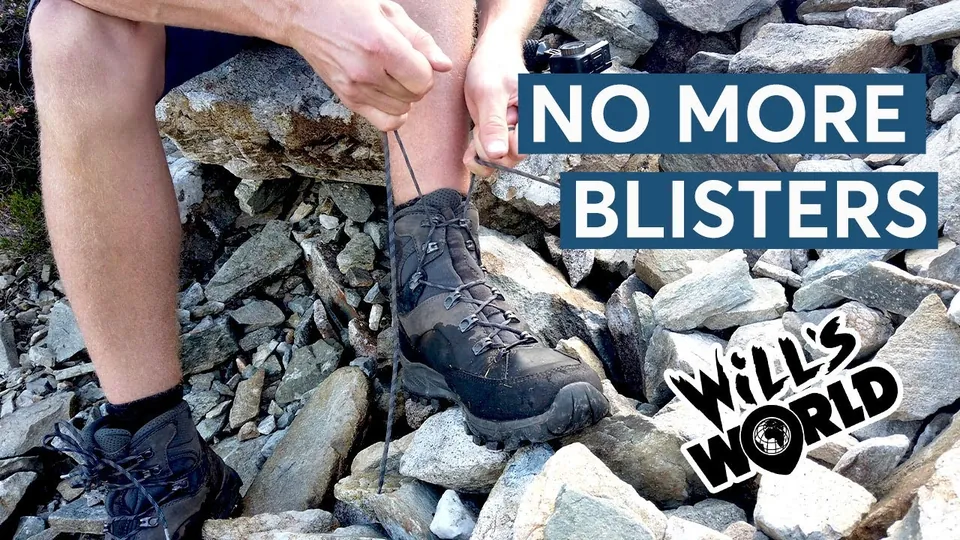
The video is hosted by YouTube (Google): nothing loads until you play it, and Google may then set cookies.
FAQs
Should you burst a blister on your foot?
Not yourself, says the NHS: keep it clean and covered with a soft plaster or padded dressing; a GP might burst a large or painful one with a sterilised needle. If it bursts on its own, let the fluid drain and leave the skin in place. In France, the Assurance maladie, by contrast, considers it useful to drain a large, painful blister with a sterilised needle, keeping the skin on top.
Which socks help prevent blisters?
Walking socks that fit you and stay dry. Among 203 walkers on the Camino de Santiago, the proportion of natural or synthetic fibres had no effect, but wet socks multiplied the risk by 1.94. The federation doctor of the FFRandonnée, France’s hiking federation, advises against thick cotton socks of the ‘tennis’ type. Take a spare pair.
Should you wear two pairs of socks?
Not necessarily. Among 357 US Marine Corps recruits, a thin polyester liner under the standard sock did not reduce blisters; combined with a thick, dense wool and polypropylene sock, it brought them down from 69% to 40% of recruits. Double-knit socks rest on a similar idea: the two layers rub against each other.
When should you get a blister seen to?
The NHS advises contacting NHS 111 if a blister is very painful or keeps coming back, looks infected (hot, with green or yellow pus, or red skin around it), or if several appear for no reason. With diabetes, see a GP or diabetes nurse about blisters on your feet. France’s Assurance maladie adds peripheral arterial disease and a weakened immune system.
How long does a blister take to heal?
The NHS says blisters often heal on their own within a week; the Assurance maladie, in France, puts healing at about 1 to 2 weeks. In the meantime, avoid the rubbing that caused it: the NHS advises against wearing the shoes that caused the blister until it has healed.
Sources
- Assurance maladie (ameli.fr, France’s national health insurance), ‘Reconnaître une ampoule ou une cloque’ (in French), 22 January 2025, accessed 8 November 2026. ameli.fr https://www.ameli.fr/assure/sante/themes/ampoules-cloques/reconnaitre-ampoule-cloque ↩
- J. J. Knapik et al., ‘Friction blisters. Pathophysiology, prevention and treatment’, Sports Medicine, 20(3), 1995, US Army review (abstract), accessed 8 November 2026. pubmed.ncbi.nlm.nih.gov https://pubmed.ncbi.nlm.nih.gov/8570998/ ↩
- M. Yavuz and B. L. Davis, ‘Plantar shear stress distribution in athletic individuals with frictional foot blisters’, Journal of the American Podiatric Medical Association, 100(2), 2010, 33 participants (abstract), accessed 8 November 2026. pubmed.ncbi.nlm.nih.gov https://pubmed.ncbi.nlm.nih.gov/20237363/ ↩
- J.-B. Damoisy et al., ‘Epidemiology, prevention methods, and risk factors of foot blisters in French trail ultramarathons’, Journal of Sports Medicine and Physical Fitness, 63(8), 2023, 533 runners (abstract), accessed 8 November 2026. pubmed.ncbi.nlm.nih.gov https://pubmed.ncbi.nlm.nih.gov/37166255/ ↩
- Assurance maladie (ameli.fr), ‘Éviter les ampoules et les cloques’ (in French), 22 January 2025, accessed 8 November 2026. ameli.fr https://www.ameli.fr/assure/sante/themes/ampoules-cloques/eviter-ampoules-cloques ↩
- Fédération française de la randonnée pédestre (FFRandonnée, France’s hiking federation), ‘Les ampoules : comment les éviter ?’ (in French), 5 January 2024, accessed 8 November 2026. ffrandonnee.fr https://www.ffrandonnee.fr/s-informer/actualites/les-ampoules-comment-les-eviter ↩
- Dr Catherine Kabani, the FFRandonnée’s federation doctor, ‘Ampoules : comment les éviter ?’, Doc du Sport, article shared by the FFRandonnée on 5 January 2024 (in French), accessed 8 November 2026. docdusport.com https://www.docdusport.com/ampoules-comment-les-eviter/ ↩
- Assurance maladie (ameli.fr), ‘Comment prendre soin de ses pieds ?’ (in French), accessed 8 November 2026. ameli.fr https://www.ameli.fr/assure/sante/bons-gestes/quotidien/prendre-soin-pieds ↩
- K. M. Herring and D. H. Richie, ‘Friction blisters and sock fiber composition. A double-blind study’, Journal of the American Podiatric Medical Association, 80(2), 1990, 35 long-distance runners (abstract), accessed 8 November 2026. pubmed.ncbi.nlm.nih.gov https://pubmed.ncbi.nlm.nih.gov/2304016/ ↩
- E. Chicharro-Luna et al., ‘The influence of sock composition on the appearance of foot blisters in hikers’, Journal of Tissue Viability, 31(2), 2022, 203 walkers on the Camino de Santiago (abstract), accessed 8 November 2026. pubmed.ncbi.nlm.nih.gov https://pubmed.ncbi.nlm.nih.gov/35144880/ ↩
- J. J. Knapik et al., ‘Influence of boot-sock systems on frequency and severity of foot blisters’, Military Medicine, 161(10), 1996, 357 US Marine Corps recruits (abstract), accessed 8 November 2026. pubmed.ncbi.nlm.nih.gov https://pubmed.ncbi.nlm.nih.gov/8918120/ ↩
- J. J. Knapik et al., ‘Influence of an antiperspirant on foot blister incidence during cross-country hiking’, Journal of the American Academy of Dermatology, 39(2), 1998, West Point officer cadets (abstract), accessed 8 November 2026. pubmed.ncbi.nlm.nih.gov https://pubmed.ncbi.nlm.nih.gov/9704829/ ↩
- K. Reynolds et al., ‘Effects of an antiperspirant with emollients on foot-sweat accumulation and blister formation while walking in the heat’, Journal of the American Academy of Dermatology, 33(4), 1995, 23 men (abstract), accessed 8 November 2026. pubmed.ncbi.nlm.nih.gov https://pubmed.ncbi.nlm.nih.gov/7673497/ ↩
- G. S. Lipman et al., ‘A prospective randomized blister prevention trial assessing paper tape in endurance distances (Pre-TAPED)’, Wilderness & Environmental Medicine, 25(4), 2014, 90 runners analysed (abstract), accessed 8 November 2026. pubmed.ncbi.nlm.nih.gov https://pubmed.ncbi.nlm.nih.gov/25443754/ ↩
- G. S. Lipman et al., ‘Paper Tape Prevents Foot Blisters: A Randomized Prevention Trial Assessing Paper Tape in Endurance Distances II (Pre-TAPED II)’, Clinical Journal of Sport Medicine, 26(5), 2016, 128 runners (abstract), accessed 8 November 2026. pubmed.ncbi.nlm.nih.gov https://pubmed.ncbi.nlm.nih.gov/27070112/ ↩
- R. M. Worthing et al., ‘Prevention of Friction Blisters in Outdoor Pursuits: A Systematic Review’, Wilderness & Environmental Medicine, 28(2), 2017 (abstract), accessed 8 November 2026. pubmed.ncbi.nlm.nih.gov https://pubmed.ncbi.nlm.nih.gov/28602272/ ↩
- Scarpa (UK), ‘The Best Lacing techniques for Walking Boots’, manufacturer’s blog, accessed 8 November 2026. scarpa.co.uk https://www.scarpa.co.uk/blogs/blog/the-best-lacing-techniques-for-walking-boots ↩
- Assurance maladie (ameli.fr), ‘Ampoules : que faire pour les soigner et quand consulter ?’ (in French), 22 January 2025, accessed 8 November 2026. ameli.fr https://www.ameli.fr/assure/sante/themes/ampoules-cloques/que-faire-quand-consulter ↩
- N. Hamnerius et al., ‘Colophonium-related Allergic Contact Dermatitis Caused by Medical Adhesive Tape Used to Prevent Skin Lesions in Soldiers’, Acta Dermato-Venereologica, 103, 2023, 26 Swedish conscripts (abstract), accessed 8 November 2026. pubmed.ncbi.nlm.nih.gov https://pubmed.ncbi.nlm.nih.gov/38059803/ ↩
- NHS, ‘Blisters’, page last reviewed 22 November 2023, accessed 8 November 2026. nhs.uk https://www.nhs.uk/conditions/blisters/ ↩
- NHS, ‘Complications of type 1 diabetes’, page last reviewed 31 October 2024, accessed 8 November 2026. nhs.uk https://www.nhs.uk/conditions/type-1-diabetes/complications/ ↩
- NHS, ‘Complications of type 2 diabetes’, page last reviewed 10 February 2025, accessed 8 November 2026. nhs.uk https://www.nhs.uk/conditions/type-2-diabetes/complications/ ↩

Camping, wild camping, bushcraft and hiking
Guillaume Hoarau writes for Outfarer about camping, wild camping, bushcraft and hiking. A survival-skills enthusiast and a collector of old field manuals, he likes clear explanations, lists that earn their place and other people’s stories, which he tells well.


