 Français (France)
 English (UK)
 English (US)
 Deutsch (Deutschland)

Saturday morning, the boot wall of an outdoor shop: forty pairs in a row, labels reading ‘B1’, ‘B2’ and ‘A/B’ that belong in the vitamin aisle, and a shop assistant asking where you plan to walk. It’s the only question that matters: boots are chosen for the ground, not for the colour or the promise on the box.
It isn’t just about comfort. In Scotland, a slip or trip played a part in 152 of the 491 mountaineering incidents attended by mountain rescue teams in 2025, more than any other factor, according to Scottish Mountain Rescue. The ankle was the most common injury site [1]. In Switzerland, the Council for Accident Prevention (BFU) puts most mountain walking accidents down to trips and slips. It asks for sturdy boots with a non-slip, well-treaded sole [2], and Mountaineering Scotland for soles that grip on rock, grass and mud [3].
The upper: low, mid or high cut
The upper wraps your foot and ankle. Approach shoes or soft fabric boots are fine on simple tracks, says Mountaineering Ireland. Rougher ground, especially in poor weather, calls for a sturdier mountain walking boot: water resistant, with an aggressive tread, medium ankle support and, above all, a sole that resists twisting. Fabric boots often grip poorly on wet, grassy slopes, and in winter, light fabric boots or trainers greatly increase the risk of a slip or fall [4].
The BFU sorts boots the same way: light walking shoes for yellow-waymarked paths, trekking boots that wrap the ankle for mountain paths, stiff mountain boots that take crampons for alpine routes [2]. A mid-cut boot is a compromise. The German Alpine Club (DAV) notes that the soft, mid-height cuff of light mountain boots gives mobility, but little support under a very heavy rucksack [5]. The heavier the load and the rougher the ground, the higher the cut.
The sole: grip and stiffness
Two qualities count underfoot. Grip first: a non-slip sole with a well-defined tread, as the BFU asks [2].
Then stiffness. A flexible sole bends with the path, comfortable on easy ground; a stiff sole shields your foot from stones, holds on the edge of a step and takes crampons. Most summer walking boots are designed to flex for comfort: their midsole isn’t rigid enough for crampons, and softer uppers can compress under crampon straps, causing discomfort and cold feet, explains the British Mountaineering Council (BMC) [6]. That’s why, in the categories below, the sole stiffens as the cuff rises [5].
The A to D categories: a European yardstick
Many boot labels also carry a letter from A to D. The German Alpine Club explains that walking and mountain boots are sorted by use into these categories, introduced in the 1970s. Category A covers models with a soft sole and a low cut, comfortable on easy paths; category D, models with a stiff sole and a high, stable cuff, for hard routes in the Western Alps or expeditions [5]. Intermediate categories sit in between. The German maker Meindl says the system was devised within the family firm in 1975 to classify its boots, and that many manufacturers now use it. Its UK site sets out the grid like this [7]:
| Category | Terrain | Crampons |
|---|---|---|
| A | Everyday walking, trails and lower-level paths | No |
| A/B | Leisure and hill walking: footpaths and lower hills | No |
| B | Demanding walks in the Lake District, North Wales and Scotland; lower-level paths in the Alps or Pyrenees in summer | No |
| B/C | Multi-day trips, high mountains, poor paths, scree, fixed-rope routes; winter walking in Scotland | Occasional use |
| C | Mountains: unmarked routes, scree, glaciers; Scottish winters | Yes |
| D | High-level mountaineering, expeditions to the high Alps and the Himalayas | Fully compatible |
Based on Meindl’s UK grid, which mentions crampons only from B/C upwards; other makers grade their own models. [7]
These categories are a manufacturer’s yardstick: they describe the use each maker intends for its own models [7]. Between two categories, choose for your most demanding walk, not your most frequent one. Meindl’s advice runs the same way: if in doubt, go for the sturdier boot, which covers a wider range of uses [7]. And look closely at light mountain boots, which are hard to classify because they blend stability and agility, notes the DAV [5].
Crampons and the B0 to B3 ratings
Crampons only go on boots designed for them: if the sole isn’t stiff, the boot bends and the crampon can fall off, warns the BMC. It rates walking boots from B0 to B3 and crampons from C1 to C3, and calls a B1 boot the absolute minimum for crampons [6]:
| Boot | What it is | Crampons |
|---|---|---|
| B0 | Summer walking boot, designed to flex for comfort | Unsuitable |
| B1 | Reasonably stiff sole, for crossing a short patch of snow or ice at lower levels in the shoulder seasons | C1 only |
| B2 | Stiff four-season mountaineering boot | All day; likely to take a heel clip, not just a heel basket |
| B3 | Technical boot, rigid in sole and upper, for mountaineering and ice climbing | C3, and also C2 and C1 |
From the British Mountaineering Council (BMC). [6]
On the crampon side, a C1 is a flexible walking crampon held on with straps and toe and heel baskets, and a C3 a technical climbing crampon fixed with a heel clip [6]. Micro-spikes are no substitute on serious ground. The BMC keeps them for flat or gently sloping paths with ice or compacted snow, and warns that they often won’t give enough security where a slip could become a long slide or a fall [6].
On the A to D scale, Meindl’s grid starts crampons at B/C, for occasional use [7], and the DAV rates light mountain boots as conditionally compatible with semi-automatic crampons [5]. When you buy crampons, take your boots along, says the BMC: the two must suit each other and be adjusted together [6].
Fitting and breaking in
Try boots on in the afternoon or evening: your feet swell a little over the day, as they do at the end of a walk, say Mountaineering Ireland, Meindl and the DAV [4, 7, 5]. The DAV suggests walking around in them for at least 10 to 15 minutes, the only way to tell whether they really fit [5]. Mountaineering Ireland adds a slope to walk up and down, and a loaded rucksack, which changes the shape of your foot [4]. Every maker builds on its own lasts, the foot-shaped forms a boot is made around, and they can vary between models [5]: there’s no skipping the fitting. Back home, Meindl suggests wearing them indoors first to check the size [7].
New boots need wearing in. Mountaineering Ireland suggests breaking in stiffer boots on progressively longer walks, and calls it very risky to take new boots on a long trek [4]. The BFU adds good walking socks to reduce the risk of blisters [2]; AdventureSmart UK prefers breathable ones, merino wool ideally, rather than cotton [8]. At the first hot spot, act at once, says Mountaineering Ireland [4]. Our day walk kit list keeps a first aid kit within reach for exactly that.
The right boot is neither the dearest nor the tallest: it’s the one that suits the ground of your next walk, tried on in the afternoon and already shaped to your foot. For the rest of the preparation, our guide to planning a hike takes you through it step by step, and our guide to mountain walking grades tells you what the ground will look like.
Kit related to this article
No affiliation: no commission, no sponsored products.
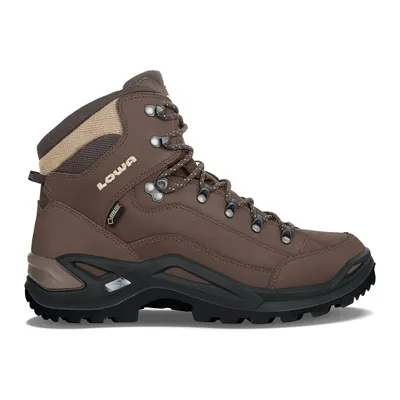
Lowa Renegade GTX Mid
A versatile mid-cut walking boot: leather upper, Gore-Tex membrane and Vibram sole, on a last made for medium-width feet. Men’s model, also made in a women’s version.
View on Amazon (opens in a new tab)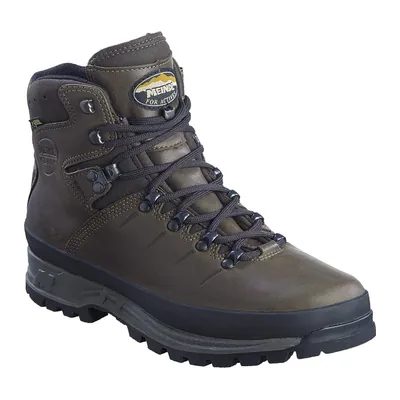
Meindl Bhutan MFS
A leather mountain boot in waxed nubuck with a Gore-Tex lining, Meindl’s memory foam system and a Multigriff sole by Vibram; 800 g, says Meindl. Men’s model.
View on Amazon (opens in a new tab)
Worth watching
Icicle, based in Windermere, explains what B1, B2 and B3 boots are for and the kinds of route each one suits, to go with this guide’s section on boot ratings and crampons.
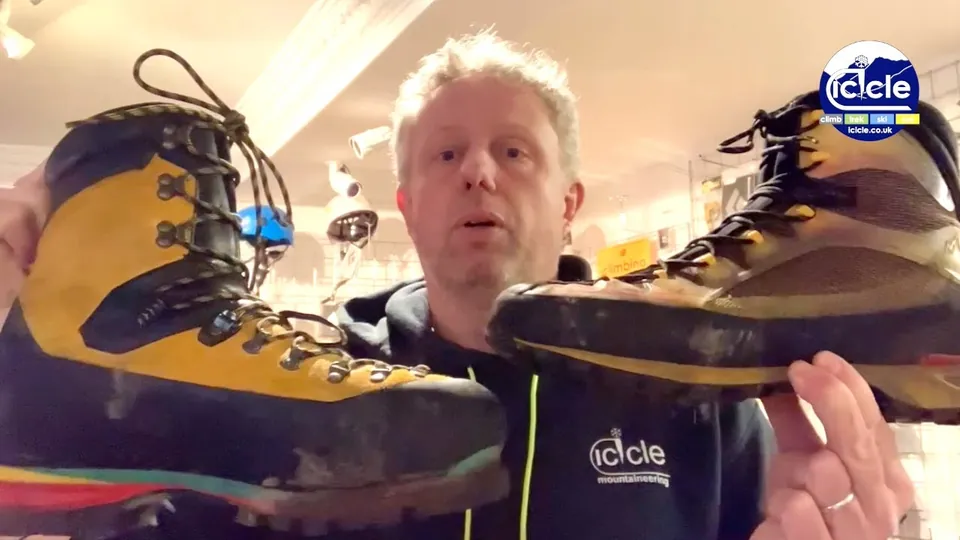
The video is hosted by YouTube (Google): nothing loads until you play it, and Google may then set cookies.
FAQs
Low or high-cut boots for hillwalking?
It depends on the ground. Mountaineering Ireland finds approach shoes or soft fabric boots fine on simple tracks, but wants a sturdier mountain boot, with medium ankle support and a sole that resists twisting, on rougher ground, especially in poor weather. In winter, it warns that light fabric boots or trainers greatly increase the risk of a slip or fall. The heavier the rucksack, the higher the cut.
What do the B0 to B3 ratings mean?
They are the British Mountaineering Council’s boot ratings. B0 boots are summer walking boots that flex and won’t take crampons; B1 boots have a reasonably stiff sole and take only a flexible C1 crampon, to cross a short patch of snow or ice; B2 boots are stiff four-season boots that can wear crampons all day; B3 boots are rigid technical boots for mountaineering and ice climbing.
What do the A, B, C and D categories mean?
They show the use the manufacturer intends. Category A covers flexible, low-cut models for easy paths; D, stiff, high-cut models for mountaineering and expeditions, with A/B and B/C in between. Meindl’s UK grid puts demanding walks in the Lake District, North Wales and Scotland at B, and recommends B/C for winter walking in Scotland. Each maker grades its own models.
Can I put crampons on walking boots?
Only if they are designed for it. A summer boot that flexes bends under a crampon, which can fall off, warns the BMC. A B1 boot is the absolute minimum, and only with a flexible C1 crampon; on the A to D scale, Meindl starts crampons at B/C, for occasional use. Micro-spikes are no substitute where a slip could turn into a long slide or a fall.
When and how should I try on walking boots?
In the afternoon or evening, when your feet have swollen a little, with the socks you will walk in. Walk around for at least 10 to 15 minutes, as the German Alpine Club suggests, try a slope up and down and, as Mountaineering Ireland advises, wear a loaded rucksack, which changes the shape of your foot. Each maker has its own lasts: your usual size is only a starting point.
How do I avoid blisters with new boots?
Wear them in first, on progressively longer walks: Mountaineering Ireland calls it very risky to take new boots on a long trek. Choose breathable walking socks rather than cotton, as AdventureSmart UK advises; a thin liner under a thicker sock reduces the chance of blisters, according to Mountaineering Ireland. And at the first hot spot, stop and deal with it straight away.
Sources
- Scottish Mountain Rescue, ‘Statistics and Reports’, key figures for 2025, updated 18 May 2026, accessed 28 October 2026. scottishmountainrescue.org https://www.scottishmountainrescue.org/facts-and-statistics/ ↩
- Swiss Council for Accident Prevention (BFU), ‘Rando en montagne’ campaign, ‘Bien s’équiper’ (in French), accessed 28 October 2026. rando-en-montagne.ch https://www.rando-en-montagne.ch/fr/bien-s-equiper ↩
- Mountaineering Scotland, ‘Essential kit’, summer hill-walking kit list, accessed 28 October 2026. mountaineering.scot https://www.mountaineering.scot/activities/hillwalking/getting-started/essential-kit ↩
- Mountaineering Ireland, ‘Staying Safe’, accessed 28 October 2026. mountaineering.ie https://www.mountaineering.ie/content/StayingSafe/140 ↩
- German Alpine Club (DAV), ‘Materialkunde: Leichtbergstiefel’, Panorama 1/2026, 4 February 2026 (in German), accessed 28 October 2026. alpenverein.de https://www.alpenverein.de/artikel/materialkunde-leichtbergstiefel_772fd56e-8269-4b7d-82ae-8da671438226 ↩
- British Mountaineering Council (BMC), ‘Walking boots, crampons and micro spikes’, accessed 28 October 2026. thebmc.co.uk https://thebmc.co.uk/en/walking-boots-crampons-micro-spikes ↩
- Meindl UK, ‘Which Meindl boot should I choose?’, the manufacturer’s category grid, updated 23 June 2026, accessed 28 October 2026. meindl.co.uk https://www.meindl.co.uk/which-meindl-boot-should-i-choose/ ↩
- AdventureSmart UK, ‘Hill Walking Kit List’, updated 19 February 2025, accessed 28 October 2026. adventuresmart.co.uk https://www.adventuresmart.co.uk/hill-walking-kit-list/ ↩
- Swiss Council for Accident Prevention (BFU), ‘Rando en montagne’ campaign, factsheet ‘Hydrolyse: quand vos chaussures de randonnée vieillissent (parfois prématurément)’ (PDF, in French), accessed 28 October 2026. cdn.sanity.io https://cdn.sanity.io/files/vy2mige5/production/bd936a76d6737d9c4b56e60da714e863bced3664.pdf ↩

Camping, wild camping, bushcraft and hiking
Guillaume Hoarau writes for Outfarer about camping, wild camping, bushcraft and hiking. A survival-skills enthusiast and a collector of old field manuals, he likes clear explanations, lists that earn their place and other people’s stories, which he tells well.


