 Français (France)
 English (UK)
 English (US)
 Deutsch (Deutschland)

Contents
The Camino at a glance: one destination, many routes
Six in the morning in a dormitory in Galicia. Head torches come on one by one, rucksacks are zipped up in whispers, and someone is already hunting for dry socks on the washing line. In the public albergues, the pilgrim hostels run by the Xunta de Galicia, Galicia’s regional government, you have to be out by 8am in any case [1]. The real question of the Camino de Santiago, though, comes up long before that morning, at home, in front of a map: where to start?
There is one destination: the cathedral of Santiago de Compostela, in Galicia, where the Pilgrim’s Office, the Oficina de Acogida al Peregrino, issues the Compostela. The routes, on the other hand, are many. The office recognises as official those designated by Galicia’s 2016 cultural heritage law: the Camino Francés, the Camino del Norte, the Primitivo, the Inglés, the two Portuguese routes, inland and along the coast, the Vía de la Plata, the Camino de Invierno and the extension to Fisterra and Muxía [2].
In 2025, the same office registered nearly 531,000 pilgrims, 6% more than in 2024. More than 92% arrived on foot, 4% by bike and a few hundred on horseback, under sail or in a wheelchair [3]. Behind those figures lie very different journeys: a few days’ walking in Galicia for some, more than a month from the Pyrenees for others.
Which route? The main Caminos compared
Every route has its own character, and its own crowds. The table brings together published distances and the number of pilgrims who reached Santiago on each in 2025. Distances vary a little from one source to another, depending on the exact starting point and variants: treat them as orders of magnitude.
| Route | Usual start | Distance to Santiago | Pilgrims arriving in 2025 |
|---|---|---|---|
| Camino Francés | Saint-Jean-Pied-de-Port | About 780 km [5] | 242,000 |
| Le Puy route (GR 65), then the Camino Francés | Le Puy-en-Velay | About 1,530 km [5, 6] | 2,800 |
| Portuguese Camino, inland | Lisbon or Porto | 608 km from Lisbon, 233 km from Porto [5] | 101,000 |
| Portuguese Camino, coastal | Porto | 163 km for the Galician stretch alone [7] | 90,000 |
| Camino del Norte | Irún | 844 km [5] | 21,000 |
| Camino Primitivo | Oviedo | 302 km [5] | 28,000 |
| Vía de la Plata | Seville | 930 to 944 km, depending on the variant [5] | 9,000 |
| Camino Inglés | Ferrol or A Coruña | 112 km from Ferrol, 73 km from A Coruña [8] | 30,000 |
Pilgrims registered by the Pilgrim’s Office in Santiago in 2025, rounded to the nearest thousand (dashboard accessed 23 October 2026) [3]. For the Le Puy route, pilgrims who started in Le Puy, rounded to the nearest hundred and already counted under the Camino Francés.
So who is each one for? The sources sketch fairly clear profiles:
- The Camino Francés: very well supplied with accommodation and generously waymarked, but also very busy, especially from June to September and over the last 100 km. Between Burgos and León it crosses the Meseta, Spain’s high central plateau, then climbs to O Cebreiro, at about 1,300 m [9].
- The Portuguese routes: a shorter first Camino, 233 km from Porto. Between them, they drew more than one pilgrim in three in 2025 [3].
- The Camino del Norte: it follows Spain’s northern coast, with a climate that is ‘mild and humid all year round’, and remains, according to the French Camino agency, ‘a real adventure route, wild and sporty’ [10].
- The Camino Primitivo: the Xunta de Galicia describes it as the very first pilgrim route, the one taken by the earliest pilgrims from the Kingdom of Asturias [11].
- The Vía de la Plata: more than 900 km from Seville, and fewer than 9,000 arrivals in 2025. The French agency lists it, with the Norte, among the Spanish routes that ‘remain little used’ [12].
- The Camino Inglés: entirely in Galicia. From A Coruña, its 73 km fall short of the 100 km required for the Compostela, unless you started outside Spain on a recognised route and walked at least 70 km of it in Spain [13].
To follow a route in detail, the viewer from Spain’s National Geographic Institute shows the Camino routes across Europe on a map you can zoom into, down to each stage. The Spanish Federation of Associations of Friends of the Camino also publishes a page for each route, with its stages, its albergues and tracks to download: the Camino Francés, the Portuguese Camino inland and along the coast, the Camino del Norte, the Camino Primitivo, the Vía de la Plata and the Camino Inglés. For the Le Puy route, France’s Agence des chemins de Compostelle offers an interactive map.
Starting in France: the Le Puy route and the GR 65
For walkers who want to set off in France, the Le Puy route is the main gateway. Waymarked by the French Hiking Federation in the early 1970s, the GR 65 was the first Camino route laid out in France [14, 6]. It actually begins in Geneva, on the Via Gebennensis, then crosses the volcanic Velay, the Margeride and Aubrac uplands and the Quercy, before rolling through south-west France to the Basque Country [14, 6].
From Le Puy-en-Velay to Saint-Jean-Pied-de-Port, allow 750 km [6]: almost as far as what then remains to Santiago. It is the busiest route in France. In 2025, it accounted for 55% of the credentials sold by the French Camino agency [17], with most of the traffic between Le Puy and Conques; away from the Le Puy route, France’s main Camino routes see only ‘a few thousand walkers a year’ [18].
In 2025, 2,800 of the pilgrims who reached Santiago had started in Le Puy [3]. Many others walk it a section at a time: buyers of the French agency’s credentials most often plan 4 days to a fortnight of walking [17], and the agency points out that the Camino can be done in several stages, one section a year [12].
Sarria and the last 100 km: where everyone meets
One figure sums up the Camino’s crowds: in 2025, 162,000 pilgrims set off from Sarria, nearly one in three overall and two thirds of everyone who arrived on the Camino Francés [3]. The reason lies in the rules: the Compostela requires 100 km on foot [13], and Sarria lies just beyond that mark. The same logic applies on the inland Portuguese route, where Tui and Valença, facing each other across the River Minho on the Spanish-Portuguese border, were the starting point for six pilgrims in ten [3].
Over those final kilometres, the Camino changes character: more people, more services, dormitories that fill up early. The French Camino agency notes heavy traffic on the Camino Francés, ‘especially in summer and over the last 100 kilometres’ [9]. If you are after some peace, there are two levers: go outside the peak months, or choose a quieter route.
How long does it take? Stages and pace
On the Camino Francés, the pilgrim association that runs the welcome office in Saint-Jean-Pied-de-Port reckons on ‘about a month of walking, at 25 to 30 km a day’ for just under 800 km [19]. American Pilgrims on the Camino notes that most people walk 20 to 30 km a day, and suggests a few rest days on a long route [20]. At 20 km a day, the Camino Francés’s 780 km take close to 40 days.
| Walking time | What fits |
|---|---|
| About a week | The Camino Inglés from Ferrol, 112 km, or the last 100 km of another route |
| A fortnight | 280 to 378 km according to American Pilgrims [20]: the Portuguese Camino from Porto or the Primitivo from Oviedo |
| A month | The Camino Francés from Saint-Jean-Pied-de-Port, at 25 to 30 km a day [19] |
| More than a month | The Camino Francés at 20 km a day, the whole Norte or Vía de la Plata, or a long French route |
Walking days only, without the rest days American Pilgrims suggests planning on a long route.
At the start, the Xunta de Galicia’s safety guide recommends shorter stages, and points out that your body has to cope with 20 to 25 km a day, several days running, with a rucksack, in heat, cold or rain [21]. The Xunta also sets a ceiling that the gram-counters among us will relish: never more than 10 kg on your back [22]. To estimate your stages, our guide to estimating walking time explains the method, breaks included.
The credential: the pilgrim’s passport
Before you set off, get hold of a The pilgrim passport, or credencial: a personal document stamped along the way, which gives access to pilgrim albergues and serves as proof of your route when you apply for the Compostela.. The French Camino agency describes it as compulsory in Spain and recommended in France [23]. The Pilgrim’s Office gives it two purposes: admission to the albergues run in the tradition of Christian hospitality, and proof of your route so that you can receive the Compostela [24].
Only the Church and the institutions it authorises issue it: parishes, confraternities, Friends of the Camino associations, some albergues; you can also ask for one at the Pilgrim’s Office itself [24]. It has no expiry date, and must carry at least two dated stamps a day [2]. Stamps are given where you sleep, but also in churches, monasteries, town halls and hostales, Spain’s small guesthouses [24].
| Country | Organisation | Price | Stated lead time |
|---|---|---|---|
| France | Agence française des chemins de Compostelle | €15, free postage [25] | Not stated |
| Switzerland | Jakobsweg Schweiz Compostelle Suisse | CHF 12, plus postage [26] | Not stated |
| Germany | Deutsche St. Jakobus-Gesellschaft | No set price, €10 donation requested [27] | Up to about 3 weeks |
| United Kingdom | Confraternity of Saint James | £6 for non-members [28] | Not stated |
| United States | American Pilgrims on the Camino | $5 minimum donation, free for members [29] | 4 weeks to US addresses, 6 elsewhere |
Prices as published by each organisation, in its own currency. American Pilgrims notes that credentials can also be picked up at most starting points [29].
The Compostela: 100 km on foot, 200 km by bike
The Compostela is a free certificate, written in Latin, which the cathedral awards to those who have made the pilgrimage in a Christian spirit, ‘devotionis affectu, voti vel pietatis’, on one of the recognised routes [13]. The conditions published by the Pilgrim’s Office:
- On foot or on horseback: 100 continuous km towards Santiago, on one and the same official route, the last stage being at least the one immediately before your arrival at the cathedral.
- Starting outside Spain: on a route recognised by the office, at least 70 continuous km in Spain.
- By bike: 200 km, under the same conditions as on foot.
- Under sail: 100 nautical miles, then the rest of the Camino on foot from the port, stamped stage by stage.
Two details matter. You do not mix routes: you choose one and follow it to the end. And if you cover that 100 or 200 km minimum over several trips, get a stamp at the start and end of each section, to show you picked up the Camino where you left off [13].
On arrival, in Rúa Carretas, you register by scanning a QR code, then receive a numbered ticket to collect your Compostela. The office is open every day from 9am to 7pm, except 25 December and 1 January, and warns that on busy days, same-day collection cannot be guaranteed [13]. To record a longer journey, it also issues a certificate of distance, giving your starting date and place, the kilometres covered and your route [30].
How much does the Camino cost? Published prices
For the budget, we only use what is published by those who run or support the Camino. First benchmark, an official one: in the Xunta de Galicia’s public network, a night in an albergue costs €10 per person [1]. Beyond that, American Pilgrims on the Camino, the only organisation authorised by the Pilgrim’s Office to issue credentials in the United States [29], publishes price ranges by type of accommodation [31].
| Accommodation | Price per night | Booking |
|---|---|---|
| Municipal or parish albergue | €7 to €14 | Rarely |
| Private albergue | €14 to €25 | Usually |
| ‘Donativo’ albergue | Pay what you can | Rarely |
| Hostal or pension, private room | €35 to €70 | Yes |
| Casa rural (country guesthouse) | €55 to €150 | Yes |
| Hotel | €65 to €180 | Yes |
Ranges published by American Pilgrims on the Camino, accessed 23 October 2026. The Xunta de Galicia’s public albergues cost €10 a night and cannot be booked.
The same organisation suggests three daily budgets, excluding travel to the start and home from the finish [20]: €45 to €55 if you mostly sleep in municipal albergues, carry your own lunch and have a pilgrim menu or cook your own supper; €55 to €75 if you mix public and private albergues, with a few nights in a private room and most meals out; €75 to €80 if you mostly stay in private rooms. A bag transfer service adds €7 to €10 a day [20], and the three-course pilgrim menu costs €12 to €18 [32].
A month’s walking on the tightest budget therefore comes to €1,350 to €1,650, travel excluded: 30 days at €45 to €55. Add the credential, the Compostela itself being free [13], and a margin for the pharmacy, buses or kit that needs replacing, as the organisation advises [20]. In France, the price of gîtes varies by route, the French Camino agency warns [16], and none of the sources consulted publishes a common rate: compare the accommodation on your route before settling your budget.
Albergues, gîtes or hotels: where to sleep along the way
The pilgrim dormitory, the albergue, is still the heart of the Camino. In the Xunta de Galicia’s public network, 76 albergues and more than 3,000 beds, the rules are clear [1]:
- no bookings: beds go to those who turn up;
- one night per albergue, except for illness or force majeure;
- open from 1pm to 10pm, lights out at 10.30pm, departure before 8am;
- priority for pilgrims with reduced mobility, then walkers, riders, cyclists and, last of all, people travelling with a support vehicle;
- disposable bedding provided, kitchen without crockery or pans.

Outside that network, private albergues usually take bookings, municipal and parish ones rarely. From May to September, on the popular routes, beds become scarce: many people book their first few nights and then see how it goes, while others stop between the guidebook stages to avoid the crowded towns. And Spain requires all accommodation to record its guests’ identity details, so keep your passport to hand [31].
Pack a sleeping bag, which the Xunta’s safety guide lists for albergue stays [21]; our guide to sleeping bag temperature ratings will help you choose one for the season. Then there is the ‘donativo’ tradition, in some albergues as in private homes: you give what you can, which is not the same as free [31]; ‘honesty requires you to contribute to the costs’, the French Camino agency reminds pilgrims [16].
When to go? What the figures and the climate say
Arrivals in Santiago describe the season better than any long explanation. In 2025, September was the busiest month, with 81,500 pilgrims, ahead of May and August. From May to September, the office recorded 71% of the year’s arrivals; from November to March, barely 7% [3].
The climate explains the curve. Between Burgos and León, the Meseta is a plateau ‘scorched by the sun in summer’, exposed to storms and swept by an icy wind in winter [9]. In Galicia it rains for much of the year; the hottest days of July and August reach 25 to 30 °C, and minimum temperatures fall to 0 to 5 °C in places inland and in the mountains [22]. American Pilgrims picks April to October for the weather and the number of albergues open, and identifies early May to mid-September as the busiest period [20].
- April and October: the season without the peak. In 2025, there were 54,600 arrivals in April and 62,900 in October, against more than 77,000 in May, August and September [3].
- May and September: among the most popular months, at the start too: the welcome office in Saint-Jean-Pied-de-Port, which saw nearly 55,000 walkers in 2025, peaks in May and September [17].
- July and August: heat on the Meseta, and crowds on the final stages [9].
- November to March: peace and quiet, but fewer places to stay [20]; leaving Saint-Jean, the Napoleon route over the Pyrenees is closed from 1 November to 31 March, which leaves the route via Valcarlos [33].
A word on 2027: it will be a Compostela Holy Year, and the Xunta de Galicia is already preparing its Xacobeo 2027 programme [34]. Even before then, arrivals from January to September 2026 were running 7% above the same period of 2025 [3].
Getting home from Santiago: plane, train, coach
The Camino ends at the cathedral; your journey does not. The French Camino agency sums up the options for heading home, or for reaching the start of another route [35]:
| By | From Santiago | Good to know |
|---|---|---|
| Plane | Lavacolla airport, about 10 km from the centre | Buses to the centre every 30 to 40 minutes |
| Train | Renfe, Spain’s national railway company | Timetables and tickets on the Renfe website |
| Coach | Bus station in Rúa de San Caetano | Long-distance services to Spain, France, Switzerland, Germany or Belgium, including Alsa coaches to Irún, on the French border |
Source: Agence française des chemins de Compostelle, ‘Moyens de transport’ page, accessed 23 October 2026. Check timetables before you travel.
Many carry on to the ocean: the Camino de Fisterra y Muxía leaves Santiago for Cape Fisterra and the Virxe da Barca shrine in Muxía [11]. And if you are travelling with more than your rucksack can carry, the Spanish post office can keep a parcel sent ahead near the cathedral, from about €25 depending on weight, distance and storage time [32].
Gallery: from Le Puy to Santiago in six landscapes
Six real photos of the Le Puy route and the Camino Francés, in walking order, published under free licences on Wikimedia Commons by their authors, who are credited under each image. Tap or click a photo to enlarge it.
Kit related to this article
No affiliation: no commission, no sponsored products.
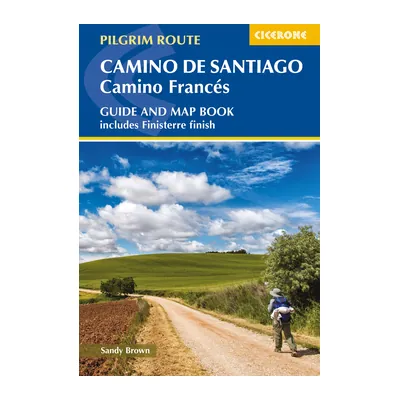
Camino de Santiago: Camino Francés (Cicerone)
Sandy Brown’s guide and map book from Saint-Jean-Pied-de-Port to Santiago, about 784 km, with the Finisterre finish; reprinted in August 2025.
View on Amazon (opens in a new tab)
Worth watching
Having walked both, David Wen compares the Camino Francés and the Camino Portugués chapter by chapter: crowds, beds, infrastructure, scenery, languages, food and costs.
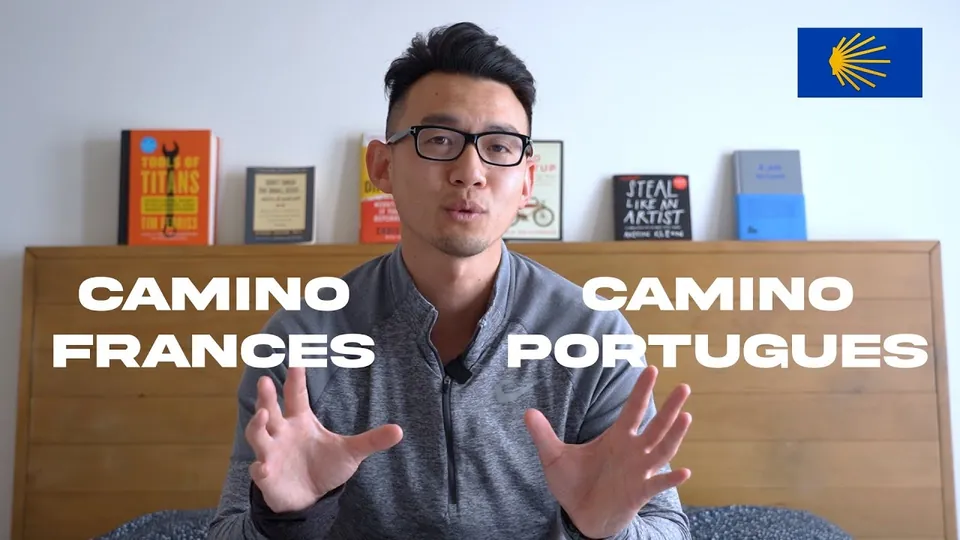
The video is hosted by YouTube (Google): nothing loads until you play it, and Google may then set cookies.
FAQs
How long does it take to walk the Camino de Santiago?
It depends on the route. From Saint-Jean-Pied-de-Port, the Camino Francés takes about a month at 25 to 30 km a day, according to the association that welcomes pilgrims at the start. A fortnight covers 280 to 378 km, says American Pilgrims on the Camino: enough for the Portuguese Camino from Porto or the Primitivo from Oviedo.
How much does the Camino cost per day?
American Pilgrims on the Camino reckons on €45 to €55 a day if you mostly sleep in municipal albergues, €55 to €75 with a few private rooms, and €75 to €80 if you mostly stay in private rooms, travel excluded. Galicia’s public albergues cost €10 a night. In France, the price of gîtes varies by route.
How many kilometres do you need to walk for the Compostela?
100 continuous km on foot or horseback, or 200 km by bike, on a single official route, all the way to the cathedral. If you start outside Spain on a recognised route, at least 70 km must be walked in Spain. Your credential needs two dated stamps a day. The Compostela is free and collected in person at the Pilgrim’s Office.
When is the best time to walk the Camino de Santiago?
April to October, according to American Pilgrims on the Camino, for the weather and the number of albergues open. To avoid the crowds, aim for April or October: in 2025, May, August and above all September were Santiago’s busiest months. Summer is hot on the Meseta, and the Napoleon route out of Saint-Jean-Pied-de-Port is closed from 1 November to 31 March.
Do you need to book albergues on the Camino?
Not Galicia’s public albergues, which take no bookings and allow only one night. Private albergues usually accept bookings, municipal ones rarely. From May to September, many pilgrims book their first few nights. In France, the French Camino agency advises booking gîtes several days ahead during the season.
Sources
- Xunta de Galicia (Galician regional government), Turismo de Galicia, ‘La Red Pública de Albergues del Camino de Santiago en Galicia’ (in Spanish), accessed 23 October 2026. caminodesantiago.gal https://www.caminodesantiago.gal/es/descubre/el-camino-en-la-actualidad/la-red-de-albergues-publicos ↩
- Oficina de Acogida al Peregrino, the Pilgrim’s Office of Santiago Cathedral, ‘Caminos Oficiales y la Credencial’ (in Spanish), accessed 23 October 2026. oficinadelperegrino.com https://oficinadelperegrino.com/preparacion/planificacion/ ↩
- Oficina de Acogida al Peregrino, the Pilgrim’s Office of Santiago Cathedral, ‘Estadísticas’ (in Spanish), dashboard of pilgrims by year, month, route, starting point and means of travel, 2024 to 2026 data, accessed 23 October 2026. oficinadelperegrino.com https://oficinadelperegrino.com/estadisticas-nueva/ ↩
- Xunta de Galicia (Galician regional government), Turismo de Galicia, ‘Camino Francés’ (in Spanish), accessed 23 October 2026. caminodesantiago.gal https://www.caminodesantiago.gal/es/planifica/las-rutas/camino-frances ↩
- American Pilgrims on the Camino, ‘Route Overviews for the Camino de Santiago’, accessed 23 October 2026. americanpilgrims.org https://americanpilgrims.org/route-overviews/ ↩
- Agence française des chemins de Compostelle (French Camino agency), ‘Voie du Puy-en-Velay’ (in French), accessed 23 October 2026. chemins-compostelle.com https://www.chemins-compostelle.com/voie/voie-du-puy-en-velay/ ↩
- Xunta de Galicia (Galician regional government), Turismo de Galicia, ‘Camino Portugués de la Costa’ (in Spanish), accessed 23 October 2026. caminodesantiago.gal https://www.caminodesantiago.gal/es/planifica/las-rutas/camino-portugues-de-la-costa ↩
- Xunta de Galicia (Galician regional government), Turismo de Galicia, ‘Camino Inglés’ (in Spanish), accessed 23 October 2026. caminodesantiago.gal https://www.caminodesantiago.gal/es/planifica/las-rutas/camino-ingles ↩
- Agence française des chemins de Compostelle (French Camino agency), ‘Camino Frances’ (in French), accessed 23 October 2026. chemins-compostelle.com https://www.chemins-compostelle.com/voie/camino-frances/ ↩
- Agence française des chemins de Compostelle (French Camino agency), ‘Camino del Norte’ (in French), accessed 23 October 2026. chemins-compostelle.com https://www.chemins-compostelle.com/voie/camino-del-norte/ ↩
- Xunta de Galicia (Galician regional government), Turismo de Galicia, ‘Las rutas’ (in Spanish), accessed 23 October 2026. caminodesantiago.gal https://www.caminodesantiago.gal/es/planifica/las-rutas ↩
- Agence française des chemins de Compostelle (French Camino agency), ‘Foire aux questions’ (in French), accessed 23 October 2026. chemins-compostelle.com https://www.chemins-compostelle.com/foire-aux-questions/ ↩
- Oficina de Acogida al Peregrino, the Pilgrim’s Office of Santiago Cathedral, ‘La Compostela: acreditación de la peregrinación’ (in Spanish), accessed 23 October 2026. oficinadelperegrino.com https://oficinadelperegrino.com/peregrinacion/la-compostela/ ↩
- French Hiking Federation (FFRandonnée), MonGR, ‘GR® 65, le chemin du Puy : l’appel de Compostelle’ (in French), accessed 23 October 2026. mongr.fr https://www.mongr.fr/trouver-prochaine-randonnee/itineraire/gr-65-le-chemin-du-puy-l-appel-de-compostelle ↩
- Agence française des chemins de Compostelle (French Camino agency), ‘S’orienter (balisage et signalétique)’ (in French), accessed 23 October 2026. chemins-compostelle.com https://www.chemins-compostelle.com/balisage-et-signaletique/ ↩
- Agence française des chemins de Compostelle (French Camino agency), ‘S’héberger’ (in French), accessed 23 October 2026. chemins-compostelle.com https://www.chemins-compostelle.com/sheberger/ ↩
- Agence française des chemins de Compostelle (French Camino agency), Note de conjoncture 2025 : fréquentation des chemins de Compostelle en France (in French), 2026, accessed 23 October 2026. chemins-compostelle.com https://www.chemins-compostelle.com/wp-content/uploads/2026/04/Note-de-conjoncture-2025-1-1.pdf ↩
- Agence française des chemins de Compostelle (French Camino agency), ‘Observatoire des publics sur les chemins’ (in French), accessed 23 October 2026. chemins-compostelle.com https://www.chemins-compostelle.com/observatoire-des-chemins/ ↩
- Compostelle.fr, the pilgrim association that runs the pilgrim welcome office in Saint-Jean-Pied-de-Port, ‘800 km de Saint-Jean-Pied-de-Port à Santiago’ (in French), 3 May 2026, accessed 23 October 2026. compostelle.fr https://www.compostelle.fr/chemins/camino-frances/article/un-condense-de-l-art-religieux-europeen ↩
- American Pilgrims on the Camino, ‘Prepare for Your Camino’, accessed 23 October 2026. americanpilgrims.org https://americanpilgrims.org/prepare-for-camino/ ↩
- Xunta de Galicia, Guía de emergencias para la peregrinación por los Caminos de Santiago (in Spanish), accessed 23 October 2026. caminodesantiago.gal https://www.caminodesantiago.gal/documents/17639/100607/Folleto_guia_peregrinos_E_V6.pdf?version=1.0 ↩
- Xunta de Galicia (Galician regional government), Turismo de Galicia, ‘Consejos y recomendaciones’ (in Spanish), accessed 23 October 2026. caminodesantiago.gal https://www.caminodesantiago.gal/es/preparate/consejos-y-recomendaciones ↩
- Agence française des chemins de Compostelle (French Camino agency), ‘La credencial’ (in French), accessed 23 October 2026. chemins-compostelle.com https://www.chemins-compostelle.com/la-credencial/ ↩
- Oficina de Acogida al Peregrino, the Pilgrim’s Office of Santiago Cathedral, ‘La Credencial’ (in Spanish), accessed 23 October 2026. oficinadelperegrino.com https://oficinadelperegrino.com/peregrinacion/la-credencial/ ↩
- Agence française des chemins de Compostelle (French Camino agency), ‘La Credencial | « Passeport » du pèlerin’ (in French), accessed 23 October 2026. chemins-compostelle.com https://www.chemins-compostelle.com/produit/la-credencial-passeport-du-pelerin/ ↩
- Jakobsweg Schweiz Compostelle Suisse, ‘Pilgerpass bestellen’ (in German), accessed 23 October 2026. jakobswegschweiz-compostellesuisse.ch https://www.jakobswegschweiz-compostellesuisse.ch/pages/pilgerpass-bestellen ↩
- Deutsche St. Jakobus-Gesellschaft, ‘Pilgerausweis’ (in German), accessed 23 October 2026. deutsche-jakobus-gesellschaft.de https://deutsche-jakobus-gesellschaft.de/pilgerausweis ↩
- Confraternity of Saint James, ‘Non-members pilgrim passport’, accessed 23 October 2026. csj.org.uk https://www.csj.org.uk/shop/non-members-pilgrim-passport ↩
- American Pilgrims on the Camino, ‘Request a Credential’, updated 20 June 2026, accessed 23 October 2026. americanpilgrims.org https://americanpilgrims.org/request-a-credential/ ↩
- Oficina de Acogida al Peregrino, the Pilgrim’s Office of Santiago Cathedral, ‘Certificado de Distancia’ (in Spanish), accessed 23 October 2026. oficinadelperegrino.com https://oficinadelperegrino.com/peregrinacion/certificado-de-distancia/ ↩
- American Pilgrims on the Camino, ‘Where to Sleep on the Camino: Albergues and More’, accessed 23 October 2026. americanpilgrims.org https://americanpilgrims.org/where-to-sleep-on-the-camino/ ↩
- American Pilgrims on the Camino, ‘What to Expect on the Camino’, accessed 23 October 2026. americanpilgrims.org https://americanpilgrims.org/what-to-expect-on-camino/ ↩
- Government of Navarre, Visit Navarra, ‘Camino Santiago Francés’ (in Spanish), accessed 23 October 2026. visitnavarra.es https://www.visitnavarra.es/es/camino-santiago-frances ↩
- Xunta de Galicia, press release on preparations for Xacobeo 2027 (in Spanish), 8 October 2026, accessed 23 October 2026. caminodesantiago.gal https://www.caminodesantiago.gal/es/sala-de-prensa/detalle?content=/60-Espazo-institucional/.content/noticias/noticia_1855.xml ↩
- Agence française des chemins de Compostelle (French Camino agency), ‘Moyens de transport’ (in French), accessed 23 October 2026. chemins-compostelle.com https://www.chemins-compostelle.com/moyens-de-transport/ ↩
- Policía Foral de Navarra (Navarre police), ‘Consejos para el Camino de Santiago’, 2026 leaflet in Spanish, Basque and French, accessed 23 October 2026. visitnavarra.es https://www.visitnavarra.es/documents/8191683/59452711/Consejos+para+el+Camino+de+Santiago.+Policia+Foral+2026.pdf/659e0322-decd-3f62-2685-2052724db786?t=1776753119298 ↩
- Xunta de Galicia, ‘Camiño seguro’ (in Galician, Spanish, English and French), accessed 23 October 2026. caminoseguro.gal https://caminoseguro.gal/ ↩
- Service-Public.fr (French government), ‘Quels sont les numéros en cas d’urgence (Samu, pompiers...) et les numéros d’écoute ?’ (in French), checked 25 August 2026, accessed 23 October 2026. service-public.gouv.fr https://www.service-public.gouv.fr/particuliers/vosdroits/F33954 ↩
- European Commission, ‘112 - the EU’s emergency phone number’, accessed 23 October 2026. digital-strategy.ec.europa.eu https://digital-strategy.ec.europa.eu/en/policies/112 ↩

Camping, wild camping, bushcraft and hiking
Guillaume Hoarau writes for Outfarer about camping, wild camping, bushcraft and hiking. A survival-skills enthusiast and a collector of old field manuals, he likes clear explanations, lists that earn their place and other people’s stories, which he tells well.


