 Français (France)
 English (UK)
 English (US)
 Deutsch (Deutschland)

Contents
France: in forests, the leash depends on the trail and the season
The dog already has its nose in the ferns. Something has caught its interest at the foot of a bank, 10 feet off the trail, and its wagging tail says exactly what it thinks of this May morning. That’s the very moment a rule more than 70 years old is aimed at, though not quite the way most people think.
Two rules overlap. The first applies year-round, in woods and meadows alike: your dog must not roam. Under French law, it’s roaming as soon as it’s no longer under your effective supervision, it’s out of range of your voice or of the whistle you use to call it back, or it wanders more than 330 feet (100 m) from you; only hunting and guarding a flock are exempt [1]. The second fits into one sentence of a ministerial order that’s still in force [1, 2]:
In woods and forests, it is prohibited to walk dogs that are not kept on a leash outside the forest tracks during the period from April 15 to June 30.
Read the end again: a leash is required “outside the forest tracks.” And the French authorities count roads, paths, and forest trails as tracks, including the GR long-distance trails and marked walking routes [3]. Logging lanes, firebreaks, and lot boundaries, on the other hand, don’t count as trails [4]. Think of the forest as a house in spring: the hallway stays open, the rooms around it are closed. My reading is simple: a dog that doesn’t stay on the trail when called should be on a leash. Otherwise, the fixed fine is €135 [3]. The dates aren’t random: this is when mammals start giving birth and birds are nesting, some of them on the ground [3].
French national parks: dogs stay out of the core of the mountain parks
In the core of mainland France’s four mountain national parks, the Vanoise, the Écrins, the Mercantour, and the Pyrenees, dogs are banned, even on a leash [5, 6, 7, 8]. The Mercantour adds: even carried [7]. The exemptions mainly cover working herding dogs and dogs guiding or assisting a person with a disability. In the Vanoise, the fine is €135 [5].
A leash isn’t enough, the Vanoise park explains: a chamois will flee from a dog more than 330 feet (100 m) away, even a leashed one. Dogs can also pass on to wildlife the worms that cause gid, a brain disease, in sheep, chamois, and ibex, and dewormer residues in their poop seriously harm insects [5].
Other parks allow leashed dogs even in their core, such as the Cévennes [9]. We’ve rounded up each park’s rules in our guide to France’s national parks.
Livestock and guardian dogs: keep the leash on, then know when to let go
On mountain pastures, your dog isn’t just another visitor. The A large dog, often a Great Pyrenees, nicknamed “patou” in France, that lives day and night with a flock of sheep or goats to keep wolves, stray dogs, and any intruder away. watches over the flock even when the shepherd isn’t there, and creates a protection zone around it: an off-leash dog is a threat there, just like a wild animal. The guardian dog may then chase, attack, and injure it [5].
The pastoral services of France’s Auvergne-Rhône-Alpes region and the Luberon regional nature park give the same advice. Best of all, don’t bring your dog where flocks are grazing [10, 11]. If you do: dog on a leash, a wide detour around the flock, and no running toward the animals. When a guardian dog comes over, stop, talk to it calmly without staring it in the eye, and let it “check” you: it takes a few minutes [10, 11]. Don’t pick up a small dog, since you’d put yourself in danger; and if the dogs need to size each other up, drop the leash, because a tight leash riles them up and keeps them from working things out [11]. If you still can’t get through, turn around [10].
Before you go, the MapPatou map shows the mountain pastures guarded by livestock guardian dogs, with expected dates [5]. Elsewhere, the local tourist office or town hall usually knows where the flocks are headed.
In the UK: a short leash in spring and near livestock
In England and Wales, the Countryside Code, the official code of conduct for the countryside, asks you to keep your dog on a leash or in sight, and to be confident it will come back when called. On Mountains, moorland, heath, downs, and registered common land where the Countryside and Rights of Way Act 2000 lets you walk away from footpaths; a brown symbol of a hiker marks it., two legal requirements apply on top of that: a leash around livestock year-round, and a leash from March 1 to July 31, even with no animals in sight [12].
The Countryside and Rights of Way Act 2000 spells out what a “short lead” is: a leash of fixed length, no longer than 6.6 feet (2 m). Break the rule and you lose your right to be on that land [15]. So the 16-foot (5 m) retractable leash, handy as it is elsewhere, won’t cut it.
Off access land, livestock is protected too. In England and Wales, since March 18, 2026, the Dogs (Protection of Livestock) Act 1953 also covers attacks on or worrying of livestock on roads and paths, not just in fields; it now includes llamas and alpacas, and the fine has no upper limit [16, 17]. Simply letting your dog run loose, off leash and not under close control, in a field with sheep in it already counts as worrying [16]. And the Countryside Code puts it bluntly: a farmer can shoot a dog that is attacking or chasing livestock [12].
Germany, Switzerland, Austria: one rule per state, per canton, sometimes per town
In Germany, leash rules in the countryside are set state by state, and often town by town: three states show how far apart they can be. Lower Saxony is the strictest of the three. From April 1 to July 15, the breeding season, every dog must be leashed in the “open countryside,” forests, fields, trails, and waterways included, except hunting, rescue, herding, police, and customs dogs and guide dogs [18, 19]. The fine can reach €5,000 [19].
Baden-Württemberg has no general leash requirement in its forests, but your dog may only run free if you can control it without a leash and call it back right away; otherwise, you’re committing an offense [20]. Bavaria leaves it to its towns to restrict large dogs and so-called fighting dogs running loose [21]. Its hunting law shows what’s at stake: game wardens may kill a dog that is visibly chasing game in a hunting district and could endanger it [22].
US national parks: a 6-foot leash, and many trails off-limits
In the national parks, the federal rule fits on one line: a pet must be crated, caged, restrained on a leash no longer than 6 feet, or otherwise physically confined at all times; each park superintendent can also close areas to pets [25]. The National Park Service sums it up for owners in four letters, B.A.R.K.: Bag your pet’s waste, Always leash your pet, Respect wildlife, Know where you can go. Each park then runs its own Bark Ranger program [26].
It’s “know where you can go” that holds the surprises. In Yellowstone, dogs must stay in developed areas, within 100 feet of roads, parking lots, and campgrounds: no trails, no boardwalks, no backcountry, even carried in a backpack, to protect them from bears, coyotes, and hot springs [27]. At the Grand Canyon, they can walk on a leash on the trails along the South Rim, but never below the rim [28]. Acadia, by contrast, opens 100 miles of hiking trails and 45 miles of carriage roads to them, except for a list of closed trails such as Precipice and Beehive [29], and Shenandoah closes fewer than 20 miles of its 500-plus miles of trails to them [30]. For park fees and passes as a foreign visitor sees them, see what overseas visitors pay.
| Place | Where | When | What the text says |
|---|---|---|---|
| France | Woods and forests, off roads, paths, and trails | April 15 to June 30 | Leash required; year-round, dog under supervision, within 330 feet (100 m) [1, 3] |
| France, mountain national parks | Core of the Vanoise, Écrins, Mercantour, and Pyrenees | Year-round | Dogs banned, even on a leash [5, 6, 7, 8] |
| England and Wales | Open access land | March 1 to July 31, and year-round near livestock | Fixed leash of 6.6 feet (2 m) or less [15] |
| Scotland | Moorland, forests, grassland, shores | Usually April through July | Short leash or close at heel (Access Code) [13] |
| Lower Saxony, Germany | Forests, fields, trails, waterways | April 1 to July 15 | Leash required [18] |
| Baden-Württemberg, Germany | Forests | Year-round | No general leash rule; dog under control and recallable at once [20] |
| Canton of Fribourg, Switzerland | Forests | April 1 to July 15 | Leash required [23] |
| US national parks | Wherever pets are allowed | Year-round | Leash of 6 feet or less [25] |
Towns, nature reserves, and parks can be stricter: the sign on site has the final word.
Getting your dog ready: stamina, heat, water, and paws
Before you think about the trail, think about the dog. Shenandoah National Park asks the right question: does your dog have the endurance, and the paw pads, for the trail you’ve chosen [30]? Just like yours, that endurance is built up, with hikes that get longer gradually, in distance and then in elevation gain, rather than one big day right off the bat. A puppy, an older dog, or an overweight one doesn’t train like a fit dog in its prime; if you have any doubt about its health, ask your vet.
Heat is the real trap. According to the RSPCA, the British animal welfare charity, dogs are 10 times more likely to suffer heat-related illness from exercising in hot weather than from overheating in cars. Most at risk: flat-faced breeds, dogs with thick coats, overweight or out-of-shape dogs, and those with heart or breathing problems, which can struggle even on a mild spring day after a cold winter [31]. Our canicross guide digs into the studies on overheating during exercise.
- Water: small amounts every 15 to 20 minutes, but not while your dog is panting hard [31]. Pack enough for two, plus a bowl.
- The ground: before crossing pavement or another hard surface in the sun, test it with the back of your hand to avoid burned paws [31]; the Grand Canyon also asks owners to protect paws from the hot rim pavement [28].
- Warning signs: heavy panting and trouble breathing, excessive drooling, lethargy or wobbliness, collapse or vomiting. Stop, offer water, find shade [31], and if your dog doesn’t improve, call a vet.

After the hike: ticks, vipers, and processionary caterpillars
The hike ends with an inspection. ESCCAP, the European scientific council on companion animal parasites, recommends checking your dog after every walk. Remove a tick with a tick hook, a sort of tiny claw hammer; don’t pull it, squeeze it, or pour alcohol or ether on it: that makes it regurgitate, which is how diseases such as babesiosis, ehrlichiosis, or Lyme disease get passed on. Preventive treatment is something to ask your vet about, and it rarely protects 100%; before traveling to a high-risk area, a spray or spot-on goes on at least 2 days before departure, a collar 2 weeks before [32].
In spring and early summer, France’s national forest agency, the ONF, flags two more hazards in French forests. First, processionary caterpillars, whose hairs can cause severe swelling of a dog’s tongue that calls for a rush to the vet. Then vipers, whose bite can kill a dog, which is why it pays to keep yours out of brush and undergrowth [4].
Gear related to this article
No affiliation: no commission, no sponsored products.
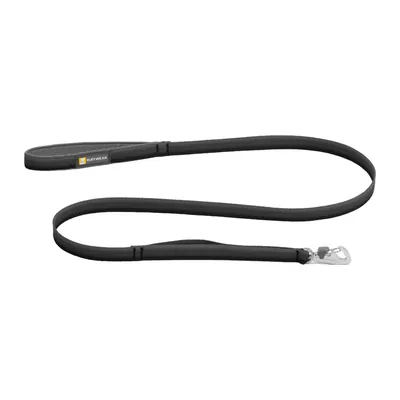
Ruffwear Front Range Leash
A fixed 5 ft leash with a padded handle and a locking clip: it keeps your dog close on trails where leashes are required and whenever you pass livestock.
View on Amazon (opens in a new tab)
Ruffwear Quencher
A packable fabric bowl that holds 4.2 cups, with a waterproof lining: it folds into a pocket so your dog can drink a little every 15 to 20 minutes.
View on Amazon (opens in a new tab)
Worth watching
Yosemite’s rangers walk through the National Park Service’s B.A.R.K. Ranger code: bag your pet’s waste, always leash your pet, respect wildlife, and know where you can go.
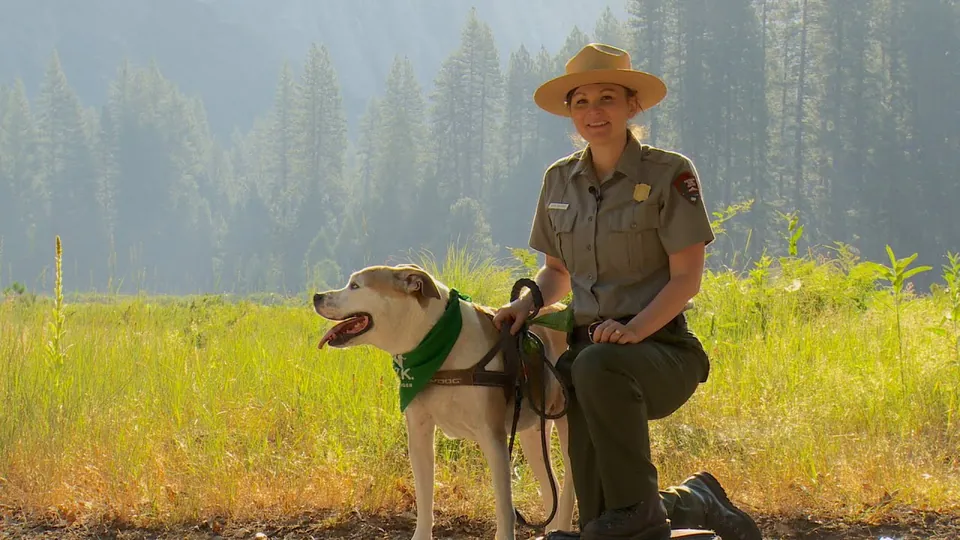
The video is hosted by YouTube (Google): nothing loads until you play it, and Google may then set cookies.
FAQ
Do dogs have to be leashed in French forests year-round?
Not under the national rule. Year-round, your dog has to stay under your supervision, within earshot and within 330 feet (100 m). From April 15 to June 30, the 1955 order also requires a leash off roads, paths, and trails. A town, a nature reserve, or a park can go further, so the sign on site has the final word.
Can I bring my dog to a national park in France or the US?
In France, not into the core of the Vanoise, Écrins, Mercantour, and Pyrenees parks, even on a leash; the Cévennes allow leashed dogs. In US national parks, dogs are allowed on a leash of 6 feet or less, but many parks keep them to developed areas, the way Yellowstone does. Check the park’s own pet page before you go.
What should I do if a livestock guardian dog approaches my dog?
Stop, stay calm, and talk quietly to the guardian dog without staring it in the eye. Don’t pick your dog up. French pastoral services recommend dropping the leash so the dogs can size each other up: a tight leash riles them up. Make a wide detour around the flock, and if you still can’t get through, turn around.
What should I do if cows charge me and my dog?
Drop the leash and leave the field by the shortest, safest route, without trying to protect your dog: that’s the advice of England’s Countryside Code, the Scottish Outdoor Access Code, and Austria’s agriculture ministry. Once it’s free, your dog can get away from the cattle more easily, and so can you. Better yet, avoid fields of cows with calves.
What are the fines for an off-leash dog?
In France, a fixed fine of €135 for walking a dog off leash and off the trail in a forest between April 15 and June 30, and the same €135 for a dog in the core of the Vanoise. In Lower Saxony, Germany, the fine can reach €5,000. In England and Wales, an owner whose dog worries livestock faces a fine with no upper limit.
Sources
- Service-Public.fr (French government information service), “Peut-on promener son chien sans laisse ?” (in French), checked October 23, 2025, accessed October 23, 2026. service-public.gouv.fr https://www.service-public.gouv.fr/particuliers/vosdroits/F35062 ↩
- French order of March 16, 1955, on preventing dogs from roaming (arrêté relatif à l’interdiction de la divagation des chiens), Journal officiel, March 24, 1955, text in force on AIDA (French Ministry for Ecological Transition, Ineris) (in French), accessed October 23, 2026. aida.ineris.fr https://aida.ineris.fr/reglementation/arrete-160355-divagation-chiens ↩
- Service-Public.fr, “Promenades en forêt : vous êtes obligé de tenir votre chien en laisse jusqu’au 30 juin” (in French), published April 11, 2026, accessed October 23, 2026. service-public.gouv.fr https://www.service-public.gouv.fr/particuliers/actualites/A17343 ↩
- Office national des forêts (French national forest agency), “Promener mon chien sans laisse en forêt : je peux ou je ne peux pas ?” (in French), accessed October 23, 2026. onf.fr https://www.onf.fr/vivre-la-foret/+/96::promener-mon-chien-sans-laisse-foret-peux-peux-pas.html ↩
- Vanoise National Park, “Venir avec mon chien” (in French), accessed October 23, 2026. vanoise-parcnational.fr https://www.vanoise-parcnational.fr/fr/des-decouvertes/sejourner-dans-le-parc/venir-avec-mon-chien ↩
- Écrins National Park, “Réglementation” (in French), accessed October 23, 2026. ecrins-parcnational.fr https://www.ecrins-parcnational.fr/reglementation ↩
- Mercantour National Park, “La réglementation” (in French), accessed October 23, 2026. mercantour-parcnational.fr https://www.mercantour-parcnational.fr/fr/le-parc-national-du-mercantour/la-reglementation ↩
- Pyrenees National Park, “La réglementation du Parc national des Pyrénées” (in French), accessed October 23, 2026. pyrenees-parcnational.fr https://www.pyrenees-parcnational.fr/fr/le-parc-national-des-pyrenees/la-reglementation-du-parc-national-des-pyrenees ↩
- Cévennes National Park, “Modalités d’application de la réglementation du cœur” (in French), park charter, updated December 2024, accessed October 23, 2026. cevennes-parcnational.fr https://www.cevennes-parcnational.fr/sites/cevennes-parcnational.fr/files/2024-12/marcoeurs_pnc_maj_2024_12.pdf ↩
- Luberon Regional Nature Park, “Troupeaux et chiens de protection ! Quelques réflexes à adopter” (in French), March 2024, accessed October 23, 2026. parcduluberon.fr https://www.parcduluberon.fr/wp-content/uploads/2024/11/PNRL_jadoptelaluberonattitude_CHIENS_DE_PROTECTION_2024.pdf ↩
- Pasto Kezako, network of pastoral services in Auvergne-Rhône-Alpes, “Comment faire en cas de rencontre ?” (in French), accessed October 23, 2026. pasto-kezako.fr https://www.pasto-kezako.fr/rencontre-chiens-de-protection/ ↩
- Natural England and Natural Resources Wales, “The Countryside Code: advice for countryside visitors,” GOV.UK, updated May 26, 2023, accessed October 23, 2026. gov.uk https://www.gov.uk/government/publications/the-countryside-code/the-countryside-code-advice-for-countryside-visitors ↩
- NatureScot, Scottish Outdoor Access Code, “Dog walking,” accessed October 23, 2026. outdooraccess-scotland.scot https://www.outdooraccess-scotland.scot/practical-guide-all/dog-walking ↩
- Austrian Federal Ministry of Agriculture (BMLUK), “Sichere Almen” leaflet (in German), 2026, accessed October 23, 2026. bmluk.gv.at https://www.bmluk.gv.at/dam/jcr:b955ba4b-fd0f-4182-9aac-d12171d6a377/Folder_Sichere%20Almen_DE_2026_BF_.pdf ↩
- United Kingdom, Countryside and Rights of Way Act 2000, Schedule 2, paragraphs 4 to 6, legislation.gov.uk, accessed October 23, 2026. legislation.gov.uk https://www.legislation.gov.uk/ukpga/2000/37/schedule/2 ↩
- United Kingdom, Dogs (Protection of Livestock) Act 1953, version for England and Wales as amended on March 18, 2026, and version for Scotland, legislation.gov.uk, accessed October 23, 2026. legislation.gov.uk https://www.legislation.gov.uk/ukpga/Eliz2/1-2/28 ↩
- Defra (UK Department for Environment, Food and Rural Affairs), “Law changes strengthen protection for livestock,” Farming blog, December 18, 2025, accessed October 23, 2026. defrafarming.blog.gov.uk https://defrafarming.blog.gov.uk/2025/12/18/law-changes-strengthen-protection-for-livestock/ ↩
- Municipality of Nordstemmen, “Hinweise zur Hundehaltung” (in German), notice quoting section 33 of the Lower Saxony Forest and Landscape Act (NWaldLG), April 1, 2025, accessed October 23, 2026. nordstemmen.de https://www.nordstemmen.de/rathaus-service/aktuelles/bekanntmachungen/2025-04-01-bk-nwaldg-hundehaltung-presse.pdf?cid=nls ↩
- Lüneburg district, “Brut- und Setzzeit. Leinenpflicht in Niedersachsen vom 1. April bis zum 15. Juli” (in German), leaflet, February 2022, accessed October 23, 2026. landkreis-lueneburg.de https://www.landkreis-lueneburg.de/_Resources/Persistent/2/5/8/2/258252c727ad6599de08f26600b8d0c423c99489/Brut-%20und%20Setzzeit%20Flyer%20%28Stand%20M%C3%A4rz%202022%29.pdf ↩
- ForstBW, Baden-Württemberg state forests, “Verhalten im Wald” (in German), accessed October 23, 2026. forstbw.de https://www.forstbw.de/erleben-lernen/erlebnis/verhalten-im-wald ↩
- Bavaria, State Criminal and Regulatory Law Act (LStVG), Article 18, version in force since December 17, 2024 (in German), accessed October 23, 2026. gesetze-bayern.de https://www.gesetze-bayern.de/Content/Document/BayLStVG-18 ↩
- Bavaria, Hunting Act (BayJG), Article 42, version in force since April 1, 2026 (in German), accessed October 23, 2026. gesetze-bayern.de https://www.gesetze-bayern.de/Content/Document/BayJG-42 ↩
- Canton of Fribourg, Forest and Nature Service, “Obligation de tenir les chiens en laisse en forêt” (in French), press release, March 30, 2026, accessed October 23, 2026. fr.ch https://www.fr.ch/diaf/sfn/actualites/obligation-de-tenir-les-chiens-en-laisse-en-foret-1 ↩
- Swiss Hiking Federation (Suisse Rando), “Bovins et protection des troupeaux” (in French), accessed October 23, 2026. suisse-rando.ch https://www.suisse-rando.ch/fr/savoir/prevention-des-risques-et-responsabilite/bovins-et-protection-des-troupeaux ↩
- Code of Federal Regulations, title 36, section 2.15 (“Pets”), edition of July 1, 2025, govinfo, accessed October 23, 2026. govinfo.gov https://www.govinfo.gov/content/pkg/CFR-2025-title36-vol1/pdf/CFR-2025-title36-vol1-sec2-15.pdf ↩
- National Park Service, “Be a B.A.R.K. Ranger,” accessed October 23, 2026. nps.gov https://www.nps.gov/subjects/pets/be-a-bark-ranger.htm ↩
- Yellowstone National Park, “Pets,” updated July 29, 2026, accessed October 23, 2026. nps.gov https://www.nps.gov/yell/planyourvisit/pets.htm ↩
- Grand Canyon National Park, “Pets,” updated September 25, 2025, accessed October 23, 2026. nps.gov https://www.nps.gov/grca/planyourvisit/pets.htm ↩
- Acadia National Park, “Pets,” updated September 10, 2026, accessed October 23, 2026. nps.gov https://www.nps.gov/acad/planyourvisit/pets.htm ↩
- Shenandoah National Park, “Pets,” updated June 25, 2025, accessed October 23, 2026. nps.gov https://www.nps.gov/shen/planyourvisit/pets.htm ↩
- RSPCA, “Dogs die on hot walks,” accessed October 23, 2026. rspca.org.uk https://www.rspca.org.uk/adviceandwelfare/pets/dogs/health/hotwalks ↩
- ESCCAP France, “Les tiques du chien et du chat” (in French), accessed October 23, 2026. esccap.fr https://www.esccap.fr/arthropodes/tiques-risques-maladie-chien-chat.html ↩

Camping, backpacking, bushcraft and hiking
Guillaume Hoarau writes for Outfarer about camping, backpacking, bushcraft, and hiking. A survival-skills buff and a collector of vintage field manuals, he loves clear explanations, lists that actually help and other people’s stories, which he tells well.

 Nolwenn Bastide

