 Français (France)
 English (UK)
 English (US)
 Deutsch (Deutschland)

Running as a team, linked by a line
As much as 1.2 to 2.5 mph (2 to 4 km/h) faster. That’s the boost a dog can give its runner in canicross, according to the Fédération française des sports et loisirs canins (FFSLC), France’s dog sports federation: a form of running where runner and dog are linked by a line with a shock absorber, and where speed depends first and foremost on the bond between the two [1].
Under the French federation’s rules, the sport is open to everyone and to every breed of dog, except dogs classified as category 1 under French law [8]. Spiked shoes are strictly banned to avoid injuring the dogs, and races run 3.1 to 5.6 miles (5 to 9 km) depending on the temperature [1]. If you race outside France, check the rules of the event you enter.
The gear: harness, belt, and bungee line
The French federation is clear: specialized equipment is essential, meaning a harness, a belt with leg loops, a waist belt, and a towline [1]. Each piece has its job.
| Item | What it does | What to check |
|---|---|---|
| Pulling harness | Lets the dog pull while moving comfortably | It fits the dog’s build, to prevent injuries; try several models if needed |
| Waist belt, or belt with leg loops | Connects the runner to the line, protects the back, and leaves the hands free | A belt with leg loops for several dogs or a very powerful dog |
| Bungee line | Connects harness and belt, with a shock absorber that cushions jolts | A handle near the dog end, useful for keeping the dog close |
Based on the Fédération française des sports et loisirs canins and beginner tips from Decathlon.
The harness is the piece that matters most: it’s a long harness, designed so the dog can pull comfortably, and it has to fit the dog’s build [2]. Clubs often lend gear, so you can try several harnesses before you buy [2].

How old does a dog need to be for canicross?
For racing in France, the federation’s rule is clear: a dog has to be 18 months old to start competing [1]. For recreational training, age isn’t everything: a young dog, even at 18 months, starts with very short distances [2]. A checkup at the vet before you begin will show whether its heart, joints, and paw pads are ready for the effort.
The first runs, step by step
- Run without the canicross gear at first, so your dog finds its pace next to you, and teach it the basic command: stop [2].
- Then put on the gear and jog slowly: the dog usually moves out in front. Before a turn, say “left” or “right” while steering the line that way [2].
- Build up very gradually: for an 18-month-old dog, 0.3 mile (500 m) of pulling, then 0.4 mile (700 m), then 0.6 mile (1 km) [2].
- Start and end every outing with a short off-leash walk, where that’s allowed, so your dog can warm up, unwind, and do its business [2].
Terrain matters as much as distance. Stick to dirt trails and forest roads, which are easy on paws, and avoid asphalt and concrete: that’s an injury waiting to happen. Stop every 15 minutes to let your dog drink, with a water bottle and its bowl in your pack, and watch its breathing: if it seems very out of breath, slow down or stop [2].
Overheating: the number one danger, even in winter
In the UK, researchers reviewed the records of more than 900,000 dogs under primary veterinary care in 2016 and identified 1,259 cases of heat-related illness, or heatstroke. Where the trigger was recorded, exercise accounted for 74.2% of them, compared with 5.2% for confinement in a hot vehicle: exertional heatstroke affected around ten times as many dogs as hot cars, and caused eight times as many deaths. And it’s not just athletic dogs: where the type of exercise was recorded, two out of three cases followed a simple walk. Young males were more at risk of it, and brachycephalic (flat-faced) dogs, like bulldogs, were more at risk from all three main triggers [3].
| Trigger | Cases | Share |
|---|---|---|
| Exertional (exercise) | 652 | 74.2% |
| Environmental (hot weather) | 113 | 12.9% |
| Vehicular confinement | 46 | 5.2% |
| Under the care of a vet or groomer | 40 | 4.6% |
| Building confinement | 24 | 2.7% |
| Blanket entrapment | 4 | 0.5% |
Source: Hall, Carter, and O’Neill, 2020. Of the 1,259 cases found in the records of dogs under veterinary care in 2016, 380 had no trigger recorded; the shares are based on the other 879.
Running in winter won’t keep your dog safe. In another study, researchers took the temperature of 108 dogs at the finish of ten canicross races in the UK, run in feels-like temperatures of 23 to 52 °F (-5 to 11 °C). At every race, some dogs went above 105 °F (40.6 °C), the point beyond which a prolonged high temperature is likely to cause heatstroke: 30 of the 281 readings did. Male dogs, dark-coated dogs, and the fastest runners were most at risk [4].
The danger doesn’t end at the finish line. In a third study, also at UK races, the dog’s temperature kept climbing during the five minutes after exercise in nearly one case in four (24.4%). Dogs loaded straight into a vehicle cooled down less well, while immersion in water at 32 to 59 °F (0 to 15 °C) cooled them effectively, with no adverse effects. The researchers’ advice fits on one line: “cool first, transport second.” [5]

The most common injuries, for your dog and for you
The first survey on canicross injuries, published in 2018 from the responses of 160 participants, gives a sense of the risks: 21.9% of the dogs had been injured at least once. Lacerations, abrasions, and punctures topped the list, most often on the pads of the front paws, and most dogs had recovered [6].
Runners aren’t spared either: 69 of the 147 handlers surveyed had been injured while racing, most often at the ankle. Among the dogs, three profiles got hurt more often: those running with another dog, those also competing in agility, and purebred Labradors [6]. So it’s smarter to start with just one dog, on trails without sharp rocks, and to check its paw pads after every run.
Races, kids, and clubs
Canicross is a family sport, too. In France, the federation scales distances to children’s ages and requires an adult to be present for the youngest; an adult can also run attached to the dog, a little behind the child, if the dog is too powerful for the child’s size [7].
| FFSLC category | Age | Maximum distance |
|---|---|---|
| Benjamins | Ages 7 to 9 | 0.93 mile (1.5 km), with an adult required |
| Minimes | Ages 10 to 12 | 1.55 miles (2.5 km) |
| Cadets | Ages 13 to 14 | 2.17 miles (3.5 km) |
| Juniors | Ages 15 to 18 | Race with the adults |
Source: Fédération française des sports et loisirs canins, Le canicross enfant.
The easiest way to get started is to join a club: according to Decathlon, the French sporting goods retailer, there are more than 250 in France, and they offer good advice as well as loaner gear [2]. If you already run on your own, our training plan for a first trail race lays out the principles of a gradual build-up: they apply to your dog, too.

The day your dog is waiting at the door, tail wagging, the second you buckle on your belt, you’ll know you’ve gained a lot more than 1.2 mph.
Gear related to this article
No affiliation: no commission, no sponsored products.
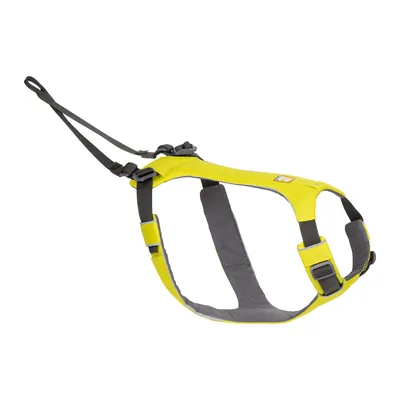
Ruffwear Omnijore Joring System
A complete canicross kit: a padded pulling harness with four adjustment points, a hip belt with leg loops, and a part-bungee towline of 6.5 to 8.75 ft that absorbs jolts.
View on Amazon (opens in a new tab)
Worth watching
Basic canine anatomy and how to fit a pulling harness for canicross, on the principle that there’s no perfect harness, only a perfect fit for your dog.
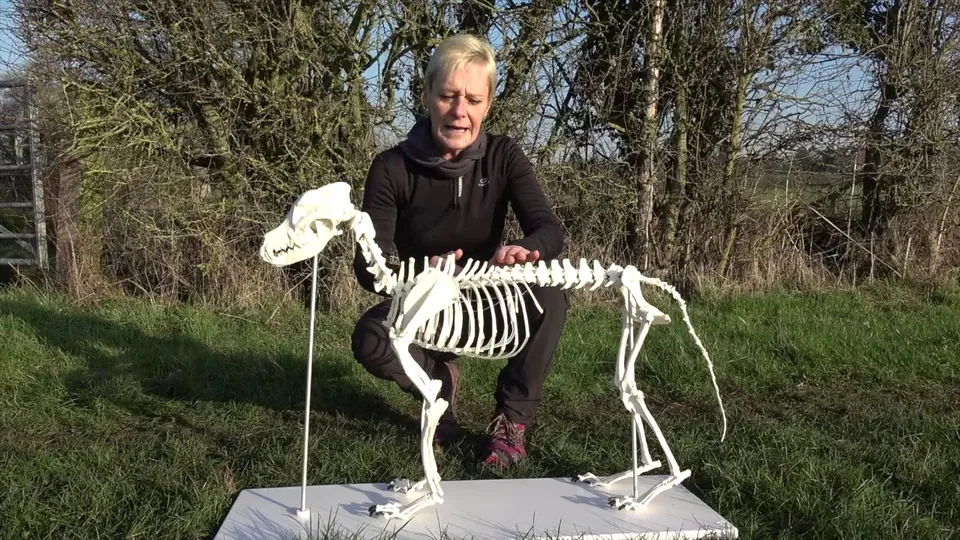
The video is hosted by YouTube (Google): nothing loads until you play it, and Google may then set cookies.
FAQ
How old does a dog have to be to do canicross?
To race in France, the Fédération française des sports et loisirs canins requires dogs to be at least 18 months old. For recreational training, start with very short distances too, 0.3 mile (500 m), then 0.4 mile (700 m), then 0.6 mile (1 km) of pulling, and it’s smart to have a vet confirm that your dog is ready for the effort.
What gear do I need for canicross?
Three pieces: a pulling harness that fits your dog’s build, a waist belt, or a belt with leg loops for a very powerful dog, and a line with a shock absorber connecting the two. Spiked shoes are banned in races in France. Clubs often lend gear, so you can try before you buy.
Can I do canicross when it’s hot out?
Better not. Above 68 °F (20 °C), the advice is to postpone your run, because overheating can be fatal for a dog and hot ground can injure its paw pads. Run early in the morning or in the evening, in the shade, with water, and stop as soon as your dog seems very out of breath.
Can a dog get heatstroke in winter?
Yes. At ten canicross races in the UK held in feels-like temperatures of 23 to 52 °F (-5 to 11 °C), dogs finished above 105 °F (40.6 °C) at every race, a dangerous threshold if it lasts. Male dogs, dark-coated dogs, and the fastest runners were most at risk. After exercise, cool your dog in the open air or in cold water before it goes back in the car.
Can kids do canicross?
Yes. In France, the Fédération française des sports et loisirs canins sets age-appropriate distances: no more than 0.93 mile (1.5 km) for ages 7 to 9, with an adult required, 1.55 miles (2.5 km) for ages 10 to 12, and 2.17 miles (3.5 km) for ages 13 to 14; juniors race with the adults. An adult can also be attached to the dog if it’s too powerful for the child.
Sources
- Fédération française des sports et loisirs canins (FFSLC, France’s dog sports federation), Le canicross (in French), accessed October 22, 2026. ffslc.fr https://ffslc.fr/le-canicross/ ↩
- Decathlon (French sporting goods retailer), Comment courir avec son chien ? Nos conseils pour débuter (in French), accessed October 22, 2026. conseilsport.decathlon.fr https://conseilsport.decathlon.fr/comment-courir-avec-son-chien-nos-conseils-pour-debuter ↩
- Hall E. J., Carter A. J., O’Neill D. G., Dogs Don’t Die Just in Hot Cars: Exertional Heat-Related Illness (Heatstroke) Is a Greater Threat to UK Dogs, Animals, July 2020, accessed October 22, 2026. pubmed.ncbi.nlm.nih.gov https://pubmed.ncbi.nlm.nih.gov/32751913/ ↩
- Carter A. J., Hall E. J., Investigating factors affecting the body temperature of dogs competing in cross country (canicross) races in the UK, Journal of Thermal Biology, February 2018, accessed October 22, 2026. pubmed.ncbi.nlm.nih.gov https://pubmed.ncbi.nlm.nih.gov/29496012/ ↩
- Carter A. J. et al., Post-exercise management of exertional hyperthermia in dogs participating in dog sport (canicross) events in the UK, Journal of Thermal Biology, April 2024, accessed October 22, 2026. pubmed.ncbi.nlm.nih.gov https://pubmed.ncbi.nlm.nih.gov/38518416/ ↩
- Lafuente P., Whyle C., A Retrospective Survey of Injuries Occurring in Dogs and Handlers Participating in Canicross, Veterinary and Comparative Orthopaedics and Traumatology, September 2018, accessed October 22, 2026. pubmed.ncbi.nlm.nih.gov https://pubmed.ncbi.nlm.nih.gov/30138953/ ↩
- Fédération française des sports et loisirs canins (FFSLC), Le canicross enfant (in French), accessed October 22, 2026. ffslc.fr https://ffslc.fr/le-canicross-enfant/ ↩
- Fédération française des sports et loisirs canins (FFSLC), Règlement de course FFSLC, toutes disciplines juniors/adultes, saison 2026/2027 (REG-03.A22, PDF in French), accessed October 22, 2026. ffslc.fr https://ffslc.fr/wp-content/uploads/2026/08/REG-03.A22-Reglement-toutes-disciplines-Juniors-Adultes-2026-2027.pdf ↩

Trail running, snow, water, nature and destinations
Nolwenn covers trail running, snow, water, nature and destinations for Outfarer. Curious about everything, from meteor showers to night-train schedules, she has a knack for digging up the one detail that changes everything, and nailing it in a single sentence.


