 Français (France)
 English (UK)
 English (US)
 Deutsch (Deutschland)

Contents
How it works: a box, coordinates, and a logbook
Sunday afternoon, at the foot of an old oak. The kids are circling the stump, phone in hand, the blue dot on the screen almost on top of the target. A small box turns up between two roots, with a rolled-up logbook and a pencil inside. That moment, repeated all over the world, is geocaching.
The game is run by Geocaching HQ, which has developed its guidelines with the worldwide community of players since September 2000 [1]. To play, you create an account online or in the Geocaching app, which shows a map of nearby caches. The app then guides you to a cache; just don’t forget a pen. Once you’ve found the cache, you sign and date the logbook, put the cache back where you found it, and log your find online [2].
Not all caches look alike. Geocaching HQ’s Help Center lists a whole range of types: Traditional Caches, Mystery Caches, Letterbox Hybrids, Wherigo Caches, Virtual Caches, challenge caches, night caches you track down with a flashlight, and more [3]. For beginners, the Traditional Cache is still the simplest: a container at the posted coordinates.

Searching for a cache: what the rules ask of you
Geocaching HQ’s guidelines are aimed first at people who hide caches, but they also spell out how searchers should behave. All local laws and land management policies apply, both to where the cache is placed and to the route needed to reach it, and a cache must never require or encourage you to trespass or to go past signs that prohibit access [1]. If a cache seems to ask for either, skip it.
A cache also must not encourage anyone to damage a place, public or private, especially an archaeological or historical site, or to harm plants and animals; in some areas, geocaching even has to stop for part of the year to protect sensitive species [1]. You never dig to find a cache: the guidelines prohibit burying one, even partially [1].
Hiding your first cache: Geocaching HQ’s rules
Geocaching HQ encourages you to find at least 20 caches before you hide one: the more you find, the better you understand what makes a good cache. Every new cache is then checked by a volunteer reviewer before it’s published [1]. And one maxim sums up the spirit of the game: if the cache is the only reason to bring people to a spot, find a better spot [1].
| Rule | What it requires |
|---|---|
| Permission | Permission from the landowner or land manager; on public land, from the agency or association that manages it |
| Distance | At least 528 feet (161 m) between the containers or physical stages of two different caches |
| Ground | Don’t bury the cache, even partially, or dig a hole to place or find it; the only exception is a hole to place it, with the property owner’s explicit permission |
| Places to avoid | Archaeological and historical sites, cemeteries, railroad property, and areas near highway bridges, major roads, dams, schools, hospitals, airports, or military installations |
| Nature | Don’t harm plants or animals; accept a seasonal pause where species are sensitive |
| Container | Nothing that could pass for a bomb; permanently cover or remove any military markings; nothing dangerous inside |
Source: “Geocache hiding guidelines,” Geocaching HQ. The cache owner remains responsible for every aspect of the cache and its placement.
The guidelines are clear about responsibility: every aspect of a cache and its placement is on its owner, who may be held liable for any consequences. A poorly placed cache can be disabled or archived after a complaint, even if no law prohibits it [1].
Forests and protected areas: precautions in France
France’s government-owned forests (forêts domaniales) are open to the public, and an outing on your own, with your family, or in a small group doesn’t require any permission. For an event, check with the National Forests Office (Office national des forêts, or ONF), which manages them: in the government-owned forests of eastern Île-de-France, the region around Paris, for example, it requires permission for any for-profit event from the very first participant, and for any nonprofit gathering of more than 60 people [4].
The same ONF page points out that entering integral biological reserves (réserves biologiques intégrales) is strictly prohibited, and access to managed biological reserves (réserves biologiques dirigées) is limited to certain trails [4]. In the core of French national parks, each park’s own rules apply on top of that: our guide to the rules in French national parks sums them up.
With the family: planning a first outing
For a first try, pick a Traditional Cache nearby, on an easy trail, and plan your time on the trail as you would for any hike: our guide to estimating hiking time gives you the benchmarks. Toss a pen, water, snacks, and a warm layer into your backpack; your phone, on the other hand, drains fast when the screen stays on.
Let the kids read the map, call out the distance that’s left, and check the likely hiding spots: the stump, the low stone wall, the hollow in the tree. They’re the ones who get to sign the logbook. And if the cache just won’t turn up, that’s a geocaching lesson too: it might be there next time.

The smart move: put the cache back exactly where you found it, and leave no trace other than your name in the logbook.
Gear related to this article
No affiliation: no commission, no sponsored products.
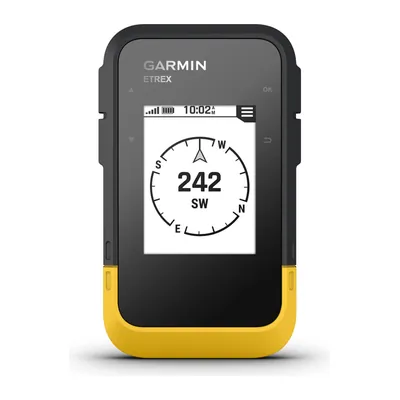
Garmin eTrex SE
A hiking GPS running on two AA batteries for up to 168 hours in standard mode, IPX7 waterproof, that shows geocaches once registered on Geocaching.com: your phone keeps its charge.
View on Amazon (opens in a new tab)
Worth watching
The official introduction from Geocaching HQ, whose guidelines the article quotes: what geocaching is, how it works and how to get started, in just over a minute.
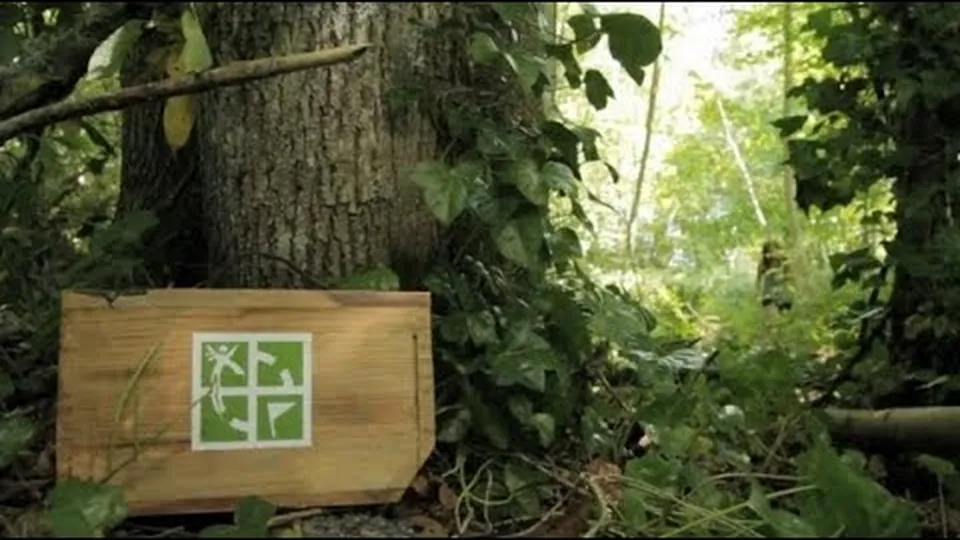
The video is hosted by YouTube (Google): nothing loads until you play it, and Google may then set cookies.
FAQ
How do I get started with geocaching?
Create an account online or in the Geocaching app, which shows a map of nearby caches. Pick an easy Traditional Cache, head for its coordinates, and bring a pen. Once you’ve found the container, sign and date its logbook, put it back exactly where you found it, then log your find online.
Can you hide a geocache anywhere?
No. You need permission from the landowner or land manager, and on public land, from the agency or association that manages it. The guidelines prohibit burying the cache, damaging a place, harming plants or animals, and placing it near sensitive sites such as railroads, schools, or bridges. Every cache is reviewed before it’s published.
Can you go geocaching in French forests during hunting season?
Yes, but with caution. In France’s government-owned forests, hunting generally runs from September to March; the ONF publishes its hunting calendars, posted in the forest and available to download from its website, and on hunting days, signs reading “chasse en cours” mark the areas involved. Check the calendar before you head out and respect the signs.
Do you need permission to organize a geocaching event?
Often. In the government-owned forests east of Paris, for example, the ONF requires permission for any for-profit event and for any nonprofit gathering of more than 60 people. An outing on your own, with your family, or in a small group doesn’t need it. Elsewhere, check with the landowner or land manager.
Sources
- Geocaching HQ, “Geocache hiding guidelines,” accessed October 22, 2026. geocaching.com https://www.geocaching.com/play/guidelines ↩
- Geocaching HQ, “Play,” how to play the game, accessed October 22, 2026. geocaching.com https://www.geocaching.com/play ↩
- Geocaching HQ Help Center, “Learn about cache types,” accessed October 22, 2026. geocaching.com https://www.geocaching.com/help/index.php?pg=kb.chapter&id=127&pgid=921 ↩
- Office national des forêts (French National Forests Office), “Demande d’autorisation pour l’organisation d’une manifestation ou d’un tournage dans les forêts domaniales de l’Est francilien” (in French), accessed October 22, 2026. onf.fr https://www.onf.fr/vivre-la-foret/que-faire-en-foret/regles-et-bonnes-pratiques-en-foret/+/1d0b::demande-autorisation-organisation-manifestation-tournage-forets-domaniales-est-francilien.html ↩
- Office national des forêts, “Les calendriers de chasse sont en ligne” (in French), government-owned forests in Normandy, accessed October 22, 2026. onf.fr https://www.onf.fr/chasse/+/22c1::les-calendriers-de-chasse-sont-en-ligne.html ↩

Camping, backpacking, bushcraft and hiking
Guillaume Hoarau writes for Outfarer about camping, backpacking, bushcraft, and hiking. A survival-skills buff and a collector of vintage field manuals, he loves clear explanations, lists that actually help and other people’s stories, which he tells well.


